


Contents
- 1 1. Introduction: Why AI Is Reshaping the Future of SaaS
- 2 2. What Is AI in SaaS?
- 3 3. Why AI Is Becoming Essential for Modern SaaS Products
- 3.1 3.1 Rising Customer Expectations
- 3.2 3.2 The Growing Demand for Intelligent Automation
- 3.3 3.3 Data Is Growing Faster Than Humans Can Analyze
- 3.4 3.4 Businesses Need Faster and Smarter Decision-Making
- 3.5 3.5 Competitive Advantage Through Innovation
- 3.6 3.6 AI Is Transforming SaaS from Reactive to Proactive
- 4 4. Key Benefits of AI in SaaS Applications
- 4.1 4.1 Smarter Automation for Everyday Tasks
- 4.2 Business Benefits
- 4.3 4.2 Personalized User Experiences
- 4.4 Business Benefits
- 4.5 4.3 Predictive Analytics and Business Intelligence
- 4.6 Business Benefits
- 4.7 4.4 AI-Powered Virtual Assistants
- 4.8 Business Benefits
- 4.9 4.5 Workflow Optimization and Productivity
- 4.10 Business Benefits
- 4.11 4.6 Enhanced Security and Fraud Detection
- 4.12 Summary of Key Benefits
- 4.13 Key Takeaway
- 5 5. Real-World Applications of AI in SaaS
- 5.1 5.1 Customer Relationship Management (CRM)
- 5.2 Business Benefits
- 5.3 5.2 Marketing Automation Platforms
- 5.4 Business Benefits
- 5.5 5.3 Human Resource Management Systems
- 5.6 Business Benefits
- 5.7 5.4 Financial and Accounting Software
- 5.8 5.5 Healthcare SaaS Solutions
- 5.9 Business Benefits
- 5.10 5.6 E-commerce Platforms
- 5.11 Business Benefits
- 5.12 5.7 Project Management and Collaboration Tools
- 5.13 How AI Is Driving Innovation Across Industries
- 6 6. Core AI Technologies Behind Intelligent SaaS Platforms
- 7 7. Challenges of Integrating AI into SaaS Products
- 8 8. Best Practices for Building AI-Powered SaaS Solutions
- 8.1 8.1 Start with Clear Business Objectives
- 8.2 Best Practices
- 8.3 8.2 Build Around User Needs
- 8.4 Best Practices
- 8.5 8.3 Ensure High-Quality Data
- 8.6 8.4 Design for Scalability
- 8.7 8.5 Prioritize Security and Compliance
- 8.8 8.6 Continuously Monitor and Improve AI Models
- 8.9 Best Practices Checklist for AI-Powered SaaS Development
- 8.10 Building AI That Delivers Long-Term Value
- 9 9. Future Trends Shaping AI-Powered SaaS
- 10 9.6 The Rise of Self-Learning SaaS Products
- 11 10. How CrossShore Infotech Helps Businesses Build AI-Powered SaaS Solutions
- 12 11. Frequently Asked Questions (FAQs)
- 13 12. Conclusion: Building the Next Generation of Intelligent SaaS Products
1. Introduction: Why AI Is Reshaping the Future of SaaS
Software as a Service (SaaS) has never stood still.
Over the past two decades, it has transformed the way businesses purchase, deploy, and use software. Cloud computing replaced expensive on-premise infrastructure. Subscription models made enterprise software more accessible. Real-time collaboration changed how teams work together.
Today, the SaaS industry is entering another defining chapter, but this time, the transformation isn’t about where software runs. It’s about how software thinks.
Businesses no longer measure SaaS products solely by the number of features they offer. Instead, they expect software to automate repetitive work, uncover valuable insights from data, personalize every interaction, and proactively recommend the next best action. In short, they want software that contributes to business outcomes rather than simply supporting business processes.
This growing demand is accelerating the adoption of AI in SaaS.
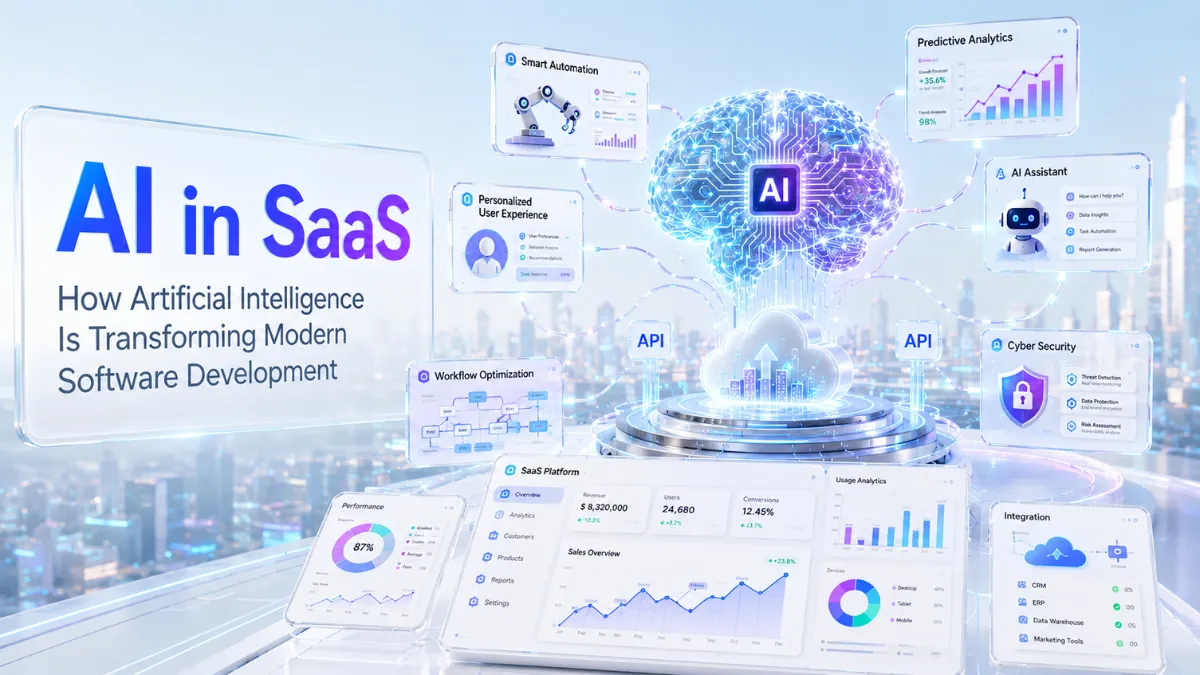
By combining artificial intelligence with cloud-based software, modern SaaS platforms are evolving from static applications into intelligent systems that continuously learn, adapt, and assist users. Whether it’s predicting customer behavior, automating complex workflows, generating content, strengthening cybersecurity, or helping teams make faster decisions, AI is fundamentally redefining what SaaS products can achieve.
For businesses, this isn’t just another technology trend it’s a competitive shift. Organizations that successfully integrate AI into their SaaS products can deliver smarter user experiences, improve operational efficiency, unlock new revenue opportunities, and differentiate themselves in an increasingly crowded market.
Whether you’re a startup building your first SaaS platform, an enterprise modernizing an existing product, or a business leader exploring the future of intelligent software, understanding AI in SaaS has become essential.
In this guide, we’ll explore what AI in SaaS is, how it works, its key benefits, real-world applications, the core technologies powering intelligent SaaS platforms, common implementation challenges, future trends, and the best practices for building next-generation AI-powered software.
Quick Answer
AI in SaaS refers to the integration of artificial intelligence technologies such as machine learning, natural language processing (NLP), generative AI, and predictive analytics into Software as a Service (SaaS) applications. It enables software to automate tasks, personalize user experiences, generate actionable insights, optimize workflows, and support faster, data-driven decision-making, transforming traditional SaaS platforms into intelligent, adaptive solutions.
2. What Is AI in SaaS?
Artificial intelligence (AI) is transforming Software as a Service (SaaS) from a platform that simply delivers software over the internet into one that can learn, adapt, and make intelligent decisions. Instead of relying solely on predefined rules and manual inputs, AI-powered SaaS applications analyze data, recognize patterns, automate tasks, and provide recommendations that help users work more efficiently.
As businesses continue to embrace digital transformation, AI in SaaS has become more than just a competitive advantage it’s rapidly becoming a necessity. Organizations are looking for software that not only manages business processes but also helps improve productivity, enhance customer experiences, and uncover valuable insights from growing volumes of data.
Let’s take a closer look at what AI-powered SaaS really means and why it’s transforming the future of software.
2.1 Understanding AI-Powered SaaS
AI-powered SaaS refers to cloud-based software applications that integrate artificial intelligence technologies to perform tasks that typically require human intelligence. These technologies enable software to learn from user interactions, automate repetitive processes, identify trends, and provide intelligent recommendations.
Unlike traditional SaaS applications that operate based on fixed rules and workflows, AI-powered SaaS platforms continuously improve as they process more data. This allows them to deliver increasingly accurate predictions, personalized experiences, and proactive assistance over time.
Some common AI capabilities integrated into modern SaaS platforms include:
- Machine learning for recognizing patterns and improving predictions
- Natural language processing (NLP) for understanding and generating human language
- Generative AI for creating content, summaries, and recommendations
- Predictive analytics for forecasting trends and business outcomes
- Intelligent automation for reducing repetitive manual work
Together, these technologies enable SaaS applications to become smarter, faster, and more responsive to changing user needs.
2.2 How AI Differs from Traditional SaaS
Traditional SaaS platforms are designed to execute predefined workflows. They require users to manually analyze data, make decisions, and initiate most business processes. While they are highly effective for managing information, they cannot generally adapt or improve without human intervention.
AI-powered SaaS, on the other hand, introduces intelligence into every stage of the user journey. It can analyze historical and real-time data, recognize user behavior, anticipate future needs, and even recommend or automate the next best action.
| Traditional SaaS | AI-Powered SaaS |
|---|---|
| Follows predefined rules | Learns from data and user behavior |
| Requires manual analysis | Delivers predictive insights |
| Standard user experience | Personalized experiences for every user |
| Reactive workflows | Proactive recommendations and automation |
| Static reporting | Real-time intelligence and forecasting |
This shift enables businesses to move beyond simply managing operations toward making faster, more informed decisions with the support of intelligent software.
2.3 Why Businesses Are Investing in AI-Powered SaaS
Businesses today operate in an environment where speed, efficiency, and customer experience are critical to success. Managing large volumes of data, responding quickly to market changes, and delivering personalized services have become increasingly challenging with traditional software alone.
By adopting AI in SaaS, organizations can automate time-consuming tasks, improve operational efficiency, and gain deeper insights into customer behavior and business performance. AI also helps reduce human error, accelerate decision-making, and uncover opportunities that might otherwise go unnoticed.
Some of the primary reasons businesses are investing in AI-powered SaaS include:
- Automating repetitive and manual workflows
- Delivering personalized customer experiences
- Improving productivity across teams
- Generating predictive business insights
- Strengthening security through intelligent threat detection
- Reducing operational costs while increasing efficiency
- Supporting data-driven decision-making
These capabilities allow businesses to focus less on routine operations and more on innovation, strategy, and long-term growth.
Key Takeaway
AI in SaaS is redefining what software can achieve. By combining the scalability of cloud-based applications with the intelligence of AI, businesses can build solutions that learn, adapt, automate, and continuously deliver greater value. As customer expectations continue to evolve, AI-powered SaaS is becoming the foundation for the next generation of intelligent digital products.
In the next section, we’ll explore why AI is no longer just an optional feature but an essential component of modern SaaS products and how it’s reshaping the way businesses deliver software.
3. Why AI Is Becoming Essential for Modern SaaS Products
Artificial intelligence is no longer a futuristic concept or a premium feature reserved for enterprise software. It has become a fundamental driver of innovation in the SaaS industry.
As businesses face increasing competition, growing customer expectations, and an ever-expanding volume of data, traditional software is struggling to keep pace. Users no longer want applications that simply record information or execute predefined tasks. They expect software that can anticipate their needs, automate repetitive work, and provide meaningful insights that help them make better decisions.
This shift is why AI in SaaS is rapidly becoming an essential component of modern software products rather than an optional enhancement.
Let’s explore the key factors driving this transformation.
3.1 Rising Customer Expectations
Today’s users expect software to be intuitive, responsive, and personalized. Whether they’re using a CRM, project management platform, or e-commerce solution, they want experiences tailored to their unique needs and behaviors.
AI enables SaaS platforms to understand user preferences, analyze interactions, and deliver personalized recommendations, dashboards, and workflows. Instead of offering a one-size-fits-all experience, AI-powered applications adapt to individual users, making the software more relevant and valuable over time.
This level of personalization improves user satisfaction, increases engagement, and encourages long-term product adoption.
3.2 The Growing Demand for Intelligent Automation
Manual processes consume valuable time and often lead to inefficiencies. From entering customer information and scheduling meetings to generating reports and processing documents, repetitive tasks can significantly impact productivity.
AI-powered automation helps eliminate these bottlenecks by handling routine operations with speed and accuracy. Rather than replacing human expertise, AI allows teams to focus on strategic initiatives, creative problem-solving, and customer relationships while software manages repetitive tasks in the background.
As organizations continue to seek greater efficiency, intelligent automation has become one of the most valuable capabilities of modern SaaS products.
3.3 Data Is Growing Faster Than Humans Can Analyze
Every business generates vast amounts of data through customer interactions, transactions, marketing campaigns, operational processes, and connected devices. While this data holds valuable insights, extracting meaningful information manually is becoming increasingly difficult.
AI excels at processing large datasets, identifying hidden patterns, and uncovering trends that would be nearly impossible to detect through traditional analysis alone.
For example, AI can help businesses:
- Predict future sales trends
- Identify customers at risk of leaving
- Recommend products based on buying behavior
- Detect unusual activity that may indicate fraud
- Forecast inventory demand more accurately
These insights enable organizations to make faster, more informed decisions backed by data rather than assumptions.
3.4 Businesses Need Faster and Smarter Decision-Making
In today’s competitive marketplace, delays in decision-making can result in missed opportunities. Business leaders need access to real-time insights that help them respond quickly to changing customer demands and market conditions.
AI-powered SaaS platforms continuously analyze incoming data and present actionable recommendations instead of simply displaying raw information.
For instance, instead of showing only monthly sales figures, an AI-powered CRM can identify declining customer engagement, predict future revenue trends, and recommend actions to improve sales performance.
By transforming raw data into actionable intelligence, AI helps businesses make confident decisions with greater speed and accuracy.
3.5 Competitive Advantage Through Innovation
The SaaS market has become increasingly competitive, with businesses offering similar features and services. As a result, user experience and intelligent functionality have become major differentiators.
Organizations that integrate AI into their SaaS products can deliver capabilities such as:
- Personalized user experiences
- Predictive recommendations
- AI-powered assistants
- Intelligent search
- Automated workflows
- Proactive notifications
These features not only improve customer satisfaction but also create stronger competitive advantages by helping users accomplish more with less effort.
Companies that embrace AI are better positioned to innovate, adapt to changing market demands, and deliver greater long-term value to their customers.
3.6 AI Is Transforming SaaS from Reactive to Proactive
Traditional SaaS platforms typically respond to user commands. Users search for information, generate reports, and manually decide what actions to take next.
AI-powered SaaS changes this relationship entirely.
Instead of waiting for users to ask questions, intelligent software proactively identifies opportunities, highlights risks, recommends actions, and even automates entire workflows.
This transformation marks one of the most significant shifts in the evolution of SaaS. Software is no longer just a tool; it is becoming an intelligent collaborator that actively helps users achieve better outcomes.
| Business Challenge | How AI-Powered SaaS Solves It |
|---|---|
| Time-consuming manual tasks | Automates repetitive workflows |
| Information overload | Delivers actionable insights |
| Generic user experiences | Provides personalized recommendations |
| Slow decision-making | Enables real-time predictive analytics |
| Increasing cybersecurity risks | Detects anomalies and potential threats |
| Growing competition | Enhances innovation and customer experience |
Key Takeaway
The rapid adoption of AI in SaaS is being driven by changing customer expectations, increasing data complexity, and the need for greater efficiency. Businesses are no longer looking for software that simply manages operations they want intelligent platforms that automate work, provide predictive insights, personalize experiences, and support smarter decision-making. As AI technologies continue to evolve, they will play an even greater role in shaping the future of SaaS products across every industry.
In the next section, we’ll explore the key benefits of AI in SaaS applications and how these capabilities are helping businesses improve productivity, customer experiences, security, and overall business performance.
4. Key Benefits of AI in SaaS Applications
The true value of AI in SaaS lies in its ability to solve real business challenges. Rather than simply adding advanced features, AI enhances the way software functions by making it more intelligent, efficient, and responsive to user needs.
From automating repetitive tasks to delivering personalized experiences and predictive insights, AI-powered SaaS applications help businesses improve productivity, reduce operational costs, and make faster, data-driven decisions.
Let’s explore the key benefits that are transforming modern SaaS platforms.
4.1 Smarter Automation for Everyday Tasks
One of the biggest advantages of AI-powered SaaS is intelligent automation. Many business processes involve repetitive tasks that consume valuable time but require little strategic thinking.
AI can automate these routine activities with greater speed and accuracy, allowing employees to focus on higher-value work.
Common examples include:
- Automatically categorizing customer support tickets
- Processing invoices and financial documents
- Scheduling meetings and sending reminders
- Generating reports from raw data
- Updating CRM records
- Managing email workflows
By reducing manual effort, businesses can improve operational efficiency, minimize human error, and increase overall productivity.
Business Benefits
- Saves time on repetitive tasks
- Reduces operational costs
- Improves process accuracy
- Enables teams to focus on strategic initiatives
4.2 Personalized User Experiences
Modern users expect software to understand their preferences and adapt to their unique needs. AI enables SaaS platforms to create highly personalized experiences by analyzing user behavior, preferences, and interaction history.
Instead of presenting identical interfaces to every user, AI dynamically customizes dashboards, recommendations, notifications, and workflows based on individual usage patterns.
For example, an AI-powered CRM may prioritize high-value leads based on a salesperson’s past activity, while a project management platform may recommend tasks that require immediate attention.
Personalization makes software more intuitive, helping users accomplish their goals faster while increasing satisfaction and long-term engagement.
Business Benefits
- Higher user engagement
- Better customer retention
- Improved user satisfaction
- Increased product adoption
4.3 Predictive Analytics and Business Intelligence
Traditional SaaS applications primarily report what has already happened. AI goes a step further by helping businesses anticipate what is likely to happen next.
Using predictive analytics, AI identifies trends, forecasts outcomes, and uncovers hidden opportunities by analyzing historical and real-time data.
Businesses can use these insights to:
- Forecast future sales
- Predict customer churn
- Estimate inventory requirements
- Identify high-value customer segments
- Detect potential operational risks
Instead of reacting to problems after they occur, organizations can take proactive measures based on AI-driven insights.
Business Benefits
- Faster decision-making
- Improved forecasting accuracy
- Reduced business risks
- Better strategic planning
4.4 AI-Powered Virtual Assistants
Customer support has evolved significantly with the introduction of AI-powered virtual assistants. These intelligent assistants can answer common questions, guide users through complex workflows, and provide instant support around the clock.
Unlike traditional chatbots that rely on scripted responses, modern AI assistants understand context, interpret natural language, and generate more accurate, conversational responses.
Beyond customer support, AI assistants are also helping employees by:
- Summarizing documents
- Generating reports
- Answering internal knowledge-base questions
- Assisting with onboarding
- Recommending next steps within applications
This improves both customer experience and employee productivity.
Business Benefits
- Faster customer support
- Reduced support costs
- Increased customer satisfaction
- Improved employee efficiency
4.5 Workflow Optimization and Productivity
AI is helping businesses streamline entire workflows by identifying inefficiencies and recommending smarter ways of working.
Instead of requiring users to perform every step manually, AI can automate repetitive processes, prioritize tasks, and even suggest the most effective course of action based on previous outcomes.
Examples include:
- Automatically generating marketing content
- Prioritizing sales opportunities
- Routing customer inquiries to the appropriate teams
- Suggesting project timelines
- Automating approval workflows
By reducing unnecessary manual intervention, businesses can complete complex processes faster while maintaining consistency and accuracy.
Business Benefits
- Improved operational efficiency
- Faster project completion
- Reduced manual workload
- Better collaboration across teams
4.6 Enhanced Security and Fraud Detection
As cyber threats continue to evolve, security has become a top priority for SaaS providers. AI strengthens software security by continuously monitoring user behavior, detecting anomalies, and identifying potential threats before they escalate.
Unlike traditional security systems that rely solely on predefined rules, AI learns from historical data and recognizes unusual activity that may indicate unauthorized access or fraudulent behavior.
Common AI-powered security capabilities include:
- Real-time threat detection
- Fraud prevention
- Behavioral analytics
- Automated risk assessment
- Continuous system monitoring
These intelligent security measures help businesses protect sensitive data while maintaining user trust.
Business Benefits
- Stronger cybersecurity
- Faster threat detection
- Reduced financial losses
- Enhanced regulatory compliance
Summary of Key Benefits
| AI Capability | Business Value |
|---|---|
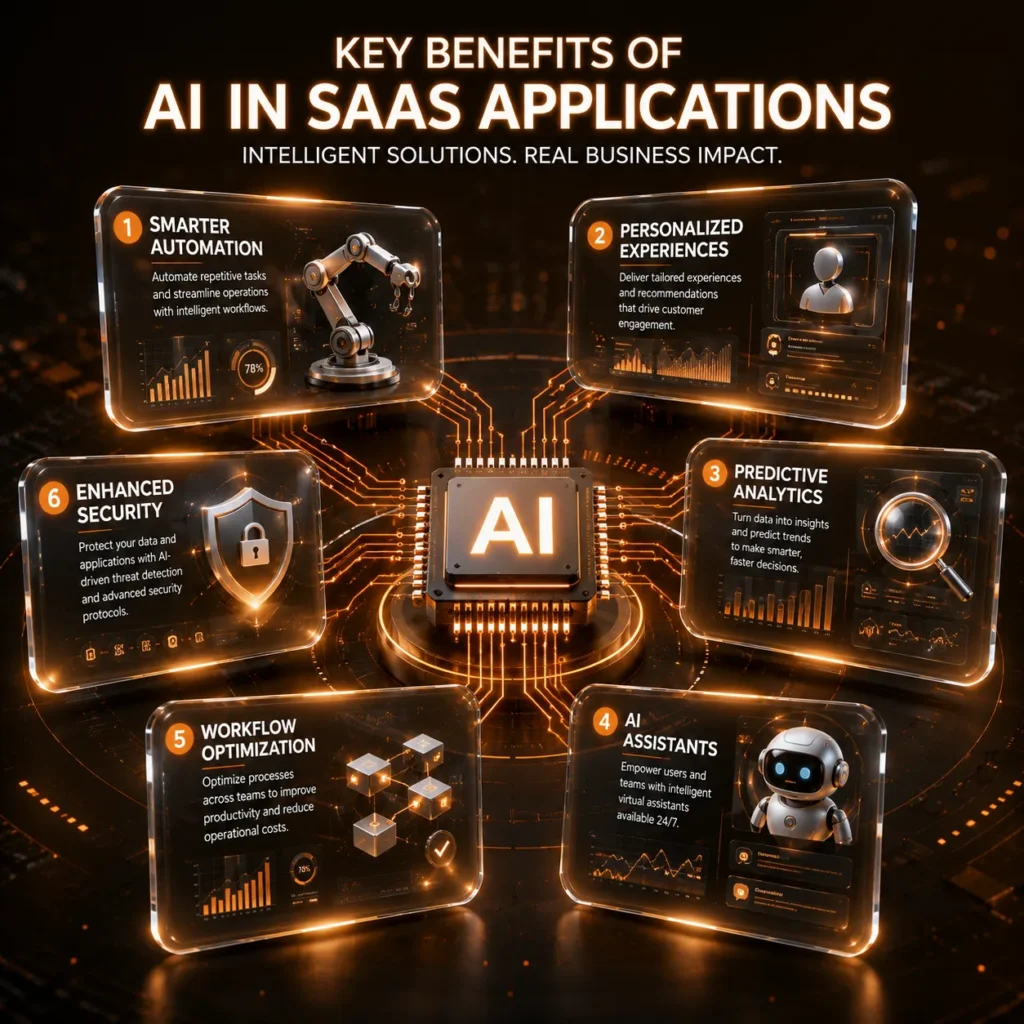
| Intelligent Automation | Saves time and reduces manual work |
| Personalized Experiences | Increases engagement and customer loyalty |
| Predictive Analytics | Enables proactive decision-making |
| AI Virtual Assistants | Improves support and productivity |
| Workflow Optimization | Streamlines business operations |
| AI-Driven Security | Protects systems and sensitive data |
Key Takeaway
The benefits of AI in SaaS extend far beyond automation. By combining intelligent decision-making, personalized experiences, predictive analytics, workflow optimization, and advanced security, AI enables SaaS platforms to deliver significantly greater value to both businesses and end users. Organizations that successfully integrate AI into their software are better equipped to improve efficiency, drive innovation, and stay competitive in an increasingly digital world.
In the next section, we’ll explore real-world applications of AI in SaaS and examine how businesses across different industries are using intelligent software to solve complex challenges and deliver better customer experiences.
5. Real-World Applications of AI in SaaS
The impact of AI in SaaS extends far beyond automation and personalization. Today, businesses across virtually every industry are leveraging AI-powered SaaS solutions to improve efficiency, enhance customer experiences, optimize operations, and gain a competitive edge.
From managing customer relationships and streamlining marketing campaigns to improving healthcare outcomes and strengthening financial security, AI is transforming how organizations use software to solve complex business challenges.
Let’s explore some of the most common real-world applications of AI-powered SaaS.
5.1 Customer Relationship Management (CRM)
Customer Relationship Management (CRM) platforms generate enormous amounts of customer data, making them ideal candidates for AI integration.
AI enhances CRM software by analyzing customer interactions, identifying sales opportunities, and helping sales teams prioritize high-value leads.
Modern AI-powered CRM platforms can:
- Predict which leads are most likely to convert
- Recommend the next best sales action
- Automate follow-up emails
- Identify customers at risk of churn
- Generate sales forecasts
- Summarize customer interactions
Instead of spending hours analyzing reports, sales teams receive actionable insights that help them close deals faster and build stronger customer relationships.
Business Benefits
- Improved sales productivity
- Higher customer retention
- Better forecasting accuracy
- Faster decision-making
5.2 Marketing Automation Platforms
Digital marketing generates vast amounts of customer behavior data. AI helps marketers turn this data into personalized campaigns that improve engagement and conversions.
AI-powered marketing platforms can:
- Segment audiences automatically
- Personalize email campaigns
- Recommend the best time to send messages
- Generate marketing content
- Predict campaign performance
- Optimize advertising budgets
Rather than relying on guesswork, marketing teams can make data-driven decisions that maximize return on investment (ROI).
Business Benefits
- Increased campaign effectiveness
- Better customer engagement
- Higher conversion rates
- Improved marketing ROI
5.3 Human Resource Management Systems
Human Resources (HR) teams handle recruitment, onboarding, employee engagement, and performance management, all of which can benefit from AI-powered automation.
AI-enabled HR software can:
- Screen resumes based on job requirements
- Match candidates with suitable roles
- Automate interview scheduling
- Answer employee queries through AI assistants
- Analyze employee engagement
- Predict employee turnover
These capabilities reduce administrative workloads while improving hiring decisions and employee experiences.
Business Benefits
- Faster recruitment
- Improved hiring accuracy
- Better employee engagement
- Reduced HR administration
5.4 Financial and Accounting Software
Finance teams require accuracy, compliance, and real-time insights. AI helps automate financial operations while improving decision-making and risk management.
AI-powered financial SaaS applications can:
- Detect fraudulent transactions
- Automate invoice processing
- Categorize expenses
- Forecast cash flow
- Identify unusual financial activity
- Generate financial reports
By automating routine accounting tasks, finance professionals can focus on strategic financial planning instead of manual data processing.
Business Benefits
- Reduced financial errors
- Improved fraud prevention
- Faster financial reporting
- Better cash flow management
5.5 Healthcare SaaS Solutions
Healthcare organizations manage large volumes of patient data while striving to improve care quality and operational efficiency.
AI-powered healthcare SaaS platforms assist medical professionals by:
- Analyzing patient records
- Supporting clinical decision-making
- Predicting patient risks
- Automating appointment scheduling
- Assisting with medical documentation
- Improving resource allocation
Although AI supports healthcare professionals, clinical decisions continue to rely on qualified medical expertise and human judgment.
Business Benefits
- Improved operational efficiency
- Better patient experiences
- Reduced administrative workload
- Enhanced decision support
5.6 E-commerce Platforms
AI has become an essential component of modern e-commerce SaaS platforms, helping businesses create personalized shopping experiences and optimize sales performance.
Common AI applications include:
- Product recommendations
- Dynamic pricing strategies
- Personalized promotions
- Customer behavior analysis
- Inventory demand forecasting
- AI-powered shopping assistants
These intelligent capabilities increase customer satisfaction while helping businesses improve revenue and operational efficiency.
Business Benefits
- Higher sales conversions
- Increased average order value
- Better customer retention
- Smarter inventory management
5.7 Project Management and Collaboration Tools
Project management platforms are evolving from simple task trackers into intelligent productivity solutions.
AI enhances collaboration software by:
- Prioritizing tasks
- Predicting project risks
- Estimating completion timelines
- Summarizing meetings
- Automatically generating project updates
- Recommending workflow improvements
This enables teams to focus more on execution while AI assists with planning, organization, and progress tracking.
Business Benefits
- Improved team productivity
- Better project visibility
- Reduced scheduling conflicts
- Faster project delivery
How AI Is Driving Innovation Across Industries
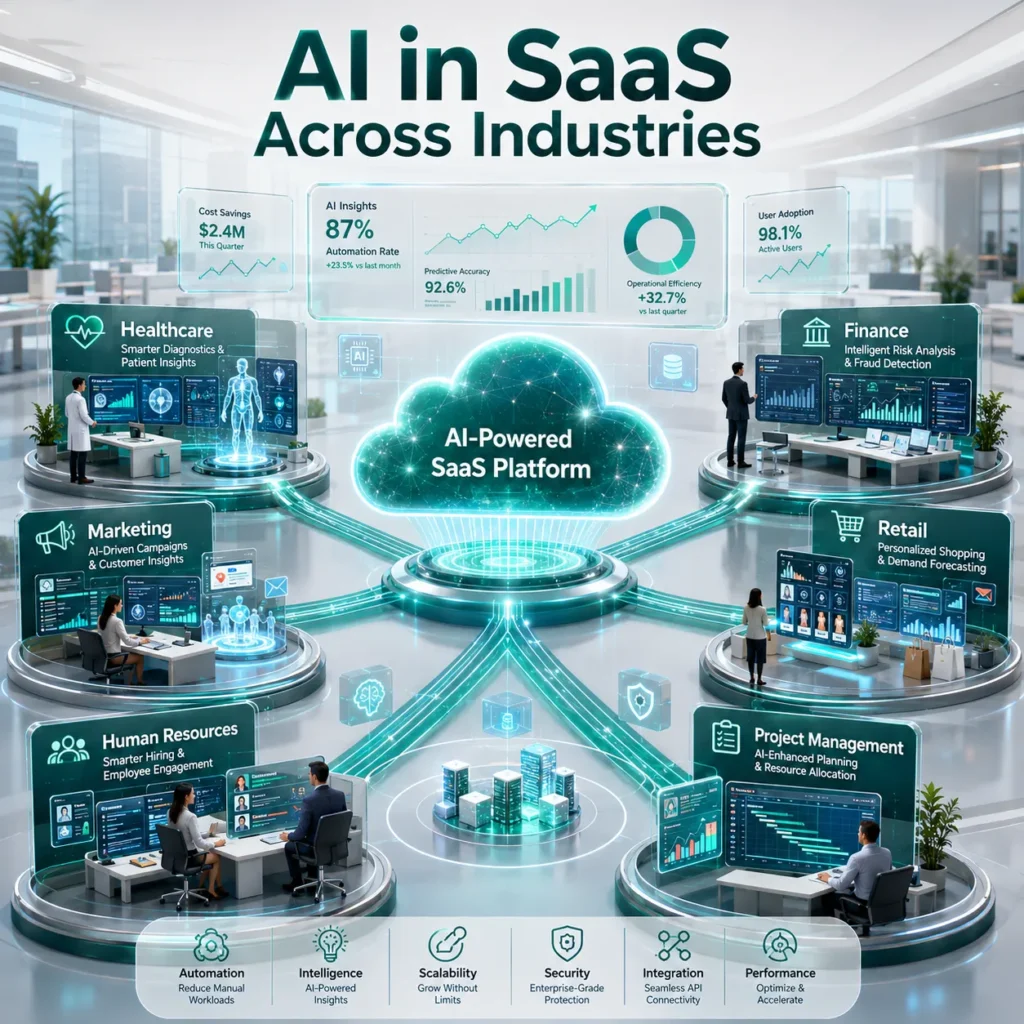
| Industry | Common AI SaaS Applications |
|---|---|
| CRM | Lead scoring, sales forecasting, customer insights |
| Marketing | Campaign optimization, personalization, content generation |
| Human Resources | Resume screening, employee engagement, AI assistants |
| Finance | Fraud detection, invoice automation, cash flow forecasting |
| Healthcare | Patient analytics, documentation, scheduling |
| E-commerce | Product recommendations, dynamic pricing, demand forecasting |
| Project Management | Task prioritization, workflow automation, meeting summaries |
Key Takeaway
The adoption of AI in SaaS is accelerating across industries because it enables businesses to solve real-world challenges more efficiently. Whether improving customer relationships, automating financial processes, optimizing marketing campaigns, or enhancing healthcare operations, AI-powered SaaS platforms are helping organizations work smarter, make better decisions, and deliver exceptional user experiences.
In the next section, we’ll explore the core AI technologies that power intelligent SaaS platforms and examine how innovations such as machine learning, natural language processing, generative AI, and AI agents are making modern software more adaptive and capable than ever before.
6. Core AI Technologies Behind Intelligent SaaS Platforms
The success of AI in SaaS is powered by a combination of advanced artificial intelligence technologies that enable software to learn, reason, automate, and continuously improve. While users may interact with features such as AI assistants, personalized dashboards, or predictive analytics, these capabilities are driven by sophisticated AI models working behind the scenes.
Understanding these technologies helps businesses make informed decisions when developing or upgrading AI-powered SaaS products. Rather than adopting AI for its own sake, organizations can identify the right technologies to solve specific business challenges and deliver meaningful value to users.
Let’s explore the core AI technologies that are transforming modern SaaS platforms.
6.1 Machine Learning (ML)
Machine Learning (ML) is one of the most widely used technologies in AI-powered SaaS applications. It enables software to learn from historical and real-time data without being explicitly programmed for every scenario.
Instead of relying on fixed rules, machine learning algorithms continuously improve their predictions as they process more information.
In SaaS applications, machine learning is commonly used for:
- Predicting customer churn
- Recommending products or services
- Detecting fraudulent transactions
- Forecasting sales and revenue
- Identifying user behavior patterns
- Automating business processes
For example, a CRM platform can analyze previous customer interactions to identify which prospects are most likely to become paying customers, helping sales teams prioritize their efforts more effectively.
Business Benefits
- More accurate predictions
- Continuous improvement through data
- Better decision-making
- Reduced manual analysis
6.2 Natural Language Processing (NLP)
Natural Language Processing (NLP) allows software to understand, interpret, and generate human language. This technology has become essential for creating more natural interactions between users and SaaS applications.
Instead of relying on structured commands, users can communicate with software using everyday language.
NLP powers features such as:
- AI chatbots
- Virtual assistants
- Intelligent search
- Document summarization
- Language translation
- Sentiment analysis
For instance, a customer support platform can understand a user’s question, identify the intent behind it, and provide a relevant response without requiring human intervention.
As conversational AI continues to improve, NLP is making SaaS platforms more intuitive and accessible for users.
Business Benefits
- Faster customer support
- Improved user interactions
- Reduced support workload
- Better knowledge management
6.3 Generative AI
Generative AI has rapidly become one of the most influential technologies in modern software development. Unlike traditional AI models that primarily analyze data, generative AI creates new content based on user prompts and contextual information.
In SaaS platforms, generative AI can assist users by producing:
- Marketing copy
- Business reports
- Product descriptions
- Email drafts
- Meeting summaries
- Software documentation
- Code suggestions
Rather than replacing human creativity, generative AI accelerates content creation and helps users complete complex tasks more efficiently.
This capability has significantly expanded the value that SaaS products can deliver across industries.
Business Benefits
- Faster content creation
- Increased productivity
- Improved user efficiency
- Reduced repetitive work
6.4 Predictive Analytics
Predictive analytics combines machine learning, statistical modeling, and historical data to forecast future outcomes.
Instead of simply showing past performance, predictive analytics helps businesses anticipate trends and make proactive decisions.
Common applications include:
- Revenue forecasting
- Customer churn prediction
- Inventory planning
- Demand forecasting
- Risk assessment
- Maintenance scheduling
For example, an AI-powered retail platform can predict future inventory demand based on purchasing trends, seasonal patterns, and historical sales data.
These insights help organizations reduce uncertainty and improve long-term planning.
Business Benefits
- Smarter forecasting
- Reduced business risks
- Improved planning
- Faster strategic decisions
6.5 Computer Vision
Computer Vision enables AI systems to interpret and analyze visual information such as images, scanned documents, and videos.
Although not every SaaS product requires computer vision, it plays an increasingly important role in industries that rely on visual data.
Common SaaS applications include:
- Document scanning and data extraction
- Identity verification
- Quality inspection
- Medical image analysis
- Invoice processing
- Visual search
For example, an accounting SaaS platform can automatically extract key information from invoices, receipts, and financial documents, eliminating manual data entry.
Business Benefits
- Faster document processing
- Improved accuracy
- Reduced manual effort
- Better operational efficiency
6.6 AI Agents and Autonomous Workflows
One of the most exciting developments in AI in SaaS is the emergence of AI agents.
Unlike traditional automation tools that follow predefined workflows, AI agents can understand objectives, plan tasks, make decisions, and execute multi-step processes with minimal human intervention.
For example, an AI agent within a CRM platform could:
- Analyze new sales leads
- Prioritize prospects
- Draft personalized follow-up emails
- Schedule meetings
- Update customer records
- Notify sales representatives about high-priority opportunities
Similarly, AI agents in project management software can coordinate tasks, monitor deadlines, identify risks, and recommend corrective actions before delays occur.
As AI technology continues to evolve, autonomous workflows are expected to become a defining feature of next-generation SaaS platforms.
Business Benefits
- End-to-end task automation
- Increased operational efficiency
- Reduced manual intervention
- Smarter decision support
How These AI Technologies Work Together
Modern AI-powered SaaS applications rarely rely on a single technology. Instead, multiple AI capabilities work together to deliver seamless user experiences.
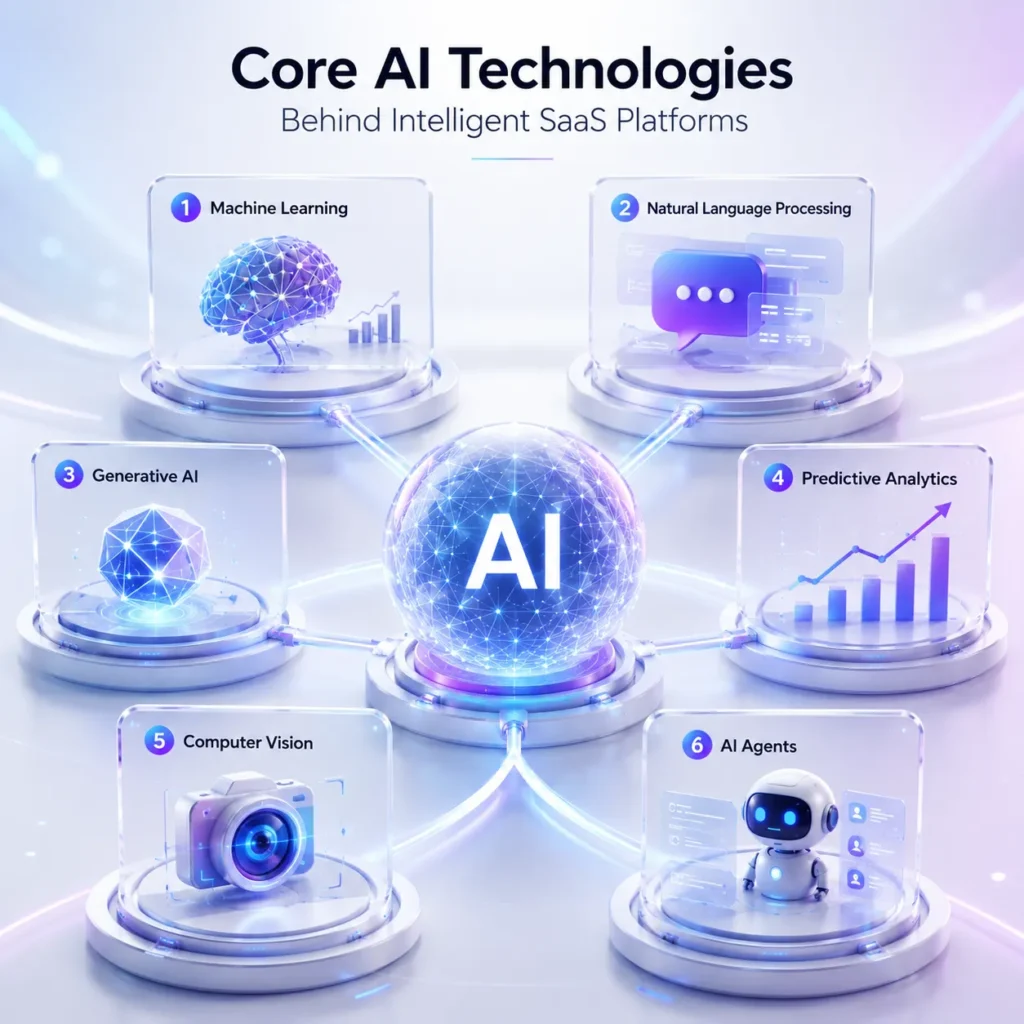
| AI Technology | Primary Role in SaaS |
|---|---|
| Machine Learning | Learns from data and improves predictions |
| Natural Language Processing | Understands and generates human language |
| Generative AI | Creates content, summaries, and recommendations |
| Predictive Analytics | Forecasts future trends and outcomes |
| Computer Vision | Processes and interprets visual information |
| AI Agents | Automates complex workflows and decision-making |
By combining these technologies, SaaS platforms become more than software they evolve into intelligent systems capable of learning, adapting, and collaborating with users.
Key Takeaway
The evolution of AI in SaaS is driven by a combination of powerful technologies, including machine learning, natural language processing, generative AI, predictive analytics, computer vision, and AI agents. Together, these innovations enable SaaS platforms to automate tasks, generate valuable insights, personalize user experiences, and support smarter decision-making. As these technologies continue to advance, they will play an increasingly important role in shaping the future of intelligent software.
In the next section, we’ll examine the challenges of integrating AI into SaaS products and explore the best practices businesses can follow to build secure, scalable, and trustworthy AI-powered applications.
7. Challenges of Integrating AI into SaaS Products
While the benefits of AI in SaaS are substantial, successfully integrating artificial intelligence into a SaaS product comes with its own set of challenges. Building an AI-powered application involves more than adding an AI model or chatbot—it requires careful planning, high-quality data, scalable infrastructure, robust security, and ongoing monitoring.
Organizations that understand these challenges early are better positioned to develop AI-powered SaaS solutions that are reliable, secure, and capable of delivering long-term business value.
Let’s explore some of the most common challenges businesses face when integrating AI into SaaS products and how they can address them effectively.
7.1 Data Privacy and Security
AI systems rely heavily on data to learn, make predictions, and generate insights. However, using large volumes of business and customer data also raises important privacy and security considerations.
Organizations must ensure that sensitive information is collected, stored, and processed responsibly while complying with applicable data protection regulations.
Some common concerns include:
- Protecting customer information
- Preventing unauthorized access
- Securing cloud infrastructure
- Managing user permissions
- Ensuring compliance with data protection regulations
Implementing encryption, access controls, regular security audits, and secure cloud architectures helps reduce these risks while maintaining customer trust.
Best Practices
- Encrypt sensitive data
- Implement role-based access controls
- Regularly monitor security threats
- Follow industry compliance standards
- Conduct routine security assessments
7.2 AI Bias and Ethical Considerations
AI systems learn from the data they receive. If training data contains inaccuracies, imbalances, or historical biases, AI models may produce unfair or misleading results.
For example, an AI-powered recruitment platform trained on biased hiring data could unintentionally favor certain candidate profiles over others.
Organizations should regularly evaluate AI outputs to ensure they remain fair, transparent, and aligned with ethical business practices.
Responsible AI development includes:
- Using diverse and representative datasets
- Continuously monitoring model performance
- Reviewing AI-generated recommendations
- Maintaining human oversight for important decisions
Building trustworthy AI requires balancing automation with accountability.
Best Practices
- Use high-quality, representative data
- Audit AI models regularly
- Keep humans involved in critical decisions
- Document how AI makes recommendations
7.3 Integration with Existing Systems
Many businesses already rely on multiple software platforms to manage operations. Integrating AI into these existing systems can be technically challenging, especially when dealing with legacy applications or disconnected data sources.
Successful AI implementation often requires seamless integration with:
- CRM platforms
- ERP systems
- Marketing automation tools
- Customer support software
- Financial applications
- Third-party APIs
Without proper integration, AI may struggle to access accurate data or deliver meaningful insights.
A well-planned architecture ensures that AI becomes a natural extension of the existing SaaS ecosystem rather than an isolated feature.
Best Practices
- Assess existing infrastructure before implementation
- Use standardized APIs for integration
- Maintain consistent data formats
- Design scalable system architectures
7.4 Infrastructure and Operational Costs
Developing AI-powered SaaS products requires significant computing resources, particularly when training and deploying advanced AI models.
Businesses should consider costs related to:
- Cloud computing
- AI model training
- Data storage
- Infrastructure scaling
- Continuous model updates
- Monitoring and maintenance
While these investments may increase initial development costs, they often generate long-term value through improved efficiency, automation, and enhanced customer experiences.
Organizations should focus on implementing AI where it delivers measurable business outcomes rather than adopting AI simply because it is trending.
Best Practices
- Start with high-impact AI use cases
- Optimize cloud resource usage
- Scale AI capabilities gradually
- Continuously measure ROI
7.5 User Trust and AI Transparency
Even the most advanced AI system is unlikely to succeed if users do not trust it.
Customers increasingly want to understand when AI is being used, how recommendations are generated, and what role humans play in decision-making.
Building trust requires transparency.
Businesses should clearly communicate:
- When users are interacting with AI
- How AI-generated recommendations should be interpreted
- What data AI uses
- When human review is involved
Providing users with clear explanations and maintaining transparency helps increase confidence in AI-powered applications.
Best Practices
- Clearly disclose AI-generated content
- Explain AI recommendations where possible
- Offer users control over AI-assisted features
- Maintain human oversight for sensitive decisions
Common AI Integration Challenges and Solutions
| Challenge | Recommended Solution |
|---|---|
| Data privacy concerns | Strong security measures and regulatory compliance |
| AI bias | High-quality data, regular audits, and human oversight |
| Legacy system integration | API-driven architecture and scalable development |
| High infrastructure costs | Phased implementation and cloud optimization |
| Limited user trust | Transparent AI practices and explainable recommendations |
Turning Challenges into Opportunities
Although integrating AI into SaaS presents technical and operational challenges, these obstacles can be overcome with the right strategy, technology stack, and development expertise.
Organizations that invest in secure architectures, responsible AI practices, scalable infrastructure, and continuous optimization are more likely to build intelligent SaaS products that users trust and businesses can confidently scale.
Rather than viewing these challenges as barriers, forward-thinking companies treat them as opportunities to create stronger, more reliable, and more competitive software solutions.
Key Takeaway
Successfully implementing AI in SaaS requires more than advanced technology—it demands thoughtful planning, responsible data management, scalable infrastructure, and a strong commitment to transparency and user trust. By addressing these challenges proactively, businesses can unlock the full potential of AI while delivering secure, reliable, and intelligent SaaS products that create lasting value.
In the next section, we’ll explore the best practices for building AI-powered SaaS solutions and discover how businesses can develop intelligent software that is scalable, user-centric, and future-ready.
8. Best Practices for Building AI-Powered SaaS Solutions
Integrating artificial intelligence into a SaaS product is only the first step. The real challenge lies in building AI solutions that are scalable, secure, user-friendly, and capable of delivering measurable business value over time.
Many AI initiatives fail because organizations focus on adopting the latest technology instead of solving real business problems. Successful AI-powered SaaS products are built around clear objectives, high-quality data, thoughtful user experiences, and continuous improvement.
Whether you’re developing a new SaaS platform or enhancing an existing application, following proven best practices can help maximize the value of your AI investment while minimizing implementation risks.
Let’s explore the key principles for building successful AI-powered SaaS solutions.
8.1 Start with Clear Business Objectives
AI should always solve a specific business challenge rather than exist as a standalone feature.
Before integrating AI into a SaaS platform, businesses should clearly identify:
- The problem they want to solve
- The users who will benefit
- The expected business outcomes
- The metrics that define success
For example, a customer support platform may implement AI to reduce response times, while a CRM system might use AI to improve lead conversion rates.
Aligning AI initiatives with business goals ensures that every implementation delivers measurable value instead of unnecessary complexity.
Best Practices
- Define clear business objectives
- Identify measurable success metrics
- Prioritize high-impact use cases
- Focus on solving real customer problems
8.2 Build Around User Needs
The most successful AI-powered SaaS products enhance the user experience rather than complicate it.
AI should make software feel more intuitive by reducing manual effort, simplifying workflows, and helping users achieve their goals faster.
When designing AI features, businesses should consider:
- What decisions users struggle with
- Which repetitive tasks consume the most time
- Where intelligent recommendations add value
- How AI can simplify everyday workflows
Rather than replacing users, AI should act as a collaborative assistant that improves productivity and supports informed decision-making.
Best Practices
- Design AI features that simplify tasks
- Keep user interactions intuitive
- Provide clear AI-generated recommendations
- Collect user feedback continuously
8.3 Ensure High-Quality Data
AI systems are only as effective as the data they learn from.
Poor-quality, incomplete, or outdated data can lead to inaccurate predictions, biased recommendations, and unreliable automation.
Organizations should establish strong data governance practices that ensure information remains accurate, consistent, and relevant.
This includes:
- Cleaning and validating datasets
- Removing duplicate information
- Standardizing data formats
- Updating datasets regularly
- Monitoring data quality over time
High-quality data enables AI models to deliver more accurate insights and better business outcomes.
Best Practices
- Maintain clean and structured datasets
- Continuously monitor data quality
- Establish strong data governance policies
- Regularly retrain AI models using updated data
8.4 Design for Scalability
Business requirements evolve over time, and AI-powered SaaS platforms should be able to grow alongside them.
Scalable architecture allows organizations to:
- Support increasing numbers of users
- Process larger datasets
- Introduce new AI capabilities
- Expand into additional markets
- Integrate emerging technologies
Cloud-native development, modular system architecture, and API-first design make it easier to scale AI-powered applications without disrupting existing operations.
Planning for scalability early reduces future development costs and improves long-term flexibility.
Best Practices
- Use cloud-native infrastructure
- Build modular AI services
- Design API-driven architectures
- Plan for future growth from the beginning
8.5 Prioritize Security and Compliance
As AI systems process increasing amounts of business and customer data, security should remain a top priority throughout the development lifecycle.
Organizations should implement security measures that protect sensitive information while complying with relevant industry regulations.
Important considerations include:
- Data encryption
- Identity and access management
- Secure API communication
- Continuous threat monitoring
- Compliance with applicable data protection laws
Building security into every stage of development helps reduce risks while strengthening customer trust.
Best Practices
- Implement secure development practices
- Encrypt sensitive information
- Regularly update security controls
- Conduct periodic compliance reviews
8.6 Continuously Monitor and Improve AI Models
Unlike traditional software features, AI models require continuous monitoring and refinement.
As user behavior, market conditions, and business requirements change, AI models must be evaluated and updated to maintain accuracy and relevance.
Organizations should regularly monitor:
- Prediction accuracy
- User satisfaction
- AI performance metrics
- Model drift
- System reliability
Collecting user feedback and retraining models with updated data ensures that AI continues delivering meaningful value over time.
Continuous improvement transforms AI from a one-time implementation into a long-term competitive advantage.
Best Practices
- Monitor AI performance regularly
- Collect user feedback
- Retrain models with fresh data
- Continuously optimize AI workflows
Best Practices Checklist for AI-Powered SaaS Development
| Best Practice | Why It Matters |
|---|---|
| Start with clear business goals | Ensures AI delivers measurable value |
| Focus on user needs | Creates intuitive and engaging experiences |
| Use high-quality data | Improves AI accuracy and reliability |
| Build scalable architecture | Supports future business growth |
| Prioritize security and compliance | Protects users and builds trust |
| Continuously optimize AI models | Maintains long-term performance and relevance |
Building AI That Delivers Long-Term Value
Successful AI-powered SaaS products are not defined by the number of AI features they include but by how effectively those features solve real business problems.
Organizations that combine thoughtful product strategy, user-centered design, high-quality data, scalable architecture, and continuous optimization are more likely to build intelligent software that delivers lasting value.
As AI technologies continue to evolve, businesses that follow these best practices will be better positioned to innovate, adapt, and remain competitive in an increasingly AI-driven marketplace.
Key Takeaway
Building successful AI in SaaS solutions requires more than integrating advanced technologies. It involves aligning AI with business objectives, designing around user needs, maintaining high-quality data, building scalable and secure architectures, and continuously improving AI performance. By following these best practices, businesses can create intelligent SaaS platforms that drive innovation, improve customer experiences, and support sustainable long-term growth.
In the next section, we’ll explore the future trends shaping AI-powered SaaS and examine how emerging technologies are transforming software from intelligent assistants into autonomous business partners.
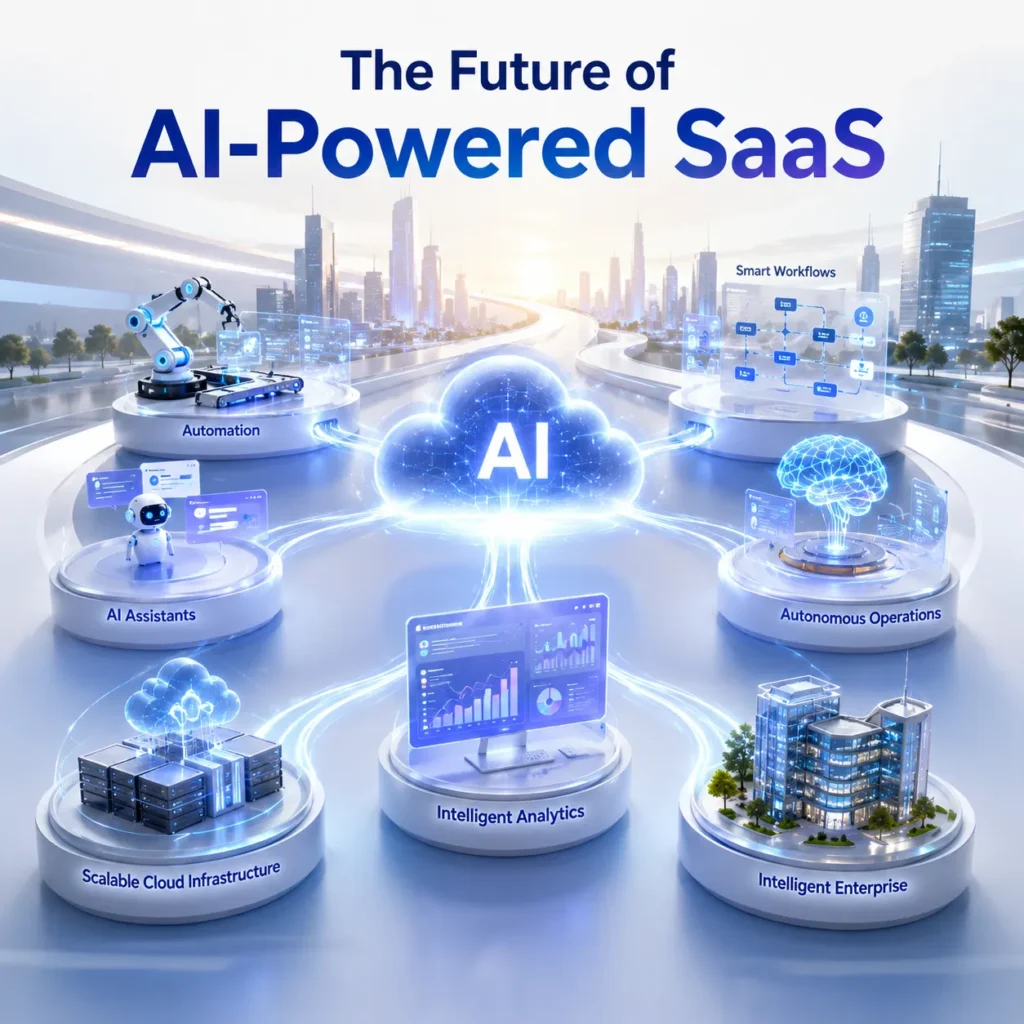
9. Future Trends Shaping AI-Powered SaaS
The evolution of AI in SaaS is far from over. While today’s AI-powered applications already automate workflows, personalize user experiences, and deliver predictive insights, the next generation of SaaS platforms will become even more intelligent, autonomous, and collaborative.
Emerging AI technologies are changing the role of software from a passive business tool to an active business partner. Instead of waiting for users to initiate actions, future SaaS applications will anticipate needs, make recommendations, execute complex tasks, and continuously optimize business processes with minimal human intervention.
Businesses that understand these emerging trends today will be better prepared to build software that remains competitive in the years ahead.
Let’s explore the trends that are shaping the future of AI-powered SaaS.
9.1 Autonomous SaaS Platforms
Traditional SaaS applications depend heavily on user input. Future AI-powered platforms will be capable of managing many routine business operations autonomously.
Rather than requiring users to manually analyze reports or configure workflows, autonomous SaaS platforms will:
- Monitor business performance continuously
- Detect issues before they become critical
- Recommend corrective actions
- Execute approved workflows automatically
- Optimize business processes over time
This shift will enable organizations to reduce operational overhead while allowing employees to focus on strategic decision-making and innovation.
Business Impact
- Reduced manual intervention
- Faster business operations
- Improved efficiency
- Greater operational agility
9.2 AI Agents as Digital Co-workers
One of the biggest advancements in AI in SaaS is the emergence of AI agents.
Unlike traditional AI assistants that respond to individual prompts, AI agents can understand business objectives, plan multiple steps, interact with different software systems, and complete complex workflows independently.
For example, an AI sales agent could:
- Identify promising leads
- Research customer information
- Draft personalized outreach emails
- Schedule meetings
- Update CRM records
- Notify sales managers about high-priority opportunities
Similarly, AI agents in finance, HR, customer support, and project management can automate sophisticated business processes while collaborating with human teams.
Rather than replacing employees, AI agents will increasingly act as intelligent digital co-workers that enhance productivity.
Business Impact
- End-to-end workflow automation
- Faster decision execution
- Increased employee productivity
- Better resource utilization
9.3 Hyper-Personalized User Experiences
Personalization is already a major advantage of AI-powered SaaS, but future platforms will deliver experiences that are even more adaptive and context-aware.
Instead of relying only on historical behavior, AI will consider factors such as:
- Real-time user activity
- Business priorities
- Device preferences
- Individual work patterns
- Team collaboration habits
As a result, software interfaces, recommendations, notifications, and workflows will continuously adapt to each user’s unique needs.
This level of personalization helps users work more efficiently while creating stronger engagement and long-term customer loyalty.
Business Impact
- Higher customer satisfaction
- Increased product adoption
- Improved user engagement
- Better retention rates
9.4 Multimodal AI Applications
Future SaaS products will interact with users through multiple forms of communication rather than relying solely on text-based interfaces.
Multimodal AI combines text, images, voice, documents, videos, and other data types to create richer and more natural user experiences.
Examples include:
- Voice-enabled business assistants
- Document analysis using text and images
- Image-based customer support
- Video meeting summaries
- Visual search capabilities
- Intelligent document processing
These capabilities will allow businesses to work with information more naturally while reducing manual effort.
Business Impact
- More intuitive user experiences
- Improved accessibility
- Faster information processing
- Better collaboration
9.5 Industry-Specific AI Solutions
Rather than offering generic AI features, SaaS providers are increasingly developing AI solutions tailored to the needs of specific industries.
Examples include:
Healthcare
- Clinical documentation assistance
- Patient risk prediction
- Resource optimization
Financial Services
- Fraud detection
- Regulatory compliance support
- Financial forecasting
Retail
- Demand forecasting
- Inventory optimization
- Personalized shopping experiences
Manufacturing
- Predictive maintenance
- Production planning
- Quality control
Industry-specific AI enables organizations to address unique business challenges while delivering more relevant and actionable insights.
Business Impact
- Higher business value
- Improved operational efficiency
- Better decision-making
- Stronger competitive advantage
9.6 The Rise of Self-Learning SaaS Products
Today’s AI systems require regular updates and retraining to maintain performance. Future SaaS platforms will become increasingly self-learning, allowing them to improve continuously as they process new information.
Self-learning applications will:
- Adapt to changing user behavior
- Optimize workflows automatically
- Improve prediction accuracy
- Refine recommendations
- Learn from business outcomes
This continuous improvement enables software to remain effective even as markets, customer expectations, and business processes evolve.
Instead of becoming outdated, SaaS products will become more valuable over time.
Business Impact
- Continuous performance improvement
- Better long-term ROI
- More accurate predictions
- Increased business adaptability
Emerging Trends at a Glance
| Future Trend | Business Value |
|---|---|
| Autonomous SaaS Platforms | Reduced manual operations and improved efficiency |
| AI Agents | Intelligent task execution and workflow automation |
| Hyper-Personalization | Better customer experiences and engagement |
| Multimodal AI | More natural interactions across multiple data formats |
| Industry-Specific AI | Tailored solutions for unique business needs |
| Self-Learning Applications | Continuous optimization and long-term value |
The Next Evolution of SaaS
The future of SaaS is not just about adding more AI features it’s about fundamentally changing how software supports businesses.
Tomorrow’s SaaS platforms will be capable of understanding context, learning from experience, collaborating with users, and proactively solving business problems before they arise.
Organizations that begin investing in AI-powered SaaS today will be better prepared to take advantage of these innovations as they become mainstream.
Businesses that delay adoption may find it increasingly difficult to compete in a market where intelligent software becomes the standard rather than the exception.
Key Takeaway
The future of AI in SaaS is centered on autonomy, adaptability, and intelligent collaboration. Technologies such as AI agents, self-learning applications, multimodal AI, and hyper-personalized experiences are redefining what businesses can expect from modern software. As these innovations mature, SaaS platforms will evolve from tools that users operate into intelligent systems that actively help organizations innovate, grow, and make smarter decisions.
In the next section, we’ll explore how CrossShores Infotech helps businesses design, develop, and scale AI-powered SaaS solutions that are secure, user-centric, and built for long-term success.
10. How CrossShore Infotech Helps Businesses Build AI-Powered SaaS Solutions
Building a successful AI-powered SaaS product requires much more than integrating an AI model or adding a chatbot. It involves creating a solution that aligns with business objectives, delivers exceptional user experiences, scales with growth, and maintains high standards of security and performance.
At CrossShore Infotech, we help businesses transform innovative ideas into intelligent SaaS solutions by combining AI expertise, product strategy, modern cloud architecture, and user-centric design. Explore our homepage to learn more about our software development expertise and the innovative digital solutions we build for businesses across industries.
Here’s how we help businesses build the next generation of AI-powered SaaS products.
AI Strategy and Product Consulting
Every successful AI initiative begins with a clear strategy.
Before selecting technologies or building features, we work closely with clients to understand their business goals, operational challenges, and user expectations. This strategic approach helps identify where AI can deliver the greatest impact while ensuring that every investment supports measurable outcomes.
Our consulting process includes:
- Product discovery and market research
- AI opportunity assessment
- Feature prioritization
- User journey mapping
- Technology selection
- AI implementation roadmap
By aligning AI capabilities with business objectives, we help organizations build products that solve real problems instead of adding unnecessary complexity.
Custom AI-Powered SaaS Development
Every business has unique workflows, users, and operational requirements. That’s why we develop custom SaaS applications tailored to each organization’s goals rather than relying on one-size-fits-all solutions.
Our development approach focuses on creating scalable, secure, and intelligent platforms that support long-term business growth.
Depending on project requirements, AI capabilities may include:
- Intelligent workflow automation
- Predictive analytics
- AI-powered search
- Personalized user experiences
- Virtual assistants
- Content generation
- Recommendation engines
- Smart reporting dashboards
Every feature is designed to improve efficiency, simplify operations, and deliver meaningful value to end users.
Seamless AI Integration into Existing SaaS Platforms
Many organizations already have established SaaS products but want to introduce AI without rebuilding their entire platform.
Our team helps businesses integrate AI capabilities into existing applications while preserving business continuity and minimizing disruption.
This may include:
- Integrating Large Language Models (LLMs)
- AI chatbot implementation
- Predictive analytics modules
- Intelligent automation workflows
- AI-powered recommendation systems
- Document intelligence
- API integrations
By enhancing existing software with intelligent capabilities, businesses can modernize their products while protecting previous technology investments.
We build cloud-native SaaS platforms designed for:
- High availability
- Performance optimization
- Flexible scalability
- API-first architecture
- Secure cloud deployment
- Reliable system integration
This enables businesses to expand their products confidently without compromising performance or user experience.
User-Centric AI Experiences
Powerful AI features are only valuable if users can interact with them easily.
Our design philosophy emphasizes intuitive user experiences that make AI feel like a natural extension of the product rather than a complicated technology layer.
We focus on:
- Clean and intuitive interfaces
- Personalized user journeys
- Accessible AI interactions
- Context-aware recommendations
- Intelligent dashboards
- Simplified workflows
By placing users at the center of every design decision, we create AI-powered SaaS products that are both intelligent and easy to use.
Security, Compliance, and Continuous Optimization
As AI becomes more deeply integrated into business software, maintaining security and reliability is essential.
We follow development best practices that emphasize:
- Secure application architecture
- Data privacy
- Role-based access controls
- Performance monitoring
- Ongoing AI model improvements
- Continuous feature optimization
Our goal is to help businesses build SaaS products that remain secure, scalable, and capable of adapting to evolving customer needs and technological advancements.
Why Partner with CrossShore Infotech?
Choosing the right development partner is critical to the success of any AI-powered SaaS initiative.
At CrossShore Infotech, we combine technical expertise with a deep understanding of product strategy, user experience, and modern software architecture. Rather than simply implementing AI, we focus on building intelligent SaaS solutions that solve real business challenges, improve operational efficiency, and deliver long-term value.
Whether you’re a startup building an innovative SaaS product or an established enterprise looking to enhance your platform with AI, our team is committed to helping you turn your vision into a scalable, future-ready solution.
Key Takeaway
Building successful AI in SaaS solutions requires the right combination of strategy, technology, and execution. At CrossShore Infotech, we help businesses design, develop, and scale intelligent SaaS products that leverage AI to automate processes, enhance user experiences, and drive sustainable growth. By combining modern development practices with thoughtful AI integration, we empower organizations to build software that’s ready for the future.
11. Frequently Asked Questions (FAQs)
1. What is AI in SaaS?
AI in SaaS refers to the integration of artificial intelligence technologies into Software as a Service (SaaS) applications. It enables software to automate tasks, analyze large volumes of data, provide predictive insights, personalize user experiences, and support better decision-making. Unlike traditional SaaS platforms, AI-powered SaaS solutions continuously learn and improve based on user interactions and data.
2. How does AI improve SaaS applications?
AI enhances SaaS applications by introducing intelligent capabilities such as workflow automation, predictive analytics, personalized recommendations, virtual assistants, fraud detection, and real-time decision support. These features help businesses improve efficiency, reduce manual work, enhance customer experiences, and make more informed business decisions.
3. What are the benefits of AI in SaaS?
Some of the key benefits of AI in SaaS include:
- Intelligent automation of repetitive tasks
- Personalized user experiences
- Predictive analytics and forecasting
- Faster customer support through AI assistants
- Improved workflow efficiency
- Enhanced cybersecurity and fraud detection
- Better business intelligence
- Increased productivity and operational efficiency
4. Which industries use AI-powered SaaS solutions?
AI-powered SaaS is widely used across multiple industries, including:
- Healthcare
- Finance and Banking
- Retail and E-commerce
- Manufacturing
- Human Resources
- Education
- Customer Relationship Management (CRM)
- Marketing Automation
- Project Management
- Logistics and Supply Chain
Organizations in these sectors use AI to improve efficiency, automate workflows, and deliver better customer experiences.
5. Can existing SaaS products integrate AI?
Yes. Existing SaaS applications can often be enhanced with AI capabilities without requiring a complete rebuild. Businesses can integrate features such as AI chatbots, predictive analytics, recommendation engines, intelligent search, workflow automation, and generative AI through APIs, machine learning models, or cloud-based AI services.
6. Is AI replacing traditional SaaS?
No. AI is not replacing SaaS—it is evolving it.
Traditional SaaS platforms remain the foundation of modern software delivery, while AI enhances them by making applications more intelligent, adaptive, and efficient. Rather than replacing SaaS, AI is transforming software into systems that can assist users, automate processes, and provide proactive insights.
7. What challenges should businesses consider when implementing AI in SaaS?
Some common challenges include:
- Maintaining data privacy and security
- Ensuring high-quality training data
- Preventing AI bias
- Integrating with existing systems
- Managing infrastructure costs
- Building user trust through transparency
- Meeting regulatory and compliance requirements
Addressing these challenges with careful planning and responsible AI practices helps ensure successful implementation.
8. What is the future of AI in SaaS?
The future of AI in SaaS is centered around autonomous software, AI agents, hyper-personalized user experiences, multimodal AI, and self-learning applications. As AI technologies continue to evolve, SaaS platforms will move beyond automation to become intelligent business partners capable of proactively solving problems, optimizing workflows, and supporting strategic decision-making.
9. How can businesses get started with AI-powered SaaS development?
The best starting point is identifying business processes where AI can deliver measurable value. Organizations should define clear objectives, assess their existing technology infrastructure, ensure high-quality data, and partner with an experienced development team to build secure, scalable, and user-centric AI-powered SaaS solutions.
10. Why should businesses choose CrossShore Infotech for AI-powered SaaS development?
CrossShore Infotech helps businesses design, develop, and scale intelligent SaaS products by combining AI expertise, modern cloud architecture, scalable software development, and user-centric design. From AI strategy and custom SaaS development to seamless AI integration and ongoing optimization, the company focuses on delivering solutions that solve real business challenges and support long-term growth.
12. Conclusion: Building the Next Generation of Intelligent SaaS Products
Artificial intelligence is fundamentally changing the way SaaS products are designed, developed, and experienced. What was once software built to execute predefined tasks is evolving into intelligent platforms that can learn from data, automate complex workflows, deliver predictive insights, and adapt to the unique needs of every user.
As we’ve explored throughout this guide, AI in SaaS offers far more than improved automation. It empowers businesses to create personalized customer experiences, optimize operations, strengthen security, support data-driven decision-making, and unlock new opportunities for innovation. From CRM and marketing automation to healthcare, finance, and project management, AI-powered SaaS solutions are helping organizations work smarter and respond more effectively to an increasingly competitive digital landscape.
However, successfully integrating AI into SaaS requires more than adopting the latest technology. It demands a clear business strategy, high-quality data, scalable architecture, user-centric design, and a commitment to responsible AI development. Organizations that approach AI with these principles in mind are better positioned to build products that deliver measurable value today while remaining adaptable to tomorrow’s technological advancements.
As AI continues to evolve with innovations such as AI agents, autonomous workflows, multimodal intelligence, and self-learning systems, the future of SaaS will be defined by software that doesn’t just support users it collaborates with them. Businesses that embrace this transformation now will be better equipped to improve efficiency, accelerate innovation, and create exceptional digital experiences for their customers.
Ready to Build an AI-Powered SaaS Solution?
Whether you’re developing a new SaaS product or looking to enhance an existing platform with intelligent capabilities, choosing the right technology partner can make all the difference.
At CrossShore Infotech, we specialize in designing and developing scalable, secure, and user-centric AI-powered SaaS solutions that solve real business challenges. From product strategy and custom SaaS development to AI integration, cloud architecture, and ongoing optimization, our team helps businesses transform innovative ideas into future-ready digital products.
If you’re ready to harness the power of AI and build smarter SaaS applications, our team is here to help. Contact us to discuss your project, explore AI integration opportunities, and discover how we can build a scalable SaaS solution tailored to your business needs.