


Contents
- 1 Table of Contents
- 2 1. Introduction: The New Era of AI-Powered Customer Service
- 3 Quick Answer: What Are Digital Humans in Customer Service?
- 4 2. What Are Digital Humans?
- 5 3. What Are AI Avatars?
- 6 4. Digital Humans vs. Traditional Chatbots: What’s the Difference?
- 7 5. Why Businesses Are Adopting Digital Humans for Customer Service
- 8 6. Key Benefits of Digital Humans in Customer Service
- 8.1 6.1 Natural, Human-Like Conversations
- 8.2 6.2 Instant Support Available 24/7
- 8.3 6.3 Personalized Customer Interactions
- 8.4 6.4 Multilingual Communication
- 8.5 6.5 Faster Query Resolution
- 8.6 6.6 Scalable Customer Support Without Compromising Quality
- 8.7 6.7 Consistent Customer Experience Across Every Interaction
- 8.8 Why These Benefits Matter
- 9 Why These Benefits Matter
- 10 7. How Digital Humans Work
- 10.1 7.1 Natural Language Processing (NLP): Understanding Customer Intent
- 10.2 7.2 Generative AI and Large Language Models (LLMs): Creating Intelligent Responses
- 10.3 7.3 Speech Recognition and Voice Synthesis
- 10.4 7.4 Facial Expressions and Human-Like Communication
- 10.5 7.5 CRM and Business System Integration
- 10.6 7.6 Continuous Learning and Improvement
- 10.7 Bringing Everything Together
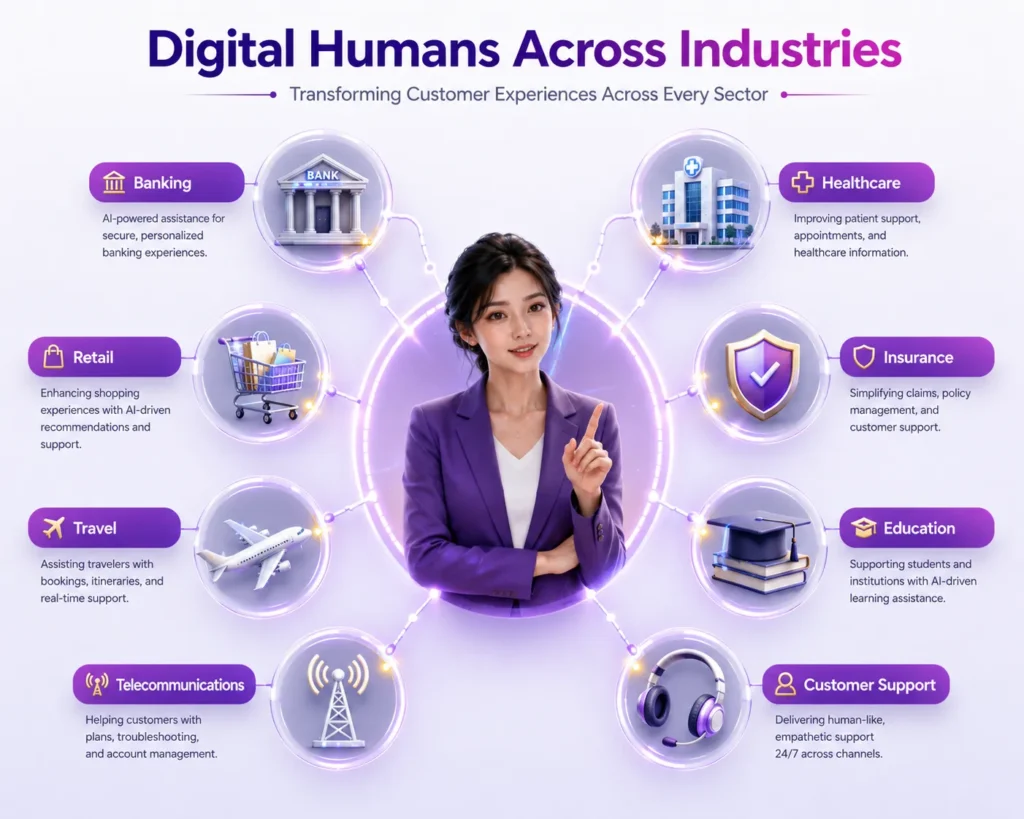
- 11 8. Real-World Applications of Digital Humans Across Industries
- 12 9. Can Digital Humans Replace Human Customer Support?
- 13 10. Challenges of Implementing Digital Humans
- 14 11. Future Trends in AI-Powered Customer Service
- 15 12. How to Successfully Implement Digital Humans in Your Business
- 16 13. Why Choose CrossShore Infotech for AI-Powered Customer Experiences?
- 17 14. Frequently Asked Questions (FAQs)
- 18 Conclusion: The Future of Customer Service Starts with Digital Humans
Table of Contents
- 1. Introduction: The New Era of AI-Powered Customer Service
- 2. What Are Digital Humans?
- 3. What Are AI Avatars?
- 4. Digital Humans vs. Traditional Chatbots: What's the Difference?
- 5. Why Businesses Are Adopting Digital Humans for Customer Service
- 6. Key Benefits of Digital Humans in Customer Service
- 7. How Digital Humans Work
- 8. Real-World Applications of Digital Humans Across Industries
- 9. Can Digital Humans Replace Human Customer Support?
- 10. Challenges of Implementing Digital Humans
- 11. Future Trends in AI-Powered Customer Service
- 12. How to Successfully Implement Digital Humans in Your Business
- 13. Why Choose CrossShore Infotech for AI-Powered Customer Experiences?
- 14. Frequently Asked Questions (FAQs)
1. Introduction: The New Era of AI-Powered Customer Service
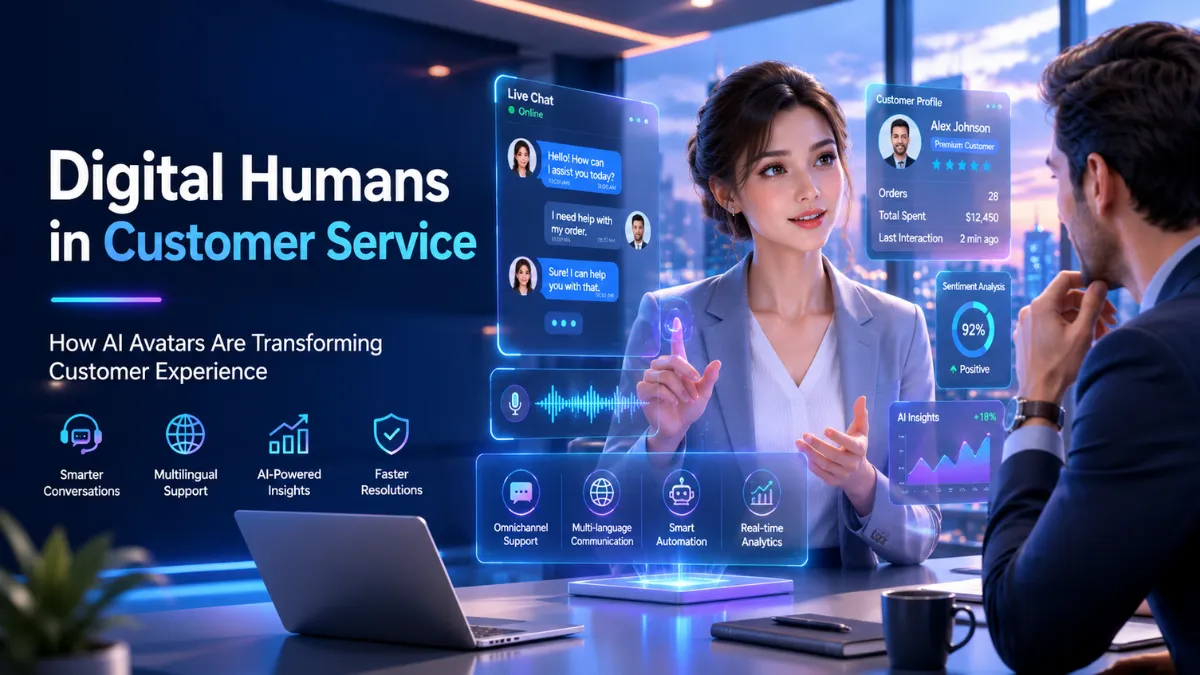
Customers today expect instant, personalized, and always-available support. While traditional chatbots have helped automate basic queries, they often struggle to deliver the natural, engaging conversations modern customers expect. That’s why businesses are increasingly adopting Digital Humans and AI Avatars to create smarter, more human-like customer experiences.
Quick Answer: What Are Digital Humans in Customer Service?
Digital Humans in Customer Service are AI-powered virtual representatives that communicate with customers using natural language, realistic voices, and lifelike facial expressions.
Powered by Generative AI, Natural Language Processing (NLP), and Conversational AI, they provide personalized, 24/7 support while helping businesses improve customer satisfaction, reduce response times, and scale support efficiently.
As customer expectations continue to evolve, businesses need solutions that go beyond answering simple questions. Businesses looking to accelerate their AI adoption can explore the innovative digital solutions offered by CrossShore Infotech, where we help organizations build intelligent, scalable, and future-ready customer experiences.
In this guide, you’ll learn what Digital Humans are, how they work, how they differ from traditional chatbots, their real-world applications, benefits, implementation strategies, and why they are shaping the future of AI-powered customer service.
2. What Are Digital Humans?
As businesses strive to deliver faster and more meaningful customer interactions, Digital Humans are emerging as one of the most significant innovations in AI-powered customer service. They combine advanced Artificial Intelligence (AI) with realistic human appearance, voice, facial expressions, and conversational abilities to create interactive virtual representatives that can communicate naturally with customers.
In simple terms, Digital Humans are AI-driven virtual people designed to simulate real human conversations. They can understand spoken or written language, interpret user intent, provide relevant responses, and even display emotions through facial expressions and body language. Unlike traditional customer support tools, they create an experience that feels closer to speaking with a real person.
What Makes Digital Humans Different?
A Digital Human is much more than an animated character or a voice assistant. It combines multiple AI technologies to deliver intelligent and engaging conversations. These technologies work together to understand customer queries, retrieve accurate information, and present responses in a natural, conversational manner.
Most Digital Humans are powered by:
- Natural Language Processing (NLP) to understand human language and intent.
- Generative AI and Large Language Models (LLMs) to generate context-aware, human-like responses.
- Speech Recognition to accurately interpret spoken conversations.
- Text-to-Speech (TTS) technology for realistic voice communication.
- Computer vision and animation systems that enable lifelike facial expressions, eye contact, and gestures.
By combining these technologies, Digital Humans in Customer Service can create conversations that feel interactive, empathetic, and personalized rather than scripted or robotic.
How Do Digital Humans Work?
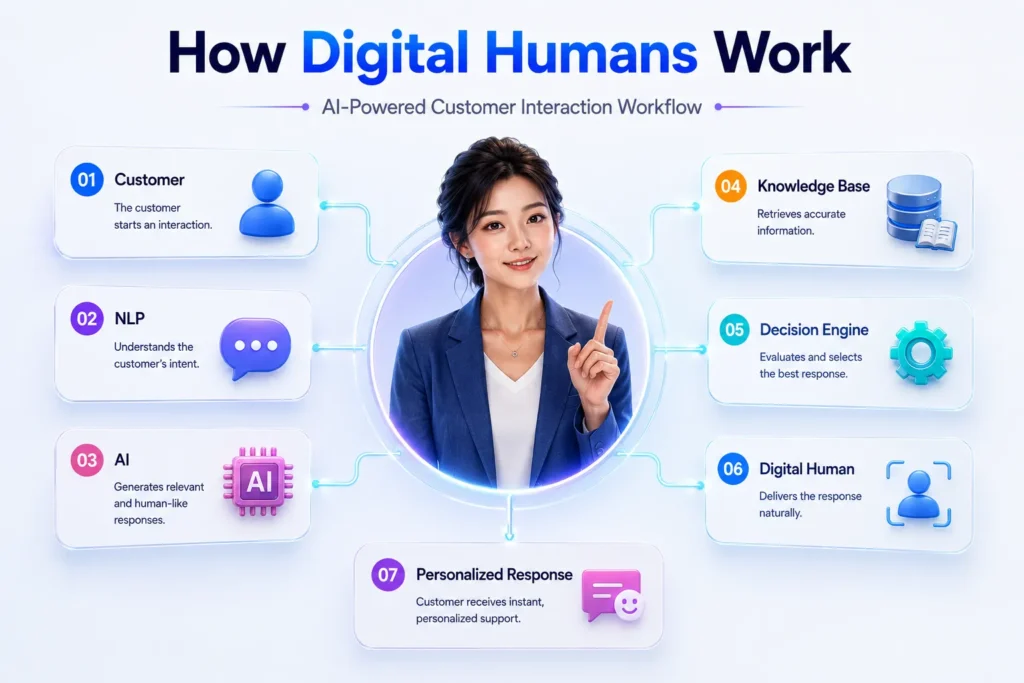
When a customer asks a question, a Digital Human processes the request in real time. It first identifies the customer’s intent using Natural Language Processing (NLP). It then retrieves relevant information from connected knowledge bases, business systems, or Customer Relationship Management (CRM) platforms. Using Generative AI, it formulates an accurate response and delivers it through natural speech, synchronized facial expressions, and realistic body language.
For example, if a customer wants to check the status of an order, update account details, or understand a product feature, the Digital Human can instantly access the required information and guide the customer through the process without human intervention. If the issue becomes too complex, it can seamlessly transfer the conversation to a human support representative while preserving the conversation history.
This ability to combine intelligence, automation, and human-like communication makes Digital Humans a powerful solution for organizations looking to improve both efficiency and customer experience.
Why Are Businesses Investing in Digital Humans?
Customer expectations are evolving faster than ever. Modern consumers want immediate answers, personalized recommendations, and consistent support across websites, mobile apps, kiosks, and messaging platforms. Traditional support models often struggle to meet these expectations, especially during peak demand.
By implementing Digital Humans in Customer Service, businesses can provide instant assistance around the clock, reduce response times, improve engagement, and maintain consistent service quality across thousands of interactions. These intelligent virtual representatives can handle repetitive inquiries, guide customers through complex workflows, and free human agents to focus on cases that require empathy, critical thinking, or specialized expertise.
As Conversational AI continues to advance, Digital Humans are becoming more intelligent, expressive, and capable of understanding context. This makes them an increasingly valuable asset for organizations seeking to deliver exceptional customer experience, improve operational efficiency, and strengthen long-term customer relationships.
3. What Are AI Avatars?
While Digital Humans and AI Avatars are often used interchangeably, they are not the same. Both are powered by Artificial Intelligence (AI) and designed to improve AI-powered customer service, but they differ in appearance, functionality, and the level of interaction they provide. Understanding this distinction helps businesses choose the right solution based on their customer engagement goals.
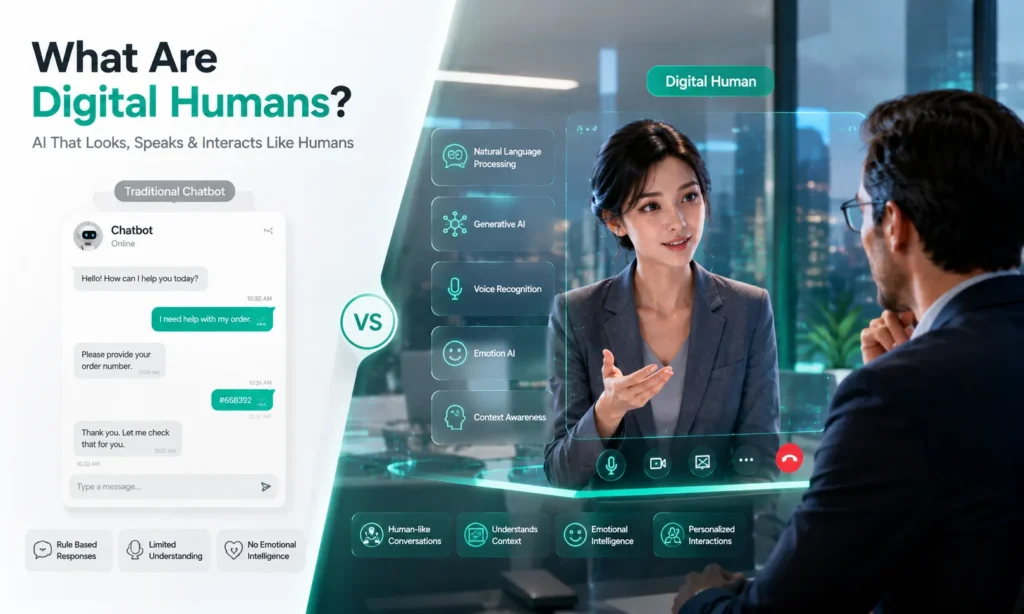
An AI Avatar is an intelligent virtual character that interacts with users through text, voice, or video. It can represent a company’s brand, answer customer questions, provide product recommendations, assist with onboarding, and guide users through various processes. Unlike traditional chatbots, AI Avatars use Generative AI, Natural Language Processing (NLP), and Conversational AI to understand context and deliver responses that feel natural rather than scripted.
Depending on the business use case, an AI Avatar may appear as a realistic human, a stylized digital assistant, or a custom brand ambassador. Regardless of its appearance, its primary purpose is to simplify customer interactions while providing fast, accurate, and engaging support.
How AI Avatars Work
An AI Avatar functions as the interactive face of an AI system. When a customer asks a question, the avatar analyzes the request using Natural Language Processing (NLP), understands the intent behind the conversation, and retrieves relevant information from connected databases, knowledge bases, or business applications. It then generates an intelligent response using Generative AI and delivers it through text or natural-sounding speech.
Many modern AI Avatars can also recognize conversational context, remember previous interactions, and adapt their responses based on customer preferences. This creates a more personalized experience and reduces the frustration of repeating the same information during every interaction.
Common Business Applications of AI Avatars
Organizations across industries are using AI Avatars to enhance customer engagement and streamline operations. Some of the most common applications include:
- Providing instant customer support on websites and mobile applications.
- Assisting customers with product selection and recommendations.
- Guiding users through account registration and onboarding.
- Answering frequently asked questions with accurate, real-time information.
- Supporting multilingual conversations for global audiences.
- Scheduling appointments, bookings, and service requests.
- Delivering personalized recommendations based on customer behavior and preferences.
These capabilities make AI Avatars valuable not only for customer support but also for sales, marketing, education, healthcare, banking, and internal employee assistance.
AI Avatars vs. Digital Humans
Although both technologies improve customer experience, there are important differences between them.
An AI Avatar focuses primarily on intelligent communication. It can interact through text, voice, or video and may have either a simple animated appearance or a realistic visual representation.
A Digital Human, on the other hand, goes a step further by replicating human-like behavior through lifelike facial expressions, eye contact, gestures, and emotional responses. The goal is to create conversations that closely resemble interactions with a real person.
In many enterprise solutions, AI Avatars serve as the conversational intelligence, while Digital Humans provide the realistic visual and emotional experience. Together, they create highly engaging and immersive customer interactions that go far beyond the capabilities of conventional chatbots.
Why AI Avatars Are Becoming Essential
Today’s customers expect businesses to respond instantly, understand their needs, and provide consistent support across every touchpoint. AI Avatars help organizations meet these expectations by combining speed, intelligence, and personalization in a scalable solution.
When integrated with Digital Humans in Customer Service, AI Avatars enable businesses to deliver conversational experiences that are available 24/7, support multiple languages, reduce operational costs, and improve overall customer satisfaction. As Conversational AI continues to evolve, these intelligent virtual assistants are becoming an integral part of modern digital customer engagement strategies.
4. Digital Humans vs. Traditional Chatbots: What’s the Difference?
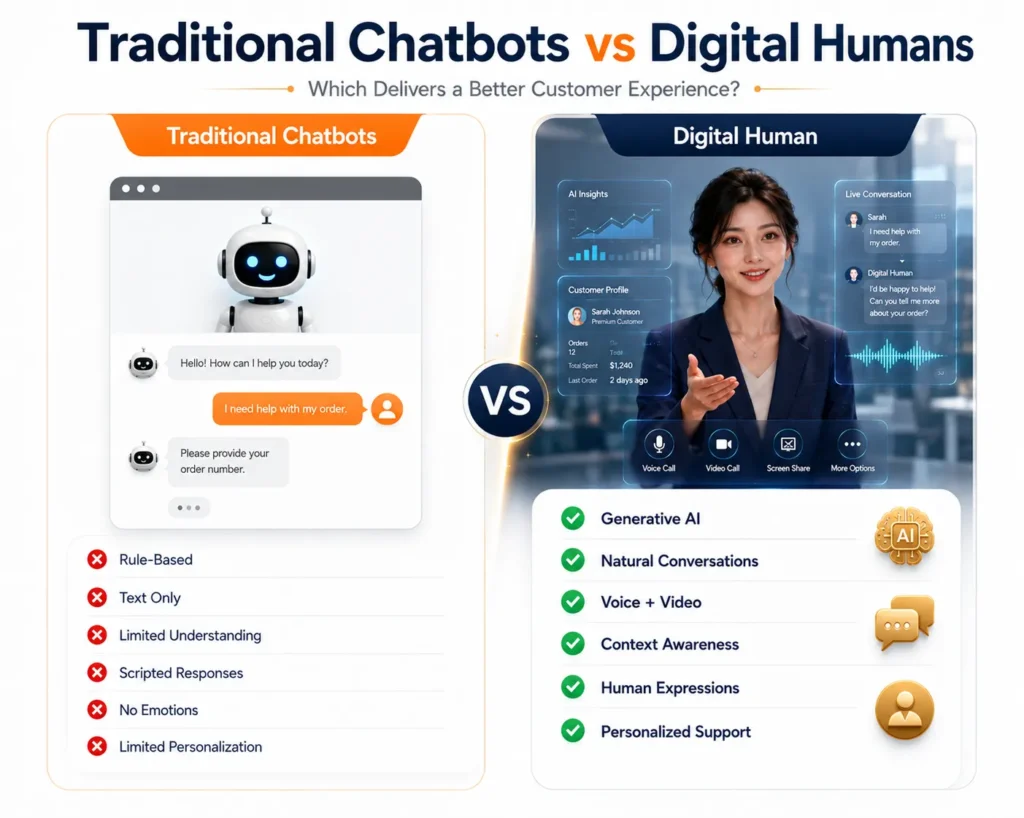
For many years, chatbots have been the go-to solution for automating customer support. They helped businesses answer frequently asked questions, provide basic information, and reduce the workload of customer service teams. However, as customer expectations have evolved, traditional chatbots have struggled to keep up with the demand for natural, personalized, and context-aware conversations.
This is where Digital Humans in Customer Service offer a significant advantage. Instead of simply responding to predefined commands or scripted questions, Digital Humans combine Generative AI, Natural Language Processing (NLP), realistic voice interactions, and lifelike visual representations to create conversations that closely resemble interactions with a human representative.
Although both technologies aim to improve customer support, their capabilities and the experiences they deliver are fundamentally different.
Digital Humans vs. Traditional Chatbots: A Comparison
| Feature | Traditional Chatbots | Digital Humans |
|---|---|---|
| Communication Style | Primarily text-based | Text, voice, and realistic visual interactions |
| Conversation Quality | Rule-based or scripted | Context-aware and human-like conversations |
| Understanding Customer Intent | Limited to predefined commands | Understands natural language and complex queries using Natural Language Processing (NLP) |
| Response Generation | Predefined responses | Dynamic responses powered by Generative AI and Large Language Models (LLMs) |
| Personalization | Basic personalization | Personalized responses based on customer history, preferences, and context |
| Emotional Engagement | Minimal | Uses facial expressions, tone, and gestures to create engaging interactions |
| Multilingual Support | Often limited | Supports multilingual conversations with natural speech capabilities |
| Learning Capability | Requires manual updates | Continuously improves through AI models and knowledge updates |
| Customer Experience | Functional but often robotic | Natural, interactive, and engaging customer experience |
Why Traditional Chatbots Have Limitations
Traditional chatbots are designed to follow predefined conversation flows. While they perform well for simple, repetitive tasks such as answering FAQs or checking order status, they often struggle when customers ask unexpected questions or provide incomplete information.
Some common limitations include:
- Difficulty understanding conversational language or slang.
- Limited ability to remember previous interactions.
- Inability to recognize customer emotions or intent.
- Frequent responses such as “I didn’t understand your question.”
- Dependence on manually created decision trees and scripts.
These limitations can frustrate customers, leading to longer resolution times and lower satisfaction levels.
How Digital Humans Deliver a Better Customer Experience
Unlike conventional chatbots, Digital Humans are designed to communicate naturally. They can understand the meaning behind a customer’s question instead of relying solely on keywords. Using Conversational AI and Generative AI, they analyze the context of the conversation, generate relevant responses, and adapt their communication style as the interaction progresses.
For example, if a customer asks multiple follow-up questions about a product, a traditional chatbot may require each question to be asked separately or in a specific format. A Digital Human, however, can maintain the flow of the conversation, remember previous responses, and provide contextually accurate answers, creating a smoother and more intuitive experience.
Additionally, realistic facial expressions, natural voice synthesis, and human-like gestures make interactions feel more engaging and trustworthy. This human-centric approach helps businesses build stronger customer relationships while maintaining the efficiency of automation.
Should Businesses Replace Chatbots with Digital Humans?
The answer depends on the complexity of the customer experience a business wants to deliver.
For organizations that only need to automate simple, repetitive queries, traditional chatbots can still be a practical and cost-effective solution. However, businesses aiming to provide highly personalized, multilingual, and engaging customer interactions are increasingly adopting Digital Humans in Customer Service.
Rather than completely replacing chatbots, many organizations use a layered approach. Traditional chatbots continue handling straightforward tasks, while Digital Humans and AI Avatars manage more complex conversations, personalized guidance, and customer engagement. This hybrid strategy enables businesses to improve efficiency without sacrificing the quality of customer interactions.
As AI-powered customer service continues to evolve, the gap between traditional chatbots and intelligent Digital Humans will become even more pronounced. Businesses that invest in advanced conversational technologies today will be better positioned to meet rising customer expectations and deliver exceptional digital experiences in the years ahead.
5. Why Businesses Are Adopting Digital Humans for Customer Service
Customer expectations have never been higher. Whether interacting with a bank, an online retailer, a healthcare provider, or a technology company, customers expect fast responses, personalized assistance, and consistent support across every digital touchpoint. Meeting these expectations with traditional customer service models can be challenging, especially as businesses grow and customer inquiries increase.
This is one of the primary reasons why organizations worldwide are investing in Digital Humans in Customer Service. By combining Artificial Intelligence (AI), Generative AI, Conversational AI, and human-like communication, Digital Humans help businesses deliver intelligent, engaging, and scalable customer experiences while improving operational efficiency.
Below are the key factors driving the adoption of this technology.
Rising Customer Expectations
Modern customers expect businesses to be available whenever they need assistance. Waiting on hold for several minutes or navigating through complex support menus can quickly lead to frustration.
Today’s consumers want customer service that is:
- Available 24/7
- Fast and responsive
- Personalized to their needs
- Consistent across all channels
- Easy to access from any device
Digital Humans address these expectations by providing immediate, conversational support that feels natural and intuitive. Instead of interacting with a static chatbot, customers engage with an intelligent virtual representative capable of understanding context and responding in a human-like manner.
The Growing Demand for Personalized Experiences
Personalization has become a major differentiator in customer service. People no longer want generic responses they expect businesses to recognize their preferences, remember previous interactions, and provide recommendations relevant to their needs.
When integrated with Customer Relationship Management (CRM) platforms and business systems, Digital Humans can access customer history, purchase records, and previous support interactions. This enables them to deliver highly personalized responses without requiring customers to repeat the same information multiple times.
By creating tailored interactions, businesses can improve trust, strengthen customer relationships, and increase long-term loyalty.
The Need for Faster Response Times
Long response times remain one of the biggest reasons customers abandon support interactions. During peak business hours, even well-trained customer service teams may struggle to manage increasing volumes of inquiries.
Digital Humans in Customer Service solve this challenge by providing instant responses to thousands of customers simultaneously. Unlike human agents, they do not require breaks, shifts, or waiting queues, making them an ideal solution for organizations with growing customer support demands.
Faster response times not only improve the customer experience but also increase customer satisfaction and reduce operational bottlenecks.
Supporting a Global Customer Base
Businesses are expanding beyond geographical boundaries, serving customers from different countries, cultures, and language backgrounds. Delivering consistent support to a global audience requires more than simply translating responses—it requires meaningful communication.
Powered by Natural Language Processing (NLP) and multilingual Conversational AI, Digital Humans can interact with customers in multiple languages while maintaining a natural conversational flow. This helps businesses provide inclusive customer support, improve accessibility, and build stronger relationships with international audiences.
Improving Operational Efficiency
As organizations scale, hiring and training large customer support teams can become expensive and time-consuming. Businesses need solutions that allow them to manage increasing customer interactions without significantly increasing operational costs.
By automating routine inquiries such as order tracking, appointment scheduling, account updates, and frequently asked questions, Digital Humans reduce the workload on human support agents. This allows customer service teams to focus on complex issues that require empathy, critical thinking, or specialized expertise.
The result is a more efficient support operation that benefits both customers and employees.
Delivering Consistent Service Quality
One of the biggest challenges in customer support is maintaining consistency across every interaction. Human agents may vary in experience, communication style, or product knowledge, leading to inconsistent customer experiences.
Digital Humans provide standardized, accurate, and brand-consistent responses based on approved business knowledge. Whether assisting the first customer of the day or the ten-thousandth, they maintain the same level of professionalism, accuracy, and responsiveness.
This consistency strengthens customer trust and helps businesses maintain a reliable brand image.
Driving Digital Transformation
Many organizations are turning to experienced AI technology partners to successfully implement Digital Humans in Customer Service and intelligent automation solutions.
Implementing Digital Humans in Customer Service enables businesses to:
- Enhance customer engagement through natural conversations.
- Reduce operational costs by automating repetitive tasks.
- Improve response speed and service availability.
- Scale customer support without compromising quality.
- Collect valuable customer insights to improve future interactions.
As AI-powered customer service continues to evolve, Digital Humans are becoming a strategic investment rather than just a technology trend. Businesses that adopt intelligent customer engagement solutions today are better equipped to meet changing customer expectations, improve efficiency, and build lasting competitive advantages.
6. Key Benefits of Digital Humans in Customer Service
The growing adoption of Digital Humans in Customer Service is driven by their ability to solve real business challenges while significantly improving the customer experience. Unlike conventional support tools, Digital Humans combine intelligence, natural communication, and automation to create interactions that are faster, more engaging, and highly personalized.
Whether a business serves hundreds or millions of customers, implementing AI-powered customer service with Digital Humans offers measurable benefits for both customers and organizations. Below are some of the most significant advantages.
6.1 Natural, Human-Like Conversations
One of the biggest advantages of Digital Humans is their ability to communicate naturally. Instead of relying on scripted responses, they use Natural Language Processing (NLP) and Generative AI to understand customer intent, analyze context, and generate relevant responses in real time.
Customers can ask questions in their own words without worrying about using specific keywords or predefined commands. The conversation feels fluid, interactive, and more like speaking with a knowledgeable customer service representative.
This human-like communication helps reduce frustration and creates a more engaging customer experience, encouraging customers to continue interacting with the brand.
6.2 Instant Support Available 24/7
Customers expect assistance whenever they need it, regardless of time zones or business hours. Delayed responses can lead to abandoned purchases, dissatisfied customers, and lost business opportunities.
With Digital Humans in Customer Service, businesses can provide round-the-clock support without increasing staffing costs. These AI-powered virtual representatives are always available to answer questions, assist with transactions, resolve common issues, and guide customers through various processes.
This continuous availability ensures customers receive immediate assistance whenever they need it, resulting in higher satisfaction and stronger customer loyalty.
6.3 Personalized Customer Interactions
Modern customers appreciate businesses that understand their preferences and provide tailored recommendations.
When connected to Customer Relationship Management (CRM) systems, Digital Humans can access relevant customer information such as previous interactions, purchase history, support tickets, and personal preferences. This enables them to deliver personalized responses instead of generic answers.
For example, rather than simply recommending a product, a Digital Human can suggest solutions based on a customer’s previous purchases or browsing behavior, creating a more meaningful and relevant interaction.
Personalization not only improves customer satisfaction but also increases engagement, retention, and conversion rates.
6.4 Multilingual Communication
Businesses today often serve customers across multiple countries and regions. Providing quality support in different languages can be expensive and difficult to manage with traditional customer service teams.
Powered by Conversational AI, Natural Language Processing (NLP), and advanced language models, Digital Humans can communicate in multiple languages while maintaining consistent quality and natural conversation flow.
This multilingual capability helps businesses:
- Serve international customers more effectively.
- Improve accessibility for diverse audiences.
- Expand into new markets with confidence.
- Deliver consistent support across global operations.
By breaking language barriers, organizations can create more inclusive and customer-centric experiences.
6.5 Faster Query Resolution
Customers value quick solutions more than lengthy support processes. Whether they are checking an order status, resetting a password, or requesting product information, they expect immediate answers.
Digital Humans can process customer requests within seconds by accessing connected knowledge bases, business applications, and enterprise systems. They instantly retrieve relevant information and provide accurate responses without requiring customers to wait in support queues.
This significantly reduces average response times and enables businesses to resolve a large percentage of customer inquiries during the first interaction.
Faster resolutions lead to improved efficiency, reduced support costs, and a better overall customer experience.
6.6 Scalable Customer Support Without Compromising Quality
As businesses grow, customer inquiries naturally increase. Expanding support teams to meet demand can require significant investments in hiring, training, and infrastructure.
Digital Humans in Customer Service solve this challenge by handling thousands of customer interactions simultaneously while maintaining the same level of accuracy, professionalism, and responsiveness.
Unlike human agents, they do not become overwhelmed during peak business periods or seasonal demand spikes. This allows organizations to scale their customer support operations efficiently without sacrificing service quality.
Scalability is especially valuable for industries such as e-commerce, banking, healthcare, telecommunications, and travel, where customer interaction volumes can fluctuate significantly.
6.7 Consistent Customer Experience Across Every Interaction
Consistency is a critical factor in building customer trust. Customers expect accurate information regardless of when or how they contact a business.
Because Digital Humans rely on centralized knowledge and AI-driven decision-making, they deliver standardized responses that align with company policies and brand guidelines. This minimizes inconsistencies that can occur when multiple human agents provide different answers to similar questions.
Whether customers interact through a website, mobile app, self-service kiosk, or virtual assistant, they receive a reliable and consistent experience every time.
This consistency strengthens brand credibility while improving customer confidence and satisfaction.
Why These Benefits Matter
The value of Digital Humans in Customer Service extends far beyond automation. They help businesses create faster, smarter, and more personalized interactions while reducing operational costs and improving service quality.
By combining Generative AI, Conversational AI, and intelligent automation, organizations can enhance customer engagement, increase operational efficiency, and build stronger long-term relationships. As customer expectations continue to evolve, businesses that embrace Digital Humans will be better positioned to deliver exceptional digital experiences and remain competitive in an increasingly AI-driven marketplace.
Why These Benefits Matter
The value of Digital Humans in Customer Service extends far beyond automation. They help businesses create faster, smarter, and more personalized interactions while reducing operational costs and improving service quality.
By combining Generative AI, Conversational AI, and intelligent automation, organizations can enhance customer engagement, increase operational efficiency, and build stronger long-term relationships.
As customer expectations continue to evolve, businesses that embrace Digital Humans will be better positioned to deliver exceptional digital experiences and remain competitive in an increasingly AI-driven marketplace.
7. How Digital Humans Work
Understanding how Digital Humans in Customer Service work helps businesses appreciate why they deliver a more natural and engaging support experience than traditional automation tools. While interacting with a Digital Human may feel like speaking to a real customer service representative, several advanced AI technologies work together behind the scenes to make every conversation intelligent, responsive, and personalized.
From interpreting customer questions to generating accurate responses and presenting them with realistic speech and expressions, each interaction follows a sophisticated yet seamless process.
7.1 Natural Language Processing (NLP): Understanding Customer Intent
Every conversation begins with Natural Language Processing (NLP), one of the core technologies behind Digital Humans. NLP enables the AI to understand spoken or written language the way humans naturally communicate.
Instead of searching for exact keywords, NLP analyzes the meaning, intent, and context of a customer’s question. This allows Digital Humans to understand different sentence structures, conversational language, and even follow-up questions.
For example, if a customer asks, “I ordered a laptop last week. Can you tell me when it will arrive?”, the system understands that the customer is requesting an order status rather than simply identifying isolated words like “laptop” or “arrive.”
This contextual understanding creates smoother, more natural conversations and reduces misunderstandings.
7.2 Generative AI and Large Language Models (LLMs): Creating Intelligent Responses
Once the customer’s intent is identified, Generative AI powered by Large Language Models (LLMs) generates an appropriate response.
Unlike rule-based systems that rely on predefined scripts, Generative AI creates responses dynamically based on the conversation, customer context, and available business information. This enables Digital Humans to answer both common and complex questions while maintaining a conversational tone.
For example, if a customer asks several related questions about a product, warranty, and delivery options, the AI can address all of them within the same conversation without forcing the customer to restart or navigate through multiple menus.
This flexibility significantly improves the overall customer experience.
7.3 Speech Recognition and Voice Synthesis
Many Digital Humans communicate through voice rather than text alone.
Using Speech Recognition, they accurately convert spoken language into text that AI models can understand. Once a response is generated, Text-to-Speech (TTS) technology transforms it into realistic, natural-sounding speech.
Modern voice synthesis systems replicate natural pacing, pronunciation, pauses, and intonation, making conversations feel much more authentic than the robotic voices commonly associated with older virtual assistants.
As a result, customers experience interactions that are easier to understand and far more engaging.
7.4 Facial Expressions and Human-Like Communication
One of the defining characteristics of Digital Humans is their realistic visual presence.
Unlike text-based chatbots, they can communicate using facial expressions, eye contact, lip synchronization, and subtle gestures that closely resemble human behavior.
These visual elements enhance communication by reinforcing spoken messages and making conversations feel more personal. A welcoming smile during a greeting or an attentive expression while listening to a customer’s question can significantly improve engagement and trust.
Although these expressions are generated digitally, they help create interactions that feel more natural and approachable, particularly in industries where customer relationships are important.
7.5 CRM and Business System Integration
A Digital Human becomes significantly more valuable when connected to existing business systems.
By integrating with Customer Relationship Management (CRM) platforms, order management systems, knowledge bases, and enterprise applications, Digital Humans can access real-time information during conversations.
This allows them to:
- Check order status instantly.
- Retrieve customer account information.
- Schedule appointments.
- Process service requests.
- Recommend relevant products or services.
- Provide personalized assistance based on previous interactions.
Instead of giving generic answers, Digital Humans deliver responses that are relevant to each customer’s unique situation.
7.6 Continuous Learning and Improvement
Another major advantage of Digital Humans in Customer Service is their ability to improve over time.
As businesses update their knowledge bases, products, services, and policies, AI systems can be trained with new information to provide increasingly accurate responses.
Organizations can also analyze customer conversations to identify common questions, knowledge gaps, and opportunities for service improvement. These insights help optimize AI performance while enabling businesses to continuously refine the customer experience.
Unlike traditional scripted chatbots that require frequent manual rule updates, modern AI-driven systems can adapt more efficiently to changing customer needs and business requirements.
Bringing Everything Together
Every customer interaction involves multiple AI technologies working together seamlessly. A customer asks a question through text or voice, Natural Language Processing (NLP) identifies the intent, Generative AI generates a context-aware response, integrated business systems provide real-time information, and the Digital Human delivers the answer using natural speech, facial expressions, and human-like communication.
This combination of intelligence, personalization, and realistic interaction is what makes Digital Humans in Customer Service fundamentally different from traditional customer support technologies.
As AI continues to evolve, Digital Humans will become even more capable of understanding customer needs, handling complex conversations, and delivering highly personalized experiences. For businesses seeking to modernize their support operations, this technology represents a significant step toward creating smarter, more engaging, and customer-centric digital interactions.
8. Real-World Applications of Digital Humans Across Industries
The adoption of Digital Humans in Customer Service is no longer limited to technology companies. Organizations across industries are using Digital Humans and AI Avatars to improve customer engagement, streamline support operations, and deliver personalized experiences at scale. Their ability to provide intelligent, always-available assistance makes them valuable wherever businesses interact with customers, patients, students, or citizens.
Here are some of the industries where AI-powered customer service is making a measurable impact.
8.1 Banking and Financial Services
Banks and financial institutions receive thousands of customer inquiries every day, ranging from account-related questions to loan applications and investment guidance. Managing these requests efficiently while maintaining security and compliance can be challenging.
Digital Humans help financial organizations provide instant support by assisting customers with:
- Account balance and transaction inquiries
- Loan and credit card information
- Investment product guidance
- Digital banking assistance
- Frequently asked questions
- Appointment scheduling with financial advisors
By automating routine inquiries, banks can reduce waiting times while allowing financial experts to focus on more complex customer needs.
8.2 Healthcare
Healthcare providers are increasingly using Digital Humans to improve patient communication and simplify administrative processes.
Patients can receive assistance with:
- Appointment scheduling
- Hospital navigation
- General health information
- Prescription reminders
- Insurance-related questions
- Pre-visit and post-treatment guidance
It’s important to note that while Digital Humans can provide general information and administrative support, they are designed to complement healthcare professionals, not replace medical expertise or clinical decision-making.
This approach improves patient satisfaction while reducing administrative workloads for healthcare staff.
8.3 Retail and E-commerce
The retail industry depends heavily on delivering exceptional customer experiences throughout the buying journey.
Using Digital Humans in Customer Service, retailers can provide personalized shopping assistance by helping customers:
- Discover suitable products
- Compare product features
- Check inventory availability
- Track online orders
- Understand return policies
- Receive personalized recommendations
Because Digital Humans are available around the clock, they can assist customers even outside traditional business hours, reducing cart abandonment and improving conversion rates.
8.4 Insurance
Insurance products often involve complex terminology and lengthy customer interactions. Many customers require guidance before purchasing policies or filing claims.
Digital Humans simplify these processes by assisting with:
- Policy information
- Coverage explanations
- Premium calculations
- Claims guidance
- Renewal reminders
- Frequently asked questions
By providing accurate and consistent information, insurers can improve customer confidence while reducing support costs.
8.5 Travel and Hospitality
Travelers expect quick answers before, during, and after their journeys. Whether booking accommodations or managing itinerary changes, timely assistance significantly influences customer satisfaction.
Hotels, airlines, and travel companies use Digital Humans to help customers with:
- Flight and hotel bookings
- Reservation modifications
- Check-in guidance
- Travel policies
- Local recommendations
- Loyalty program support
Providing multilingual assistance also allows travel businesses to serve international customers more effectively.
8.6 Telecommunications
Telecommunication providers manage millions of customer interactions related to billing, technical support, service upgrades, and network issues.
By implementing AI-powered customer service, telecom companies can use Digital Humans to:
- Resolve billing inquiries
- Guide customers through device setup
- Troubleshoot common technical issues
- Recommend suitable service plans
- Schedule technician visits
- Assist with account management
This reduces call center workloads while improving first-contact resolution rates.
8.7 Education
Educational institutions are increasingly adopting Digital Humans to improve communication with students, parents, and prospective applicants.
Common applications include:
- Admissions guidance
- Course recommendations
- Campus information
- Student support services
- Scholarship information
- Frequently asked questions
Educational organizations can provide instant assistance throughout the enrollment journey while allowing staff members to focus on personalized academic support.
Why Digital Humans Work Across Industries
Although the use cases vary, the underlying business objectives remain remarkably similar. Organizations across different sectors are striving to:
- Improve the customer experience
- Reduce response times
- Deliver personalized interactions
- Support customers 24/7
- Increase operational efficiency
- Scale customer support without increasing operational costs
These goals make Digital Humans in Customer Service a versatile solution that can adapt to virtually any industry where customer communication plays a critical role.
As Generative AI and Conversational AI continue to advance, the range of applications will expand even further. Businesses will be able to create increasingly intelligent, personalized, and human-like digital experiences that strengthen customer relationships while improving overall business performance.
9. Can Digital Humans Replace Human Customer Support?
A common question businesses ask before adopting Digital Humans in Customer Service is whether they can completely replace human customer support agents. The short answer is no and that’s not the goal.
Instead of replacing people, Digital Humans are designed to enhance customer service by handling repetitive, high-volume tasks while allowing human agents to focus on situations that require empathy, critical thinking, negotiation, or complex decision-making. This collaborative approach creates a more efficient and customer-centric support model.
What Digital Humans Can Handle
Powered by Generative AI, Natural Language Processing (NLP), and Conversational AI, Digital Humans excel at managing routine interactions such as:
- Answering frequently asked questions.
- Providing product or service information.
- Tracking orders and deliveries.
- Assisting with account management.
- Scheduling appointments.
- Guiding customers through onboarding processes.
- Offering multilingual customer support.
- Providing 24/7 assistance across digital channels.
These tasks can be completed instantly and consistently, reducing customer wait times while improving operational efficiency.
Where Human Agents Remain Essential
Despite rapid advances in AI, there are situations where human expertise remains irreplaceable. Complex customer issues often require emotional intelligence, creative problem-solving, and nuanced decision-making that AI cannot fully replicate.
Human agents continue to play a vital role in:
- Resolving sensitive customer complaints.
- Managing escalations and disputes.
- Providing financial or legal consultations.
- Handling exceptional cases.
- Building long-term customer relationships through empathy and trust.
By taking over routine inquiries, Digital Humans free support teams to concentrate on these high-value interactions, improving both employee productivity and customer satisfaction.
The Future Is Human + AI Collaboration
The most successful organizations are not choosing between AI and humans; they are combining both. In this hybrid model, Digital Humans in Customer Service serve as the first point of contact, delivering instant assistance and resolving common queries. When a request requires deeper expertise or human judgment, the conversation is seamlessly transferred to a live support representative with the full interaction history intact.
This Human + AI collaboration enables businesses to deliver faster responses, more personalized experiences, and consistent service quality while maintaining the empathy and trust that only people can provide.
As AI-powered customer service continues to evolve, businesses that balance intelligent automation with human expertise will be best positioned to deliver exceptional customer experience and build lasting customer relationships.
10. Challenges of Implementing Digital Humans
While Digital Humans in Customer Service offer significant advantages, successful implementation requires careful planning and the right technology strategy. Like any AI-powered solution, businesses should address potential challenges to ensure secure, reliable, and effective customer interactions.
Understanding these considerations early helps organizations maximize the value of their AI investment while building customer trust.
Data Privacy and Security
Digital Humans often handle sensitive customer information, such as personal details, account data, or transaction history. Businesses must ensure that customer data is handled securely and complies with applicable privacy regulations and industry standards.
Implementing robust security measures, encryption, access controls, and secure system integrations helps protect customer information while maintaining trust.
AI Accuracy and Response Quality
Although Generative AI has advanced significantly, AI systems can occasionally generate inaccurate or incomplete responses if they rely on outdated or insufficient information.
To maintain response quality, businesses should regularly update their knowledge bases, monitor AI performance, and establish review processes for critical customer interactions. Continuous testing and improvement ensure that Digital Humans provide accurate and relevant information.
Integration with Existing Business Systems
For Digital Humans to deliver personalized and efficient support, they must integrate seamlessly with existing systems such as Customer Relationship Management (CRM) platforms, knowledge bases, order management systems, and other enterprise applications.
Without proper integration, AI may only provide generic responses, limiting its ability to deliver personalized customer experiences. Choosing scalable and compatible solutions is essential for long-term success.
Customer Acceptance and Trust
Some customers readily embrace AI-driven interactions, while others still prefer speaking with a human representative. Businesses should clearly communicate when customers are interacting with a Digital Human and provide an easy option to connect with a live agent whenever needed.
Maintaining transparency and offering human assistance when required helps build confidence in AI-powered customer service.
Continuous Training and Optimization
Customer expectations, products, and business processes evolve. As a result, Digital Humans require ongoing optimization to remain effective.
Organizations should regularly analyze customer interactions, identify knowledge gaps, update AI models, and measure performance using key metrics such as response accuracy, resolution time, and customer satisfaction. Continuous improvement ensures the AI remains aligned with changing business goals and customer needs.
Overcoming the Challenges
While these challenges require careful attention, they are manageable with the right implementation strategy. Businesses that prioritize security, maintain high-quality data, integrate AI with existing systems, and continuously optimize performance can unlock the full potential of Digital Humans in Customer Service.
When implemented responsibly, Digital Humans become a valuable extension of customer support teams, enabling organizations to deliver intelligent, secure, and engaging customer experiences at scale.
11. Future Trends in AI-Powered Customer Service
The evolution of Digital Humans in Customer Service is just beginning. As Artificial Intelligence (AI) continues to advance, businesses can expect customer interactions to become even more intelligent, personalized, and immersive. Future innovations will focus not only on answering questions but also on understanding customer behavior, anticipating needs, and delivering proactive support.
Here are some of the key trends shaping the future of AI-powered customer service.
Emotion-Aware AI
Future Digital Humans will become increasingly capable of recognizing emotional cues through voice tone, facial expressions, and conversation patterns. While today’s AI can understand language and context, the next generation will better identify whether a customer is frustrated, confused, or satisfied.
This will enable businesses to deliver more empathetic responses and determine when a conversation should be transferred to a human support representative.
Hyper-Personalized Customer Experiences
Personalization will move beyond using a customer’s name or purchase history. By integrating with Customer Relationship Management (CRM) systems, behavioral analytics, and business applications, Digital Humans will be able to offer recommendations, solutions, and support tailored to each customer’s unique preferences and previous interactions.
This deeper level of personalization will strengthen customer relationships and improve engagement.
Voice-First and Multimodal Interactions
Customers increasingly expect to communicate using the channel that is most convenient for them. Future Digital Humans will support seamless interactions across voice, text, video, websites, mobile apps, kiosks, and smart devices.
This multimodal approach will create a consistent customer experience, allowing users to switch between communication channels without interrupting the conversation.
Smarter Autonomous AI Agents
Powered by more advanced Generative AI and Large Language Models (LLMs), future Digital Humans will go beyond answering questions. They will be able to complete complex tasks such as processing service requests, managing appointments, updating customer accounts, initiating workflows, and coordinating with other business systems—all with minimal human intervention.
This shift toward intelligent AI agents will further improve efficiency while reducing operational workloads.
The Future Is Human-Centered AI
Although AI capabilities will continue to expand, the future of customer service is not about replacing people—it’s about creating stronger collaboration between humans and intelligent technology. Businesses that combine Digital Humans in Customer Service with skilled support teams will be able to deliver faster responses, more personalized interactions, and exceptional customer experiences.
As AI innovation accelerates, organizations that embrace these technologies today will be better prepared to meet tomorrow’s customer expectations and gain a competitive advantage in an increasingly digital marketplace.
12. How to Successfully Implement Digital Humans in Your Business
Implementing Digital Humans in Customer Service requires more than deploying an AI solution. To achieve meaningful results, businesses need a clear strategy that aligns technology with customer expectations and business objectives. A well-planned implementation ensures that Digital Humans deliver accurate, personalized, and engaging customer interactions while integrating seamlessly into existing workflows.
Here are the key steps to successfully implement Digital Humans in your organization.
Define Your Customer Service Goals
Start by identifying the challenges you want to solve. Determine whether your objective is to reduce response times, improve customer satisfaction, automate repetitive inquiries, support multiple languages, or enhance the overall customer experience.
Having clear goals helps you select the right AI capabilities and measure the success of your implementation.
Choose the Right AI Solution
Not all AI platforms offer the same capabilities. Look for solutions that combine Generative AI, Natural Language Processing (NLP), and Conversational AI to deliver natural, context-aware conversations.
The ideal solution should also support voice interactions, multilingual communication, analytics, and seamless integration with your existing business systems.
Working with an experienced AI development company like CrossShore Infotech can simplify implementation and ensure your solution integrates seamlessly with your existing business systems.
Integrate with Existing Systems
To provide personalized support, Digital Humans should connect with your Customer Relationship Management (CRM) platform, knowledge base, helpdesk software, order management system, and other enterprise applications.
These integrations enable the AI to access real-time customer information, provide accurate responses, and complete tasks without requiring customers to repeat information.
Train, Monitor, and Optimize
Even the most advanced AI solutions require ongoing improvement. Regularly review customer interactions, update knowledge bases, and monitor performance metrics such as response accuracy, resolution rates, and customer satisfaction.
Continuous optimization ensures that Digital Humans in Customer Service remain relevant, accurate, and aligned with evolving business needs.
Measure Business Impact
After implementation, evaluate the results using measurable performance indicators. Businesses commonly track:
- Customer satisfaction (CSAT)
- First-contact resolution rate
- Average response time
- Customer engagement
- Support cost reduction
- AI resolution rate
- Agent productivity
Monitoring these metrics helps organizations identify opportunities for improvement and maximize the return on their AI investment.
When implemented strategically, Digital Humans become more than a customer support tool—they become a long-term asset that enhances operational efficiency, strengthens customer relationships, and supports sustainable business growth.
13. Why Choose CrossShore Infotech for AI-Powered Customer Experiences?
As customer expectations continue to evolve, businesses need more than standalone AI tools—they need intelligent solutions that integrate seamlessly with their existing operations and deliver measurable business outcomes. At CrossShore Infotech, we help organizations leverage Digital Humans in Customer Service to create engaging, efficient, and future-ready customer experiences.
Our approach goes beyond implementing technology. We work closely with businesses to understand their objectives, customer journeys, and operational challenges before designing AI solutions tailored to their unique requirements.
Our AI Expertise
We specialize in building intelligent customer engagement solutions powered by:
- Digital Humans
- AI Avatars
- Generative AI
- Conversational AI
- Natural Language Processing (NLP)
- Intelligent automation
- Enterprise AI integration
Whether you’re looking to enhance customer support, improve self-service experiences, or modernize digital interactions, our team develops scalable solutions that align with your business goals.
End-to-End Implementation
From strategy and solution design to development, integration, and ongoing optimization, we support businesses throughout their AI transformation journey. Our solutions integrate seamlessly with existing platforms such as Customer Relationship Management (CRM) systems, knowledge bases, and enterprise applications, enabling personalized and context-aware customer interactions.
Building Smarter Customer Experiences
By implementing Digital Humans in Customer Service, businesses can:
- Deliver instant, 24/7 customer support.
- Provide personalized and multilingual interactions.
- Improve customer engagement and satisfaction.
- Automate repetitive customer service tasks.
- Increase operational efficiency while reducing support costs.
- Scale customer service without compromising quality.
At CrossShore Infotech, our focus is on helping businesses combine innovation with practical business value. We build AI-powered customer engagement solutions that not only improve operational efficiency but also strengthen customer relationships and support long-term digital transformation.
Whether you’re taking the first step toward AI adoption or looking to enhance your existing customer service strategy, our team is ready to help you build intelligent digital experiences that drive measurable business growth.
14. Frequently Asked Questions (FAQs)
1. What are Digital Humans in Customer Service?
Digital Humans in Customer Service are AI-powered virtual representatives that communicate with customers using natural language, realistic voices, and human-like facial expressions. They leverage Generative AI, Natural Language Processing (NLP), and Conversational AI to provide personalized, real-time support across digital channels.
2. How are Digital Humans different from traditional chatbots?
Traditional chatbots typically rely on predefined rules and scripted responses, making them suitable for simple, repetitive tasks. Digital Humans, on the other hand, understand context, maintain natural conversations, recognize customer intent, and often include realistic visual and voice interactions. This results in a more engaging and personalized customer experience.
3. What are AI Avatars, and how do they improve customer service?
AI Avatars are intelligent virtual assistants that interact with customers through text, voice, or video. They improve AI-powered customer service by providing instant responses, personalized recommendations, multilingual support, and consistent assistance, helping businesses enhance customer engagement while reducing response times.
4. Can Digital Humans replace human customer support agents?
No. Digital Humans are designed to complement, not replace, human agents. They efficiently handle routine inquiries and repetitive tasks, while human representatives focus on complex issues that require empathy, critical thinking, and specialized expertise. This Human + AI approach delivers the best customer outcomes.
5. Which industries benefit the most from Digital Humans in Customer Service?
Many industries are successfully adopting Digital Humans, including:
- Banking and Financial Services
- Healthcare
- Retail and E-commerce
- Insurance
- Travel and Hospitality
- Telecommunications
- Education
Any organization that frequently interacts with customers can benefit from implementing intelligent AI-powered customer support.
6. Are Digital Humans secure for handling customer interactions?
Yes, when implemented correctly. Businesses should integrate Digital Humans with secure enterprise systems, follow industry-standard security practices, encrypt sensitive data, and comply with applicable privacy regulations. Regular monitoring and updates also help maintain security and response accuracy.
7. What technologies power Digital Humans?
Modern Digital Humans combine several advanced technologies, including:
- Artificial Intelligence (AI)
- Generative AI
- Natural Language Processing (NLP)
- Large Language Models (LLMs)
- Speech Recognition
- Text-to-Speech (TTS)
- Conversational AI
- Customer Relationship Management (CRM) integration
Together, these technologies enable intelligent, context-aware, and human-like customer interactions.
8. How can businesses get started with Digital Humans in Customer Service?
The first step is to identify your customer service goals and the processes you want to improve. From there, choose an AI solution that integrates with your existing business systems and supports your long-term digital transformation strategy.
At CrossShore Infotech, we help businesses design, develop, and implement Digital Humans, AI Avatars, and intelligent automation solutions that enhance customer engagement, improve operational efficiency, and deliver scalable AI-powered customer service.
Conclusion: The Future of Customer Service Starts with Digital Humans
Customer service is evolving beyond traditional support channels, and businesses must adapt to meet rising customer expectations. Today’s customers expect fast responses, personalized interactions, and seamless support across every digital touchpoint. Digital Humans in Customer Service help organizations meet these expectations by combining Artificial Intelligence (AI) with human-like communication, intelligent automation, and personalized engagement.
Unlike conventional chatbots, Digital Humans create conversations that feel natural, understand customer intent, and provide consistent support around the clock. When combined with AI Avatars, Generative AI, and Conversational AI, they enable businesses to deliver exceptional customer experiences while improving operational efficiency and scalability.
However, the future of customer service isn’t about replacing people—it’s about empowering them. By allowing AI to manage routine interactions while human experts focus on complex customer needs, businesses can create a balanced support model that delivers speed, empathy, and efficiency.
Organizations that invest in intelligent customer engagement today will be better positioned to strengthen customer relationships, improve service quality, and remain competitive in an increasingly digital world.
At CrossShore Infotech, we’re committed to helping businesses unlock the full potential of Digital Humans in Customer Service through innovative AI solutions tailored to their unique goals. Whether you’re exploring AI Avatars, intelligent automation, or enterprise AI integration, our team can help you build customer experiences that are smarter, more engaging, and ready for the future.