


Contents
- 1 Table of Contents
- 2 Introduction
- 3 2. How Does Digital Twin Technology Work?
- 3.1 Step 1: Collect Real-Time Data from Physical Assets
- 3.2 Step 2: Transfer Data Through Cloud Computing
- 3.3 Step 3: Create the Digital Twin
- 3.4 Step 4: Analyze Data Using AI and Machine Learning
- 3.5 Step 5: Simulate Scenarios Before Taking Action
- 3.6 Step 6: Continuously Improve Operations
- 3.7 How the Complete Process Works
- 3.8 Why This Process Is Transforming Digital Transformation
- 3.9 Key Takeaway
- 4 3. Why Digital Twin Technology Is Transforming Modern Businesses
- 4.1 From Reactive Operations to Predictive Decision-Making
- 4.2 Enabling Smarter Business Decisions
- 4.3 Driving Operational Efficiency
- 4.4 Supporting Continuous Innovation
- 4.5 Improving Customer Experiences
- 4.6 Building the Foundation for Intelligent Enterprises
- 4.7 Why Businesses Are Investing in Digital Twins
- 4.8 Key Takeaway
- 5 4. Key Benefits of Digital Twin Technology
- 5.1 1. Real-Time Monitoring and Visibility
- 5.2 2. Predictive Maintenance Reduces Downtime
- 5.3 3. Smarter Decision-Making Through Data
- 5.4 4. Faster Innovation Without Operational Risk
- 5.5 5. Improved Operational Efficiency
- 5.6 6. Better Product Quality
- 5.7 7. Cost Optimization Across Operations
- 5.8 8. Enhanced Sustainability and Energy Efficiency
- 5.9 9. Stronger Risk Management
- 5.10 10. Accelerating Digital Transformation
- 5.11 Key Takeaway
- 6 5. Top Applications of Digital Twin Technology Across Industries
- 7 6. Digital Twin Technology vs Traditional Simulation: What’s the Difference?
- 8 7. Challenges of Implementing Digital Twin Technology
- 8.1 1. Managing Large Volumes of Real-Time Data
- 8.2 2. Integrating Legacy Systems
- 8.3 3. Cybersecurity and Data Privacy
- 8.4 4. High Initial Investment
- 8.5 5. Shortage of Skilled Professionals
- 8.6 6. Ensuring Data Accuracy
- 8.7 7. Scaling Across the Organization
- 8.8 Turning Challenges into Opportunities
- 8.9 Key Takeaway
- 9 8. Best Practices for Successful Digital Twin Technology Adoption
- 9.1 1. Define Clear Business Objectives
- 9.2 2. Start with a Pilot Project
- 9.3 3. Invest in High-Quality Data
- 9.4 4. Build a Scalable Cloud Infrastructure
- 9.5 5. Integrate AI and IoT from the Beginning
- 9.6 6. Prioritize Cybersecurity and Data Privacy
- 9.7 7. Encourage Cross-Functional Collaboration
- 9.8 8. Continuously Monitor and Improve
- 9.9 Why Strategic Adoption Matters
- 9.10 Key Takeaway
- 10 9. Future Trends in Digital Twin Technology
- 10.1 1. AI-Powered Digital Twins
- 10.2 2. Smarter Industry 4.0 Ecosystems
- 10.3 3. Expansion into Smart Cities
- 10.4 4. Sustainable Business Operations
- 10.5 5. Hyper-Personalized Customer Experiences
- 10.6 6. Industrial Metaverse Integration
- 10.7 7. Autonomous Business Operations
- 10.8 Why the Future Looks Promising
- 10.9 How CrossShores Infotech Helps Businesses Embrace Intelligent Technologies
- 10.10 Key Takeaway
- 11 10. Frequently Asked Questions About Digital Twin Technology
- 11.1 1. What is Digital Twin Technology in simple words?
- 11.2 2. How does Digital Twin Technology work?
- 11.3 3. What are the benefits of Digital Twin Technology?
- 11.4 4. Which industries use Digital Twin Technology?
- 11.5 5. What is the difference between Digital Twin Technology and simulation?
- 11.6 6. Is Digital Twin Technology only for large enterprises?
- 11.7 7. How does Artificial Intelligence (AI) improve Digital Twin Technology?
- 11.8 8. What is the future of Digital Twin Technology?
- 11.9 11. Conclusion
Table of Contents
- Introduction
- 2. How Does Digital Twin Technology Work?
- 3. Why Digital Twin Technology Is Transforming Modern Businesses
- 4. Key Benefits of Digital Twin Technology
- 5. Top Applications of Digital Twin Technology Across Industries
- 6. Digital Twin Technology vs Traditional Simulation: What's the Difference?
- 7. Challenges of Implementing Digital Twin Technology
- 8. Best Practices for Successful Digital Twin Technology Adoption
- 9. Future Trends in Digital Twin Technology
- 10. Frequently Asked Questions About Digital Twin Technology
Introduction
Every day, businesses make thousands of decisions that impact costs, productivity, customer satisfaction, and long-term growth. But one challenge remains the same across every industry: how do you know if a decision will actually work before implementing it?
For years, organizations have relied on historical reports, assumptions, and trial-and-error approaches to solve operational challenges. While these methods provide valuable insights, they often come after problems have already occurred, leading to unexpected downtime, higher costs, and missed opportunities.
Today, that approach is changing.
Advancements in Artificial Intelligence (AI), Internet of Things (IoT), cloud computing, and real-time data are enabling businesses to move beyond reactive decision-making. Instead of guessing what might happen, organizations can now monitor operations continuously, simulate different scenarios, and predict outcomes before taking action.
This is where Digital Twin Technology is making a significant impact. From manufacturing and healthcare to logistics, energy, and smart cities, businesses are using digital twins to improve operational efficiency, reduce risk, accelerate innovation, and support smarter digital transformation strategies.
In this guide, you’ll learn what Digital Twin Technology is, how it works, its key benefits, real-world applications, implementation challenges, and why it is becoming one of the most valuable technologies shaping the future of intelligent business operations. As a company focused on AI, IoT, cloud computing, enterprise software, and digital transformation, CrossShores Infotech helps businesses build innovative digital solutions that drive long-term growth.
Quick Answer
Digital Twin Technology is a virtual replica of a physical object, process, or system that continuously updates using real-time data. By combining Internet of Things (IoT), Artificial Intelligence (AI), cloud computing, machine learning, and predictive analytics, it helps organizations monitor performance, predict issues, optimize operations, and make smarter business decisions.
2. How Does Digital Twin Technology Work?
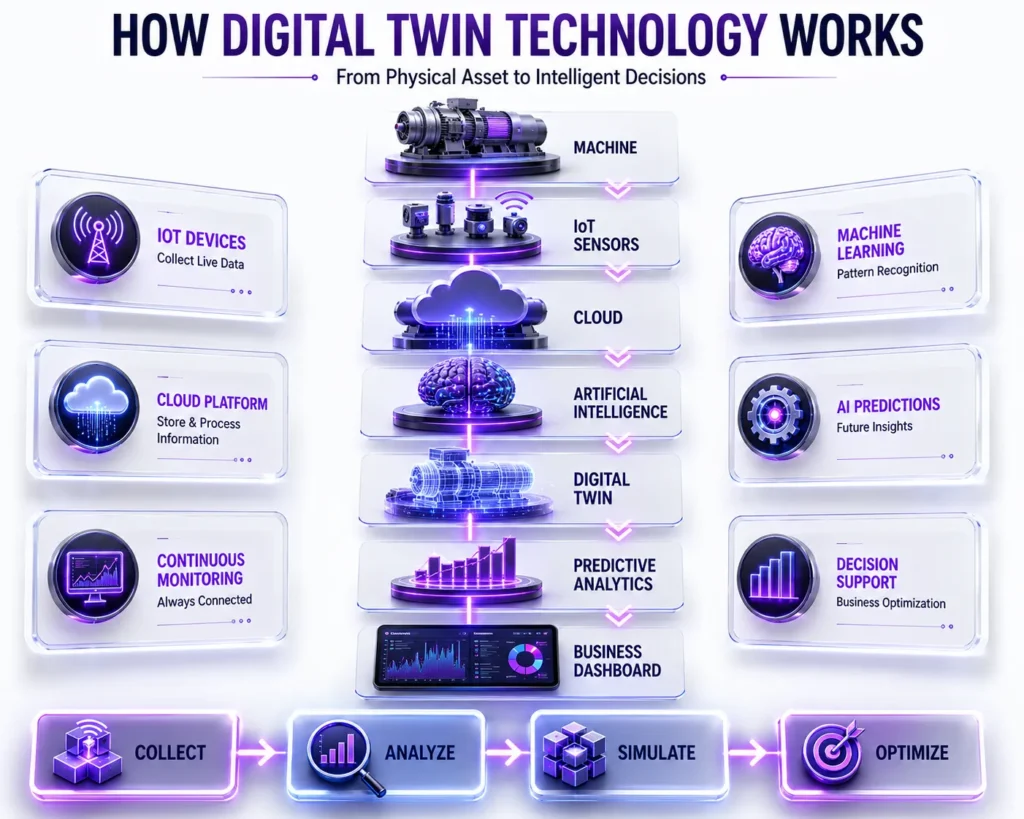
Understanding Digital Twin Technology becomes much easier when you look at how information flows between the physical and digital worlds. At its core, a digital twin is much more than a digital model it is a continuously connected system that learns, analyzes, and evolves using real-time information.
Unlike traditional software that relies on historical reports or manual updates, Digital Twin Technology creates a living digital replica that mirrors the condition and performance of its physical counterpart every second. This continuous synchronization enables organizations to monitor assets, predict failures, test improvements, and make proactive decisions with greater confidence.
Whether it’s a manufacturing machine, a wind turbine, a hospital device, a delivery fleet, or an entire smart city, the working principle remains the same.
Step 1: Collect Real-Time Data from Physical Assets
Everything begins with the physical object or system.
This could include:
- Manufacturing equipment
- Industrial robots
- Medical devices
- Vehicles
- Buildings
- Supply chain networks
- Power plants
- Smart city infrastructure
These assets are equipped with Internet of Things (IoT) sensors that continuously capture operational data.
Depending on the industry, sensors may monitor:
- Temperature
- Pressure
- Humidity
- Speed
- Energy consumption
- Vibration
- Location
- Performance metrics
- Equipment health
Instead of waiting for manual inspections, businesses receive continuous operational updates, creating complete visibility into asset performance.
Step 2: Transfer Data Through Cloud Computing
The collected information is securely transmitted to cloud computing platforms, where massive amounts of operational data can be stored, processed, and analyzed efficiently.
Cloud infrastructure enables organizations to:
- Manage large-scale connected systems.
- Access information from multiple locations.
- Scale operations as businesses grow.
- Integrate data across departments.
- Support enterprise-wide digital transformation.
Step 3: Create the Digital Twin
Once the information reaches the cloud, a virtual replica of the physical asset is created.
This digital model mirrors:
- Physical characteristics
- Operational status
- Environmental conditions
- Historical performance
- Current behavior
Unlike a static 3D model, the digital twin continuously updates itself whenever new information arrives from the physical system.
As a result, decision-makers always have an accurate, real-time view of what’s happening.
Step 4: Analyze Data Using AI and Machine Learning
This is where Artificial Intelligence (AI) and machine learning make Digital Twin Technology truly intelligent.
Instead of simply displaying operational data, AI analyzes it to identify patterns, detect anomalies, and forecast future outcomes.
Using predictive analytics, the system can:
- Predict equipment failures.
- Recommend preventive maintenance.
- Optimize production schedules.
- Detect operational inefficiencies.
- Simulate “what-if” scenarios.
- Improve resource allocation.
Over time, machine learning continuously improves prediction accuracy by learning from historical data and real-world outcomes.
This enables organizations to shift from reactive operations to proactive decision-making.
Step 5: Simulate Scenarios Before Taking Action
One of the biggest advantages of Digital Twin Technology is the ability to test decisions virtually before implementing them in the real world.
Businesses can simulate scenarios such as:
- Increasing production capacity.
- Changing factory layouts.
- Optimizing supply chain routes.
- Testing new product designs.
- Improving energy consumption.
- Planning maintenance schedules.
Because these simulations occur in the virtual environment, organizations can evaluate risks, compare outcomes, and select the most effective strategy without disrupting ongoing operations.
This significantly reduces both operational risk and implementation costs.
Step 6: Continuously Improve Operations
The process doesn’t stop after one analysis.
As new sensor data continues flowing into the system, the digital twin constantly updates itself.
This continuous feedback loop allows organizations to:
- Improve operational efficiency.
- Reduce equipment downtime.
- Enhance product quality.
- Increase workplace safety.
- Support continuous innovation.
- Make data-driven business decisions.
The more data the system receives, the more accurate and valuable its recommendations become.
How the Complete Process Works
The complete workflow of Digital Twin Technology can be summarized as follows:
Physical Asset → IoT Sensors → Cloud Computing → Digital Twin Model → Artificial Intelligence (AI) & Machine Learning → Predictive Analytics → Business Insights → Continuous Optimization
This connected ecosystem enables organizations to monitor, analyze, predict, and improve operations in real time.
Why This Process Is Transforming Digital Transformation
Traditional business systems often rely on historical reports and reactive decision-making. In contrast, Digital Twin Technology provides continuous visibility into operations, allowing businesses to anticipate problems before they occur and optimize performance as conditions change.
By integrating Internet of Things (IoT), Artificial Intelligence (AI), cloud computing, machine learning, and predictive analytics, organizations gain the ability to make faster, smarter, and more confident decisions. This is why Digital Twin Technology has become a critical enabler of Industry 4.0, helping businesses improve operational efficiency, accelerate innovation, reduce costs, and strengthen their competitive advantage in an increasingly data-driven world.
Key Takeaway
Digital Twin Technology works by connecting physical assets with intelligent digital models through IoT, cloud computing, Artificial Intelligence (AI), machine learning, and predictive analytics. This continuous flow of real-time data enables organizations to monitor performance, simulate future scenarios, predict potential issues, and optimize operations before problems occur. As businesses continue investing in digital transformation, Digital Twin Technology is becoming an essential foundation for building smarter, more resilient, and future-ready enterprises.
3. Why Digital Twin Technology Is Transforming Modern Businesses
Today’s businesses operate in an environment where speed, accuracy, and adaptability determine long-term success. Markets change rapidly, customer expectations continue to evolve, and organizations must respond to challenges faster than ever before. Traditional decision-making methods, which rely heavily on historical reports and manual inspections, are no longer sufficient.
This is why Digital Twin Technology is becoming a cornerstone of digital transformation. Instead of simply collecting operational data, organizations can now create intelligent digital environments that continuously monitor assets, simulate future scenarios, and provide actionable insights before problems occur.
The result is a shift from reactive management to proactive business innovation.
From Reactive Operations to Predictive Decision-Making
Many organizations still follow a reactive approach to operations. Equipment is repaired only after it fails, production issues are addressed after delays occur, and business decisions are often based on historical performance.
Digital Twin Technology changes this model entirely.
By combining Internet of Things (IoT) devices, Artificial Intelligence (AI), machine learning, and predictive analytics, digital twins continuously analyze real-time operational data. Instead of asking, “What went wrong?” businesses can ask:
- What is happening right now?
- What is likely to happen next?
- What actions should we take before a problem occurs?
This predictive approach allows organizations to reduce uncertainty and make more confident, data-driven decisions.
Enabling Smarter Business Decisions
Every business decision involves some level of risk. Whether launching a new product, modifying a manufacturing process, or expanding operations, organizations want to understand potential outcomes before making costly changes.
With Digital Twin Technology, companies can simulate different scenarios in a virtual environment before implementing them in the real world.
For example, businesses can:
- Test production changes without stopping operations.
- Optimize warehouse layouts before construction.
- Evaluate supply chain adjustments.
- Analyze the impact of equipment upgrades.
- Predict customer demand using real-time operational data.
Driving Operational Efficiency
Improving efficiency is one of the biggest reasons organizations invest in Digital Twin Technology.
Real-time monitoring enables businesses to identify inefficiencies that often remain hidden in traditional systems.
Organizations can continuously optimize:
- Manufacturing processes.
- Energy consumption.
- Equipment utilization.
- Workforce productivity.
- Inventory management.
- Supply chain performance.
Even small improvements across multiple operations can result in significant cost savings and higher productivity over time.
This continuous optimization is one of the defining characteristics of modern Industry 4.0 initiatives.
Supporting Continuous Innovation
Innovation often involves experimentation, but testing ideas directly in live environments can be expensive and disruptive.
Digital Twin Technology provides organizations with a safe virtual space where new ideas can be tested without affecting day-to-day operations.
Businesses can:
- Validate product designs.
- Experiment with new workflows.
- Improve production processes.
- Optimize customer experiences.
- Test automation strategies.
- Evaluate sustainability initiatives.
This ability to innovate without operational risk allows organizations to accelerate product development while reducing costs and implementation time.
Improving Customer Experiences
While Digital Twin Technology is often associated with industrial operations, its impact extends far beyond factories.
By analyzing real-world performance and customer behavior, organizations can continuously improve products and services.
Examples include:
- Delivering more reliable products.
- Reducing service interruptions.
- Personalizing customer experiences.
- Improving delivery performance.
- Enhancing product quality.
- Responding faster to customer needs.
These improvements strengthen customer trust while increasing long-term satisfaction and loyalty.
Building the Foundation for Intelligent Enterprises
Modern enterprises are increasingly integrating Artificial Intelligence (AI), Internet of Things (IoT), cloud computing, and machine learning into their operations.
Digital Twin Technology acts as the central intelligence layer that connects these technologies into a unified ecosystem.
Instead of operating in isolated systems, organizations gain a comprehensive, real-time view of their entire business.
This connected approach enables:
- Better collaboration across departments.
- Faster access to operational insights.
- Improved strategic planning.
- More accurate forecasting.
- Smarter resource allocation.
- Scalable digital transformation initiatives.
As businesses continue embracing intelligent technologies, digital twins are becoming a critical component of enterprise innovation.
Why Businesses Are Investing in Digital Twins
Organizations across industries recognize that data alone does not create value. The real advantage comes from transforming that data into meaningful actions.
Businesses invest in Digital Twin Technology because it helps them:
- Improve operational efficiency.
- Strengthen predictive analytics capabilities.
- Reduce maintenance and operational costs.
- Accelerate innovation.
- Increase productivity.
- Support sustainability initiatives.
- Enhance customer satisfaction.
- Make faster, more informed decisions.
These benefits allow organizations to remain competitive in an increasingly connected and data-driven economy.
Key Takeaway
Digital Twin Technology is transforming modern businesses by enabling intelligent, proactive decision-making powered by Artificial Intelligence (AI), Internet of Things (IoT), cloud computing, machine learning, and predictive analytics. Rather than reacting to operational challenges, organizations can monitor systems in real time, simulate future scenarios, optimize performance, and drive continuous innovation. As digital transformation accelerates across industries, Digital Twin Technology is becoming a strategic investment for businesses seeking greater efficiency, resilience, and long-term growth.
4. Key Benefits of Digital Twin Technology
The growing adoption of Digital Twin Technology is driven by one simple fact it delivers measurable business value. Organizations are no longer looking for technologies that only collect data; they need solutions that transform real-time information into smarter decisions, greater efficiency, and long-term competitive advantages.
By combining Artificial Intelligence (AI), Internet of Things (IoT), cloud computing, machine learning, and predictive analytics, Digital Twin Technology helps businesses optimize operations while reducing risks and improving innovation.
Below are the most significant benefits organizations gain from implementing Digital Twin Technology.

1. Real-Time Monitoring and Visibility
One of the biggest advantages of Digital Twin Technology is continuous visibility into physical assets and operations.
Instead of relying on periodic inspections or delayed reports, businesses receive live updates about equipment, systems, and processes.
Organizations can monitor:
- Equipment health
- Production performance
- Environmental conditions
- Energy usage
- Asset utilization
- Supply chain activities
This real-time visibility allows teams to identify abnormalities immediately, respond faster to operational changes, and make informed decisions based on current conditions rather than outdated information.
For industries where downtime is expensive, real-time monitoring significantly improves operational control.
2. Predictive Maintenance Reduces Downtime
Unexpected equipment failures can lead to costly production delays, emergency repairs, and customer dissatisfaction.
Digital Twin Technology minimizes these risks through predictive maintenance.
Using Artificial Intelligence (AI) and predictive analytics, digital twins continuously analyze equipment behavior to detect early warning signs before failures occur.
Instead of replacing components on fixed schedules or waiting for breakdowns, organizations can:
- Schedule maintenance only when needed.
- Prevent unexpected failures.
- Extend equipment lifespan.
- Reduce maintenance costs.
- Improve operational reliability.
This proactive maintenance strategy increases productivity while minimizing business disruptions.
3. Smarter Decision-Making Through Data
Modern organizations generate enormous volumes of operational data every day. However, data alone has little value unless it can support better business decisions.
Digital Twin Technology transforms raw information into actionable insights by combining machine learning, Artificial Intelligence (AI), and real-time data analysis.
Decision-makers can:
- Evaluate business performance.
- Compare multiple operational scenarios.
- Identify process inefficiencies.
- Forecast future outcomes.
- Optimize resource allocation.
This enables leaders to make faster, evidence-based decisions instead of relying on assumptions or historical reports.
4. Faster Innovation Without Operational Risk
Innovation often requires testing new ideas, processes, or product designs. Conducting experiments in live environments can be expensive and risky.
With Digital Twin Technology, businesses can safely simulate changes in a virtual environment before implementing them.
Organizations can test:
- New manufacturing processes.
- Product designs.
- Factory layouts.
- Supply chain improvements.
- Automation strategies.
- Energy optimization initiatives.
Because these simulations happen digitally, companies reduce implementation risks while accelerating innovation and shortening product development cycles.
5. Improved Operational Efficiency
Every organization seeks opportunities to improve productivity while reducing unnecessary costs.
Digital Twin Technology continuously analyzes operations to identify areas for optimization.
Businesses can improve:
- Production efficiency.
- Equipment utilization.
- Workforce productivity.
- Inventory management.
- Resource allocation.
- Process automation.
Small operational improvements across multiple departments often generate substantial long-term savings while increasing overall business performance.
6. Better Product Quality
Quality issues frequently originate from manufacturing inconsistencies or unnoticed process variations.
With continuous monitoring and analysis, Digital Twin Technology helps organizations detect quality-related problems before they affect customers.
Manufacturers can:
- Identify production deviations.
- Maintain consistent quality standards.
- Improve product reliability.
- Reduce defects.
- Minimize waste.
Higher product quality strengthens customer trust while reducing warranty claims and operational losses.
7. Cost Optimization Across Operations
One of the most compelling reasons businesses invest in Digital Twin Technology is its ability to reduce operational costs.
Organizations save money by:
- Preventing costly equipment failures.
- Reducing maintenance expenses.
- Optimizing energy consumption.
- Improving resource utilization.
- Minimizing production waste.
- Increasing process efficiency.
Instead of making expensive decisions based on assumptions, businesses rely on data-driven insights to optimize investments and operational strategies.
8. Enhanced Sustainability and Energy Efficiency
Sustainability has become a strategic priority for organizations across industries.
Digital Twin Technology supports environmental initiatives by helping businesses monitor and optimize resource consumption.
Companies can:
- Track energy usage.
- Reduce emissions.
- Optimize utility consumption.
- Improve asset efficiency.
- Minimize material waste.
- Support sustainable manufacturing.
These improvements not only lower operational costs but also help organizations achieve their environmental and sustainability goals.
9. Stronger Risk Management
Operational risks can arise from equipment failures, process inefficiencies, supply chain disruptions, or unexpected environmental changes.
Because Digital Twin Technology continuously analyzes live operational data, organizations can identify potential risks before they become major problems.
Businesses gain the ability to:
- Detect anomalies early.
- Evaluate potential failures.
- Simulate emergency scenarios.
- Improve disaster preparedness.
- Reduce business interruptions.
This proactive approach improves resilience and business continuity.
10. Accelerating Digital Transformation
Perhaps the greatest benefit of Digital Twin Technology is its ability to bring together multiple advanced technologies into one intelligent ecosystem.
By integrating Internet of Things (IoT), Artificial Intelligence (AI), cloud computing, machine learning, and predictive analytics, digital twins enable organizations to build connected, data-driven operations.
As a result, businesses can:
- Modernize legacy systems.
- Improve enterprise-wide visibility.
- Enable intelligent automation.
- Increase organizational agility.
- Scale innovation more efficiently.
This makes Digital Twin Technology one of the most important technologies driving modern digital transformation initiatives.
Key Takeaway
The true value of Digital Twin Technology lies in its ability to transform real-time operational data into intelligent business decisions. From predictive maintenance and operational efficiency to predictive analytics, innovation, sustainability, and smarter decision-making, digital twins provide organizations with the insights they need to stay competitive in a rapidly evolving digital economy. As businesses continue investing in Industry 4.0, Artificial Intelligence (AI), and Internet of Things (IoT), Digital Twin Technology will remain a key driver of innovation, resilience, and long-term business growth.
5. Top Applications of Digital Twin Technology Across Industries
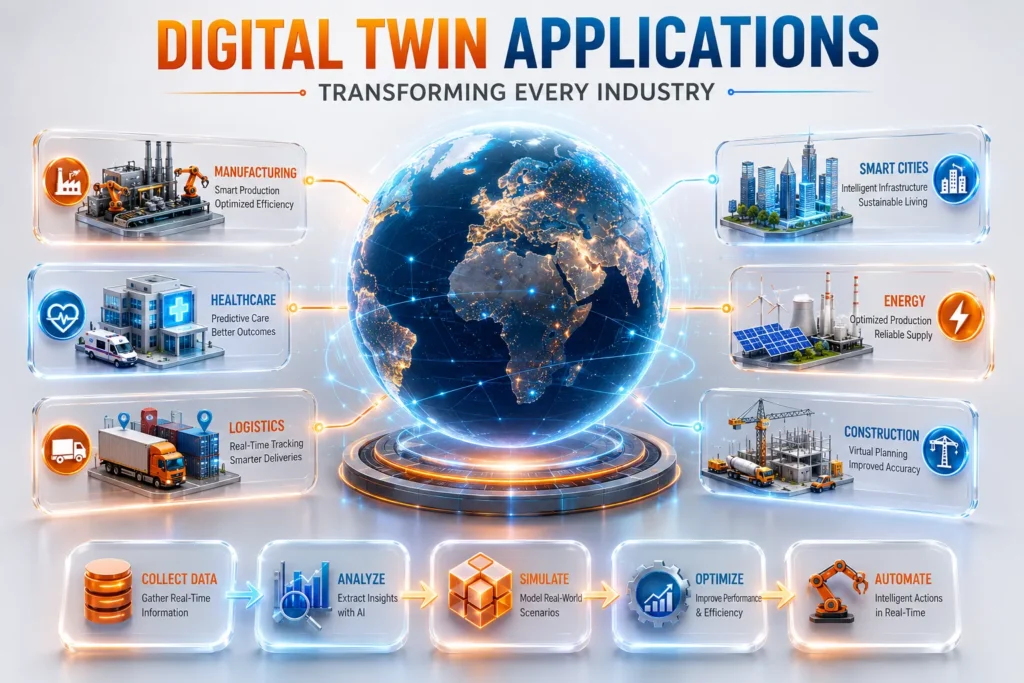
The true strength of Digital Twin Technology lies in its versatility. While it first gained attention in manufacturing and engineering, its applications have expanded rapidly across almost every industry. From improving factory operations to enhancing patient care and building smarter cities, organizations are using digital twins to make better decisions, reduce operational risks, and drive continuous innovation.
By integrating Artificial Intelligence (AI), Internet of Things (IoT), cloud computing, machine learning, and predictive analytics, Digital Twin Technology enables businesses to create intelligent ecosystems that continuously learn from real-world data and optimize performance.
Let’s explore how different industries are leveraging Digital Twin Technology to accelerate digital transformation.
1. Manufacturing
Manufacturing remains one of the largest adopters of Digital Twin Technology.
Modern factories generate enormous amounts of operational data every second. Digital twins allow manufacturers to monitor production lines, equipment, and processes in real time while identifying opportunities to improve efficiency.
Manufacturers use Digital Twin Technology to:
- Monitor production equipment continuously.
- Enable predictive maintenance.
- Reduce machine downtime.
- Improve product quality.
- Optimize factory layouts.
- Increase production efficiency.
- Reduce operational costs.
Instead of reacting to equipment failures, manufacturers can predict potential issues and resolve them before they interrupt production.
This is one of the key reasons Digital Twin Technology has become a foundational component of Industry 4.0.
2. Healthcare
Healthcare organizations are increasingly adopting Digital Twin Technology to improve patient outcomes and optimize hospital operations.
Digital twins can create virtual models of:
- Medical devices
- Hospital equipment
- Healthcare facilities
- Patient treatment processes
In advanced healthcare environments, Artificial Intelligence (AI) analyzes patient data alongside digital twins to support better treatment planning and operational efficiency.
Healthcare providers benefit through:
- Improved equipment reliability.
- Better resource allocation.
- Optimized hospital workflows.
- Personalized treatment planning.
- Enhanced patient experiences.
As healthcare continues embracing digital transformation, digital twins are becoming valuable tools for delivering safer and more efficient care.
3. Smart Cities
Cities around the world are becoming more connected through Internet of Things (IoT) infrastructure.
Using Digital Twin Technology, city planners can create virtual replicas of entire urban environments.
These digital models help manage:
- Traffic flow.
- Public transportation.
- Energy consumption.
- Water distribution.
- Waste management.
- Emergency response.
- Infrastructure maintenance.
Real-time monitoring enables city authorities to improve public services while making more informed urban planning decisions.
The result is greater operational efficiency and an improved quality of life for citizens.
4. Logistics and Supply Chain
Supply chain disruptions can significantly impact business performance.
With Digital Twin Technology, logistics companies gain real-time visibility into every stage of the supply chain.
Organizations can monitor:
- Warehouse operations.
- Inventory levels.
- Delivery routes.
- Fleet performance.
- Shipment tracking.
- Transportation efficiency.
Using predictive analytics, businesses can anticipate delays, optimize delivery schedules, and improve inventory management before disruptions occur.
This leads to:
- Faster deliveries.
- Lower transportation costs.
- Better customer satisfaction.
- More resilient supply chains.
5. Automotive Industry
The automotive sector relies heavily on Digital Twin Technology throughout the product lifecycle.
Manufacturers create digital twins of vehicles, production facilities, and manufacturing equipment to improve both design and operational efficiency.
Applications include:
- Vehicle performance testing.
- Production line optimization.
- Predictive maintenance.
- Quality assurance.
- Product design validation.
- Electric vehicle development.
Instead of relying solely on physical testing, engineers can simulate thousands of scenarios digitally, reducing development time and costs.
6. Energy and Utilities
Power generation and utility companies manage complex infrastructure where equipment failures can have serious consequences.
Digital Twin Technology enables organizations to monitor critical assets such as:
- Power plants.
- Wind turbines.
- Solar farms.
- Electrical grids.
- Water treatment facilities.
- Oil and gas infrastructure.
Using Artificial Intelligence (AI) and machine learning, operators can detect performance issues early, optimize energy production, and improve infrastructure reliability.
This supports both operational efficiency and long-term sustainability initiatives.
7. Construction and Infrastructure
Construction projects involve numerous variables, including budgets, schedules, materials, equipment, and workforce coordination.
Digital Twin Technology allows project teams to create virtual models of buildings and infrastructure before construction begins.
Organizations use digital twins to:
- Simulate construction processes.
- Monitor project progress.
- Improve resource planning.
- Identify design conflicts.
- Optimize building performance.
- Support long-term facility management.
Even after construction is complete, digital twins continue helping facility managers maintain buildings more efficiently throughout their lifecycle.
Why Every Industry Is Investing in Digital Twin Technology
Although industries differ, the business objectives remain remarkably similar.
Organizations across sectors want to:
- Improve operational efficiency.
- Reduce downtime.
- Increase productivity.
- Lower operational costs.
- Improve customer experiences.
- Strengthen predictive analytics.
- Accelerate innovation.
- Make data-driven decisions.
By combining Artificial Intelligence (AI), Internet of Things (IoT), cloud computing, and machine learning, Digital Twin Technology provides a scalable solution that adapts to virtually any business environment.
As connected technologies continue evolving, digital twins are becoming a strategic investment for organizations seeking long-term growth and competitive advantage.
Key Takeaway
The applications of Digital Twin Technology extend far beyond manufacturing. Industries including healthcare, logistics, automotive, energy, construction, and smart cities are using digital twins to improve operational efficiency, enhance predictive maintenance, optimize resources, and accelerate digital transformation. As organizations continue embracing Industry 4.0, Artificial Intelligence (AI), Internet of Things (IoT), and cloud computing, Digital Twin Technology will play an increasingly important role in building intelligent, connected, and future-ready businesses.
6. Digital Twin Technology vs Traditional Simulation: What’s the Difference?
Many people assume that Digital Twin Technology is simply another form of computer simulation. While both technologies create virtual models, they serve very different purposes. Traditional simulations provide a snapshot of how a product or system might behave under predefined conditions, whereas Digital Twin Technology creates a living, continuously updated digital replica that evolves alongside its real-world counterpart.
Understanding this difference helps organizations choose the right technology for their digital transformation initiatives and unlock greater business value.
What Is Traditional Simulation?
Traditional simulation has been used for decades in engineering, manufacturing, and product development. It creates a virtual model to test specific scenarios before building or modifying a physical object.
For example, an automotive company may simulate how a new vehicle design performs during a crash test or how airflow affects fuel efficiency. Once the simulation is complete, the results remain static until a new simulation is run.
Traditional simulations are excellent for:
- Product design validation.
- Engineering calculations.
- Testing specific scenarios.
- Performance analysis before production.
- Research and development.
However, they rely on predefined assumptions and historical inputs rather than continuously updating with real-world information.
What Makes Digital Twin Technology Different?
Digital Twin Technology goes far beyond simulation by maintaining a continuous connection between the physical asset and its virtual counterpart.
Using Internet of Things (IoT) sensors, cloud computing, Artificial Intelligence (AI), and machine learning, the digital twin receives real-time operational data and automatically updates itself.
This allows organizations to:
- Monitor live performance.
- Detect anomalies instantly.
- Predict future failures.
- Optimize operations continuously.
- Simulate future scenarios using current data.
Unlike traditional simulations, Digital Twin Technology never becomes outdated because it evolves as the physical system changes.
Traditional Simulation vs Digital Twin Technology
| Feature | Traditional Simulation | Digital Twin Technology |
|---|---|---|
| Data Source | Historical or predefined data | Real-time data from IoT sensors |
| Updates | Static after completion | Continuously updates automatically |
| Purpose | Test individual scenarios | Monitor, analyze, predict, and optimize continuously |
| AI Integration | Limited | Extensive use of Artificial Intelligence (AI) and machine learning |
| Predictive Capabilities | Scenario-based | Continuous predictive analytics |
| Real-Time Monitoring | No | Yes |
| Business Value | Product testing | Operational intelligence and business optimization |
Why Businesses Prefer Digital Twin Technology
As businesses become increasingly connected, static simulations are often no longer enough.
Organizations need technology that can:
- Adapt to changing operating conditions.
- Provide continuous operational insights.
- Support faster decision-making.
- Improve operational efficiency.
- Reduce maintenance costs.
- Enable predictive maintenance.
- Accelerate innovation.
Digital Twin Technology delivers these capabilities by combining live operational data with intelligent analytics.
For example, imagine a logistics company managing hundreds of delivery vehicles.
A traditional simulation can estimate fuel consumption based on planned routes.
A digital twin, however, continuously monitors:
- Vehicle location.
- Fuel efficiency.
- Driver behavior.
- Traffic conditions.
- Weather changes.
- Maintenance requirements.
The system can then recommend route adjustments, schedule maintenance, and predict delivery delays in real time.
This level of intelligence is simply not possible with conventional simulations.
When Should Businesses Use Each Technology?
Both technologies remain valuable, but they solve different business challenges.
Traditional simulation is best suited for:
- Product design.
- Engineering analysis.
- Prototype testing.
- Research projects.
- One-time performance evaluations.
Digital Twin Technology is ideal for:
- Continuous asset monitoring.
- Smart manufacturing.
- Predictive maintenance.
- Supply chain optimization.
- Smart city management.
- Healthcare operations.
- Industrial automation.
- Enterprise digital transformation.
Many organizations actually combine both approaches, using simulations during product development and digital twins after deployment to monitor real-world performance.
The Future Is Intelligent, Connected Systems
As Industry 4.0 continues to evolve, organizations are moving beyond isolated simulations toward intelligent ecosystems powered by Digital Twin Technology.
By integrating Artificial Intelligence (AI), Internet of Things (IoT), cloud computing, and predictive analytics, businesses gain continuous visibility into their operations while making smarter, faster, and more proactive decisions.
Rather than simply predicting what might happen, digital twins help organizations understand what is happening now, what is likely to happen next, and how to achieve the best possible outcome.
Key Takeaway
While traditional simulation remains valuable for testing designs and analyzing specific scenarios, Digital Twin Technology offers a far more advanced approach by connecting virtual models with real-time operational data. Powered by Artificial Intelligence (AI), Internet of Things (IoT), machine learning, cloud computing, and predictive analytics, digital twins enable organizations to monitor performance, optimize operations, predict future outcomes, and support continuous digital transformation. This makes Digital Twin Technology an essential capability for businesses building intelligent, data-driven, and future-ready operations.
7. Challenges of Implementing Digital Twin Technology
While Digital Twin Technology offers significant advantages, successful implementation requires careful planning, the right technology infrastructure, and a clear business strategy. Like any advanced digital solution, organizations may face technical, operational, and organizational challenges during adoption.
Understanding these challenges helps businesses prepare effectively and maximize the return on their digital transformation investments. With the right approach, most of these obstacles can be overcome, allowing organizations to fully benefit from intelligent, data-driven operations.
1. Managing Large Volumes of Real-Time Data
One of the biggest challenges of Digital Twin Technology is handling enormous amounts of real-time information.
A single manufacturing plant, logistics network, or smart city can generate millions of data points every day through Internet of Things (IoT) sensors.
Organizations must ensure they have the infrastructure to:
- Collect data accurately.
- Process information quickly.
- Store large datasets securely.
- Analyze data efficiently.
- Maintain consistent data quality.
Without reliable data management, even the most advanced digital twin cannot deliver accurate insights.
This is why scalable cloud computing platforms are essential for successful implementation.
2. Integrating Legacy Systems
Many businesses still rely on older software, machinery, and operational systems that were never designed to communicate with modern digital technologies.
Integrating these legacy systems with Digital Twin Technology can be complex.
Organizations often need to connect:
- ERP systems
- Manufacturing equipment
- CRM platforms
- Supply chain software
- Industrial control systems
- Enterprise databases
Building seamless communication between old and new technologies requires careful planning and experienced technology partners.
Fortunately, modern APIs, middleware solutions, and cloud platforms make integration much easier than it was a few years ago.
3. Cybersecurity and Data Privacy
Because Digital Twin Technology continuously exchanges operational data between physical assets and digital environments, cybersecurity becomes a top priority.
Businesses must protect sensitive information from:
- Unauthorized access.
- Cyberattacks.
- Data breaches.
- Network vulnerabilities.
- System manipulation.
Strong cybersecurity strategies should include:
- End-to-end encryption.
- Multi-factor authentication.
- Secure cloud infrastructure.
- Continuous monitoring.
- Regular security audits.
Protecting connected systems is critical for maintaining trust and ensuring business continuity.
4. High Initial Investment
Implementing Digital Twin Technology often requires an upfront investment in technology, infrastructure, and skilled professionals.
Organizations may need to invest in:
- Internet of Things (IoT) sensors.
- Cloud infrastructure.
- Software platforms.
- Network upgrades.
- AI-powered analytics tools.
- Employee training.
For small and medium-sized businesses, these initial costs may appear significant.
However, when organizations consider long-term benefits such as reduced downtime, lower maintenance costs, improved operational efficiency, and increased productivity, the return on investment often outweighs the initial expenditure.
5. Shortage of Skilled Professionals
Building and managing digital twin ecosystems requires expertise across multiple technologies.
Organizations need professionals with knowledge of:
- Artificial Intelligence (AI)
- Machine learning
- Internet of Things (IoT)
- Cloud computing
- Data analytics
- Software engineering
- Industrial automation
- Cybersecurity
Finding experienced talent can be challenging as demand for digital transformation specialists continues to grow.
Many businesses address this challenge by partnering with experienced technology providers who can design, implement, and manage digital twin solutions.
6. Ensuring Data Accuracy
The effectiveness of Digital Twin Technology depends entirely on the quality of the data it receives.
If sensor data is incomplete, inaccurate, or delayed, the digital twin may generate misleading insights.
Organizations should establish strong data governance practices, including:
- Regular sensor calibration.
- Automated data validation.
- Continuous monitoring.
- Standardized data collection processes.
- Routine system maintenance.
Accurate data ensures reliable predictive analytics and supports better business decisions.
7. Scaling Across the Organization
Many companies begin with a single pilot project before expanding Digital Twin Technology across multiple departments or business units.
Scaling successfully requires organizations to consider:
- Infrastructure capacity.
- System interoperability.
- Employee adoption.
- Process standardization.
- Change management.
Without a clear roadmap, businesses may struggle to maintain consistency as digital twin implementations grow.
A phased implementation strategy often delivers better long-term results while minimizing operational disruptions.
Turning Challenges into Opportunities
Although these challenges are real, they should not discourage organizations from adopting Digital Twin Technology.
Successful businesses focus on building a strong foundation by:
- Defining clear business objectives.
- Investing in scalable cloud computing infrastructure.
- Leveraging Artificial Intelligence (AI) and Internet of Things (IoT) effectively.
- Prioritizing cybersecurity.
- Working with experienced digital transformation partners.
- Training employees on new technologies.
When these best practices are followed, organizations can overcome implementation challenges and unlock the full value of intelligent digital ecosystems.
Key Takeaway
Implementing Digital Twin Technology requires careful planning, secure infrastructure, quality data, and the right technical expertise. Challenges such as data integration, cybersecurity, legacy systems, scalability, and workforce skills are common, but they are manageable with a strategic approach. By combining Artificial Intelligence (AI), Internet of Things (IoT), cloud computing, machine learning, and strong governance, businesses can successfully adopt Digital Twin Technology and accelerate their digital transformation journey with confidence.
8. Best Practices for Successful Digital Twin Technology Adoption
Adopting Digital Twin Technology is not simply about implementing new software it requires a well-defined strategy that aligns technology, business goals, and organizational processes. Companies that achieve the greatest success focus on creating a scalable foundation that supports continuous innovation rather than treating digital twins as standalone projects.
By combining Artificial Intelligence (AI), Internet of Things (IoT), cloud computing, machine learning, and predictive analytics, businesses can maximize the value of Digital Twin Technology while minimizing implementation risks.
Below are the best practices organizations should follow to ensure a successful adoption journey.
1. Define Clear Business Objectives
Before investing in Digital Twin Technology, organizations should identify the specific business problems they want to solve.
Common objectives include:
- Reducing equipment downtime.
- Improving operational efficiency.
- Enhancing predictive maintenance.
- Optimizing energy consumption.
- Increasing product quality.
- Improving customer experiences.
- Accelerating digital transformation.
Clearly defined goals help organizations prioritize investments, measure success, and ensure that the digital twin delivers measurable business value.
2. Start with a Pilot Project
Implementing Digital Twin Technology across an entire enterprise at once can be complex.
A better approach is to begin with a focused pilot project.
For example, businesses may initially create a digital twin for:
- A single production line.
- One manufacturing machine.
- A warehouse operation.
- A logistics fleet.
- A critical business process.
Pilot implementations allow organizations to validate performance, identify challenges, and refine their strategy before expanding the solution across multiple departments.
This phased approach reduces implementation risk while building internal confidence.
3. Invest in High-Quality Data
A digital twin is only as effective as the data it receives.
Organizations should establish strong data management practices to ensure information remains:
- Accurate.
- Complete.
- Consistent.
- Timely.
- Secure.
Reliable Internet of Things (IoT) sensors, standardized data collection methods, and continuous monitoring all contribute to higher-quality insights.
Accurate data also improves the performance of Artificial Intelligence (AI), machine learning, and predictive analytics, resulting in more reliable recommendations and business decisions.
4. Build a Scalable Cloud Infrastructure
As organizations grow, the amount of connected data generated by digital twins increases rapidly.
A scalable cloud computing platform provides the flexibility needed to:
- Store large volumes of operational data.
- Process information in real time.
- Support enterprise-wide collaboration.
- Integrate multiple business systems.
- Expand digital twin capabilities as operations grow.
Cloud infrastructure also enables teams to access critical business insights from anywhere while supporting long-term digital transformation initiatives.
5. Integrate AI and IoT from the Beginning
The full potential of Digital Twin Technology is realized when it works alongside Artificial Intelligence (AI) and Internet of Things (IoT).
Rather than treating these technologies separately, businesses should design connected ecosystems where:
- IoT devices continuously collect operational data.
- AI identifies patterns and anomalies.
- Machine learning improves prediction accuracy over time.
- Predictive analytics supports proactive decision-making.
This integrated approach creates intelligent systems that continuously learn and improve.
6. Prioritize Cybersecurity and Data Privacy
Since Digital Twin Technology relies on connected devices and continuous data exchange, cybersecurity should be embedded into every stage of implementation.
Organizations should adopt security measures such as:
- Data encryption.
- Secure cloud environments.
- Multi-factor authentication.
- Role-based access controls.
- Continuous security monitoring.
- Regular vulnerability assessments.
Protecting digital assets ensures business continuity while maintaining customer trust and regulatory compliance.
7. Encourage Cross-Functional Collaboration
Successful digital twin initiatives involve more than just IT teams.
Organizations should encourage collaboration between:
- Business leaders.
- Engineers.
- Operations managers.
- Data analysts.
- Software developers.
- Cybersecurity specialists.
- Maintenance teams.
Cross-functional collaboration ensures that digital twin solutions address real business challenges while supporting organization-wide innovation.
8. Continuously Monitor and Improve
Implementing Digital Twin Technology is not a one-time project it is an ongoing process of optimization.
Organizations should regularly evaluate:
- System performance.
- Data accuracy.
- Business outcomes.
- User adoption.
- Operational improvements.
- Return on investment (ROI).
Continuous improvement allows businesses to refine digital models, enhance predictions, and unlock additional value as technologies evolve.
Why Strategic Adoption Matters
Organizations that approach Digital Twin Technology strategically often achieve better outcomes than those focused solely on technology implementation.
A successful adoption strategy helps businesses:
- Improve operational efficiency.
- Strengthen predictive analytics.
- Reduce implementation risks.
- Increase scalability.
- Accelerate innovation.
- Maximize return on investment.
- Build intelligent, future-ready operations.
As Industry 4.0 continues to reshape global industries, businesses that combine Artificial Intelligence (AI), Internet of Things (IoT), cloud computing, and Digital Twin Technology will be better positioned to adapt, innovate, and compete in an increasingly connected world.
Key Takeaway
Successful adoption of Digital Twin Technology requires more than advanced technology it demands a clear strategy, high-quality data, scalable cloud computing, strong cybersecurity, and seamless integration with Artificial Intelligence (AI), Internet of Things (IoT), machine learning, and predictive analytics. By following these best practices, organizations can reduce implementation risks, improve operational efficiency, accelerate digital transformation, and build intelligent systems that continue delivering value well into the future.
Businesses looking to modernize operations often benefit from working with an experienced software development company that understands emerging technologies and enterprise digital transformation.
9. Future Trends in Digital Twin Technology
As businesses continue investing in digital transformation, Digital Twin Technology is evolving far beyond monitoring physical assets. The next generation of digital twins will become more intelligent, autonomous, and deeply integrated with emerging technologies such as Artificial Intelligence (AI), Internet of Things (IoT), cloud computing, machine learning, and advanced predictive analytics.
Organizations are no longer viewing digital twins as optional innovation projects. Instead, they are becoming a strategic foundation for building intelligent enterprises that can anticipate change, automate decisions, and continuously optimize operations.
Let’s explore the major trends shaping the future of Digital Twin Technology.

1. AI-Powered Digital Twins
One of the most significant advancements is the integration of Artificial Intelligence (AI) into Digital Twin Technology.
While today’s digital twins already analyze real-time data, AI-powered digital twins will go even further by making intelligent recommendations, identifying hidden patterns, and automatically optimizing business operations.
Future capabilities include:
- Automated decision-making.
- Self-learning operational models.
- Intelligent process optimization.
- Real-time anomaly detection.
- Advanced predictive forecasting.
- Personalized business recommendations.
As machine learning algorithms continue improving, digital twins will become increasingly accurate and capable of supporting complex business decisions with minimal human intervention.
2. Smarter Industry 4.0 Ecosystems
The future of Industry 4.0 depends on seamless connectivity between machines, software, and intelligent systems.
Digital Twin Technology will play a central role by connecting:
- Smart factories.
- Industrial robots.
- Automated production lines.
- Enterprise software.
- Supply chain systems.
- IoT-enabled devices.
Instead of isolated operations, organizations will manage interconnected ecosystems where every asset communicates continuously.
This level of connectivity enables businesses to improve productivity, reduce operational costs, and respond instantly to changing market conditions.
3. Expansion into Smart Cities
Urban populations continue growing, increasing pressure on transportation, utilities, healthcare, and public infrastructure.
Governments are increasingly adopting Digital Twin Technology to create intelligent digital replicas of entire cities.
Future smart city applications include:
- Traffic optimization.
- Public transportation management.
- Energy distribution.
- Water management.
- Disaster response planning.
- Infrastructure maintenance.
- Environmental monitoring.
By combining Internet of Things (IoT) data with Artificial Intelligence (AI), city planners can improve resource utilization while creating safer and more sustainable urban environments.
4. Sustainable Business Operations
Sustainability is becoming a business priority across every industry.
Organizations are using Digital Twin Technology to better understand how resources are consumed and identify opportunities to reduce environmental impact.
Future digital twins will help businesses:
- Lower energy consumption.
- Reduce carbon emissions.
- Minimize production waste.
- Optimize resource utilization.
- Improve environmental compliance.
- Support ESG initiatives.
These capabilities allow organizations to balance operational efficiency with long-term sustainability goals.
5. Hyper-Personalized Customer Experiences
Although digital twins are commonly associated with industrial applications, they are increasingly influencing customer-focused industries.
Businesses will use Digital Twin Technology to better understand customer behavior and continuously improve products and services.
Potential applications include:
- Personalized healthcare treatments.
- Customized retail experiences.
- Intelligent banking services.
- Connected vehicles.
- Smart homes.
- Personalized travel experiences.
By combining customer insights with predictive analytics, organizations can deliver more relevant, efficient, and engaging experiences.
6. Industrial Metaverse Integration
The concept of the Industrial Metaverse is rapidly gaining attention.
This emerging environment combines immersive digital experiences with real-time operational intelligence.
Within the Industrial Metaverse, Digital Twin Technology will allow engineers, managers, and technicians to:
- Visualize entire factories in 3D.
- Collaborate remotely.
- Monitor live production.
- Simulate operational changes.
- Train employees using virtual environments.
- Resolve issues before they occur.
This immersive approach improves collaboration while accelerating innovation across global organizations.
7. Autonomous Business Operations
As Artificial Intelligence (AI) continues advancing, digital twins will move beyond providing recommendations toward executing automated actions.
Future systems may automatically:
- Adjust production schedules.
- Optimize energy consumption.
- Schedule maintenance.
- Rebalance supply chains.
- Allocate resources.
- Respond to operational anomalies.
This evolution will transform organizations from reactive businesses into highly adaptive, self-optimizing enterprises.
Why the Future Looks Promising
The rapid evolution of Digital Twin Technology is creating new opportunities for businesses across every industry.
Organizations that embrace these innovations will benefit from:
- Better operational efficiency.
- Faster innovation cycles.
- Smarter predictive analytics.
- More accurate forecasting.
- Improved customer experiences.
- Stronger competitive advantage.
- Sustainable business growth.
As the technologies supporting digital twins continue to mature, businesses will gain access to increasingly intelligent systems capable of learning, adapting, and optimizing operations continuously.
How CrossShores Infotech Helps Businesses Embrace Intelligent Technologies
At CrossShores Infotech, we help organizations navigate the future of digital transformation by building intelligent software solutions powered by Artificial Intelligence (AI), Internet of Things (IoT), cloud computing, and modern enterprise technologies.
Whether businesses are looking to modernize operations, develop smart enterprise applications, integrate connected systems, or explore the potential of Digital Twin Technology, our team delivers scalable, secure, and future-ready digital solutions tailored to evolving business needs.
By combining technology expertise with innovation-driven strategies, CrossShores Infotech enables organizations to accelerate growth, improve efficiency, and build intelligent digital ecosystems that are ready for tomorrow.
Key Takeaway
The future of Digital Twin Technology extends far beyond virtual models. Powered by Artificial Intelligence (AI), Internet of Things (IoT), machine learning, cloud computing, and predictive analytics, digital twins are evolving into intelligent systems capable of optimizing operations, supporting autonomous decision-making, and driving sustainable innovation. As businesses continue embracing Industry 4.0 and digital transformation, Digital Twin Technology will remain one of the most influential technologies shaping the future of enterprise operations and connected digital ecosystems.
10. Frequently Asked Questions About Digital Twin Technology
As Digital Twin Technology becomes more popular across industries, many business leaders and technology professionals have similar questions about how it works, where it can be applied, and why it matters. Below are answers to some of the most common questions users search for online. This FAQ section is optimized to address user intent while improving the article’s visibility in search engines and AI-powered search results.
1. What is Digital Twin Technology in simple words?
Digital Twin Technology is a virtual replica of a physical object, machine, process, or system that continuously receives real-time data from its physical counterpart. By combining Internet of Things (IoT), Artificial Intelligence (AI), cloud computing, and predictive analytics, it helps organizations monitor performance, simulate different scenarios, predict potential issues, and optimize operations before problems occur.
2. How does Digital Twin Technology work?
Digital Twin Technology works by collecting live data from IoT sensors installed on physical assets. This data is transmitted to a cloud platform where a digital model mirrors the real-world asset. Artificial Intelligence (AI) and machine learning analyze the data to identify patterns, predict future outcomes, and provide actionable insights that help businesses improve efficiency and make smarter decisions.
3. What are the benefits of Digital Twin Technology?
Some of the biggest benefits of Digital Twin Technology include:
- Improved operational efficiency
- Real-time asset monitoring
- Predictive maintenance
- Better decision-making
- Reduced downtime
- Faster product innovation
- Cost optimization
- Enhanced customer experiences
- Smarter digital transformation
These advantages help businesses improve productivity while reducing operational risks.
4. Which industries use Digital Twin Technology?
Today, Digital Twin Technology is used across a wide range of industries, including:
- Manufacturing
- Healthcare
- Automotive
- Logistics and Supply Chain
- Construction
- Energy and Utilities
- Aerospace
- Smart Cities
- Retail
As organizations continue investing in Industry 4.0, digital twins are becoming increasingly valuable for businesses seeking greater efficiency and innovation.
5. What is the difference between Digital Twin Technology and simulation?
Traditional simulations are static models used to test predefined scenarios, while Digital Twin Technology continuously updates using real-time data from physical assets.
Unlike traditional simulations, digital twins can:
- Monitor live performance.
- Predict future issues.
- Optimize operations continuously.
- Support proactive decision-making.
This makes Digital Twin Technology far more dynamic and valuable for ongoing business operations.
6. Is Digital Twin Technology only for large enterprises?
No. Although large enterprises were early adopters, Digital Twin Technology is becoming more accessible for businesses of all sizes.
With advancements in cloud computing, scalable software platforms, and affordable Internet of Things (IoT) devices, small and medium-sized businesses can also implement digital twin solutions to improve efficiency, reduce costs, and support growth.
7. How does Artificial Intelligence (AI) improve Digital Twin Technology?
Artificial Intelligence (AI) enables digital twins to analyze massive amounts of real-time data, identify hidden patterns, predict future outcomes, and recommend the best course of action.
When combined with machine learning, AI continuously improves prediction accuracy, making digital twins smarter and more valuable over time.
8. What is the future of Digital Twin Technology?
The future of Digital Twin Technology is closely connected with Artificial Intelligence (AI), Internet of Things (IoT), machine learning, and Industry 4.0.
Future developments are expected to include:
- Autonomous digital twins
- Smarter predictive analytics
- Industrial Metaverse integration
- Sustainable business optimization
- AI-powered decision-making
- Intelligent enterprise automation
As these technologies evolve, digital twins will become even more capable of helping businesses innovate and compete in a rapidly changing digital economy.
11. Conclusion
Digital Twin Technology is no longer a futuristic concept it is a practical solution helping organizations transform data into smarter business decisions. By creating intelligent virtual replicas of physical assets, businesses gain real-time visibility, improve operational efficiency, reduce downtime through predictive maintenance, and unlock valuable insights with predictive analytics.
As industries continue embracing Industry 4.0, the combination of Artificial Intelligence (AI), Internet of Things (IoT), cloud computing, and machine learning is making Digital Twin Technology more powerful and accessible than ever before. From manufacturing and healthcare to logistics, energy, construction, and smart cities, organizations are using digital twins to accelerate innovation, optimize resources, and build more resilient operations.
The true value of Digital Twin Technology lies in its ability to shift businesses from reactive problem-solving to proactive decision-making. Instead of responding to issues after they occur, organizations can anticipate challenges, simulate outcomes, and continuously improve performance using real-time data.
At CrossShores Infotech, we help businesses harness emerging technologies to create intelligent, scalable, and future-ready digital solutions. Whether you’re exploring Digital Twin Technology, integrating Artificial Intelligence (AI) and Internet of Things (IoT), or accelerating your digital transformation journey, our team delivers innovative software solutions tailored to your business goals.
The future belongs to organizations that can turn data into action. By adopting Digital Twin Technology today, businesses can improve operational performance, enhance customer experiences, drive sustainable innovation, and build a strong foundation for long-term success in an increasingly connected digital world.