


Contents
- 1 Introduction
- 2 1. What Is the Future of UX with AI?
- 3 2. Why Is AI Transforming User Experience Design?
- 4 3. How Does AI Improve User Experience?
- 5 4. Which AI Technologies Are Shaping the Future of UX?
- 5.1 4.1 What role does Artificial Intelligence play in UX?
- 5.2 4.2 How does Machine Learning improve user experiences?
- 5.3 4.3 Why is Generative AI becoming important for UX?
- 5.4 4.4 How does Natural Language Processing make interfaces smarter?
- 5.5 4.5 How does Predictive Analytics improve digital products?
- 5.6 4.6 Why do these technologies work better together?
- 6 5. Why Is Human-Centered Design More Important in an AI-First World?
- 7 6. What Are the Biggest Benefits of AI-Powered UX for Businesses and Users?
- 8 7. What Challenges Do Designers Face When Creating AI-Powered User Experiences?
- 8.1 7.1 How can AI affect user trust?
- 8.2 7.2 What privacy concerns should businesses consider?
- 8.3 7.3 Can AI introduce bias into user experiences?
- 8.4 7.4 How do you balance automation with human control?
- 8.5 7.5 Why is continuous testing essential for AI-powered UX?
- 8.6 7.6 Why overcoming these challenges is critical
- 9 8. What Are the Best Practices for Designing Human-Centered AI Experiences?
- 9.1 8.1 How can designers make AI feel natural instead of complicated?
- 9.2 8.2 Why should users stay in control of AI?
- 9.3 8.3 How can AI personalize experiences without overwhelming users?
- 9.4 8.4 What role does continuous UX testing play in AI-powered products?
- 9.5 8.5 How can businesses design ethical and transparent AI experiences?
- 9.6 8.6 Why will these best practices define the future of UX with AI?
- 10 9. How Are Leading Companies Using AI to Improve User Experience?
- 10.1 9.1 How does Netflix use AI to personalize user experiences?
- 10.2 9.2 How does Spotify create smarter listening experiences?
- 10.3 9.3 How does Amazon improve product discovery with AI?
- 10.4 9.4 How does ChatGPT demonstrate conversational UX?
- 10.5 9.5 What can businesses learn from these AI-powered experiences?
- 11 10. What Should Businesses Do to Prepare for the Future of UX with AI? (Conclusion)
- 12 11. Frequently Asked Questions About the Future of UX with AI
- 12.1 What is the future of UX with AI?
- 12.2 What is AI in UX design?
- 12.3 Will AI replace UX designers?
- 12.4 How does AI improve user experience?
- 12.5 What is human-centered AI?
- 12.6 Why is trust important in AI-powered UX?
- 12.7 What skills should UX designers develop for the AI era?
- 12.8 How can businesses prepare for the future of UX with AI?
Introduction
The way people interact with digital products is evolving faster than ever. Whether it’s shopping online, using a mobile banking app, streaming personalized content, or chatting with an AI assistant, users now expect experiences that are faster, smarter, and tailored to their individual needs. Simply offering a visually appealing interface is no longer enough; modern digital experiences must understand users, anticipate their needs, and help them achieve their goals with minimal effort.
This shift is being driven by Artificial Intelligence, which is redefining how businesses design and deliver digital products. From intelligent recommendations and conversational interfaces to predictive workflows and adaptive user journeys, AI is changing the way users engage with websites, applications, and digital platforms. However, as automation becomes more advanced, one important question continues to shape the future of design:
How can businesses use AI without losing the human touch that makes great user experiences memorable?
The answer lies in human-centered AI, where technology enhances human capabilities rather than replacing them. The future of UX with AI isn’t about adding AI features simply because they’re innovative; it’s about creating experiences that are intuitive, transparent, accessible, and genuinely valuable for users. The most successful digital products will be those where AI works quietly in the background, helping users complete tasks naturally while maintaining trust and control.
In this guide, you’ll learn how the future of UX with AI is transforming digital experiences, the technologies driving this change, the importance of human-centered AI, the benefits and challenges of AI-powered design, and the best practices businesses should follow to create intelligent digital products that users truly enjoy.
Quick Answer
The future of UX with AI is centered on creating intelligent, personalized, and human-centered AI experiences that adapt to user behavior while maintaining trust, transparency, and accessibility. By combining AI in UX design, Machine Learning, Generative AI, Natural Language Processing, and predictive technologies, businesses can build digital products that deliver smarter interactions without compromising usability or the human experience.
1. What Is the Future of UX with AI?
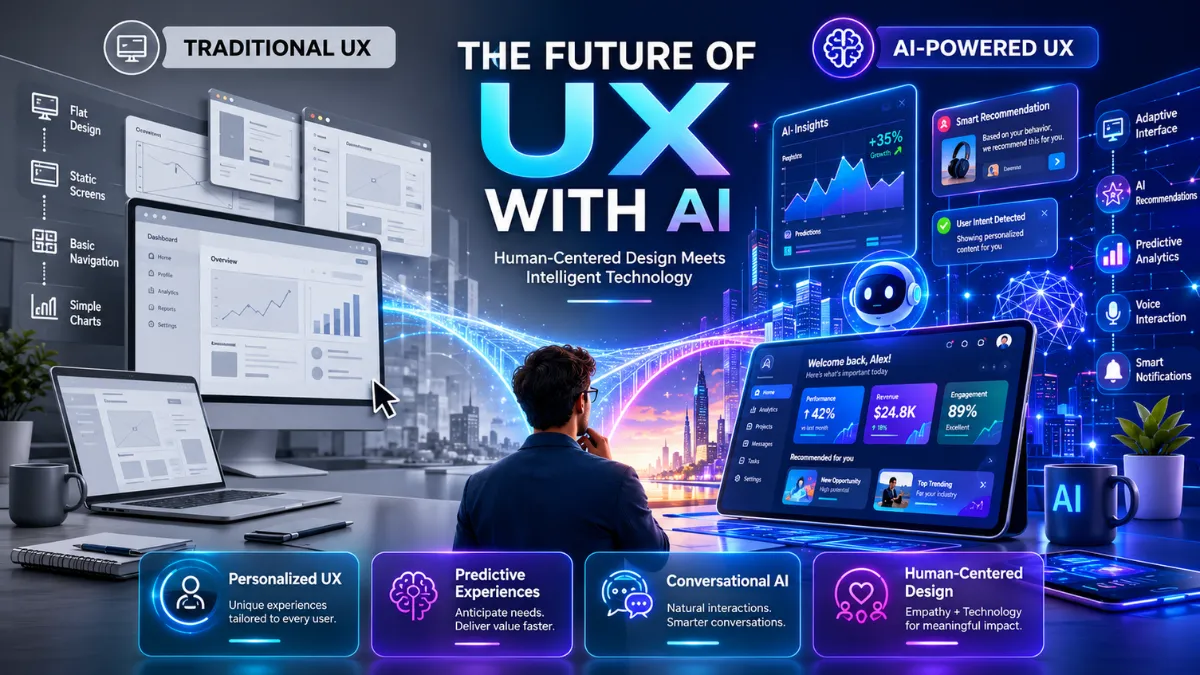
The future of UX with AI is not about replacing designers or eliminating human interaction it’s about creating digital experiences that are more intelligent, adaptive, and user-focused than ever before. As Artificial Intelligence becomes deeply integrated into digital products, user experience is evolving from static interfaces to systems that learn, adapt, and respond to individual users in real time.
Traditionally, user experience design focused on understanding user behavior through research, usability testing, and iterative improvements. While these principles remain essential, AI in UX design adds a new dimension by enabling products to continuously learn from user interactions and make intelligent decisions that improve the overall experience.
For example, instead of presenting the same interface to every user, an AI-powered application can recommend personalized content, adjust navigation based on usage patterns, suggest relevant actions, or provide contextual assistance exactly when it’s needed. This shift allows digital products to move beyond being reactive and become proactive in helping users achieve their goals.
However, intelligence alone doesn’t create great experiences. As AI becomes more capable, users also expect digital products to be transparent, reliable, and respectful of their privacy. This is why the future of UX with AI depends on balancing advanced technology with human-centered design principles.
1.1 What does AI-powered UX really mean?
AI-powered user experience refers to the use of Artificial Intelligence, Machine Learning, Generative AI, Natural Language Processing (NLP), and Predictive Analytics to enhance user interactions with digital products. Instead of relying solely on predefined workflows, AI enables systems to analyze user behavior, understand intent, and deliver more relevant, personalized experiences.
Some common examples include:
- Personalized product recommendations in e-commerce.
- AI chatbots providing instant customer support.
- Streaming platforms suggesting content based on viewing history.
- Navigation apps recommending faster routes using live traffic data.
- Productivity tools offering intelligent task suggestions.
These capabilities reduce friction, simplify decision-making, and make digital experiences feel more intuitive.
1.2 How is AI changing the future of user experience?
The biggest transformation brought by AI is the shift from reactive interfaces to intelligent experiences.
Previously, users had to navigate applications, search for information, and manually complete tasks. Today, AI can anticipate needs, automate repetitive actions, and provide contextual guidance before users even ask for help.
For example:
- Predictive AI can recommend the next best action based on user behavior.
- Conversational AI allows users to interact naturally using voice or text.
- Adaptive interfaces automatically adjust layouts, content, and recommendations according to user preferences.
- AI-driven personalization ensures every user receives a unique experience based on their goals and interactions.
These advancements are making digital products faster, smarter, and significantly more user-friendly.
1.3 Why is human-centered AI becoming the new UX standard?
While AI offers incredible capabilities, a successful user experience still depends on understanding human needs. This is where human-centered AI plays a crucial role.
Human-centered AI focuses on designing systems that support people rather than replacing them. Instead of making decisions without explanation, AI should help users understand recommendations, maintain control over important actions, and build confidence through transparent interactions.
In the future of UX with AI, the most successful products won’t be the ones with the most advanced algorithms—they’ll be the ones that combine intelligent automation with empathy, accessibility, usability, and trust.
Whether it’s recommending products, simplifying complex workflows, or enabling natural conversations, AI should always enhance the user experience rather than create confusion or unnecessary complexity.
Ultimately, the future of UX with AI is about building digital experiences where technology works quietly in the background, allowing users to accomplish their goals effortlessly while feeling informed, empowered, and in control.
2. Why Is AI Transforming User Experience Design?
The rapid adoption of Artificial Intelligence is fundamentally changing how digital products are designed, developed, and experienced. As users interact with more intelligent applications every day, their expectations continue to rise. They no longer want generic interfaces that require unnecessary effort; they expect digital products to understand their preferences, anticipate their needs, and provide relevant experiences instantly.
This shift is one of the biggest reasons why the future of UX with AI is becoming a strategic priority for businesses across industries. Organizations are no longer adopting AI simply to automate tasks; they are using it to create more meaningful, efficient, and personalized user experiences that strengthen customer relationships and drive business growth.
2.1 Why are user expectations changing in the AI era?
Modern users have become accustomed to intelligent digital experiences. Whether they’re receiving personalized movie recommendations, using AI-powered search, interacting with virtual assistants, or shopping through recommendation engines, people now expect technology to simplify their lives.
This evolution has raised the standard for every digital product.
Today’s users expect:
- Personalized recommendations instead of generic content.
- Faster access to information.
- Natural conversations with AI assistants.
- Smarter search experiences.
- Interfaces that remember preferences.
- Seamless experiences across devices.
These expectations are shaping the future of UX with AI, encouraging businesses to design products that feel intuitive rather than instructional.
Instead of forcing users to adapt to software, modern UX focuses on software adapting to users.
2.2 How does AI make digital experiences more intelligent?
Unlike traditional software that follows predefined rules, AI in UX design allows applications to learn continuously from user behavior.
Using Machine Learning, Predictive Analytics, and Natural Language Processing (NLP), AI can identify patterns, understand user intent, and improve interactions over time.
For example, AI can:
- Recommend relevant products based on browsing behavior.
- Display personalized dashboards for different users.
- Prioritize frequently used features.
- Predict what users may need next.
- Offer contextual guidance during complex workflows.
- Automatically optimize content for individual preferences.
Rather than delivering the same experience to everyone, AI-powered user experience enables dynamic interfaces that evolve alongside user behavior. This makes digital products more responsive, efficient, and engaging.
2.3 Why are businesses investing in AI-powered UX?
Businesses recognize that exceptional user experiences are no longer just a competitive advantage; they’re a business necessity.
Customers are more likely to stay loyal to brands that provide fast, relevant, and effortless digital interactions. As a result, organizations are increasingly investing in AI-driven UX, not only to improve customer satisfaction but also to achieve measurable business outcomes.
Some of the key business benefits include:
- Improved customer engagement.
- Higher conversion rates.
- Increased customer retention.
- Faster task completion.
- Better product adoption.
- More informed decision-making through user insights.
In addition, Generative AI is enabling businesses to accelerate content creation, automate support, and deliver more personalized experiences at scale, making AI an essential component of modern digital product strategies.
2.4 Why isn’t AI alone enough to create great user experiences?
Although AI brings powerful capabilities, technology alone doesn’t guarantee an exceptional user experience.
Users still value simplicity, clarity, accessibility, and trust. An application may offer advanced AI features, but if users struggle to understand recommendations, feel uncertain about how decisions are made, or lose control over important actions, the experience quickly becomes frustrating.
This is why human-centered AI is becoming the foundation of modern UX design.
The future of UX with AI depends on combining intelligent automation with thoughtful design principles that prioritize:
- Transparency.
- User control.
- Accessibility.
- Ethical decision-making.
- Privacy.
- Simplicity.
When AI is designed around real human needs instead of technological capabilities alone, it becomes an invisible assistant that enhances every interaction without overwhelming the user.
Ultimately, businesses that successfully combine AI in UX design with human-centered AI will create digital experiences that are not only smarter but also more trustworthy, intuitive, and valuable qualities that will define the next generation of exceptional user experiences.
3. How Does AI Improve User Experience?
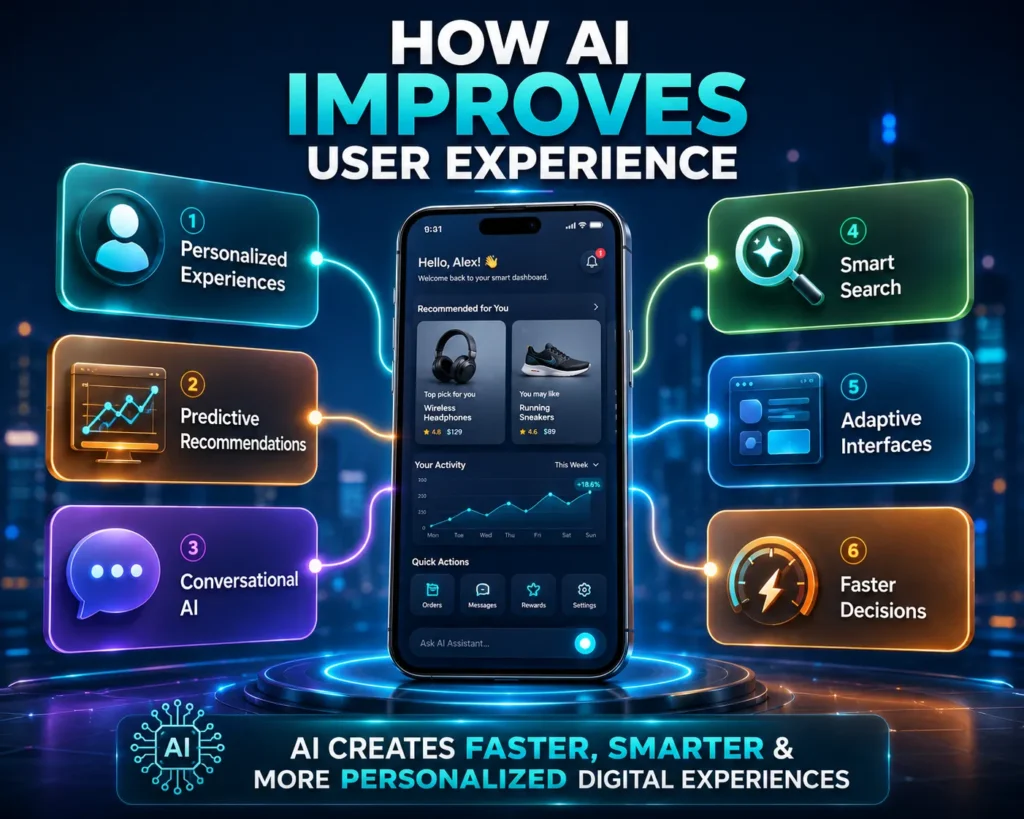
The growing adoption of Artificial Intelligence is transforming digital products from static interfaces into intelligent systems that understand users, adapt to their preferences, and deliver highly personalized experiences. Rather than simply responding to user actions, AI enables applications to anticipate needs, simplify complex tasks, and create interactions that feel natural and effortless.
This shift is one of the defining characteristics of the future of UX with AI. Instead of focusing solely on visual design, businesses are now using AI to build experiences that continuously evolve based on user behavior and real-time data.
Let’s explore the key ways AI is improving user experience across modern digital products.
3.1 How does AI personalize user experiences?
One of the biggest advantages of AI-powered user experience is personalization. Every user has different goals, preferences, browsing habits, and behaviors. AI makes it possible to recognize these differences and tailor digital experiences accordingly.
Using Machine Learning, AI analyzes user interactions to identify patterns and deliver more relevant content, recommendations, and features.
For example, AI can:
- Recommend products based on previous purchases.
- Display personalized dashboards for different user roles.
- Suggest relevant articles or videos.
- Remember frequently used settings.
- Customize notifications based on user preferences.
- Adapt homepage content for individual visitors.
Instead of presenting identical experiences to every user, AI creates dynamic interfaces that evolve, making interactions more relevant and engaging.
This level of personalization not only improves usability but also increases customer satisfaction, retention, and long-term engagement.
3.2 How does predictive AI improve usability?
Traditional software waits for users to initiate actions. In contrast, Predictive Analytics enables digital products to anticipate user needs before they explicitly request assistance.
By analyzing historical behavior and real-time interactions, AI can identify what users are likely to do next and provide proactive recommendations.
Examples include:
- Predicting frequently searched products.
- Recommending the next logical workflow step.
- Suggesting documents before users search for them.
- Highlighting important business insights automatically.
- Offering contextual shortcuts based on previous activity.
Predictive experiences reduce unnecessary clicks, shorten user journeys, and help users complete tasks more efficiently.
As the future of UX with AI continues to evolve, predictive interactions will become increasingly common across enterprise software, e-commerce platforms, SaaS applications, and mobile apps.
3.3 How do conversational interfaces enhance UX?
The way people interact with technology is changing rapidly. Instead of navigating through multiple menus and buttons, users increasingly prefer natural conversations.
Thanks to Natural Language Processing (NLP) and Generative AI, conversational interfaces allow users to communicate with digital products using everyday language.
Common examples include:
- AI-powered chatbots.
- Virtual customer support assistants.
- Voice assistants.
- Intelligent search interfaces.
- AI copilots inside productivity software.
These conversational experiences make digital products easier to use because users can simply ask questions instead of learning complex navigation patterns.
For businesses, conversational UX also offers several advantages:
- Faster customer support.
- Reduced support costs.
- Improved accessibility.
- Better user satisfaction.
- Higher engagement.
As conversational AI becomes more advanced, it will play an increasingly important role in shaping the future of UX with AI.
3.4 How does AI support faster and smarter decision-making?
Another significant contribution of AI in UX design is helping users make informed decisions more quickly.
Modern digital products often present users with large amounts of information, making decision-making time-consuming and overwhelming. AI simplifies this process by analyzing data, identifying meaningful insights, and presenting contextual recommendations.
For example, AI can:
- Recommend the most suitable products or services.
- Highlight unusual business trends.
- Prioritize important notifications.
- Suggest optimal scheduling times.
- Identify potential risks before they become problems.
- Recommend the next best action based on user goals.
Instead of forcing users to analyze complex data manually, AI delivers actionable insights that improve confidence and reduce cognitive effort.
This intelligent assistance allows users to focus on achieving their objectives rather than navigating complicated systems.
3.5 Why does AI make digital experiences feel more effortless?
The ultimate goal of great UX isn’t to showcase advanced technology; it’s to make technology almost invisible.
When implemented effectively, human-centered AI works quietly in the background, removing friction without drawing attention to itself. Users don’t notice the AI; they simply notice that tasks become easier, faster, and more intuitive.
This is why the future of UX with AI isn’t about adding AI to every feature. Instead, it’s about using AI-driven UX, Machine Learning, Predictive Analytics, and Generative AI thoughtfully to create experiences that feel seamless, trustworthy, and genuinely helpful.
Businesses that focus on solving real user problems rather than showcasing technology will be the ones that deliver the most successful AI-powered digital experiences in the years ahead.
4. Which AI Technologies Are Shaping the Future of UX?
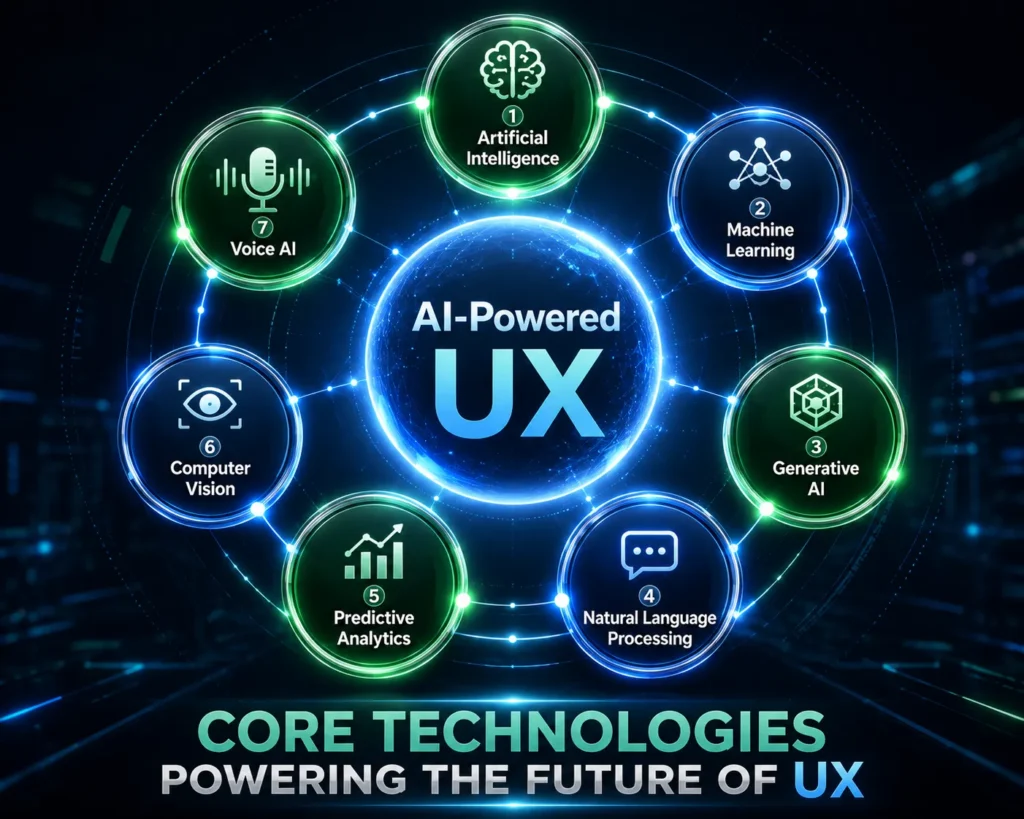
The future of UX with AI is powered by more than just Artificial Intelligence alone. Behind every personalized recommendation, intelligent chatbot, predictive dashboard, or adaptive interface are multiple AI technologies working together to create seamless user experiences.
As businesses continue investing in AI in UX design, understanding these technologies becomes essential for designing digital products that are intelligent, scalable, and user-centric.
Let’s explore the core technologies that are shaping the next generation of AI-powered user experience.
4.1 What role does Artificial Intelligence play in UX?
At its core, Artificial Intelligence enables digital products to simulate human intelligence by learning, reasoning, analyzing information, and making decisions based on data.
Unlike traditional software that follows fixed rules, AI continuously improves by learning from user interactions.
In modern UX, Artificial Intelligence helps:
- Deliver personalized experiences.
- Automate repetitive interactions.
- Recommend relevant content.
- Improve customer support.
- Analyze user behavior.
- Optimize user journeys.
Rather than replacing designers, AI provides tools that help create more adaptive and efficient digital experiences while allowing designers to focus on solving complex human problems.
4.2 How does Machine Learning improve user experiences?
One of the most important technologies behind the future of UX with AI is Machine Learning.
Machine Learning enables systems to recognize patterns from user data and continuously improve without requiring manual programming for every scenario.
For example, Machine Learning can:
- Learn user preferences over time.
- Improve recommendation accuracy.
- Identify frequently used features.
- Detect unusual user behavior.
- Personalize interfaces automatically.
- Optimize search results.
Every interaction helps the system become smarter, allowing digital products to provide increasingly relevant experiences.
This continuous learning process creates interfaces that evolve naturally with users instead of remaining static.
4.3 Why is Generative AI becoming important for UX?
The rapid growth of Generative AI is opening entirely new possibilities for digital product design.
Unlike traditional AI that focuses on prediction, Generative AI creates new content, conversations, layouts, summaries, and recommendations based on user requests.
Today, businesses use Generative AI to:
- Power intelligent chat assistants.
- Generate personalized content.
- Create product recommendations.
- Assist users during complex workflows.
- Simplify knowledge discovery.
- Produce contextual responses in real time.
Instead of searching through multiple menus, users can simply ask questions and receive meaningful answers instantly.
This conversational approach reduces friction and significantly improves usability, making Generative AI a key driver of the future of UX with AI.
4.4 How does Natural Language Processing make interfaces smarter?
One of the biggest changes in modern UX is the rise of conversational interfaces.
This is made possible through Natural Language Processing (NLP), a technology that enables computers to understand, interpret, and respond to human language.
Thanks to Natural Language Processing, users can interact with digital products naturally instead of relying only on buttons and menus.
Examples include:
- AI chatbots.
- Voice assistants.
- Smart search.
- Customer support automation.
- AI copilots.
- Language translation.
- Content summarization.
These conversational experiences make technology more accessible and reduce the learning curve for users.
As digital products become increasingly conversational, Natural Language Processing will continue to redefine how users interact with software.
4.5 How does Predictive Analytics improve digital products?
Another technology transforming AI-powered user experience is Predictive Analytics.
Rather than simply reacting to user behavior, Predictive Analytics examines historical and real-time data to forecast future actions and recommend the most relevant next steps.
Businesses use Predictive Analytics to:
- Predict customer preferences.
- Recommend products.
- Forecast user needs.
- Detect potential issues.
- Improve customer retention.
- Personalize marketing campaigns.
- Optimize business workflows.
For users, this means fewer unnecessary decisions, faster task completion, and more relevant digital experiences.
Instead of searching for information manually, users receive intelligent suggestions exactly when they need them.
4.6 Why do these technologies work better together?
The future of UX with AI doesn’t rely on a single technology it depends on how multiple technologies work together to create seamless experiences.
For example, a modern AI-powered application may combine:
- Artificial Intelligence to make intelligent decisions.
- Machine Learning to improve personalization over time.
- Generative AI to create natural conversations and content.
- Natural Language Processing to understand user intent.
- Predictive Analytics to anticipate future needs.
Together, these technologies enable businesses to move beyond traditional interfaces and build digital experiences that feel intuitive, responsive, and genuinely helpful.
As AI continues to evolve, the most successful products won’t simply adopt these technologies they’ll integrate them thoughtfully through human-centered AI, ensuring every intelligent feature enhances usability, builds trust, and delivers real value to users.
5. Why Is Human-Centered Design More Important in an AI-First World?
As Artificial Intelligence becomes more capable, many businesses are rushing to integrate AI into their products. However, simply adding intelligent features doesn’t automatically create a better user experience. In fact, poorly designed AI can confuse users, reduce trust, and make even simple tasks feel more complicated.
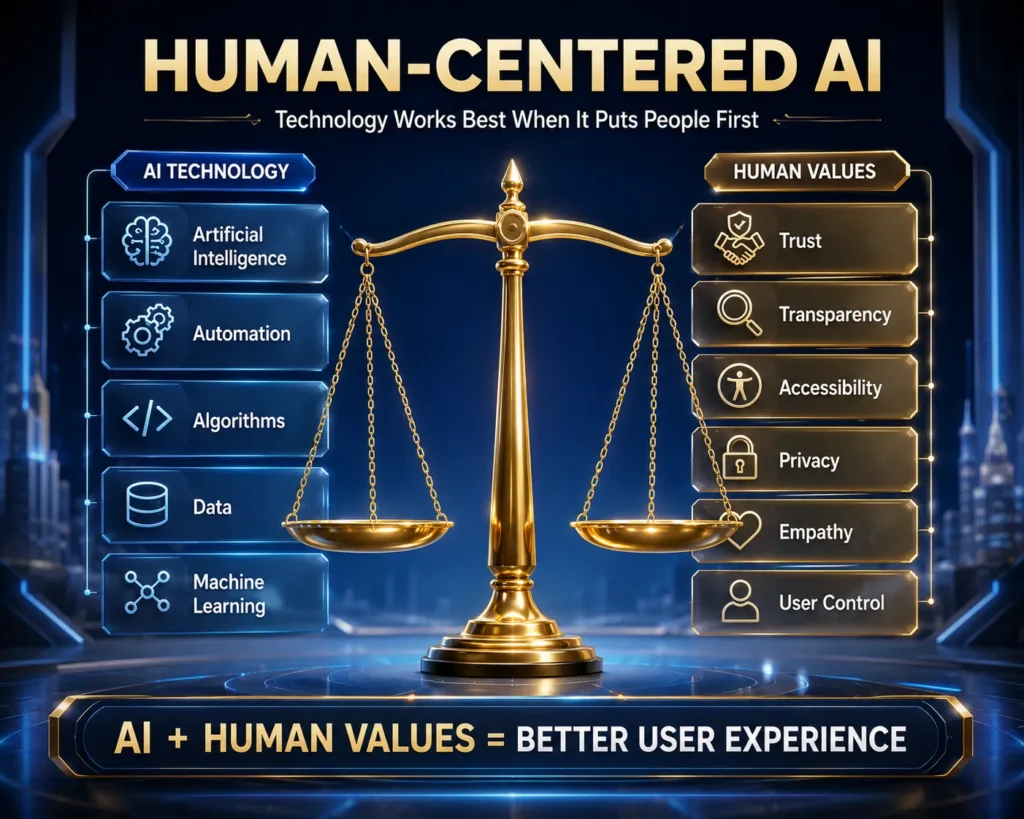
This is why human-centered AI has become one of the most important principles shaping the future of UX with AI. Instead of focusing solely on what AI can do, human-centered design asks a more important question:
How can AI genuinely help people achieve their goals?
Great user experiences have always been built around human needs, behaviors, and emotions. As AI becomes part of everyday interactions, these principles become even more critical.
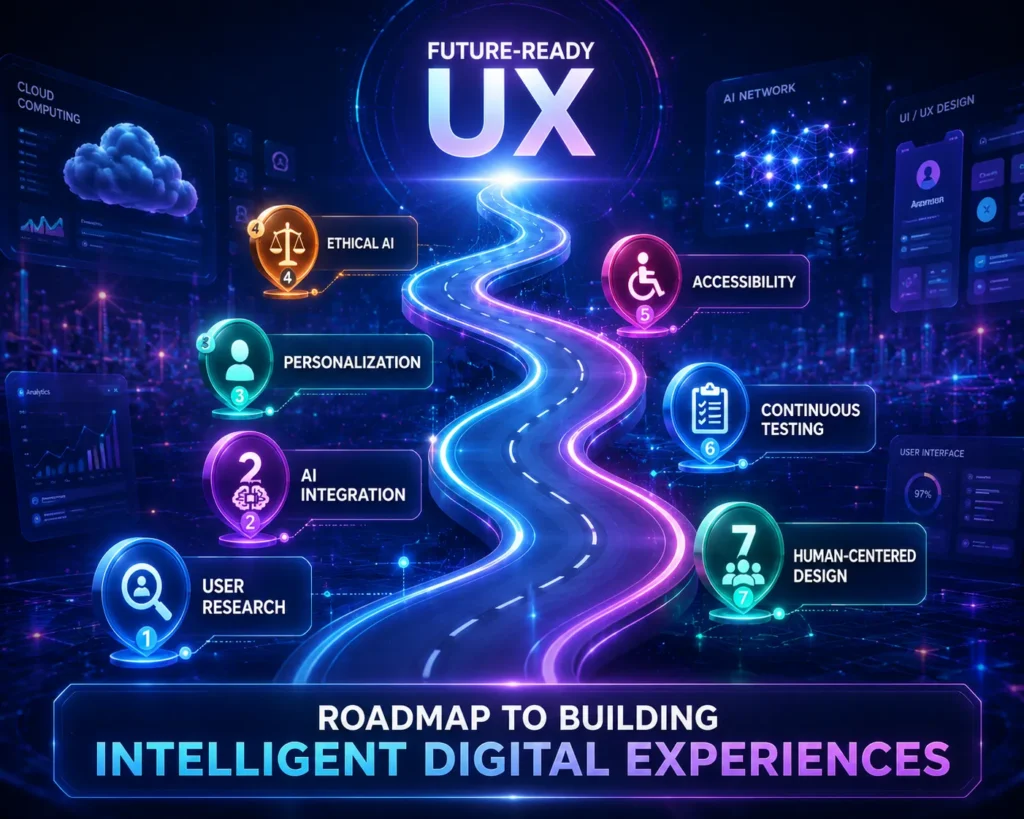
5.1 Why should AI never replace human empathy?
AI can process massive amounts of data, identify patterns, and automate complex tasks but it cannot truly understand human emotions, context, or personal experiences the way people do.
That’s why AI in UX design should focus on assisting users rather than replacing human judgment.
For example:
- AI can recommend products, but users should still have the final choice.
- AI can summarize information, but users should be able to explore the full details.
- AI can automate repetitive workflows, but important decisions should remain transparent and user-controlled.
When AI is designed as a helpful assistant instead of an invisible decision-maker, users feel more confident and empowered.
In the future of UX with AI, technology should enhance human capabilities, not diminish them.
5.2 How does transparency build user trust?
Trust is one of the biggest factors influencing the success of AI-powered user experience.
Users are becoming increasingly aware that AI influences recommendations, search results, pricing, and even business decisions. If they don’t understand why the system behaves a certain way, they may lose confidence in the product.
Good UX design makes AI transparent by helping users understand:
- Why recommendations appear.
- How personalized content is generated.
- When AI is making suggestions.
- What data is being used.
- How users can change preferences.
For example, instead of simply recommending a product, an application could explain:
“Recommended based on your recent purchases and browsing history.”
Small explanations like this increase trust because users understand the reasoning behind AI-generated recommendations.
As the future of UX with AI evolves, transparency will become a competitive advantage rather than just a design feature.
5.3 Why do accessibility and inclusivity matter even more with AI?
One of the greatest opportunities of human-centered AI is its ability to make digital products more accessible for everyone.
When designed responsibly, AI can remove barriers and create better experiences for users with different abilities, languages, and technical skills.
Examples include:
- Real-time language translation.
- Voice-controlled navigation.
- AI-generated captions.
- Intelligent screen reader support.
- Personalized accessibility settings.
- Adaptive interfaces based on user needs.
These capabilities help businesses create products that are inclusive rather than one-size-fits-all.
However, accessibility should never be treated as an afterthought. Every AI-powered feature should be tested to ensure it benefits all users equally.
By prioritizing accessibility, organizations create digital experiences that are not only compliant but also more usable, welcoming, and effective.
5.4 How can businesses design ethical AI experiences?
As AI becomes more deeply integrated into digital products, ethical design is becoming a business necessity.
Users want assurance that their personal information is protected and that AI systems operate fairly, responsibly, and without hidden bias.
Businesses designing the future of UX with AI should follow several ethical principles:
- Collect only necessary user data.
- Explain how AI-generated recommendations work.
- Allow users to review or override AI decisions.
- Minimize algorithmic bias through continuous testing.
- Respect user privacy and consent.
- Continuously evaluate AI performance for fairness and accuracy.
Ethical design isn’t just about reducing risk it also strengthens customer relationships by demonstrating transparency and accountability.
Organizations that prioritize ethical AI are more likely to build long-term trust and customer loyalty.
5.5 Why is human-centered AI the foundation of future UX?
The most successful digital products of the future won’t be those with the most advanced algorithms they’ll be the ones that make technology feel effortless.
The future of UX with AI is about creating experiences where users remain in control, understand how AI assists them, and feel confident using intelligent systems in their everyday lives.
By combining AI in UX design, Machine Learning, Generative AI, and Natural Language Processing with empathy, accessibility, transparency, and ethical design principles, businesses can create digital experiences that are both innovative and deeply human.
Ultimately, human-centered AI ensures that technology serves people not the other way around. This balance between intelligence and empathy will define the next generation of exceptional user experiences.
6. What Are the Biggest Benefits of AI-Powered UX for Businesses and Users?
The growing adoption of Artificial Intelligence is changing more than just how digital products look—it is transforming how users interact with technology and how businesses deliver value. By combining AI in UX design with human-centered AI, organizations can create experiences that are more personalized, efficient, and engaging while also improving business performance.
The future of UX with AI is not simply about automation. It is about reducing friction, simplifying complex tasks, and helping users achieve their goals faster with intelligent assistance. When implemented thoughtfully, AI-powered user experience benefits both businesses and their customers.
Let’s explore the key advantages.
6.1 How does AI improve customer engagement?
Keeping users engaged has become one of the biggest challenges for digital products. Modern users expect experiences that feel relevant, intuitive, and personalized from the very first interaction.
Using Machine Learning and Predictive Analytics, AI can analyze user behavior to deliver highly relevant experiences that keep users interested.
For example, AI can:
- Recommend personalized content.
- Suggest relevant products or services.
- Display customized dashboards.
- Send contextual notifications.
- Surface frequently used features.
- Adapt content based on user interests.
When users receive information that matches their needs instead of generic content, they are more likely to stay engaged and continue using the product.
As the future of UX with AI evolves, personalized engagement will become a standard expectation rather than a competitive advantage.
6.2 Can AI increase conversions and customer satisfaction?
Yes. One of the biggest business benefits of AI-powered user experience is its ability to simplify the customer journey.
Every unnecessary click, confusing form, or complex workflow increases the chances of users abandoning a product. AI helps eliminate these obstacles by guiding users toward the most relevant actions.
Many of these issues stem from common UX problems that directly impact business performance. Understanding the most common UX mistakes that hurt conversions can help organizations create more effective digital experiences.
Examples include:
- Personalized product recommendations.
- Intelligent onboarding experiences.
- Context-aware assistance.
- Smart search functionality.
- AI-powered customer support.
- Dynamic content based on user intent.
These improvements reduce friction throughout the user journey, making it easier for customers to complete desired actions such as making a purchase, subscribing to a service, or finding important information.
A smoother experience naturally leads to higher customer satisfaction, stronger loyalty, and improved conversion rates.
6.3 How does AI reduce user effort?
One of the core goals of great UX is minimizing cognitive effort the amount of mental work required to complete a task.
The future of UX with AI focuses on making digital interactions feel effortless by allowing AI to handle repetitive or time-consuming tasks.
For example, AI can:
- Auto-complete forms.
- Predict search queries.
- Organize information automatically.
- Suggest next steps.
- Prioritize important tasks.
- Generate summaries for lengthy content.
- Automate routine workflows.
Instead of forcing users to navigate complicated interfaces, AI streamlines interactions and allows them to focus on achieving their goals.
This reduction in effort improves usability while creating a more enjoyable digital experience.
6.4 Why does AI help businesses make smarter decisions?
While users benefit from personalized experiences, businesses gain valuable insights through AI-driven analytics.
Using Artificial Intelligence, Machine Learning, and Predictive Analytics, organizations can better understand how customers interact with their products and identify opportunities for continuous improvement.
AI helps businesses:
- Analyze user behavior patterns.
- Identify pain points in user journeys.
- Predict customer needs.
- Measure feature adoption.
- Optimize product performance.
- Improve marketing effectiveness.
- Support data-driven decision-making.
These insights enable organizations to refine their digital products based on real user behavior rather than assumptions.
As a result, businesses can create experiences that better align with customer expectations while achieving measurable growth.
6.5 Why is AI becoming essential for the future of UX?
The digital landscape is becoming increasingly competitive, and users have little patience for products that feel slow, confusing, or impersonal.
The future of UX with AI is centered on creating experiences that are intelligent enough to anticipate user needs while remaining simple, transparent, and easy to use.
When businesses combine AI in UX design, Generative AI, Natural Language Processing, and human-centered AI, they can build digital products that:
- Deliver personalized experiences at scale.
- Improve customer engagement.
- Increase conversions.
- Reduce user effort.
- Enable faster decision-making.
- Build long-term customer trust.
Ultimately, the greatest benefit of AI-powered user experience is not that it makes technology smarter it is that it makes technology more helpful. Businesses that use AI to solve real user problems, rather than simply adding new features, will be best positioned to succeed in the next generation of digital experiences.
7. What Challenges Do Designers Face When Creating AI-Powered User Experiences?
While the future of UX with AI offers exciting opportunities, designing intelligent digital experiences is not without challenges. Integrating Artificial Intelligence into digital products requires much more than advanced algorithms it requires thoughtful design, ethical considerations, and a deep understanding of user expectations.
If AI is implemented without considering usability, transparency, and trust, it can create frustration instead of convenience. This is why businesses adopting AI in UX design must address several important challenges to ensure AI enhances the user experience rather than complicates it.
7.1 How can AI affect user trust?
Trust is the foundation of every successful digital experience. No matter how advanced an AI system is, users will hesitate to rely on it if they don’t understand how it works or why it makes certain recommendations.
Many AI-powered applications provide suggestions, predictions, or automated decisions without explaining the reasoning behind them. This lack of transparency can make users feel uncertain and reduce confidence in the product.
To build trust, businesses should:
- Clearly explain AI-generated recommendations.
- Show users why specific suggestions appear.
- Allow users to review important AI decisions.
- Provide options to customize AI behavior.
- Make it easy to disable or adjust AI-powered features.
In the future of UX with AI, trust will become one of the strongest competitive advantages for digital products.
7.2 What privacy concerns should businesses consider?
Delivering a personalized AI-powered user experience often requires collecting and analyzing user data. While personalization improves usability, it also raises important privacy concerns.
Users want to know:
- What information is being collected?
- Why is the data being collected?
- How is the information being used?
- Who has access to the data?
- Can they control their privacy settings?
Businesses should prioritize responsible data practices by:
- Collecting only essential information.
- Being transparent about data usage.
- Giving users control over their preferences.
- Following privacy regulations and industry standards.
- Protecting sensitive information with strong security measures.
Respecting user privacy isn’t just a legal responsibility it is a key element of human-centered AI that strengthens long-term customer trust.
7.3 Can AI introduce bias into user experiences?
Yes. AI systems learn from data, and if that data contains bias or lacks diversity, the AI may produce unfair or inaccurate outcomes.
For example, biased AI can:
- Recommend irrelevant content.
- Prioritize certain users unfairly.
- Misinterpret user intent.
- Deliver inconsistent search results.
- Create accessibility barriers.
To reduce bias, organizations should:
- Use diverse and representative datasets.
- Continuously test AI models.
- Monitor AI performance regularly.
- Include human oversight during critical decision-making.
- Evaluate AI recommendations using real user feedback.
The future of UX with AI depends on building systems that are fair, inclusive, and reliable for every user.
7.4 How do you balance automation with human control?
One of the biggest design challenges is determining when AI should act automatically and when users should remain in control.
While automation improves efficiency, excessive automation can make users feel disconnected from important decisions.
Good AI in UX design follows a simple principle:
AI should assist users not replace their decision-making.
Businesses can achieve this balance by:
- Providing clear confirmation before important actions.
- Allowing users to edit AI-generated content.
- Offering manual alternatives when needed.
- Explaining automated decisions.
- Giving users the ability to override AI recommendations.
When users feel they remain in control, they are more likely to trust and adopt AI-powered features.
7.5 Why is continuous testing essential for AI-powered UX?
Unlike traditional interfaces, AI systems evolve over time. As user behavior changes, AI models also adapt, making continuous testing essential.
Businesses should regularly evaluate:
- Recommendation accuracy.
- Personalization quality.
- User satisfaction.
- Accessibility.
- AI transparency.
- Task completion rates.
- Overall usability.
Combining usability testing with AI performance analysis ensures that intelligent features continue delivering value without introducing new usability issues.
As the future of UX with AI continues to evolve, organizations that continuously test and refine their AI experiences will stay ahead of changing user expectations.
7.6 Why overcoming these challenges is critical
Every new technology introduces challenges, and AI is no exception. However, these obstacles should not discourage businesses from adopting AI they should encourage more thoughtful implementation.
The future of UX with AI will belong to organizations that combine Artificial Intelligence, Machine Learning, Generative AI, Natural Language Processing, and human-centered AI with strong design principles focused on trust, transparency, privacy, and user control.
When businesses address these challenges proactively, AI becomes more than just a technological innovation it becomes a reliable partner that helps users accomplish their goals with confidence, simplicity, and ease.
8. What Are the Best Practices for Designing Human-Centered AI Experiences?
As Artificial Intelligence becomes an integral part of digital products, businesses face an important challenge: how can they create intelligent experiences without making them overwhelming or impersonal?
The answer lies in designing human-centered AI experiences. While advanced technologies like Machine Learning, Generative AI, and Natural Language Processing can significantly enhance usability, they should always serve the user’s needs not distract from them.
The future of UX with AI will be defined by organizations that combine technological innovation with empathy, simplicity, and transparency. Instead of focusing on adding more AI features, successful businesses will focus on making AI feel helpful, intuitive, and almost invisible.
Here are the best practices for achieving that balance.
8.1 How can designers make AI feel natural instead of complicated?
Users should never feel like they need to “learn AI” to use a product. Great UX makes advanced technology feel effortless.
Instead of introducing unnecessary complexity, designers should ensure AI integrates naturally into existing workflows.
Some effective approaches include:
- Keeping interfaces clean and uncluttered.
- Using AI only when it adds genuine value.
- Explaining AI recommendations in simple language.
- Reducing unnecessary steps through intelligent automation.
- Designing familiar interaction patterns.
The goal is not to showcase AI but to create an experience where users accomplish tasks faster without noticing the technology working behind the scenes.
This is one of the defining characteristics of the future of UX with AI.
8.2 Why should users stay in control of AI?
One of the biggest mistakes businesses make is allowing AI to take complete control over user decisions.
While automation improves efficiency, users still want the ability to make the final choice.
For example, users should be able to:
- Edit AI-generated content.
- Reject recommendations.
- Adjust personalization settings.
- Disable AI features if desired.
- Review automated decisions before confirming actions.
Giving users control builds confidence and strengthens trust in AI-powered user experience.
When AI becomes a supportive assistant rather than an unquestionable authority, users feel more comfortable relying on intelligent systems.
8.3 How can AI personalize experiences without overwhelming users?
Personalization is one of the greatest strengths of AI in UX design, but excessive personalization can become intrusive.
Not every interaction needs to be customized.
Businesses should personalize experiences thoughtfully by focusing on areas where AI genuinely improves usability.
Examples include:
- Recommending relevant content.
- Suggesting frequently used features.
- Remembering user preferences.
- Offering contextual guidance.
- Displaying personalized dashboards.
At the same time, businesses should avoid:
- Excessive notifications.
- Irrelevant recommendations.
- Constant interface changes.
- Overly aggressive automation.
Successful personalization makes users feel understood not monitored.
Balancing personalization with simplicity is essential for the future of UX with AI.
8.4 What role does continuous UX testing play in AI-powered products?
Unlike traditional interfaces, AI-driven products constantly evolve as they learn from user behavior.
This makes continuous testing an essential part of designing successful human-centered AI experiences.
Businesses should regularly evaluate:
- User satisfaction.
- Task completion rates.
- Recommendation accuracy.
- AI response quality.
- Accessibility.
- User trust.
- Overall usability.
Combining user feedback with behavioral analytics helps teams refine AI experiences over time and identify opportunities for improvement.
Continuous testing ensures AI remains aligned with real user needs rather than assumptions.
8.5 How can businesses design ethical and transparent AI experiences?
As AI becomes more influential in everyday interactions, ethical design is no longer optional it is a competitive advantage.
Users are more likely to trust products that clearly explain how AI works and respect their privacy.
To build ethical AI-powered user experience, businesses should:
- Clearly communicate when AI is being used.
- Explain how recommendations are generated.
- Protect user data through secure practices.
- Minimize algorithmic bias.
- Provide clear privacy controls.
- Ensure accessibility for diverse user groups.
Ethical AI strengthens customer confidence while supporting long-term adoption of intelligent digital products.
8.6 Why will these best practices define the future of UX with AI?
The most successful digital products of tomorrow won’t simply have the most advanced Artificial Intelligence—they’ll deliver experiences that feel natural, trustworthy, and genuinely helpful.
The future of UX with AI belongs to businesses that use Machine Learning, Generative AI, Natural Language Processing, and Predictive Analytics responsibly while keeping people at the center of every design decision.
By focusing on transparency, user control, accessibility, personalization, and continuous improvement, organizations can create AI-powered user experience solutions that not only solve problems efficiently but also build lasting trust and stronger customer relationships.
Ultimately, the goal of human-centered AI is simple: use intelligent technology to make digital experiences easier, smarter, and more enjoyable—without ever losing sight of the people who use them.
9. How Are Leading Companies Using AI to Improve User Experience?
The future of UX with AI is no longer a concept reserved for innovation labs it’s already transforming the digital products millions of people use every day. From entertainment and e-commerce to navigation and productivity, leading companies are leveraging Artificial Intelligence, Machine Learning, Generative AI, and Natural Language Processing to create experiences that feel personalized, intuitive, and effortless.
What makes these companies successful isn’t simply their use of AI. It’s how they combine intelligent technology with human-centered AI principles to solve real user problems while maintaining simplicity, transparency, and trust.
Let’s look at how some of the world’s most recognized digital platforms are shaping the future of user experience.
9.1 How does Netflix use AI to personalize user experiences?
Netflix is one of the best examples of AI-powered user experience in action.
Instead of displaying the same homepage to every subscriber, Netflix uses Machine Learning to analyze viewing habits, search history, watch time, genres, and user preferences.
Based on this data, the platform:
- Recommends movies and TV shows.
- Personalizes homepage layouts.
- Suggests similar content.
- Optimizes thumbnail images.
- Predicts what users are likely to watch next.
This highly personalized approach reduces decision fatigue and helps users discover content more quickly.
The lesson for businesses is clear: personalization should simplify choices rather than overwhelm users.
9.2 How does Spotify create smarter listening experiences?
Spotify demonstrates how AI in UX design can transform entertainment into a highly personalized experience.
Using Artificial Intelligence and Predictive Analytics, Spotify continuously learns from user listening behavior to create recommendations that evolve over time.
Some AI-powered features include:
- Personalized playlists.
- Daily Mix recommendations.
- Discover Weekly.
- Smart music suggestions.
- Mood and activity-based playlists.
Instead of asking users to search endlessly for new music, Spotify proactively introduces relevant content that matches their interests.
This approach keeps users engaged while making the platform feel highly intuitive.
9.3 How does Amazon improve product discovery with AI?
Finding the right product among millions of options can be overwhelming.
Amazon addresses this challenge through AI-powered user experience, using Machine Learning to recommend products based on browsing history, purchases, wish lists, and customer behavior.
AI helps Amazon:
- Recommend related products.
- Personalize search results.
- Predict future purchases.
- Improve product rankings.
- Suggest complementary items.
These intelligent recommendations reduce search effort while increasing customer satisfaction and purchase confidence.
This demonstrates how AI can improve both business outcomes and user experience simultaneously.
9.4 How does ChatGPT demonstrate conversational UX?
One of the biggest shifts in the future of UX with AI is the move from traditional graphical interfaces to conversational experiences.
ChatGPT is an excellent example of how Generative AI and Natural Language Processing can simplify complex interactions.
Instead of navigating multiple menus or searching through documentation, users simply ask questions in natural language.
The system then:
- Understands user intent.
- Generates contextual responses.
- Explains complex concepts.
- Assists with creative tasks.
- Supports problem-solving through conversation.
This conversational approach significantly reduces friction and demonstrates how future digital products may rely less on traditional navigation and more on intelligent dialogue.
9.5 What can businesses learn from these AI-powered experiences?
Although companies like Netflix, Spotify, Amazon, and ChatGPT operate in different industries, they all follow the same core UX principles.
They use Artificial Intelligence to:
- Solve real user problems.
- Reduce complexity.
- Personalize experiences.
- Save users time.
- Improve decision-making.
- Continuously learn from user behavior.
More importantly, these companies don’t use AI simply because it’s a popular technology. Every AI feature has a clear purpose that improves usability and creates measurable value for users.
This is the essence of human-centered AI.
As the future of UX with AI continues to evolve, businesses of every size not just global technology companies can apply these same principles to create smarter, more engaging digital experiences. By focusing on user needs first and technology second, organizations can build products that are not only intelligent but also intuitive, trustworthy, and designed for long-term success.
10. What Should Businesses Do to Prepare for the Future of UX with AI? (Conclusion)
The future of UX with AI is no longer a distant vision it’s already influencing how people interact with websites, mobile applications, enterprise software, and digital platforms every day. As Artificial Intelligence, Machine Learning, Generative AI, and Natural Language Processing continue to evolve, businesses have an incredible opportunity to create digital experiences that are more intelligent, personalized, and efficient than ever before.
However, the organizations that succeed won’t necessarily be the ones using the most advanced AI technologies. They’ll be the ones that use AI with purpose.
Successful digital products are built by understanding real user needs, simplifying complex interactions, and designing experiences that feel intuitive rather than automated. This is where human-centered AI becomes essential. By combining intelligent automation with empathy, transparency, accessibility, and user control, businesses can ensure AI enhances the experience instead of becoming a source of confusion.
To prepare for the future of UX with AI, businesses should focus on:
- Investing in AI in UX design to create smarter digital experiences.
- Using AI to solve genuine user problems rather than following technology trends.
- Prioritizing personalization without compromising user privacy.
- Building trust through transparent and ethical AI practices.
- Continuously testing and improving AI-powered interactions based on real user feedback.
- Designing accessible and inclusive experiences for diverse audiences.
The future belongs to organizations that view AI as a tool for empowering users, not replacing them. When AI-powered user experience is combined with thoughtful design, businesses can create products that are not only more intelligent but also more engaging, trustworthy, and valuable.
At CrossShores Infotech, we believe the next generation of digital products will be shaped by the perfect balance of technology and human-centered design. By integrating Artificial Intelligence, Machine Learning, Generative AI, and user-first design principles into scalable software solutions, businesses can create experiences that delight users while driving measurable business growth.
Ultimately, the future of UX with AI isn’t about building products with more AI it’s about building products that understand people better. The businesses that embrace this philosophy today will be the ones defining tomorrow’s digital experiences.
11. Frequently Asked Questions About the Future of UX with AI
As Artificial Intelligence continues to transform digital products, businesses, designers, and users have many questions about what this means for the future of user experience. Below are answers to some of the most common questions related to the future of UX with AI.
What is the future of UX with AI?
The future of UX with AI focuses on creating intelligent, personalized, and adaptive digital experiences that understand user behavior while maintaining simplicity, trust, and accessibility. Instead of replacing human designers, AI enhances user experiences through automation, personalization, predictive interactions, and conversational interfaces.
What is AI in UX design?
AI in UX design refers to using Artificial Intelligence, Machine Learning, Generative AI, and Natural Language Processing to improve how users interact with digital products. AI helps personalize experiences, automate repetitive tasks, provide intelligent recommendations, and make interfaces more intuitive and efficient.
Will AI replace UX designers?
No. AI is expected to support UX designers rather than replace them.
While AI can automate research, generate design ideas, analyze user behavior, and assist with prototyping, it cannot replace essential human skills such as empathy, creativity, critical thinking, and strategic problem-solving. The future belongs to designers who know how to combine AI capabilities with human-centered AI principles.
How does AI improve user experience?
AI-powered user experience improves digital products by:
- Personalizing content and recommendations.
- Predicting user needs.
- Simplifying navigation.
- Automating repetitive tasks.
- Providing conversational support.
- Reducing cognitive effort.
- Helping users make faster decisions.
These improvements create digital experiences that are more relevant, efficient, and enjoyable.
What is human-centered AI?
Human-centered AI is an approach to designing AI systems that prioritize human needs, trust, accessibility, transparency, and user control. Rather than replacing people, human-centered AI helps users make better decisions while ensuring technology remains ethical, understandable, and easy to use.
Why is trust important in AI-powered UX?
Trust is essential because users need confidence in how AI makes recommendations and decisions.
Businesses can build trust by:
- Explaining AI-generated suggestions.
- Being transparent about data usage.
- Protecting user privacy.
- Allowing users to control AI features.
- Continuously testing AI for fairness and accuracy.
Without trust, even the most advanced AI features may fail to gain user acceptance.
What skills should UX designers develop for the AI era?
As the future of UX with AI evolves, UX professionals should strengthen both design and technology-related skills, including:
- User research.
- UX strategy.
- AI fundamentals.
- Prompt design.
- Data interpretation.
- Accessibility.
- Ethical AI design.
- Conversational UX.
- Design systems.
- Cross-functional collaboration.
These skills will help designers create intelligent experiences that remain user-focused and business-driven.
How can businesses prepare for the future of UX with AI?
Businesses should begin by identifying areas where AI can genuinely improve the user experience rather than adopting AI simply because it is trending.
Successful organizations invest in:
- AI in UX design strategies.
- User research.
- Ethical AI implementation.
- Continuous usability testing.
- Data privacy and security.
- Accessibility.
- Transparent AI interactions.
By combining advanced technology with human-centered AI, businesses can create digital products that are smarter, more intuitive, and ready for the next generation of user expectations.