


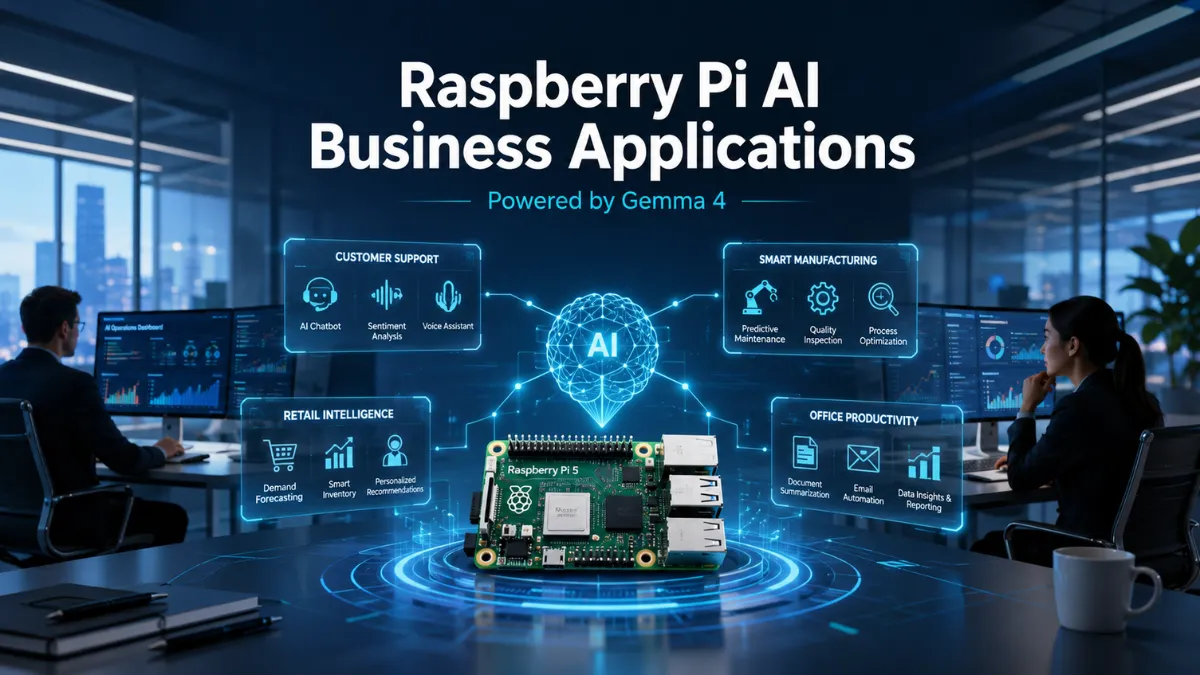
Contents
- 1 Table of Contents
- 2 1. Why Are Businesses Turning Raspberry Pi into an AI Platform?
- 3 2. Quick Answer: Best Raspberry Pi AI Business Applications
- 4 3. Understanding the Technology Stack: What Makes Raspberry Pi and Gemma 4 a Practical AI Solution?
- 5 4. Why Are Businesses Adopting Offline AI?
- 5.1 4.1 How Does Offline AI Help Reduce AI Infrastructure Costs?
- 5.2 4.2 Why Is Data Privacy a Major Advantage of Local AI?
- 5.3 4.3 Can Offline AI Deliver Faster Response Times?
- 5.4 4.4 Why Is Reliability Important for Business AI Systems?
- 5.5 4.5 How Does Offline AI Give Businesses More Control?
- 5.6 Key Takeaway
- 6 5. Raspberry Pi AI Business Applications for Customer Support
- 6.1 5.1 How Can Internal Knowledge Assistants Improve Employee Productivity?
- 6.2 5.2 Can Offline AI Support Customer Service Operations?
- 6.3 5.3 How Can Businesses Use AI for Product Information Assistance?
- 6.4 5.4 Why Are FAQ and Documentation Search Systems Popular AI Projects?
- 6.5 5.5 Can Local AI Assist Call Center Teams?
- 6.6 Key Takeaway
- 7 6. Raspberry Pi AI Business Applications in Retail
- 7.1 6.1 How Can AI Improve In-Store Product Recommendations?
- 7.2 6.2 What Role Can AI-Powered Kiosks Play in Retail?
- 7.3 6.3 Can Raspberry Pi Support Inventory Information Systems?
- 7.4 6.4 How Can AI Help Retail Employees Perform Better?
- 7.5 6.5 Why Is Offline AI Attractive for Retail Businesses?
- 7.6 Key Takeaway
- 8 7. Raspberry Pi AI Business Applications in Manufacturing
- 8.1 7.1 How Can AI Assist Shop Floor Operations?
- 8.2 7.2 Can AI Help with Equipment Troubleshooting?
- 8.3 7.3 How Does AI Improve Maintenance Knowledge Retrieval?
- 8.4 7.4 Can Manufacturing Facilities Use AI for Training and Documentation?
- 8.5 7.5 Why Is Edge AI Valuable in Industrial Environments?
- 8.6 Key Takeaway
- 9 8. Smart Office and Enterprise Productivity Applications
- 9.1 8.1 How Can AI Improve Internal Document Search?
- 9.2 8.2 Can AI Help Summarize Meetings and Business Information?
- 9.3 8.3 How Can AI Support Employee Onboarding?
- 9.4 8.4 Can AI Assist with Compliance and Policy Guidance?
- 9.5 8.5 Why Are Private Enterprise AI Assistants Gaining Popularity?
- 9.6 Key Takeaway
- 10 9. Remote Operations and Field Workforce Applications
- 10.1 9.1 How Can AI Support Remote Work Sites?
- 10.2 9.2 Can Edge AI Help Construction and Infrastructure Projects?
- 10.3 9.3 How Can AI Improve Field Service Operations?
- 10.4 9.4 Why Is Offline AI Valuable in Connectivity-Challenged Areas?
- 10.5 9.5 What Is the Business Value of Remote AI Deployment?
- 10.6 Key Takeaway
- 11 10. Cloud AI vs Raspberry Pi with Gemma 4: Which Is Better for Business?
- 12 11. Real Deployment Considerations Before Implementing Raspberry Pi AI
- 12.1 11.1 What Hardware Is Required for Business AI Deployment?
- 12.2 11.2 Why Do Storage and Memory Matter More Than Most Businesses Expect?
- 12.3 11.3 What Security Measures Should Businesses Implement?
- 12.4 11.4 How Important Are Model Selection and Quantization?
- 12.5 11.5 What Deployment Mistakes Should Businesses Avoid?
- 12.6 Key Takeaway
- 13 12. CrossShores Perspective: What Are We Seeing in the Future of Edge AI Adoption?
- 14 13. Frequently Asked Questions About Raspberry Pi AI Business Applications
- 14.1 13.1 Can Raspberry Pi Run AI Models for Real Business Applications?
- 14.2 13.2 What Are the Best Raspberry Pi AI Business Applications?
- 14.3 13.3 Is Raspberry Pi 5 Powerful Enough for Business AI?
- 14.4 13.4 Why Are Businesses Interested in Offline AI?
- 14.5 13.5 Can Raspberry Pi Replace Cloud AI?
- 14.6 13.6 Which AI Models Work Best on Raspberry Pi?
- 14.7 13.7 Is Local AI More Secure Than Cloud AI?
- 14.8 13.8 How Much Does It Cost to Deploy AI on Raspberry Pi?
- 14.9 13.9 Are Raspberry Pi AI Business Applications Suitable for Small Businesses?
- 14.10 13.10 What Is the Future of Raspberry Pi AI Business Applications?
- 15 14. Conclusion: Why Raspberry Pi AI Business Applications Matter More Than Ever
Table of Contents
- 1. Why Are Businesses Turning Raspberry Pi into an AI Platform?
- 2. Quick Answer: Best Raspberry Pi AI Business Applications
- 3. Understanding the Technology Stack: What Makes Raspberry Pi and Gemma 4 a Practical AI Solution?
- 4. Why Are Businesses Adopting Offline AI?
- 5. Raspberry Pi AI Business Applications for Customer Support
- 6. Raspberry Pi AI Business Applications in Retail
- 7. Raspberry Pi AI Business Applications in Manufacturing
- 8. Smart Office and Enterprise Productivity Applications
- 9. Remote Operations and Field Workforce Applications
- 10. Cloud AI vs Raspberry Pi with Gemma 4: Which Is Better for Business?
- 11. Real Deployment Considerations Before Implementing Raspberry Pi AI
- 12. CrossShores Perspective: What Are We Seeing in the Future of Edge AI Adoption?
- 13. Frequently Asked Questions About Raspberry Pi AI Business Applications
- 14. Conclusion: Why Raspberry Pi AI Business Applications Matter More Than Ever
1. Why Are Businesses Turning Raspberry Pi into an AI Platform?
For years, business AI has been associated with cloud subscriptions, expensive infrastructure, and ongoing operating costs. But that assumption is starting to change.
Today, businesses can run surprisingly capable AI systems on devices small enough to fit in the palm of a hand. With optimized models like Gemma 4 and advances in edge AI technology, Raspberry Pi is evolving from a maker board into a practical platform for local business intelligence.
Imagine a retail store with an AI-powered product assistant that works without the internet. Or a manufacturing facility where technicians can instantly retrieve troubleshooting information from a local AI system. Even small businesses can now deploy private AI assistants without investing in expensive servers or cloud infrastructure.
This shift is creating new opportunities for organizations that want faster response times, greater control over data, and lower long-term AI costs.
In this guide, you’ll discover the most valuable Raspberry Pi AI business applications, where offline AI delivers the greatest business impact, how Gemma 4 fits into modern edge AI deployments, and why many organizations are beginning to rethink their dependence on cloud-only AI solutions.
2. Quick Answer: Best Raspberry Pi AI Business Applications
Businesses looking to adopt AI without relying entirely on cloud infrastructure are increasingly exploring Raspberry Pi AI business applications. Thanks to lightweight language models such as Gemma 4 and efficient local inference tools, organizations can now deploy practical AI solutions on affordable hardware while maintaining control over privacy, cost, and performance.
2.1 Best Business Use Cases for Raspberry Pi with Gemma 4
The best Raspberry Pi AI business applications are those that require fast access to information, operate with predictable workloads, and benefit from local processing.
Some of the most practical use cases include:
- Internal knowledge assistants
- Customer support automation
- Product information systems
- Retail self-service kiosks
- Manufacturing troubleshooting assistants
- Document search and retrieval tools
- Employee onboarding support
- Field service guidance systems
Gemma 4 is particularly well-suited for these scenarios because it can be optimized for local deployment, enabling businesses to run AI models without depending entirely on cloud connectivity.
2.2 Who Should Consider Local AI Deployment?
Local AI deployment is ideal for organizations that prioritize privacy, reliability, and cost control.
Businesses that can benefit most include:
- Small and medium-sized enterprises
- Manufacturing companies
- Retail businesses
- Healthcare providers
- Educational institutions
- Logistics organizations
- Professional service firms
For these organizations, Raspberry Pi AI business applications provide an opportunity to implement AI capabilities while keeping sensitive information within their own environment.
2.3 When Offline AI Makes More Sense Than Cloud AI
Offline AI is often the better choice when internet connectivity, privacy requirements, or recurring cloud expenses become operational concerns.
Local AI deployment makes sense when:
- Sensitive business data must remain on-premises
- Remote locations have unreliable internet access
- Response speed is critical
- Predictable operating costs are important
- Regulatory compliance requires greater data control
For example, a manufacturing facility can use a local AI assistant to retrieve maintenance procedures instantly without sending operational data to external services. Similarly, a retail store can continue using AI-powered information systems even during network outages.
2.4 Key Benefits Businesses Can Expect
Organizations adopting Raspberry Pi AI business applications can expect several practical advantages.
Lower Operating Costs
Local AI reduces dependence on usage-based cloud pricing models, making long-term expenses easier to predict.
Improved Privacy
Business data remains under organizational control rather than being processed by third-party cloud services.
Faster Response Times
Local inference eliminates network delays, allowing users to receive answers more quickly.
Greater Reliability
AI systems can continue functioning even when internet connectivity is unavailable.
Scalable Edge AI Deployment
Businesses can deploy multiple low-cost AI systems across locations without significant infrastructure investments.
Quick Recommendation
If your goal is to build a cost-effective, private, and reliable AI solution, start with a focused use case such as an internal knowledge assistant or document search system. These applications often deliver the fastest return on investment and demonstrate the real-world value of local AI deployment before expanding into more advanced business workflows.
3. Understanding the Technology Stack: What Makes Raspberry Pi and Gemma 4 a Practical AI Solution?
Before exploring more advanced Raspberry Pi AI business applications, it is important to understand the technologies that make local AI deployment possible. A few years ago, running capable language models on low-power hardware was unrealistic. Today, model optimization techniques and efficient inference frameworks have changed that equation.
The combination of Gemma 4, Raspberry Pi 5, quantization, GGUF, and llama.cpp creates a lightweight AI stack that businesses can deploy without expensive cloud infrastructure.
3.1 What Is Gemma 4?
Gemma 4 is Google’s family of lightweight open models designed for efficient AI deployment. Unlike massive cloud-scale models that require powerful GPUs, Gemma models are optimized to deliver useful language capabilities while remaining practical for resource-constrained environments.
For business use cases, Gemma can assist with:
- Knowledge retrieval
- Question answering
- Document analysis
- Internal support systems
- Workflow assistance
Its relatively efficient architecture makes it a strong candidate for edge AI deployments where hardware resources are limited.
3.2 Why Does Gemma 4 Work Well for Edge AI?
The biggest challenge with local AI deployment is balancing performance with hardware limitations.
Gemma is well suited for edge environments because it offers:
- Smaller model sizes
- Efficient inference
- Strong reasoning capabilities
- Good performance after quantization
- Compatibility with local deployment tools
This makes it possible to build practical Raspberry Pi AI business applications without requiring dedicated AI servers.
For many business workflows, a well-optimized smaller model often provides more value than a larger model that is expensive and difficult to deploy.
3.3 Why Is Raspberry Pi Popular for Local AI Projects?
Raspberry Pi has become one of the most popular platforms for edge computing because it combines affordability, flexibility, and low power consumption.
Businesses often use Raspberry Pi devices for:
- Industrial automation
- IoT deployments
- Smart monitoring systems
- Edge computing projects
- Local AI applications
The Raspberry Pi 5 provides significant improvements in CPU performance compared to previous generations, making it increasingly capable of handling lightweight language model inference.
While it cannot replace enterprise AI servers, it can successfully power many real-world business applications.
3.4 How Does Quantization Make Local AI Possible?
Quantization is the process of reducing the precision of model weights to decrease memory usage and improve inference speed.
In simple terms, quantization allows AI models to become smaller and more efficient.
Benefits include:
- Reduced RAM requirements
- Faster inference speeds
- Lower storage consumption
- Improved suitability for CPU-only hardware
Without quantization, many language models would be too large to run effectively on Raspberry Pi devices.
This optimization technique is one of the key reasons modern Raspberry Pi AI business applications have become practical.
3.5 What Are GGUF and llama.cpp?
GGUF and llama.cpp are two of the most important technologies in the local AI ecosystem.
GGUF is a model format designed for efficient deployment and storage of quantized language models.
llama.cpp is an inference engine that enables optimized CPU-based execution of those models.
Together they provide:
- Efficient local inference
- Lower memory consumption
- Cross-platform compatibility
- Simplified deployment
- Improved performance on edge devices
Many businesses experimenting with offline AI solutions use GGUF models running through llama.cpp because the combination offers one of the most practical approaches for local deployment.
Key Takeaway
The success of modern Raspberry Pi AI deployments depends on more than just hardware. Gemma 4 provides the language model, quantization reduces resource requirements, GGUF enables efficient model storage, and llama.cpp delivers optimized CPU inference. Together, these technologies form the foundation of scalable and cost-effective Raspberry Pi AI business applications.
Businesses exploring local AI deployments should also evaluate other lightweight language models. Our guide on Best LLMs for Raspberry Pi compares model sizes, performance, and hardware requirements for edge AI projects.
4. Why Are Businesses Adopting Offline AI?
For many organizations, the conversation is no longer about whether to use AI. The focus has shifted to where AI should run and how it should be deployed. While cloud AI remains valuable for large-scale workloads, an increasing number of businesses are exploring local and edge-based solutions to address challenges related to cost, privacy, and operational reliability.
This trend is one of the primary drivers behind the growth of Raspberry Pi AI business applications and other edge AI deployments.
4.1 How Does Offline AI Help Reduce AI Infrastructure Costs?
Cloud AI services typically operate on usage-based pricing models. As AI adoption grows across departments, businesses may face increasing costs tied to API requests, token consumption, storage, and compute resources.
Offline AI changes this model by shifting processing to local hardware.
Instead of paying for every interaction, organizations invest in hardware once and use it continuously. For applications such as internal knowledge assistants, employee support tools, and document retrieval systems, this approach can significantly improve cost predictability.
Businesses with recurring AI workloads often find that local deployment becomes more economical over time.
4.2 Why Is Data Privacy a Major Advantage of Local AI?
Many organizations handle sensitive information every day. This may include customer records, financial data, intellectual property, internal procedures, or confidential business communications.
When AI processing occurs locally, data remains within the organization’s own infrastructure.
This offers several benefits:
- Greater control over sensitive information
- Reduced exposure to third-party systems
- Easier compliance with internal policies
- Improved confidence in data governance
For privacy-sensitive industries, local AI is often viewed as a strategic advantage rather than simply a technical choice.
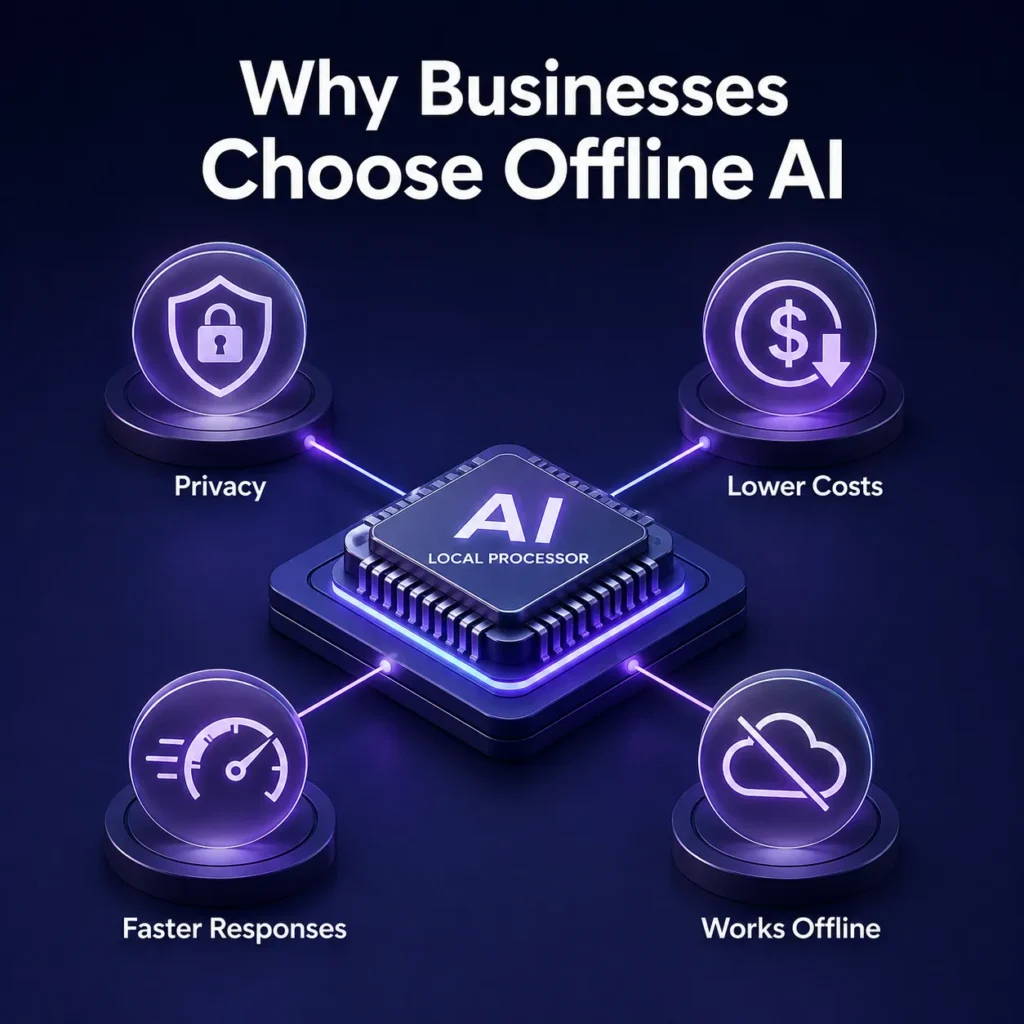
4.3 Can Offline AI Deliver Faster Response Times?
Yes. One of the most overlooked benefits of edge AI deployment is reduced latency.
Cloud-based systems must send requests across networks, wait for processing, and then return responses. While this process is usually fast, delays can become noticeable in high-volume or connectivity-constrained environments.
With local inference, processing happens directly on the device.
As a result, businesses can experience:
- Faster response times
- More consistent performance
- Reduced network dependency
- Improved user experience
This is particularly valuable for operational environments where quick access to information is critical.
4.4 Why Is Reliability Important for Business AI Systems?
AI systems are increasingly being integrated into day-to-day business operations. When employees depend on AI tools for information retrieval or decision support, reliability becomes essential.
Offline AI solutions can continue functioning even when:
- Internet connections fail
- Cloud services experience outages
- Network congestion impacts performance
- Remote locations have limited connectivity
For industries such as manufacturing, logistics, construction, and field services, uninterrupted access to AI-powered assistance can improve operational efficiency and reduce downtime.
4.5 How Does Offline AI Give Businesses More Control?
One of the strongest arguments for local AI deployment is control.
Organizations gain greater visibility into:
- How data is processed
- Where information is stored
- Which models are deployed
- How systems are maintained
- What security measures are implemented
According to observations from CrossShores Infotech, businesses evaluating long-term AI strategies increasingly prioritize ownership and operational control alongside model performance.
This shift is helping drive adoption of edge AI architectures and expanding interest in practical Raspberry Pi AI business applications across multiple industries.
Key Takeaway
Businesses are adopting offline AI because it offers advantages that extend beyond model performance. Lower operating costs, stronger privacy protections, faster response times, improved reliability, and greater operational control are making local AI deployment an increasingly attractive option. As edge hardware and lightweight language models continue to improve, these benefits will likely accelerate the adoption of Raspberry Pi-based AI solutions in real-world business environments.
5. Raspberry Pi AI Business Applications for Customer Support
Customer support is one of the most practical areas for AI adoption. Employees and customers frequently need quick answers to repetitive questions, product information, troubleshooting guidance, and policy details. These interactions often consume significant time and resources, making them ideal candidates for automation.
This is where Raspberry Pi AI business applications can deliver immediate value. By deploying lightweight AI models locally, businesses can provide faster access to information while maintaining control over sensitive data.
5.1 How Can Internal Knowledge Assistants Improve Employee Productivity?
Many organizations store critical information across multiple systems, documents, and databases. Employees often spend valuable time searching for answers rather than completing productive work.
A local AI-powered knowledge assistant can help employees quickly find:
- Company policies
- Product documentation
- Technical procedures
- Training materials
- Operational guidelines
Instead of manually searching through files, employees can ask questions in natural language and receive relevant answers instantly.
For businesses with large knowledge repositories, this can significantly reduce information retrieval time.
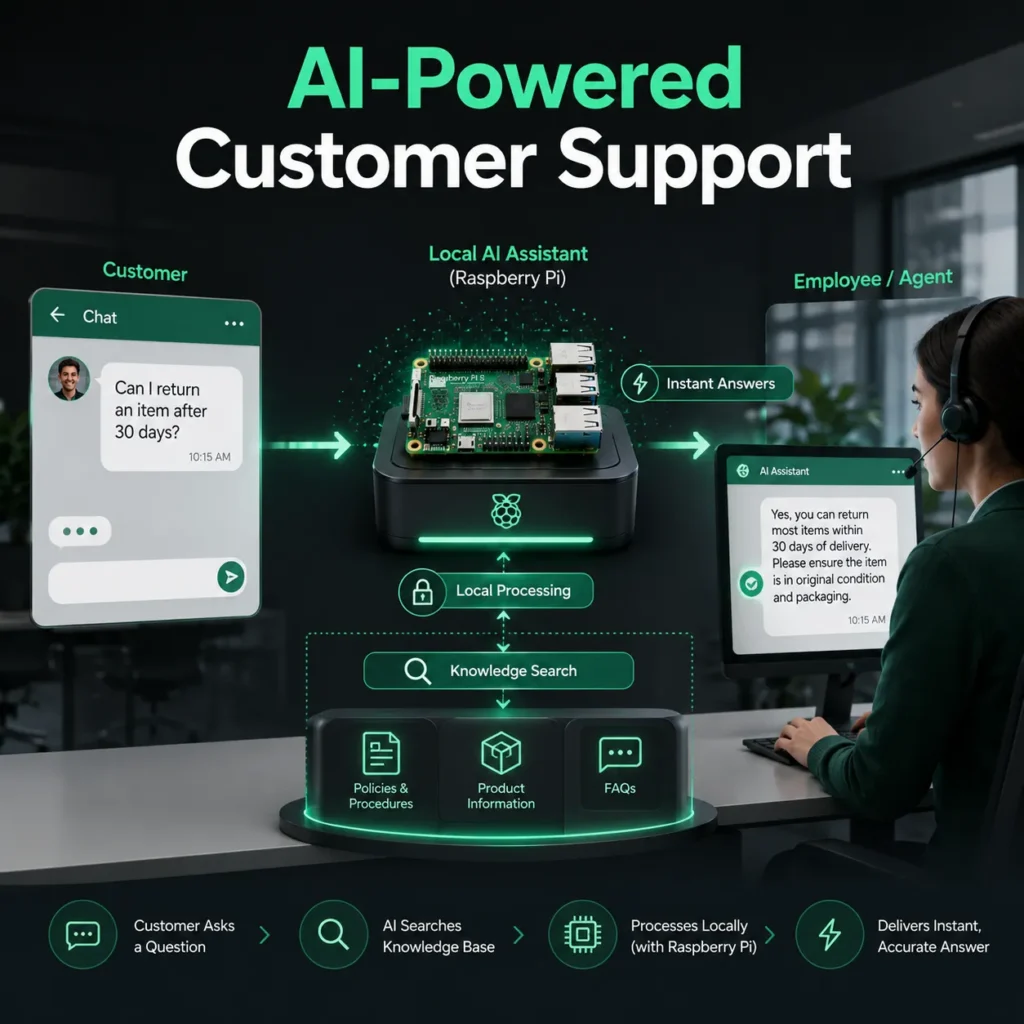
5.2 Can Offline AI Support Customer Service Operations?
Yes. Many customer inquiries involve predictable questions that can be answered using existing business knowledge.
Examples include:
- Product specifications
- Return policies
- Service information
- Warranty details
- Account guidance
An AI assistant running locally can provide accurate responses without requiring continuous access to cloud-based AI services.
This approach is particularly useful for organizations that prioritize privacy, cost control, or operational independence.
5.3 How Can Businesses Use AI for Product Information Assistance?
Customers frequently need detailed information before making purchasing decisions. Employees may also require quick access to product details when assisting customers.
A local AI system can serve as a product information assistant by providing:
- Feature explanations
- Product comparisons
- Usage instructions
- Compatibility information
- Frequently asked questions
Because the system uses approved business documentation, organizations maintain greater control over the information being delivered.
5.4 Why Are FAQ and Documentation Search Systems Popular AI Projects?
One of the fastest ways to demonstrate the value of AI is by improving access to existing knowledge.
Documentation search assistants can help users find information across:
- User manuals
- Internal documentation
- Technical guides
- Support articles
- Knowledge bases
Rather than browsing multiple files, users can ask direct questions and receive concise answers.
This type of deployment is often considered one of the lowest-risk and highest-value entry points for businesses exploring Raspberry Pi AI business applications.
5.5 Can Local AI Assist Call Center Teams?
While Raspberry Pi-based AI systems are not intended to replace enterprise call center platforms, they can serve as valuable support tools.
For example, AI assistants can help agents quickly retrieve:
- Product information
- Troubleshooting steps
- Service procedures
- Customer support guidelines
- Compliance information
This reduces time spent searching for answers and allows agents to focus more on customer interactions.
According to CrossShores Infotech’s observations, support teams often achieve the greatest results when AI is used to enhance employee productivity rather than fully automate customer conversations.
Key Takeaway
Customer support remains one of the strongest use cases for local AI deployment. Internal knowledge assistants, documentation search systems, product information tools, and employee support solutions can improve efficiency while maintaining privacy and cost control. For organizations beginning their AI journey, customer support-focused Raspberry Pi AI business applications often provide some of the quickest and most measurable business benefits.
6. Raspberry Pi AI Business Applications in Retail
Retail businesses generate a constant flow of information requests from customers, employees, and management teams. Whether it’s checking product details, locating inventory, or answering customer questions, access to accurate information plays a major role in the customer experience.
This makes retail one of the most promising sectors for Raspberry Pi AI business applications. By combining affordable hardware with lightweight AI models such as Gemma 4, retailers can deploy intelligent systems directly inside stores without relying entirely on cloud infrastructure.
6.1 How Can AI Improve In-Store Product Recommendations?
Customers often need guidance before making purchasing decisions. However, staff may not always be available to answer every question.
A local AI assistant can provide instant product recommendations based on:
- Customer requirements
- Product features
- Usage scenarios
- Compatibility information
- Available alternatives
Because the information is processed locally, stores can deliver fast responses while maintaining control over product data.
For smaller retailers, this can help improve customer engagement without requiring expensive enterprise AI solutions.
6.2 What Role Can AI-Powered Kiosks Play in Retail?
Self-service kiosks are becoming increasingly common in retail environments.
When powered by local AI, these systems can help customers:
- Find products
- Check store policies
- Access promotional information
- Receive buying guidance
- Navigate large retail locations
Unlike cloud-dependent solutions, locally deployed systems can continue operating even during connectivity issues.
This reliability is a significant advantage for high-traffic retail environments.
6.3 Can Raspberry Pi Support Inventory Information Systems?
Inventory management often requires employees to access information quickly while serving customers.
A local AI assistant can help staff retrieve:
- Product availability
- Stock locations
- Product specifications
- Supplier information
- Inventory procedures
Instead of navigating multiple software systems, employees can ask questions using natural language and receive immediate responses.
This reduces operational friction and improves efficiency on the sales floor.
6.4 How Can AI Help Retail Employees Perform Better?
Retail employees regularly encounter questions about products, policies, and operational procedures.
AI-powered support systems can act as digital assistants that provide quick access to:
- Training materials
- Return policies
- Product knowledge
- Store procedures
- Customer service guidelines
This helps employees become more confident and productive while reducing the time spent searching for information.
For businesses with multiple store locations, standardized AI assistance can also improve consistency across teams.
6.5 Why Is Offline AI Attractive for Retail Businesses?
Retail operations depend on speed, reliability, and customer satisfaction.
Offline AI offers several advantages:
- Reduced dependence on internet connectivity
- Faster response times
- Lower long-term AI costs
- Greater privacy control
- Consistent in-store performance
These benefits make local deployment increasingly attractive for organizations evaluating new Raspberry Pi AI business applications.
According to observations from CrossShores Infotech, many retailers are exploring edge AI solutions not to replace existing systems, but to improve customer interactions and employee productivity in practical, cost-effective ways.
Key Takeaway
Retail environments are well suited for local AI deployment because they involve frequent information requests and real-time customer interactions. Product recommendation assistants, AI-powered kiosks, inventory support tools, and employee knowledge systems are among the most valuable Raspberry Pi AI business applications for modern retail operations. By running AI locally, retailers can improve responsiveness while maintaining greater control over costs and data.
7. Raspberry Pi AI Business Applications in Manufacturing
Manufacturing environments generate vast amounts of operational knowledge, from maintenance procedures and equipment manuals to safety guidelines and troubleshooting documentation. Accessing this information quickly can significantly impact productivity, uptime, and operational efficiency.
This is why manufacturing has emerged as one of the most promising sectors for Raspberry Pi AI business applications. Local AI systems can provide workers with instant access to critical information without depending on cloud connectivity or expensive infrastructure.
7.1 How Can AI Assist Shop Floor Operations?
Factory employees frequently need information while working on production equipment or completing operational tasks.
A local AI assistant can help workers quickly access:
- Standard operating procedures
- Equipment instructions
- Production guidelines
- Safety protocols
- Process documentation
Instead of searching through manuals or multiple systems, employees can ask questions naturally and receive immediate guidance.
This reduces downtime and improves operational consistency across teams.
7.2 Can AI Help with Equipment Troubleshooting?
Equipment failures can be costly, especially when troubleshooting information is difficult to locate.
An AI-powered troubleshooting assistant can analyze documentation and provide step-by-step guidance for common issues.
For example, technicians can ask:
- Why did a machine stop unexpectedly?
- What are the causes of a specific error code?
- Which maintenance procedure should be followed?
Having immediate access to relevant information can accelerate problem resolution and reduce production interruptions.
7.3 How Does AI Improve Maintenance Knowledge Retrieval?
Maintenance teams often rely on large volumes of technical documentation.
A local AI system can help technicians retrieve:
- Maintenance schedules
- Service procedures
- Repair instructions
- Equipment specifications
- Historical maintenance knowledge
This allows maintenance personnel to spend less time searching for information and more time performing productive work.
In facilities with multiple machines and complex systems, knowledge retrieval can become one of the most valuable AI applications.
7.4 Can Manufacturing Facilities Use AI for Training and Documentation?
Employee training is a continuous challenge in manufacturing.
New workers must learn procedures, safety requirements, and equipment operations while experienced staff need access to updated information.
A local AI assistant can serve as an on-demand training resource that provides:
- Process explanations
- Safety guidance
- Operational instructions
- Policy information
- Documentation support
Because the information is sourced from approved company materials, businesses maintain control over content quality and accuracy.
7.5 Why Is Edge AI Valuable in Industrial Environments?
Manufacturing facilities do not always have ideal connectivity conditions. Some operations occur in locations where internet access is unreliable or restricted.
Local AI deployment offers several advantages:
- Consistent performance without internet dependence
- Faster access to information
- Improved data privacy
- Reduced cloud costs
- Greater operational reliability
These benefits align closely with the needs of industrial organizations seeking scalable and practical Raspberry Pi AI business applications.
According to CrossShores Infotech’s experience with edge AI initiatives, industrial environments often achieve the greatest value when AI focuses on knowledge retrieval, operational support, and workforce productivity rather than attempting to automate every decision-making process.
Key Takeaway
Manufacturing organizations can use local AI to improve access to operational knowledge, maintenance procedures, troubleshooting information, and employee training resources. By deploying lightweight AI models at the edge, businesses can enhance productivity, reduce downtime, and support workers with real-time information. This makes manufacturing one of the strongest opportunities for implementing Raspberry Pi AI business applications at scale.
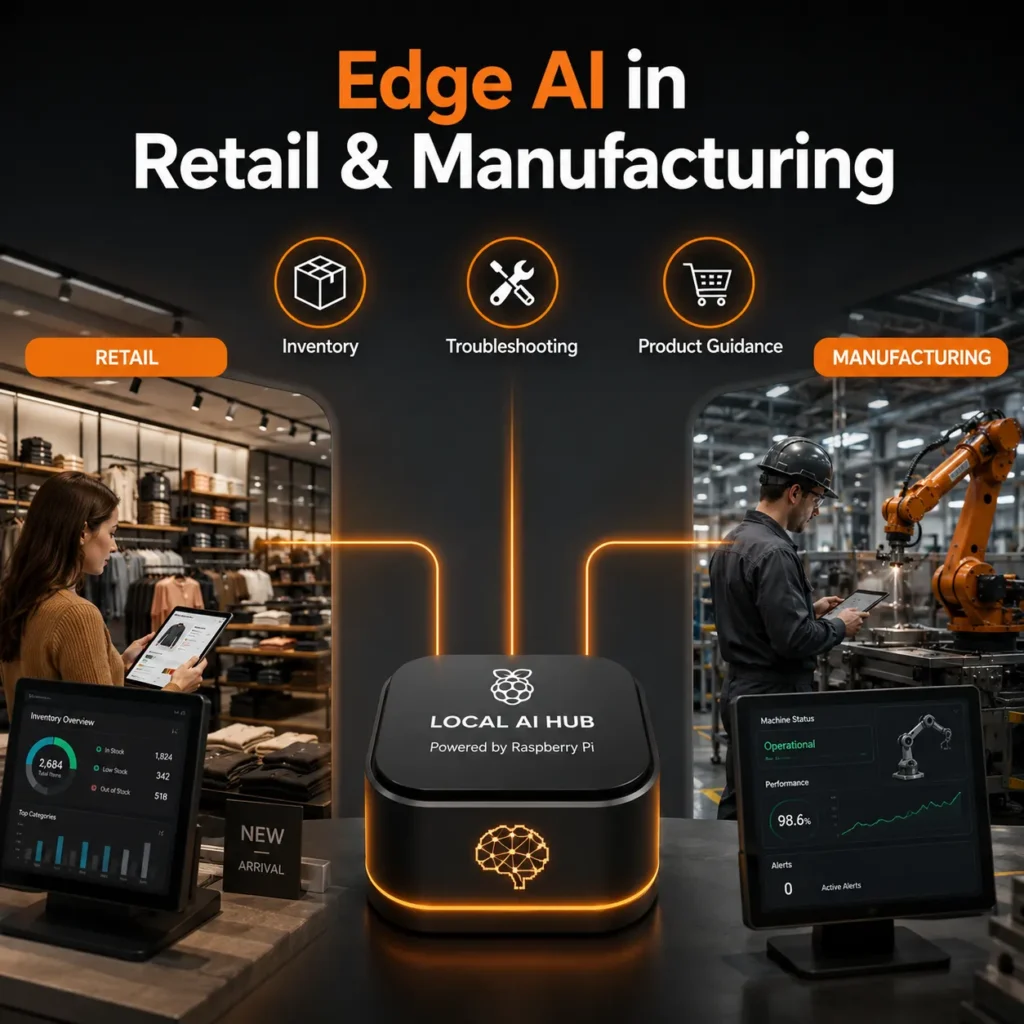
8. Smart Office and Enterprise Productivity Applications
Many organizations spend thousands of hours each year searching for documents, answering repetitive employee questions, and managing internal knowledge. While these tasks may seem minor individually, they create significant productivity losses when repeated across departments.
This is where Raspberry Pi AI business applications can provide measurable value. By deploying AI locally, businesses can improve information access, streamline workflows, and support employees without relying entirely on cloud-based services.
8.1 How Can AI Improve Internal Document Search?
Most organizations store critical information across multiple locations, including shared drives, knowledge bases, policy documents, and operational manuals.
Finding the right document often takes longer than employees expect.
A local AI-powered search assistant can help users quickly retrieve information from:
- Company policies
- Employee handbooks
- Technical documentation
- Process guidelines
- Training materials
Instead of manually searching folders, employees can ask direct questions and receive concise answers based on approved business content.
This improves efficiency while reducing frustration associated with information retrieval.
8.2 Can AI Help Summarize Meetings and Business Information?
Employees frequently spend time reviewing meeting notes, reports, and lengthy documents.
AI can assist by generating concise summaries of:
- Internal meetings
- Project updates
- Operational reports
- Business documentation
- Team communications
For organizations handling large amounts of information, summarization tools can improve knowledge sharing and help teams stay aligned on important decisions.
When deployed locally, sensitive business discussions remain within the organization’s own environment.
8.3 How Can AI Support Employee Onboarding?
Onboarding often requires new employees to learn company policies, processes, and systems within a short period.
A local AI assistant can provide instant answers to common questions related to:
- HR policies
- Internal procedures
- Benefits information
- Technology systems
- Department workflows
This creates a more efficient onboarding experience while reducing the burden on HR and management teams.
It also ensures employees have consistent access to accurate information throughout their learning process.
8.4 Can AI Assist with Compliance and Policy Guidance?
Many organizations operate under strict internal policies and regulatory requirements.
Employees frequently need clarification regarding:
- Security policies
- Compliance procedures
- Operational standards
- Industry regulations
- Documentation requirements
A local AI assistant can act as a centralized knowledge resource, helping employees locate relevant guidance quickly and accurately.
This reduces the risk of misinformation while improving compliance awareness across the organization.
8.5 Why Are Private Enterprise AI Assistants Gaining Popularity?
Businesses increasingly want the benefits of AI without exposing sensitive information to external systems.
Private AI assistants offer:
- Greater control over business data
- Improved confidentiality
- Reduced dependence on third-party platforms
- Faster local responses
- Predictable operating costs
According to CrossShores Infotech’s observations, organizations evaluating enterprise AI are placing greater emphasis on data ownership and operational control than ever before. As a result, private AI deployments are becoming a growing category within Raspberry Pi AI business applications.
Key Takeaway
Smart office AI solutions focus on improving employee productivity rather than replacing human expertise. Document search, meeting summarization, onboarding assistance, compliance support, and private enterprise assistants can help organizations work more efficiently while maintaining privacy and control. For many businesses, these applications represent some of the most practical and accessible uses of local AI technology.
9. Remote Operations and Field Workforce Applications
Many businesses operate far from traditional office environments. Construction sites, utility networks, agricultural operations, mining facilities, logistics hubs, and field service teams often work in locations where internet connectivity is inconsistent or unavailable.
In these environments, cloud-based AI can become unreliable. This is why Raspberry Pi AI business applications are gaining attention as a practical solution for delivering intelligence directly where work happens.
By combining Raspberry Pi hardware with lightweight AI models such as Gemma 4, organizations can provide employees with instant access to information even in remote locations.
9.1 How Can AI Support Remote Work Sites?
Field teams frequently need quick access to technical information while performing tasks in challenging environments.
A locally deployed AI assistant can help workers retrieve:
- Equipment manuals
- Safety procedures
- Installation instructions
- Operational guidelines
- Technical documentation
Instead of contacting a central office or searching through multiple files, workers can obtain answers directly from an on-site AI system.
This improves efficiency while reducing operational delays.
9.2 Can Edge AI Help Construction and Infrastructure Projects?
Construction projects generate large amounts of documentation, including blueprints, safety requirements, technical specifications, and project procedures.
AI-powered assistants can help project teams quickly access information related to:
- Construction standards
- Equipment operation
- Site procedures
- Safety compliance
- Project documentation
Because processing occurs locally, teams can continue accessing information even when network connectivity is limited.
This makes local AI particularly valuable for temporary work sites and remote infrastructure projects.
9.3 How Can AI Improve Field Service Operations?
Field service teams often encounter technical issues that require immediate guidance.
A local AI assistant can support technicians by providing:
- Troubleshooting instructions
- Repair procedures
- Product specifications
- Service documentation
- Maintenance guidance
Faster access to information can reduce service times and improve first-time resolution rates.
For organizations managing distributed service teams, this can have a direct impact on operational performance.
9.4 Why Is Offline AI Valuable in Connectivity-Challenged Areas?
Many industries operate in regions where reliable internet access cannot be guaranteed.
Examples include:
- Rural operations
- Industrial facilities
- Agricultural environments
- Remote energy projects
- Transportation networks
In these situations, AI systems that depend entirely on cloud connectivity may not be practical.
Local AI deployment provides:
- Continuous availability
- Consistent performance
- Reduced network dependency
- Better privacy control
- Greater operational resilience
These advantages make offline AI particularly attractive for organizations that require dependable access to information regardless of location.
9.5 What Is the Business Value of Remote AI Deployment?
The greatest value comes from bringing intelligence closer to where decisions are made.
Instead of routing every request through cloud infrastructure, businesses can process information directly at the edge.
According to CrossShores Infotech’s observations, organizations implementing edge AI often discover that operational reliability becomes just as important as model performance. In remote environments, the ability to function independently of internet connectivity can significantly improve productivity and business continuity.
This is one of the key reasons Raspberry Pi AI business applications continue to expand across industries with distributed workforces.
Key Takeaway
Remote operations often face unique challenges related to connectivity, information access, and response times. Local AI systems running on Raspberry Pi devices can help field teams retrieve knowledge, troubleshoot problems, and access operational guidance without depending on cloud services. For organizations with distributed workforces, these applications demonstrate the practical value of edge AI in real-world business environments.
10. Cloud AI vs Raspberry Pi with Gemma 4: Which Is Better for Business?
There is no universal winner between cloud AI and local AI. The right choice depends on business objectives, data requirements, budget constraints, and deployment environments.
For some organizations, cloud platforms provide unmatched scalability and access to large foundation models. For others, local deployments powered by Gemma 4 offer a more practical solution that prioritizes privacy, reliability, and cost control.
Understanding these trade-offs is essential when evaluating Raspberry Pi AI business applications.
10.1 How Do Costs Compare?
Cloud AI typically follows a usage-based pricing model. Businesses pay according to API calls, token usage, storage, and compute consumption.
This model works well for occasional workloads but can become expensive as AI adoption grows.
Local AI deployments require an upfront investment in hardware and setup. However, ongoing operational costs are generally lower because inference occurs on owned infrastructure.
For businesses with predictable AI workloads, local deployment often provides better long-term cost predictability.
10.2 Which Option Offers Better Privacy?
Privacy is one of the strongest advantages of local AI.
Cloud AI systems process information through external infrastructure, which may create concerns related to:
- Data governance
- Regulatory compliance
- Confidential business information
- Intellectual property protection
Local AI keeps processing within the organization’s environment.
This gives businesses greater control over how information is stored, accessed, and managed.
For privacy-sensitive industries, this can be a significant competitive advantage.
10.3 Which Delivers Faster Response Times?
Cloud AI performance depends on internet connectivity and network conditions.
Local AI eliminates many of these dependencies by processing requests directly on the device.
As a result, businesses can benefit from:
- Reduced latency
- Faster information retrieval
- Consistent performance
- Improved user experiences
While cloud platforms may offer superior raw model capabilities, local systems often provide more predictable response times for targeted business tasks.
10.4 What About Scalability?
Cloud AI has a clear advantage when large-scale processing is required.
Organizations that need:
- Massive user volumes
- Complex reasoning workloads
- Enterprise-scale deployments
- Advanced multimodal capabilities
may benefit from cloud-based infrastructure.
Local AI solutions are generally better suited for focused use cases where workloads remain manageable and predictable.
This is why many businesses use a hybrid strategy, combining cloud AI with Raspberry Pi AI business applications at the edge.
10.5 When Should Businesses Choose Cloud AI?
Cloud AI is often the better option when organizations require:
- Large-scale deployments
- Advanced AI capabilities
- Frequent model updates
- Global accessibility
- High-volume concurrent usage
Businesses focused on experimentation or rapid scaling may also benefit from cloud-based infrastructure.
10.6 When Does Offline Edge AI Make More Sense?
Offline AI is often the stronger choice when businesses prioritize:
- Data privacy
- Cost control
- Local processing
- Low latency
- Operational reliability
- Remote deployment
Organizations operating in manufacturing facilities, retail stores, field environments, and privacy-sensitive industries often find that local AI aligns more closely with their operational requirements.
According to CrossShores Infotech’s experience, many successful deployments are not choosing one approach exclusively. Instead, they combine cloud AI for complex workloads and edge AI for everyday operational tasks.
Key Takeaway
Cloud AI and local AI solve different business challenges. Cloud platforms offer scalability and access to powerful models, while local deployments provide privacy, predictable costs, reliability, and faster on-site processing. The most effective strategy often involves selecting the right tool for each workload rather than treating cloud and edge AI as competing solutions. This balanced approach is helping drive adoption of Raspberry Pi AI business applications across a growing range of industries.
For readers interested in detailed performance measurements, our Gemma 4 benchmark explores real-world inference performance across Raspberry Pi, Jetson, and Mini PC platforms.
11. Real Deployment Considerations Before Implementing Raspberry Pi AI
Deploying AI on Raspberry Pi is easier than ever, but successful business implementation requires more than simply installing a model and starting inference. Organizations exploring Raspberry Pi AI business applications should evaluate hardware requirements, storage performance, security practices, and long-term maintenance before deployment.
Businesses that approach edge AI strategically are more likely to achieve measurable results and avoid costly implementation mistakes.
11.1 What Hardware Is Required for Business AI Deployment?
For most business workloads, the Raspberry Pi 5 offers the best balance of affordability and performance.
A typical deployment includes:
- Raspberry Pi 5 (8GB recommended)
- High-speed SSD storage
- Active cooling solution
- Reliable power supply
- Optimized Gemma model
While smaller configurations can run lightweight workloads, businesses planning continuous AI usage should prioritize stability over minimum specifications.
11.2 Why Do Storage and Memory Matter More Than Most Businesses Expect?
Many first-time deployments focus heavily on CPU performance while overlooking storage speed and memory availability.
In practice, storage often affects:
- Model loading times
- Response consistency
- Retrieval performance
- User experience
Based on deployment observations from CrossShores Infotech, organizations frequently underestimate the impact of storage performance. In many edge AI projects, upgrading from a microSD card to SSD storage delivers a more noticeable improvement than moving to a slightly larger language model.
Memory planning is equally important because insufficient RAM can create instability and significantly reduce inference performance.
11.3 What Security Measures Should Businesses Implement?
Local AI improves privacy, but it does not eliminate security responsibilities.
Organizations should establish clear controls for:
- User authentication
- Device access management
- Data protection policies
- Backup procedures
- Software updates
Businesses handling customer information, financial records, or proprietary documentation should also define governance rules for how AI systems access and process internal data.
Security should be treated as part of the deployment strategy rather than an afterthought.
11.4 How Important Are Model Selection and Quantization?
Selecting the right model is often more important than selecting the largest model.
Many successful Raspberry Pi AI business applications rely on optimized and quantized models that deliver fast responses while maintaining reasonable hardware requirements.
Factors to evaluate include:
- Business objective
- Memory consumption
- Inference speed
- Response quality
- Long-term maintainability
CrossShores Infotech has observed that organizations typically achieve better adoption rates when AI models are chosen based on operational needs rather than benchmark scores alone.
11.5 What Deployment Mistakes Should Businesses Avoid?
Several common mistakes repeatedly appear in edge AI projects:
- Choosing models too large for available hardware
- Ignoring thermal management
- Underestimating storage requirements
- Deploying AI without a clear business objective
- Focusing on technology instead of measurable outcomes
According to CrossShores Infotech, the most successful deployments begin with a specific business problem. Organizations that identify a clear use case before selecting hardware or models consistently achieve stronger results than those pursuing AI purely as a technology initiative.
Key Takeaway
Successful edge AI deployment depends on thoughtful planning rather than hardware alone. Storage performance, security, model selection, and operational goals all play critical roles in long-term success. Businesses that align technology decisions with practical objectives are far more likely to unlock the full value of Raspberry Pi AI deployments.
Choosing the right Gemma variant is critical for deployment success. Our Gemma 4 E2B vs E4B comparison explains the differences in performance, memory usage, and practical business applications.
12. CrossShores Perspective: What Are We Seeing in the Future of Edge AI Adoption?
The conversation around AI is rapidly evolving. While cloud-based AI continues to dominate headlines, many organizations are beginning to focus on a different question: where should AI actually run?
According to CrossShores Infotech, this shift is creating significant interest in edge AI architectures that bring intelligence closer to business operations rather than relying entirely on remote cloud infrastructure.
12.1 Why Are Businesses Seeking Greater Control Over AI?
One of the strongest trends emerging across industries is the desire for greater control over data, costs, and AI operations.
Organizations increasingly want answers to questions such as:
- Where is business data processed?
- How much will AI cost over time?
- What happens during service interruptions?
- Who controls the underlying infrastructure?
CrossShores Infotech has observed that businesses are becoming more selective about which workloads belong in the cloud and which can be processed locally.
This shift is encouraging broader exploration of edge AI solutions.
12.2 Why Is Demand Growing for Private AI Systems?
Privacy has become a strategic business concern rather than a purely technical issue.
Companies want to protect:
- Internal knowledge bases
- Customer information
- Operational procedures
- Proprietary business processes
According to CrossShores Infotech, private AI systems are moving beyond niche experimentation and becoming part of long-term digital transformation strategies.
Organizations increasingly view local AI as a practical method for maintaining control over sensitive information while still benefiting from modern AI capabilities.
12.3 What Opportunities Are Emerging for Edge AI?
As lightweight models continue improving, businesses are discovering new opportunities for localized intelligence.
CrossShores Infotech is seeing growing interest in:
- Internal knowledge assistants
- Retail information systems
- Manufacturing support platforms
- Employee productivity tools
- Field service AI assistants
- On-device document search
These applications align closely with the strengths of Raspberry Pi AI business applications, where low cost, privacy, and operational reliability often matter more than maximum model size.
12.4 What Does the Future of Business AI Look Like?
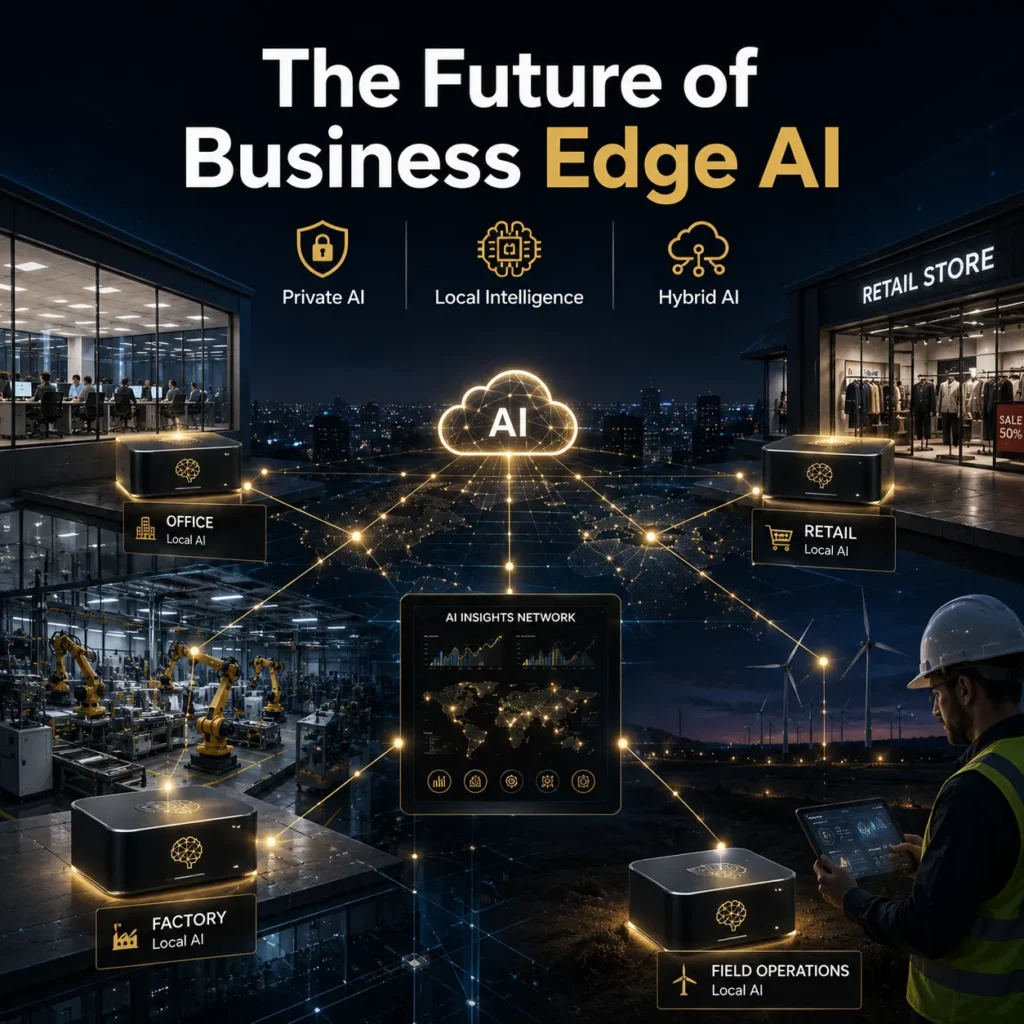
CrossShores Infotech believes the future of AI will be hybrid rather than exclusively cloud-based or entirely local.
In this model:
- Cloud AI handles large-scale processing and advanced reasoning.
- Edge AI supports operational workflows and real-time assistance.
- Local AI protects sensitive business information and reduces dependency on external infrastructure.
As language models become more efficient and hardware continues improving, businesses will gain more flexibility in deciding where AI should operate.
The result is likely to be a distributed AI ecosystem where organizations choose the most appropriate deployment model for each workload rather than relying on a single approach.
Key Takeaway
The future of AI is shifting toward flexibility, control, and practical deployment. Based on industry trends and deployment observations, CrossShores Infotech sees growing demand for private AI systems, localized intelligence, and hybrid AI strategies. As edge hardware and lightweight models continue advancing, Raspberry Pi-powered AI solutions are expected to play an increasingly important role in business operations.
13. Frequently Asked Questions About Raspberry Pi AI Business Applications
13.1 Can Raspberry Pi Run AI Models for Real Business Applications?
Yes. Modern Raspberry Pi devices, especially the Raspberry Pi 5, can run lightweight AI models for many business use cases. While they are not designed to replace enterprise GPU servers, they can effectively support knowledge assistants, document search systems, retail kiosks, customer support tools, and other edge AI workloads.
13.2 What Are the Best Raspberry Pi AI Business Applications?
Some of the most practical applications include:
- Internal knowledge assistants
- Customer support automation
- Retail information kiosks
- Employee onboarding systems
- Manufacturing troubleshooting assistants
- Document search platforms
- Field service support tools
These use cases benefit from local processing, low latency, and improved privacy.
13.3 Is Raspberry Pi 5 Powerful Enough for Business AI?
For many targeted AI workloads, yes.
A Raspberry Pi 5 with 8GB RAM, SSD storage, and proper cooling can run quantized language models efficiently. The key is selecting the right model and matching it to the business use case rather than attempting to run very large models designed for data-center hardware.
13.4 Why Are Businesses Interested in Offline AI?
Businesses are adopting offline AI because it offers:
- Better data privacy
- Lower long-term costs
- Reduced internet dependency
- Faster local responses
- Greater operational control
These benefits are especially valuable in industries where sensitive information and reliability are critical.
13.5 Can Raspberry Pi Replace Cloud AI?
No. Raspberry Pi and cloud AI serve different purposes.
Cloud AI is better suited for large-scale workloads, advanced reasoning tasks, and high-volume deployments. Raspberry Pi-based AI solutions work best for focused business applications where privacy, cost control, and local processing are priorities.
Many organizations achieve the best results by combining both approaches.
13.6 Which AI Models Work Best on Raspberry Pi?
Lightweight and quantized models generally perform best.
Popular options include:
- Gemma
- Phi
- TinyLlama
- Qwen
- Mistral (smaller quantized variants)
Model selection should always align with the specific business requirement.
13.7 Is Local AI More Secure Than Cloud AI?
Local AI can provide stronger data control because information remains within the organization’s environment. However, security still depends on proper device management, access controls, updates, and governance practices.
Local deployment improves privacy, but it is not a substitute for good security policies.
13.8 How Much Does It Cost to Deploy AI on Raspberry Pi?
Costs vary based on hardware configuration and project requirements.
A typical deployment may include:
- Raspberry Pi 5
- SSD storage
- Active cooling
- Power supply
Compared to recurring cloud AI expenses, many businesses find local deployment more predictable and cost-effective for ongoing workloads.
13.9 Are Raspberry Pi AI Business Applications Suitable for Small Businesses?
Absolutely.
Small businesses often benefit the most because they can experiment with AI without investing in expensive infrastructure. Internal support assistants, document search tools, and customer information systems are common starting points.
13.10 What Is the Future of Raspberry Pi AI Business Applications?
The future is promising as AI models continue becoming smaller and more efficient.
Advances in:
- Quantization
- Edge AI hardware
- Local inference frameworks
- Lightweight language models
are making business AI more accessible than ever. Over time, more organizations are likely to deploy AI directly at the edge rather than relying exclusively on cloud infrastructure.
14. Conclusion: Why Raspberry Pi AI Business Applications Matter More Than Ever
The growth of AI is creating new opportunities for businesses, but it is also forcing organizations to rethink how AI should be deployed. While cloud platforms remain important, many companies are discovering that not every workload requires expensive infrastructure or constant internet connectivity.
This is where Raspberry Pi AI business applications offer a compelling alternative. By combining affordable hardware with efficient models such as Gemma 4, businesses can build intelligent systems that operate locally, protect sensitive information, and deliver predictable operating costs.
From customer support and retail assistance to manufacturing operations and field workforce enablement, local AI is proving that practical business value does not always require massive computing resources. Instead, success often comes from deploying the right model in the right environment and solving specific operational challenges.
According to CrossShores Infotech’s perspective on edge AI adoption, the future of business AI will not be exclusively cloud-based or entirely local. The most effective organizations will combine both approaches, using cloud AI where scale is required and edge AI where privacy, speed, and reliability deliver the greatest value.
As lightweight language models continue to evolve, businesses that explore local AI today will be better positioned to build efficient, secure, and scalable AI solutions tomorrow.