


Contents
- 1 Introduction
- 2 2. The Biggest UI Design Trends Shaping Modern Digital Experiences
- 3 3. Why These UI Design Trends Matter for Business Growth
- 4 4. What Businesses Often Get Wrong About UI Design
- 5 5. CrossShore Infotech’s Perspective: The Future of UI Design
- 6 6. Frequently Asked Questions
- 6.1 1. What are the most important UI design trends today?
- 6.2 2. How does AI-powered personalization improve user experience?
- 6.3 3. What is glassmorphism in UI design?
- 6.4 4. Why are conversational interfaces becoming more popular?
- 6.5 5. How do microinteractions improve usability?
- 6.6 6. Why is accessibility important in UI design?
- 6.7 7. What is the difference between UI and UX design?
- 6.8 8. How does UI design affect conversion rates?
- 6.9 9. Why are minimal interfaces becoming more common?
- 6.10 10. How can businesses keep up with changing UI design trends?
- 7 7. Conclusion: Great UI Makes Technology Feel Invisible
Introduction
1.1 Users Expect More Than Attractive Interfaces
Think about the apps and websites you use every day. Chances are, you rarely notice their design. You simply open them, complete your task, and move on.
That’s the real goal of great UI design.
Users no longer judge digital products solely by their visual appearance. They judge them by how quickly they can accomplish what they came to do. If an interface feels confusing, slow, or overwhelming, users won’t spend time figuring it out-they’ll leave.
As a result, businesses are rethinking how they approach user experience. The focus is shifting from creating visually impressive interfaces to building experiences that feel intuitive, responsive, and effortless.
1.2 The Shift Toward Effortless Digital Experiences
The most successful digital products share a common trait: they remove friction.
Whether someone is shopping online, using a mobile app, managing a subscription, or interacting with business software, they expect every action to feel natural. They want interfaces that guide them, anticipate their needs, and simplify decision-making.
This is where modern UI design trends are making the biggest impact.
From AI-powered personalization and conversational interfaces to accessibility-first design and meaningful microinteractions, today’s trends are focused on improving usability rather than adding complexity.
The result is a new generation of digital experiences that feel smarter, faster, and more user-centric.
Quick Insight
The future of UI design isn’t about adding more features or visual effects. It’s about helping users achieve their goals with less effort.
In the sections ahead, we’ll explore the UI design trends that are reshaping digital products and why businesses that embrace them are creating stronger user experiences, higher engagement, and better long-term results.
2. The Biggest UI Design Trends Shaping Modern Digital Experiences
User expectations continue to evolve, and businesses must evolve with them. The most impactful UI design trends are not simply changing how digital products look-they are transforming how users interact with technology.
The following trends are helping businesses create faster, smarter, and more engaging digital experiences.
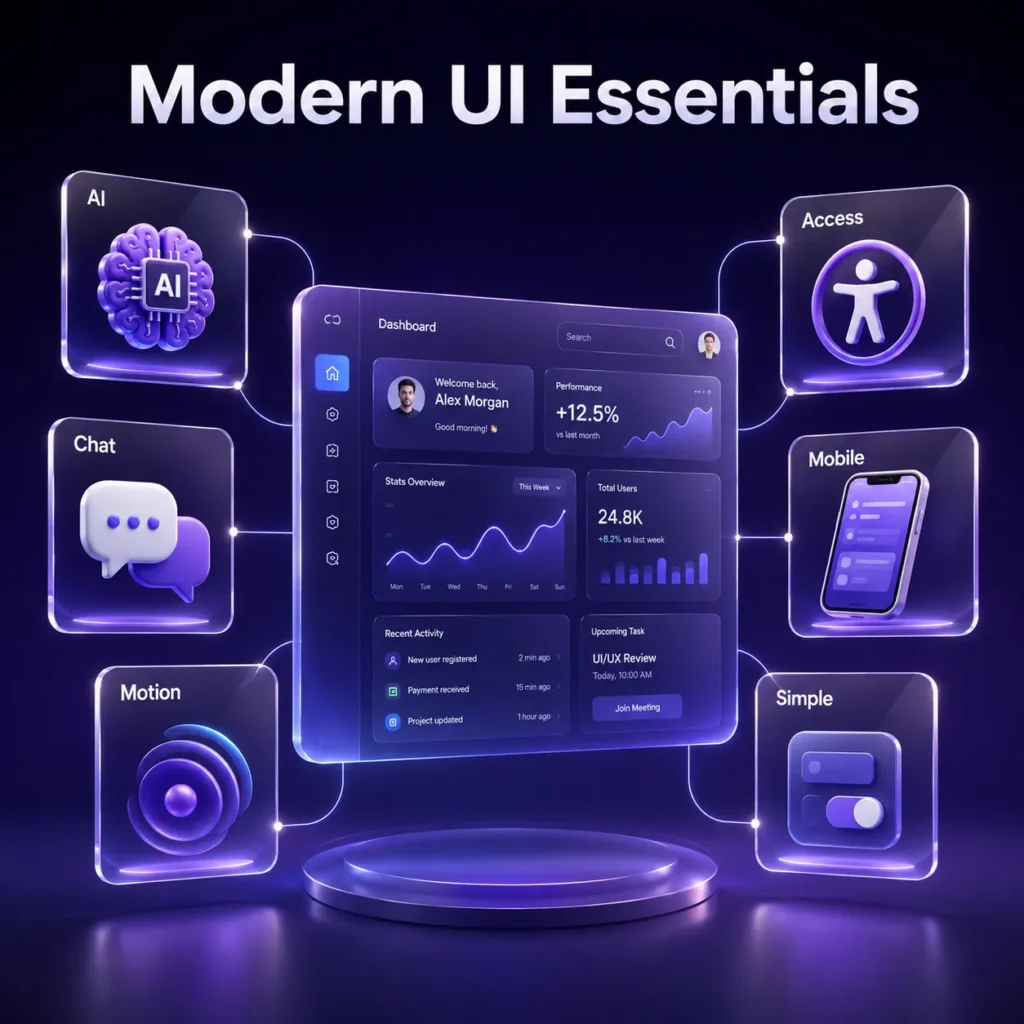
2.1 AI-Powered Personalization
Modern interfaces are becoming more adaptive.
Instead of presenting the same experience to every user, AI-powered personalization tailors content, recommendations, and workflows based on individual behavior and preferences.
Common examples include:
- Personalized product recommendations
- Smart content suggestions
- Adaptive dashboards
- Context-aware user journeys
When implemented effectively, personalization reduces friction and helps users find what they need more quickly.
2.2 Modern Glassmorphism
Glassmorphism continues to influence contemporary interface design by adding depth without creating visual clutter.
This approach uses:
- Subtle transparency
- Soft shadows
- Layered elements
- Clean visual hierarchy
When used thoughtfully, glassmorphism creates a premium user experience while maintaining readability and usability.
2.3 Purpose-Driven Microinteractions
Small design details often have a significant impact on user experience.
Microinteractions provide immediate feedback when users perform actions such as:
- Submitting a form
- Completing a payment
- Saving information
- Receiving notifications
These subtle interactions make interfaces feel more responsive and help users understand what is happening at every step.
2.4 Conversational Interfaces
Users are becoming increasingly comfortable interacting through natural language.
From AI assistants and chatbots to search experiences powered by prompts, conversational interfaces simplify complex interactions and reduce learning curves.
Instead of navigating multiple menus, users can simply ask for what they need.
This trend is becoming especially important in customer support, business applications, and AI-powered platforms.
2.5 Seamless Multi-Platform Experiences
Users move between devices constantly.
They may begin a task on a smartphone, continue on a laptop, and finish on a tablet.
Modern UI design focuses on creating consistent experiences across:
- Websites
- Mobile applications
- Business software
- Customer portals
Consistency improves usability and strengthens user trust.
2.6 Accessibility-First Design
Accessibility is no longer an optional consideration.
Designing for accessibility helps ensure that digital products are usable by a wider range of people, including those with visual, auditory, motor, or cognitive challenges.
Accessibility-first design often leads to better usability for all users, not just those with specific needs.
2.7 Minimal Interfaces, Maximum Impact
One of the strongest trends in modern design is simplicity.
Users prefer interfaces that eliminate distractions and focus attention on the most important actions.
Successful products achieve this by:
- Reducing unnecessary elements
- Simplifying navigation
- Prioritizing clarity
- Creating intuitive workflows
The goal is not to remove functionality but to make functionality easier to access.
Key Takeaway
The most successful UI design trends share a common goal: reducing friction. Whether through personalization, accessibility, conversational experiences, or cleaner layouts, modern interfaces are increasingly focused on helping users achieve their goals faster and with less effort.
3. Why These UI Design Trends Matter for Business Growth
Great design does more than improve aesthetics-it directly influences how users interact with a product. When users can navigate an interface easily, complete tasks quickly, and enjoy a frictionless experience, businesses often see measurable improvements in engagement, retention, and conversions.
Modern UI design trends are gaining attention because they help solve real business challenges, not just design challenges.
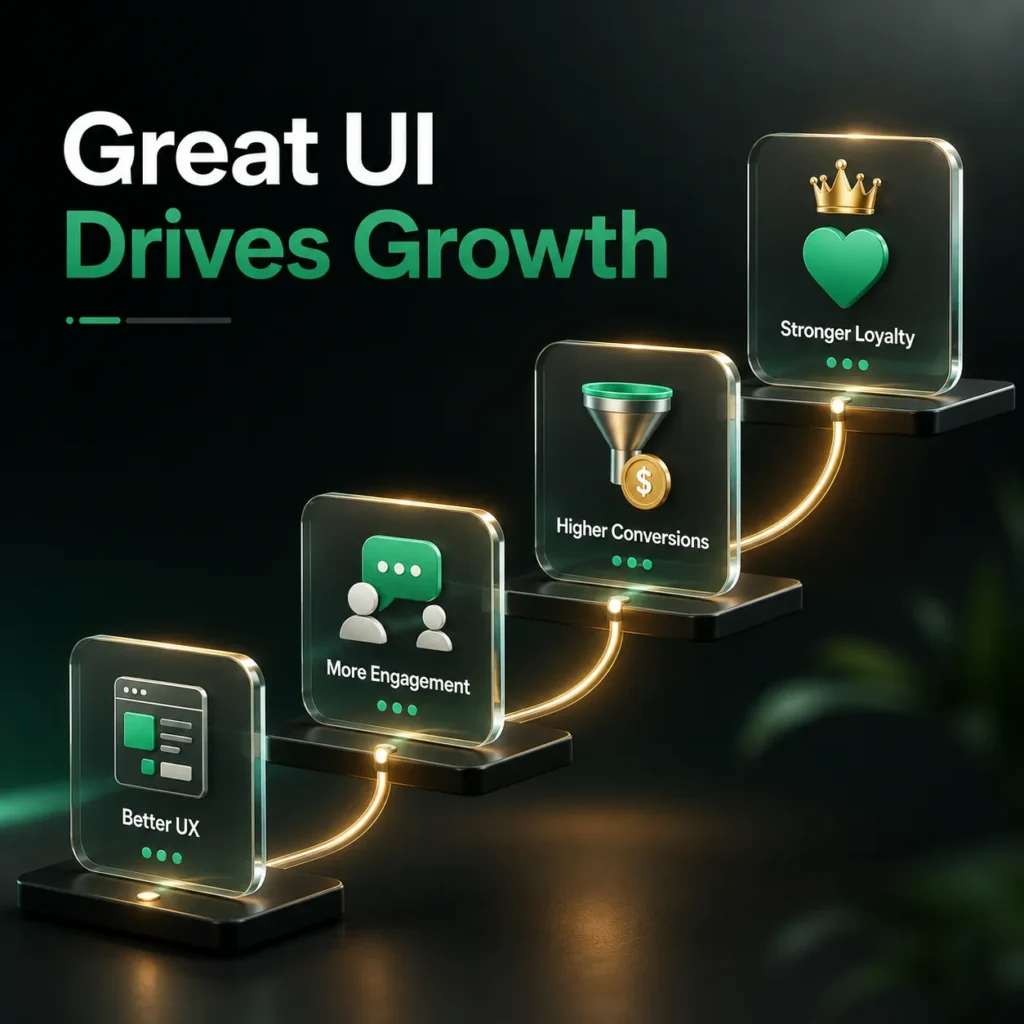
3.1 Better User Engagement
Users spend more time with products that feel intuitive and responsive.
Features such as AI-powered personalization, conversational interfaces, and thoughtful microinteractions help create experiences that feel tailored to individual users. When people can find what they need quickly, they are more likely to continue using the product.
Higher engagement often leads to:
- More active users
- Increased session duration
- Better feature adoption
- Stronger customer satisfaction
3.2 Higher Conversion Rates
Every extra click, confusing screen, or unnecessary step can reduce conversions.
Modern UI approaches focus on removing friction from critical user journeys. Whether it’s completing a purchase, signing up for a service, or submitting a form, a streamlined interface makes it easier for users to take action.
Businesses that prioritize usability often benefit from:
- Improved lead generation
- Higher sales conversions
- Reduced cart abandonment
- Better onboarding completion rates
A simple user experience frequently outperforms a feature-heavy but confusing one.
3.3 Stronger Customer Retention
Acquiring users is expensive. Keeping them is where long-term growth happens.
When users consistently have positive experiences, they are more likely to return. Accessibility-first design, cross-platform consistency, and intuitive navigation all contribute to stronger customer loyalty.
Products that are easy to use become part of a user’s routine. Over time, this creates trust, strengthens brand perception, and increases customer lifetime value.
Quick Insight
The most successful digital products are not always the ones with the most features. They are the ones that help users achieve their goals with the least amount of effort.
That’s why modern UI design is increasingly viewed as a business strategy rather than simply a design discipline.
4. What Businesses Often Get Wrong About UI Design
Many businesses invest heavily in design but still struggle with user engagement, conversions, or customer retention. The problem is rarely a lack of effort. More often, it’s a misunderstanding of what users actually need.
The best interfaces are not necessarily the most visually impressive. They are the ones that help users achieve their goals quickly and confidently.
4.1 Designing for Aesthetics Instead of Usability
A visually stunning interface may attract attention, but it won’t keep users engaged if it is difficult to use.
Businesses sometimes prioritize trendy visuals, complex animations, or unique layouts at the expense of usability. While these elements can enhance a design, they should never create friction.
Users care less about how impressive an interface looks and more about how easily they can complete a task.
A successful design balances creativity with functionality.
4.2 Ignoring Accessibility
Accessibility is often treated as a secondary consideration, even though it affects a significant portion of users.
Poor contrast, unreadable text, confusing navigation, and keyboard accessibility issues can create barriers that prevent people from using a product effectively.
Designing for accessibility benefits everyone. Clearer navigation, better readability, and simpler interactions improve the experience for all users, not just those with specific accessibility needs.
4.3 Adding Features That Create Friction
More features do not always create a better product.
As products evolve, businesses often continue adding tools, menus, options, and workflows. Over time, this can make an interface feel overwhelming.
When users are presented with too many choices, decision-making becomes harder.
Modern UI design focuses on reducing cognitive load by:
- Simplifying navigation
- Highlighting primary actions
- Removing unnecessary complexity
- Creating clear user journeys
The goal is not to offer fewer capabilities. The goal is to make important capabilities easier to find and use.
Quick Insight
Many UI problems are not caused by poor design. They are caused by unnecessary complexity.
The most successful digital products focus on clarity, usability, and user goals rather than trying to impress users with excessive features or visual effects.
5. CrossShore Infotech’s Perspective: The Future of UI Design
UI design continues to evolve, but one principle remains constant: users value simplicity.
As digital products become more sophisticated, the challenge is no longer adding new features. The challenge is creating experiences that help users achieve their goals without unnecessary effort.
At CrossShore Infotech, we believe the future of UI design lies in balancing innovation with usability. The most successful products are not those with the most advanced interfaces-they are the ones that feel natural from the very first interaction.
5.1 Design Must Solve Problems, Not Just Look Good
Many businesses still view UI design primarily as a visual exercise. While appearance matters, effective design begins with understanding user behavior.
Every design decision should answer a simple question:
Does this make the experience easier for the user?
When design focuses on solving real problems, users complete tasks faster, experience less frustration, and develop greater trust in the product.
5.2 The Growing Role of AI in User Experience
Artificial intelligence is becoming an important part of modern user experiences.
From personalized recommendations to conversational interfaces, AI is helping products become more adaptive and responsive to individual users.
However, successful implementation requires balance. Users want helpful experiences, not overwhelming automation.
The most effective AI-powered interfaces work quietly in the background, guiding users without adding complexity.
5.3 Simplicity Will Become a Competitive Advantage
As digital products continue to compete for attention, simplicity is becoming a differentiator.
Users increasingly prefer products that:
- Are easy to learn
- Require fewer steps
- Provide clear guidance
- Deliver consistent experiences
Businesses that prioritize usability are often rewarded with higher engagement, stronger customer loyalty, and improved conversion rates.
This is why many of today’s most successful products focus less on adding features and more on removing friction.
Key Takeaway
The future of UI design is not about creating more complex interfaces. It is about creating smarter, simpler, and more intuitive experiences. Organizations that prioritize usability, accessibility, and user-centered design will be better positioned to meet changing user expectations and build long-term digital success.
6. Frequently Asked Questions
1. What are the most important UI design trends today?
The most influential UI design trends include AI-powered personalization, conversational interfaces, accessibility-first design, microinteractions, seamless multi-platform experiences, and minimalist interfaces. These trends focus on improving usability and reducing friction for users.
2. How does AI-powered personalization improve user experience?
AI-powered personalization adapts content, recommendations, and workflows based on user behavior. This helps users find relevant information faster and creates a more engaging digital experience.
3. What is glassmorphism in UI design?
Glassmorphism is a design style that uses transparency, layered elements, soft shadows, and blurred backgrounds to create depth while maintaining a clean and modern interface.
4. Why are conversational interfaces becoming more popular?
Users increasingly prefer natural interactions over complex navigation. Conversational interfaces allow users to complete tasks, find information, and receive support through chat and natural language prompts.
5. How do microinteractions improve usability?
Microinteractions provide instant feedback when users perform actions such as submitting forms, completing purchases, or receiving notifications. They help users understand what is happening and create a smoother experience.
6. Why is accessibility important in UI design?
Accessibility ensures digital products can be used by people with different abilities and needs. Accessible interfaces improve usability, expand audience reach, and often create better experiences for all users.
7. What is the difference between UI and UX design?
UI (User Interface) design focuses on the visual and interactive elements of a product, while UX (User Experience) design focuses on the overall user journey and how users interact with the product.
8. How does UI design affect conversion rates?
Good UI design removes friction from user journeys, making it easier for users to complete desired actions such as signing up, making purchases, or submitting inquiries. This often leads to higher conversion rates.
9. Why are minimal interfaces becoming more common?
Minimal interfaces reduce distractions and help users focus on important actions. By simplifying navigation and removing unnecessary elements, businesses can improve usability and decision-making.
10. How can businesses keep up with changing UI design trends?
Businesses should focus on user needs rather than chasing every design trend. Regular user research, usability testing, accessibility improvements, and thoughtful adoption of new technologies help create long-lasting digital experiences.
7. Conclusion: Great UI Makes Technology Feel Invisible
The most successful digital products are not defined by flashy visuals or complex features. They succeed because they make interactions feel natural, intuitive, and effortless. When users can achieve their goals without confusion or friction, design becomes almost invisible-and that is often the hallmark of a great user experience.
The UI design trends discussed in this article reflect a broader shift toward user-centered experiences. AI-powered personalization, conversational interfaces, accessibility-first design, meaningful microinteractions, and simplified interfaces all share a common objective: helping users accomplish more with less effort.
For businesses, this presents a significant opportunity. Better user experiences can lead to higher engagement, improved conversion rates, stronger customer retention, and greater customer satisfaction. As user expectations continue to evolve, organizations that prioritize usability over complexity will be better positioned to stand out in increasingly competitive digital markets.
At CrossShore Infotech, we believe effective UI design is not about following every trend. It is about understanding user needs, removing friction, and creating experiences that deliver real value. The future belongs to products that are not only visually appealing but also easy, intuitive, and enjoyable to use.
Ultimately, great UI is no longer just a design advantage-it is a business advantage.