


Contents
- 1 1. Introduction: Why Businesses Need More Than Chatbots
- 2 2. What Are AI Agents?
- 3 3. What Makes AI Agents Different?
- 4 4. AI Agents for Business Automation: Real-World Use Cases
- 5 AI Agents Across Business Functions
- 6 5. AI Agents vs Chatbots: Understanding the Difference
- 7 6. Benefits of AI Agents for Modern Businesses
- 8 7. Challenges Businesses Should Consider Before Adopting AI Agents
- 9 8. CrossShores Infotech’s Perspective: Building AI That Takes Action
- 10 Frequently Asked Questions (FAQs)
- 11 Conclusion: The Future of Business AI Is Intelligent Action
1. Introduction: Why Businesses Need More Than Chatbots
What if AI could do more than answer questions and actually complete work on your behalf?
Imagine a customer reporting a delayed order. Instead of simply replying with an update, AI verifies inventory, checks shipping status, reschedules delivery, creates a support ticket, notifies the logistics team, and sends a personalized confirmation automatically.
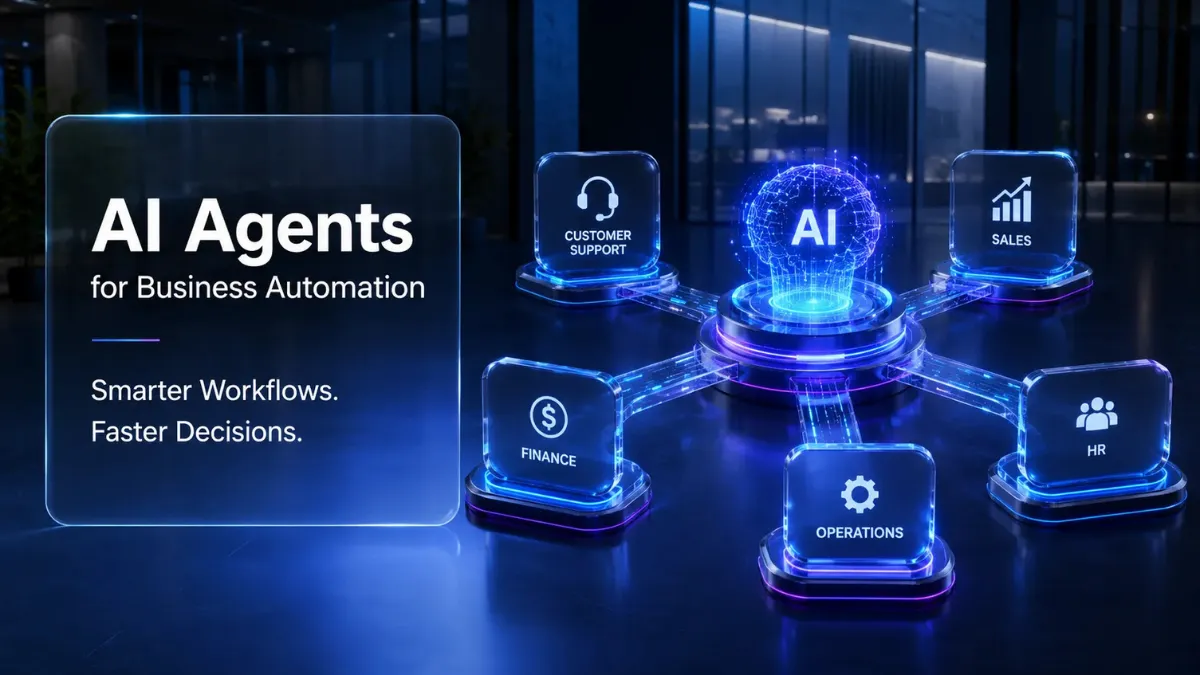
That shift from conversation to execution is why AI agents for business automation are becoming a strategic priority for modern organizations.
Unlike traditional chatbots that follow predefined conversation flows, AI agents can reason, plan, interact with multiple business systems, and complete multi-step workflows with minimal human intervention. They function less like virtual assistants and more like intelligent digital teammates.
From customer support and sales to HR, finance, and operations, Businesses are increasingly adopting AI agents to reduce repetitive work, improve decision-making, and create faster, more connected digital experiences through custom AI solutions.
Quick Answer
AI agents for business automation are intelligent software systems that analyze information, make decisions, and execute complete business workflows across multiple applications instead of simply generating responses.
AI Agents at a Glance
| Aspect | Description |
|---|---|
| Primary Purpose | Automate end-to-end business workflows |
| Core Capability | Reasoning, planning, and execution |
| Common Integrations | CRM, ERP, Help Desk, HRMS, Finance Systems |
| Best Use Cases | Customer support, sales, HR, finance, operations |
| Business Benefit | Reduced manual work and faster decision-making |
Businesses are moving beyond conversational AI because productivity no longer depends on receiving better answers it depends on completing more work with greater accuracy and speed.
In this guide, you’ll learn how AI agents work, how they differ from chatbots, where organizations are using them today, and why AI agents for business automation are becoming the foundation of intelligent enterprise operations.
Key Takeaway
AI is evolving from a communication tool into an execution engine. Organizations that adopt AI agents strategically can automate complex workflows, improve operational efficiency, and enable employees to focus on higher-value work.
Businesses have used automation for years, but most traditional systems follow fixed rules and predefined workflows. They can perform repetitive tasks, yet they struggle when situations change or decisions require context.
2. What Are AI Agents?
Organizations investing in AI-powered business solutions are moving beyond simple automation to intelligent workflow execution.
Instead of simply responding to instructions, AI agents continuously evaluate available data and determine the most effective action, making them valuable across customer support, sales, HR, finance, and operations.
Quick Answer
AI agents are intelligent software systems that can understand objectives, make decisions, and execute multi-step workflows across business applications with minimal human intervention.
Unlike traditional chatbots, they don’t stop after generating a response; they continue working until the business objective is completed.
2.1 How AI Agents Differ from Traditional Chatbots
At first glance, chatbots and AI agents may appear similar because both interact using natural language. However, their capabilities and business value are fundamentally different.
A chatbot is designed to answer questions and guide conversations based on predefined rules or AI-generated responses.
An AI agent is designed to achieve a goal.
For example, if a customer asks about a delayed shipment, a chatbot may provide the latest tracking information. An AI agent can verify inventory, identify the cause of the delay, update delivery estimates, notify the customer, create a support ticket, and alert the logistics team all within a single workflow.
This ability to move from conversation to execution is what makes AI agents a powerful business technology.
AI Agent vs Chatbot
| Capability | Chatbot | AI Agent |
|---|---|---|
| Primary Purpose | Answer questions | Complete business goals |
| Decision Making | Rule-based or prompt-based | Context-aware reasoning |
| Workflow Execution | Limited | Multi-step automation |
| Business Integrations | Basic | CRM, ERP, Help Desk, APIs |
| Adaptability | Low | High |
| Best Use Case | FAQs and support | End-to-end business automation |
2.2 Why Businesses Are Adopting AI Agents
Organizations today operate across dozens of connected platforms, generating vast amounts of operational data every day.
Managing these workflows manually slows productivity and increases the risk of errors.
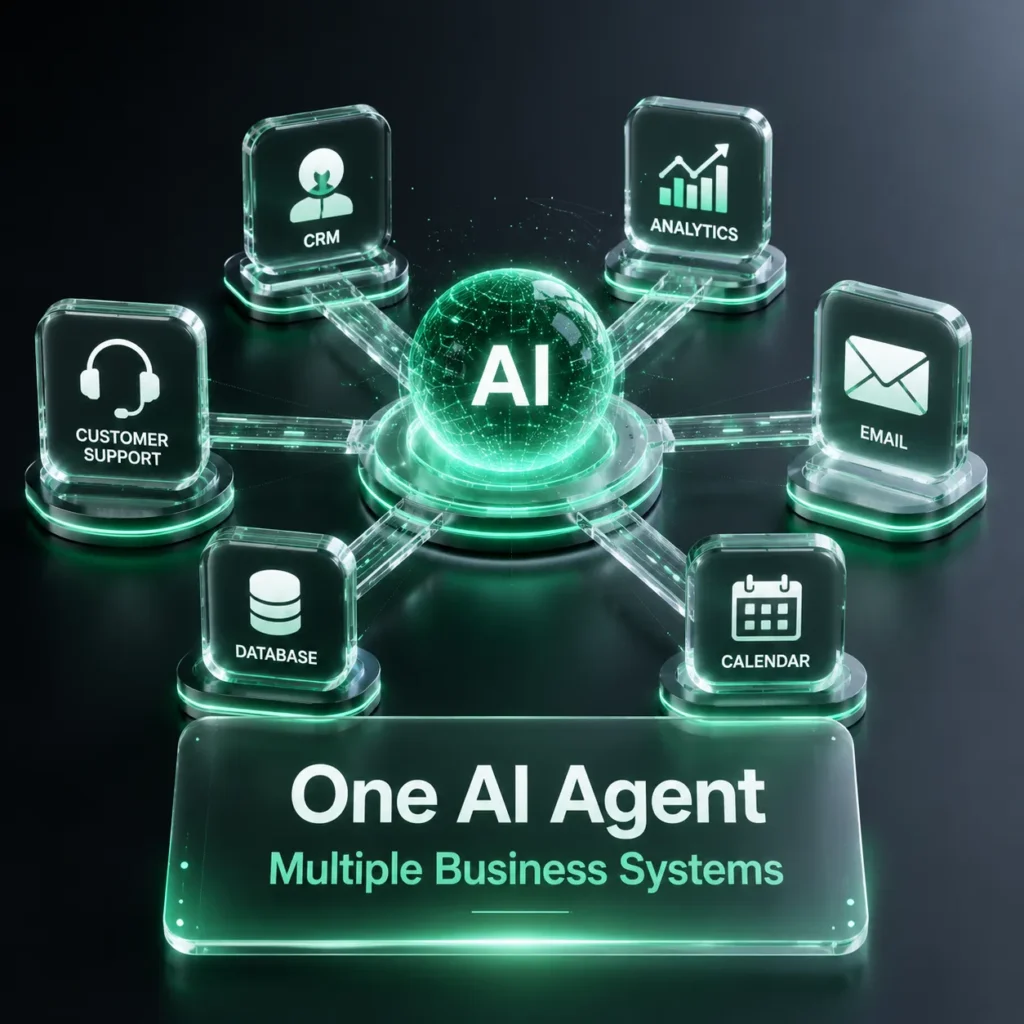
AI agents for business automation help solve this challenge by connecting systems, interpreting business context, and executing repetitive processes automatically.
Instead of switching between multiple applications, employees can delegate routine tasks to AI agents while focusing on strategic initiatives, customer relationships, and innovation.
This shift improves operational efficiency while creating faster and more consistent business processes.
2.3 When a Chatbot Is Still the Better Choice
Despite the growing adoption of AI agents, chatbots continue to play an important role in digital experiences.
If the objective is answering frequently asked questions, collecting basic information, or providing instant customer assistance, a chatbot remains a practical and cost-effective solution.
AI agents become valuable when organizations need intelligent decision-making, workflow automation, and integration across multiple business systems.
Rather than replacing chatbots, many businesses combine both technologies.
The chatbot handles the conversation, while the AI agent executes the work behind the scenes.
Key Takeaway
Choosing between a chatbot and an AI agent is not about selecting newer technology, it’s about selecting the right tool for the business objective.
Chatbots improve communication, while AI agents for business automation improve execution, productivity, and operational efficiency.
3. What Makes AI Agents Different?
Many automation tools can follow instructions, but very few can understand an objective and determine the best way to achieve it.
That’s the defining characteristic of AI agents for business automation.
Instead of waiting for step-by-step commands, AI agents analyze available information, evaluate multiple possibilities, interact with business systems, and execute actions that move a workflow toward a desired outcome. This combination of reasoning, planning, and execution makes them fundamentally different from traditional automation and conversational AI.
Quick Answer
AI agents combine reasoning, planning, context awareness, and workflow execution to complete business objectives instead of simply responding to prompts or following fixed rules.
This capability allows organizations to automate complex processes that previously required continuous human involvement.
3.1 Goal-Oriented Decision Making
Traditional automation is designed around predefined rules.
If a condition changes or an unexpected situation occurs, the workflow usually stops until someone intervenes.
AI agents operate differently. They begin with a business objective and continuously evaluate the best path to achieve it.
Consider an online retailer facing a stock shortage.
Rather than generating an error message, an AI agent can verify inventory across warehouses, identify alternative products, update delivery timelines, notify the customer, and inform the procurement team, all while keeping the workflow moving.
This goal-driven approach makes AI agents valuable for dynamic business environments where decisions depend on real-time information instead of static rules.
3.2 Planning and Multi-Step Execution
Business operations rarely consist of a single action.
A refund request, employee onboarding process, or sales inquiry often involves multiple applications, approvals, and teams.
AI agents for business automation can coordinate these connected activities without requiring manual supervision.
For example, a customer refund may involve:
- Verifying purchase history
- Checking eligibility rules
- Processing the refund
- Updating the CRM
- Notifying the finance team
- Sending confirmation to the customer
Instead of treating these as separate tasks, AI agents execute them as one continuous workflow.
How AI Agents Process a Business Workflow
| Workflow Stage | AI Agent Action |
|---|---|
| Understand Goal | Identifies the business objective |
| Collect Information | Retrieves data from connected systems |
| Analyze Context | Evaluates available options |
| Make Decision | Selects the best next action |
| Execute Workflow | Completes tasks across applications |
| Monitor Results | Adjusts actions if conditions change |
This structured decision-making process enables organizations to automate workflows that extend far beyond simple task automation.
3.3 Learning from Context and Data
Business decisions depend on context.
The same customer inquiry may require a different response depending on purchase history, support interactions, account status, or inventory availability.
AI agents continuously combine information from multiple business systems to create a more complete understanding before taking action.
Rather than relying on isolated data points, they can connect information from:
- CRM platforms
- ERP systems
- Help desk software
- Knowledge bases
- Internal databases
- Communication tools
This contextual awareness improves decision quality while reducing unnecessary manual reviews and repetitive work.
For example, a sales AI agent can automatically prioritize high-value leads, recommend personalized follow-ups, update pipeline records, and schedule meetings based on customer behavior, all within a single workflow.
Why These Capabilities Matter
Organizations are moving beyond simple automation because modern business processes require adaptability, collaboration, and intelligent decision-making.
The combination of reasoning, planning, execution, and contextual understanding allows AI agents for business automation to automate entire workflows instead of isolated tasks.
As businesses continue to integrate AI into daily operations, these capabilities will become essential for improving productivity, reducing operational complexity, and delivering better customer experiences.
Key Takeaway
The biggest advantage of AI agents is not their ability to generate answers, it’s their ability to understand business objectives, make informed decisions, and execute complete workflows across connected systems. This shift from conversation to intelligent action is what defines the next generation of business automation.
4. AI Agents for Business Automation: Real-World Use Cases
Businesses investing in digital transformation services are increasingly using AI agents to streamline operations across departments.
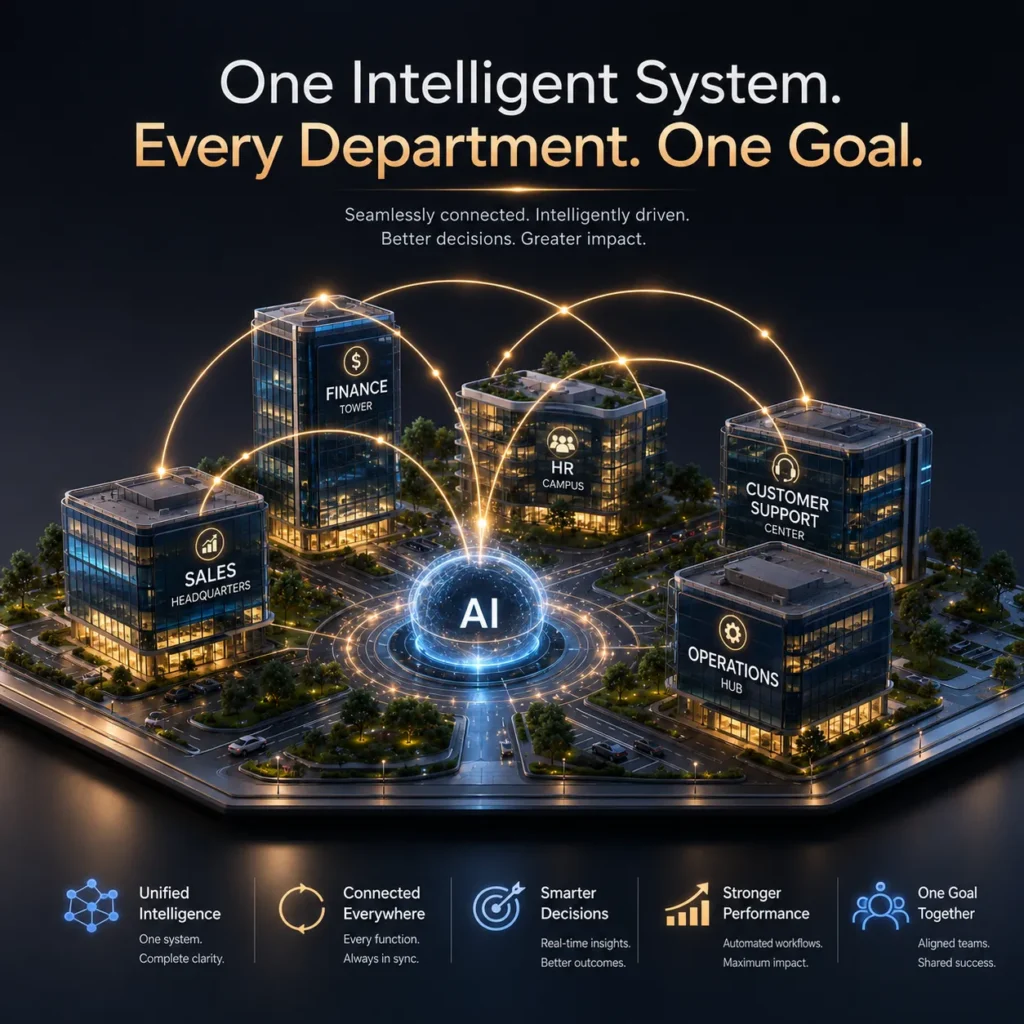
The biggest advantage of AI agents for business automation is their ability to integrate multiple applications, analyze context, and complete workflows end-to-end. Instead of assisting with a single task, AI agents can coordinate entire business processes while adapting to changing conditions.
Quick Answer
AI agents for business automation automate end-to-end workflows across customer support, sales, HR, finance, and operations by combining reasoning, decision-making, and intelligent execution.
This allows organizations to improve productivity while enabling employees to focus on strategic and customer-facing activities.
4.1 Customer Support
Customer expectations continue to evolve. People no longer want quick replies, they want quick resolutions.
Traditional chatbots can answer common questions, but AI agents can investigate issues, retrieve information from connected systems, and complete the entire support process.
For example, when a customer reports a delayed shipment, an AI agent can verify order details, check warehouse inventory, update delivery estimates, notify the logistics team, create a support ticket, and send a personalized confirmation without requiring multiple human interactions.
The result is faster resolution, consistent communication, and a better overall customer experience.
4.2 Sales and Lead Management
Sales teams often spend valuable time updating CRM records, qualifying leads, scheduling meetings, and following up with prospects.
AI agents transform this process by acting as intelligent sales assistants.
They can analyze customer behavior, prioritize high-value opportunities, generate personalized follow-ups, update pipeline data, and automatically schedule meetings based on availability.
Instead of replacing sales professionals, AI agents reduce administrative work, allowing teams to focus on building relationships and closing deals.
4.3 Human Resources and Employee Experience
Human Resources departments manage hundreds of repetitive requests every month, from onboarding and policy questions to leave approvals and document collection.
AI agents streamline these workflows by providing employees with immediate assistance while automating administrative processes behind the scenes.
A new employee, for example, can receive onboarding guidance, complete required documentation, access training materials, and schedule orientation sessions through a single AI-powered workflow.
This creates a more consistent employee experience while reducing manual effort for HR teams.
4.4 Finance and Business Operations
Accuracy and speed are critical in financial operations.
AI agents can process invoices, verify expense reports, reconcile data across systems, generate business reports, and route approvals automatically while maintaining audit trails and compliance requirements.
Because they integrate with multiple enterprise applications, AI agents help finance teams reduce repetitive work and improve operational visibility without disrupting existing processes.
AI Agents Across Business Functions
| Business Function | AI Agent Example | Primary Business Value |
|---|---|---|
| Customer Support | Resolve tickets and update customers | Faster issue resolution |
| Sales | Qualify leads and automate follow-ups | Higher productivity |
| Human Resources | Employee onboarding and policy assistance | Better employee experience |
| Finance | Invoice processing and approvals | Improved accuracy and compliance |
| Operations | Multi-system workflow coordination | Increased operational efficiency |
Why Businesses Are Investing in AI Agents
Organizations are adopting AI agents because they bridge the gap between communication and execution.
Rather than automating isolated tasks, AI agents for business automation create connected workflows that improve collaboration across departments, reduce manual effort, and accelerate decision-making.
As AI capabilities continue to evolve, businesses that integrate intelligent agents into their daily operations will be better positioned to scale efficiently while delivering faster, more personalized experiences for customers and employees.
Key Takeaway
The most successful AI implementations are no longer focused on generating better responses, they’re focused on completing meaningful work. From customer support and sales to HR, finance, and operations, AI agents for business automation are helping organizations transform disconnected processes into intelligent, end-to-end workflows.
5. AI Agents vs Chatbots: Understanding the Difference
Businesses often use the terms AI agent and chatbot interchangeably, but they solve different problems.
A chatbot is designed to communicate with users by answering questions, providing information, or guiding conversations. An AI agent goes beyond communication by understanding objectives, making decisions, interacting with multiple systems, and completing business workflows.
Understanding this distinction helps organizations choose the right technology for their automation strategy.
Quick Answer
A chatbot focuses on conversations, while an AI agent focuses on achieving business goals through reasoning, planning, and multi-step execution.
For simple customer interactions, a chatbot may be sufficient. For complex workflows involving multiple applications and business rules, AI agents provide significantly greater value.
AI Agent vs Chatbot: Side-by-Side Comparison
| Feature | Chatbot | AI Agent |
|---|---|---|
| Primary Purpose | Answer questions and guide conversations | Complete business workflows and achieve goals |
| Decision Making | Rule-based or prompt-driven | Context-aware and goal-oriented |
| Workflow Execution | Limited to predefined actions | Multi-step autonomous execution |
| Business Integrations | Basic APIs or knowledge bases | CRM, ERP, Help Desk, HRMS, Finance systems |
| Context Awareness | Session-based | Cross-system contextual understanding |
| Adaptability | Responds to user input | Continuously evaluates and adjusts actions |
| Best Business Use | FAQs, customer support, lead capture | Intelligent automation and workflow orchestration |
| Human Involvement | Frequently required | Primarily for oversight and exceptions |
5.1 When a Chatbot Is the Right Choice
Not every business needs an AI agent.
If the objective is answering frequently asked questions, providing product information, collecting customer details, or offering 24/7 support, a chatbot remains a practical and cost-effective solution.
For many organizations, chatbots improve customer communication without requiring complex integrations or advanced automation.
5.2 When AI Agents Deliver Greater Value
As business processes become more connected, organizations need systems that can do more than generate responses.
AI agents for business automation can retrieve information from multiple applications, evaluate business context, execute tasks, and monitor outcomes without requiring continuous human input.
For example, instead of simply informing a customer that an order is delayed, an AI agent can investigate the issue, identify alternative inventory, update delivery timelines, notify internal teams, and communicate the resolution automatically.
This ability transforms AI from a conversational interface into an operational partner.
5.3 Can Businesses Use Both Together?
In many cases, the most effective strategy is combining chatbots and AI agents.
A chatbot acts as the customer-facing interface, while an AI agent works behind the scenes to complete workflows and coordinate business operations.
Example Workflow
A customer asks:
“Can I reschedule my delivery?”
The chatbot understands the request and forwards it to an AI agent.
The AI agent then:
- Verifies the order
- Checks delivery availability
- Updates the schedule
- Notifies the logistics team
- Sends confirmation to the customer
- Updates the CRM automatically
The customer experiences a simple conversation, while the AI agent manages the entire workflow.
Why This Difference Matters
As organizations continue their digital transformation journey, success will depend on automating complete business processes rather than isolated conversations.
That’s why AI agents for business automation are becoming a strategic investment across customer support, sales, HR, finance, and operations.
Businesses that combine conversational AI with intelligent workflow execution can improve efficiency, reduce manual work, and deliver more seamless customer experiences.
Key Takeaway
Chatbots help businesses communicate more effectively, while AI agents help businesses operate more intelligently. Rather than competing technologies, they work best together, chatbots handling conversations and AI agents executing the actions that drive real business outcomes.
6. Benefits of AI Agents for Modern Businesses
Every business wants to improve productivity, reduce operational costs, and deliver better customer experiences. The challenge is achieving these goals without increasing manual work or adding unnecessary complexity.
That’s where AI agents for business automation create measurable value.
Unlike traditional automation tools that perform isolated tasks, AI agents connect data, applications, and workflows to execute complete business processes. They help organizations move faster, make smarter decisions, and scale operations while allowing employees to focus on strategic work.
Quick Answer
AI agents improve business performance by automating repetitive workflows, accelerating decision-making, enhancing customer experiences, and enabling scalable operations across multiple departments.
Rather than replacing people, AI agents act as intelligent digital teammates that handle routine processes with speed and consistency.
6.1 Reduced Manual Work and Higher Productivity
Many business teams spend a significant portion of their day updating records, transferring information between applications, creating reports, or responding to repetitive requests.
AI agents eliminate much of this administrative workload by executing connected workflows automatically. Businesses investing in custom AI development services can further streamline operations by integrating intelligent automation with their existing digital ecosystem.
For example, instead of manually updating a CRM after every customer interaction, an AI agent can capture conversation details, update records, assign follow-up tasks, and notify the appropriate team all within seconds.
This allows employees to dedicate more time to innovation, collaboration, and customer relationships rather than repetitive operations.
6.2 Faster and Smarter Decision-Making
Modern organizations generate data from dozens of systems, making it difficult to identify the right action quickly.
AI agents analyze information from multiple sources, understand business context, and recommend or execute the next best step in real time.
Whether prioritizing support tickets, identifying high-value sales opportunities, or detecting operational bottlenecks, AI agents help businesses respond faster with greater confidence.
The result is improved agility and more informed decision-making across the organization.
6.3 Better Customer and Employee Experiences
Speed and personalization have become essential expectations.
Customers expect immediate resolutions, while employees expect simple and efficient internal processes.
AI agents for business automation improve both experiences by eliminating delays and automating repetitive interactions.
Instead of waiting for multiple approvals or switching between departments, users receive faster responses, more consistent communication, and smoother workflows.
This creates stronger customer satisfaction while improving employee productivity and engagement.
6.4 Scalable and Connected Business Operations
As businesses grow, manual processes become increasingly difficult to manage.
Hiring additional resources for every operational task is rarely sustainable.
AI agents provide a scalable alternative by connecting CRM platforms, ERP systems, help desks, HR software, and communication tools into one intelligent workflow.
Instead of automating individual tasks, they automate complete business processes that continue to operate consistently as organizations expand.
Business Benefits at a Glance
| Business Challenge | How AI Agents Solve It | Business Outcome |
|---|---|---|
| Repetitive manual tasks | Intelligent workflow automation | Higher productivity |
| Slow decision-making | Real-time analysis and execution | Faster operations |
| Disconnected business systems | Cross-platform integrations | Better collaboration |
| Inconsistent customer service | Context-aware automation | Improved customer experience |
| Scaling business operations | Autonomous multi-step workflows | Sustainable growth |
Why Businesses Are Investing in AI Agents
Organizations are no longer measuring AI success by the number of questions it can answer.
They are measuring success by the amount of meaningful work it can complete.
This is why AI agents for business automation are becoming an essential part of digital transformation strategies across industries. They reduce operational friction, improve collaboration, and create intelligent workflows that adapt to changing business needs.
Companies that embrace AI agents today are building more agile, efficient, and customer-centric organizations prepared for the next generation of business operations.
Key Takeaway
The greatest benefit of AI agents is their ability to transform disconnected tasks into connected workflows. By combining reasoning, planning, and execution, AI agents for business automation help organizations increase productivity, improve decision-making, enhance customer experiences, and scale operations without adding unnecessary complexity.
7. Challenges Businesses Should Consider Before Adopting AI Agents
AI agents have the potential to transform business operations, but successful implementation depends on more than choosing the right technology. Organizations must also establish clear governance, secure integrations, and well-defined workflows to ensure AI delivers reliable and measurable business outcomes.
The most effective AI agents for business automation are designed to work alongside people, existing systems, and business policies rather than operating in isolation.
Quick Answer
The biggest challenges of implementing AI agents include data security, system integration, governance, and maintaining human oversight for business-critical decisions.
Addressing these areas early helps organizations build intelligent automation that is scalable, secure, and aligned with business objectives.
7.1 Data Security and Governance
AI agents often interact with sensitive business information, including customer records, financial data, employee details, and internal documents.
Without proper governance, organizations risk exposing confidential information or creating inconsistent workflows.
A well-designed AI strategy should include secure API connections, role-based access controls, audit logs, and compliance policies that define how AI agents access and process business data.
Security should be treated as a foundational requirement rather than an afterthought.
7.2 Human Oversight Remains Essential
AI agents are capable of reasoning and executing workflows, but they should not make every business decision independently.
Financial approvals, legal actions, contract modifications, and policy changes often require human judgment and accountability.
The most successful organizations adopt a human-in-the-loop approach, where AI handles repetitive execution while employees review high-impact decisions and manage exceptions.
This balance improves efficiency without sacrificing transparency or control.
7.3 Integration with Existing Business Systems
Most organizations already rely on multiple digital platforms, including CRM software, ERP solutions, help desks, HR systems, communication tools, and analytics platforms.
The effectiveness of AI agents for business automation depends on how seamlessly they integrate with these existing technologies.
Instead of replacing established systems, AI agents should connect them into intelligent workflows that reduce manual work and improve collaboration across departments.
Strong integration planning also minimizes implementation risks and accelerates adoption.
Common Challenges and Best Practices
| Challenge | Best Practice |
|---|---|
| Data privacy concerns | Implement role-based access and encryption |
| Inconsistent AI decisions | Define governance policies and audit trails |
| Complex system integrations | Use standardized APIs and phased deployment |
| Lack of employee trust | Maintain human oversight for critical workflows |
| Scaling automation | Start with high-impact use cases and expand gradually |
Building AI for Long-Term Success
Adopting AI is not simply a technology project-it is a business transformation initiative.
Organizations that begin with clearly defined objectives, secure integrations, and measurable success metrics are more likely to achieve sustainable results than those attempting to automate every process at once.
By treating AI as a collaborative digital teammate rather than a replacement for human expertise, businesses can create intelligent workflows that improve productivity while maintaining accountability and operational resilience.
Key Takeaway
The long-term success of AI agents for business automation depends on thoughtful implementation. Organizations that combine secure data practices, strong governance, seamless integrations, and human oversight can build AI-powered workflows that are reliable, scalable, and aligned with business goals.
8. CrossShores Infotech’s Perspective: Building AI That Takes Action
Artificial intelligence is rapidly evolving from a tool that generates responses into a technology that can execute meaningful business work.
For organizations, the real opportunity is no longer finding AI that communicates better-it’s implementing AI that can simplify operations, automate complex workflows, and help teams make faster, more informed decisions.
That’s why AI agents for business automation are becoming a strategic investment across industries, enabling businesses to move beyond isolated automation and build connected, intelligent operations.
Quick Answer
The most successful AI implementations focus on solving real business challenges by combining intelligent decision-making, secure integrations, and human oversight into scalable automation workflows.
Technology alone doesn’t create business value. The right strategy, implementation, and user experience do.
8.1 From Workflow Automation to Intelligent Operations
Traditional automation follows predefined rules and completes repetitive tasks exactly as programmed.
AI agents introduce a more adaptive approach.
They can analyze information from multiple systems, understand business context, recommend the next best action, and execute workflows while continuously responding to changing conditions.
For example, an intelligent workflow can:
- Verify customer information
- Update CRM records
- Generate internal tasks
- Notify relevant departments
- Produce reports
- Track workflow completion
Instead of managing disconnected tasks, businesses create connected operations where information flows seamlessly across teams and applications.
This shift allows organizations to improve productivity while reducing operational complexity.
8.2 How CrossShores Infotech Approaches AI Solutions
At CrossShores Infotech, we believe successful AI adoption starts with business objectives rather than technology trends.
Every organization has unique workflows, existing software investments, compliance requirements, and customer expectations. An effective AI strategy should enhance these systems instead of replacing them.
Our approach focuses on building intelligent solutions that are:
| Design Principle | Business Value |
|---|---|
| Goal-driven automation | Solves complete business processes instead of isolated tasks |
| Secure system integration | Connects CRM, ERP, HR, and business applications |
| Human-centered AI | Keeps people involved in business-critical decisions |
| Scalable architecture | Supports future growth without workflow disruption |
| User-first experiences | Makes complex processes simple and intuitive |
By combining workflow automation, intelligent decision-making, and seamless integrations, organizations can create AI-powered operations that improve efficiency while maintaining transparency and control.
Looking Beyond Conversations
The next generation of business AI will not be defined by how naturally it communicates.
It will be defined by how effectively it collaborates with people, connects systems, and completes meaningful work.
As businesses continue investing in digital transformation, AI agents for business automation will become intelligent operational partners capable of supporting customer service, sales, HR, finance, and enterprise workflows from a single connected ecosystem.
Key Takeaway
The future of AI belongs to organizations that combine strategy, technology, and user experience to create intelligent business operations. At CrossShores Infotech, we see AI agents as digital teammates that help businesses automate workflows, improve decision-making, and build scalable, customer-focused digital experiences.
Frequently Asked Questions (FAQs)
1. What are AI agents for business automation?
AI agents for business automation are intelligent software systems that can analyze information, make decisions, and execute multi-step workflows across connected business applications. Unlike traditional chatbots, they focus on completing business objectives rather than simply generating responses, making them valuable for customer support, sales, HR, finance, and operations.
2. How are AI agents different from chatbots?
A chatbot is primarily designed to answer questions and guide conversations, while an AI agent is designed to achieve a goal. AI agents can retrieve data, interact with multiple systems, make context-aware decisions, and complete workflows without requiring continuous human intervention.
3. Which business processes can AI agents automate?
AI agents can automate a wide range of business processes, including customer support, lead qualification, employee onboarding, invoice processing, CRM updates, workflow approvals, appointment scheduling, and internal reporting. Their ability to connect multiple systems makes them suitable for end-to-end workflow automation.
4. Can small businesses benefit from AI agents?
Yes. AI agents are no longer limited to large enterprises. Small and growing businesses can use AI agents to automate repetitive tasks, improve customer experiences, streamline internal operations, and increase productivity without significantly expanding their workforce.
5. Are AI agents secure for enterprise use?
AI agents can be highly secure when implemented with proper governance, encrypted data exchange, role-based access controls, audit logging, and secure API integrations. Organizations should establish clear security policies and maintain human oversight for business-critical decisions.
6. Will AI agents replace human employees?
AI agents are designed to complement human expertise rather than replace it. They automate repetitive and time-consuming workflows, allowing employees to focus on strategic thinking, creativity, collaboration, and customer relationships that require human judgment.
7. Can AI agents integrate with existing business software?
Yes. Modern AI agents are built to integrate with CRM platforms, ERP systems, HR software, help desks, communication tools, and other enterprise applications. This enables organizations to create connected workflows without replacing their existing technology investments.
8. What is the future of AI agents for business automation?
AI agents are expected to become intelligent digital teammates capable of managing increasingly complex workflows across departments. As organizations continue investing in automation and AI, these systems will play a central role in improving productivity, decision-making, and operational efficiency.
Conclusion: The Future of Business AI Is Intelligent Action
Artificial intelligence is entering a new phase where success is measured not by the quality of a conversation but by the ability to complete meaningful work.
Throughout this guide, we’ve explored how AI agents for business automation differ from traditional chatbots, automate complex workflows, improve decision-making, and create more connected business operations. From customer support and sales to HR, finance, and enterprise processes, AI agents are helping organizations transform repetitive tasks into intelligent, scalable workflows.
| Key Insight | Business Impact |
|---|---|
| AI agents execute workflows | Reduced manual effort |
| Goal-oriented decision making | Faster and smarter operations |
| Multi-system integration | Connected business processes |
| Human + AI collaboration | Better productivity and governance |
| Intelligent automation | Scalable digital transformation |
Businesses that approach AI strategically combining secure integrations, thoughtful governance, and human oversight will be better positioned to build resilient and future-ready operations.
At CrossShores Infotech, we believe the next generation of business innovation will be powered by intelligent systems that don’t just respond to requests but actively help organizations achieve their goals. By combining AI expertise, modern software development, and user-centric design, businesses can create digital experiences that are smarter, faster, and built for long-term growth.