


Contents
- 1 Introduction: Why AI Is Redefining UX Research
- 2 2. What Is AI in UX Research?
- 3 3. Why Traditional UX Research Is Evolving
- 4 4. How AI Is Transforming UX Research
- 5 5. AI vs Traditional UX Research: What’s the Difference?
- 5.1 AI vs Traditional UX Research Comparison
- 5.2 Where Traditional UX Research Still Excels
- 5.3 Where AI Creates the Biggest Impact
- 5.4 The Most Effective Approach: Human + AI
- 5.5 Human Researchers Contribute
- 5.6 AI Contributes
- 5.7 Business Impact Comparison
- 5.8 Why Businesses Are Adopting AI-Powered Research
- 6 6. Benefits of AI in UX Research for Businesses and Product Teams
- 6.1 6.1 Faster Decision-Making
- 6.2 6.2 Better Personalization
- 6.3 6.3 Improved Usability Testing
- 6.4 6.4 Scalable Research Across Global Audiences
- 6.5 6.5 Data-Driven Product Development
- 6.6 Business Benefits at a Glance
- 6.7 Traditional Research vs AI-Assisted Research Outcomes
- 6.8 Why Businesses Are Investing in AI-Powered UX Research
- 7 CrossShores Infotech’s Perspective
- 8 7. Challenges and Best Practices for AI-Powered UX Research
- 8.1 7.1 AI Cannot Replace Human Empathy
- 8.2 7.2 Data Quality Determines Research Quality
- 8.3 7.3 Privacy and Ethical Research Matter More Than Ever
- 8.4 7.4 Avoid Over-Reliance on Automation
- 8.5 Best Practices for AI-Powered UX Research
- 8.6 Common Mistakes Businesses Should Avoid
- 8.7 AI + Human Collaboration: The Future of UX Research
- 8.8 CrossShores Infotech’s Perspective
- 9 8. CrossShores Infotech’s Perspective: Building Smarter Digital Experiences with AI-Powered UX Research
- 10 Frequently Asked Questions (FAQs)
- 11 Conclusion: The Future of UX Research Is AI-Assisted, Not AI-Replaced
Introduction: Why AI Is Redefining UX Research
What if you could understand thousands of users in the time it takes to review a single survey?
That’s exactly what AI in UX research is making possible.
Instead of spending weeks analyzing interviews, usability tests, and customer feedback, product teams can now uncover patterns, identify pain points, and generate actionable insights within minutes. The result is faster decision-making, smarter product strategies, and digital experiences built around real user behavior.
But AI isn’t replacing UX researchers.
It’s eliminating repetitive analysis so designers and researchers can focus on what matters most: understanding people and solving their problems.
Quick Answer
AI in UX research uses artificial intelligence to analyze user behavior, automate research tasks, summarize feedback, and generate data-driven insights that help businesses create better user experiences faster and at scale.
From startups building their first app to enterprises optimizing complex digital products, organizations are increasingly adopting AI in UX research to improve usability, personalize experiences, and accelerate innovation.
In this guide, you’ll learn how AI is transforming UX research, its biggest benefits and challenges, practical business applications, and why the future of user experience is powered by intelligent insights and human creativity working together.
2. What Is AI in UX Research?
User experience has always been about understanding people’s goals, frustrations, behaviors, and expectations. The better a business understands its users, the better products it can build.
However, as digital products generate millions of interactions every day, manually analyzing user data has become increasingly difficult. This is exactly where AI in UX research is creating a significant shift.
Quick Answer
AI in UX research is the use of artificial intelligence and machine learning to analyze user behavior, automate research tasks, identify patterns, summarize feedback, and generate actionable insights that help create better digital experiences.
Rather than replacing UX researchers, AI acts as an intelligent assistant that accelerates research and supports data-driven design decisions.
How AI Supports Modern UX Research
Traditional UX research often involves collecting information from multiple sources:
- User interviews
- Surveys
- Heatmaps
- Session recordings
- Product analytics
- Customer support conversations
- Usability testing
While these methods provide valuable insights, manually processing thousands of data points takes time and resources.
AI in UX research simplifies this process by automatically organizing and analyzing large datasets, allowing product teams to identify trends much faster.
For example, instead of reading hundreds of customer comments individually, AI can group similar responses, detect recurring pain points, measure sentiment, and highlight the most important findings within minutes.
This allows researchers to spend less time analyzing data and more time improving user experiences.
From Raw Data to Actionable Insights
Collecting user data is only the first step.
The real value comes from understanding what that data means.
AI-powered research tools transform scattered information into clear recommendations by identifying:
- Frequently occurring usability issues
- Navigation bottlenecks
- User intent patterns
- Customer sentiment
- Feature adoption trends
- Drop-off points in user journeys
Instead of presenting endless spreadsheets, AI delivers prioritized insights that help teams make faster and more confident product decisions.
What Makes AI Different from Traditional Research Tools?
Most traditional analytics platforms answer questions like:
- How many users visited a page?
- How long did they stay?
- Where did they click?
AI in UX research goes one step further.
It connects multiple data sources, understands behavioral relationships, and explains why users behave the way they do.
For example:
A traditional analytics tool might report that 40% of users abandon a checkout page.
An AI-powered research system can identify that users consistently abandon the process after encountering a confusing payment option, summarize related support tickets, detect negative survey sentiment, and recommend design improvements.
This deeper level of analysis helps businesses move from observation to action much more quickly.
Traditional UX Research vs AI-Powered UX Research
| Traditional UX Research | AI-Powered UX Research |
|---|---|
| Manual data analysis | Automated insight generation |
| Time-intensive reporting | Instant research summaries |
| Small sample evaluation | Large-scale behavioral analysis |
| Reactive decision-making | Predictive user insights |
| Separate data sources | Connected research ecosystem |
This evolution enables organizations to scale research without sacrificing quality or user understanding.
Why Product Teams Are Embracing AI
Today’s product teams are expected to deliver continuous improvements while responding to rapidly changing customer expectations.
Waiting weeks for research findings can slow innovation and delay critical business decisions.
By integrating AI in UX research into their workflow, organizations can:
- Discover usability issues earlier
- Validate design decisions with real data
- Prioritize features more effectively
- Improve accessibility and personalization
- Reduce manual research effort
- Accelerate product development cycles
The result is a faster research process that remains focused on delivering exceptional user experiences.
Key Takeaway
AI in UX research is not about replacing human creativity or empathy. It is about enhancing the research process through intelligent automation, advanced behavioral analysis, and faster insight discovery.
As AI-powered UX research continues to evolve, businesses that combine human expertise with data-driven intelligence will be better positioned to create intuitive, user-centric digital products that meet the expectations of modern users.
3. Why Traditional UX Research Is Evolving
Understanding users has always been the foundation of successful digital products. From startups to enterprise organizations, UX research helps teams validate ideas, identify usability issues, and build experiences that genuinely solve user problems.
However, the digital landscape has changed dramatically. Users interact with websites, mobile apps, AI assistants, smart devices, and multiple digital touchpoints every day, generating enormous amounts of behavioral data.
Traditional research methods remain valuable, but they are no longer sufficient on their own. This is why AI in UX research is becoming an essential part of modern product development.
3.1 Manual Analysis Takes Time
A typical UX research project involves collecting interviews, survey responses, usability recordings, heatmaps, analytics reports, and customer feedback.
While this information is incredibly valuable, manually reviewing thousands of data points requires significant time and resources.
Researchers often spend days or even weeks:
- Organizing research data
- Categorizing responses
- Identifying recurring patterns
- Writing reports
- Prioritizing findings
This slows down decision-making and delays product improvements.
By using AI in UX research, teams can automatically process large datasets, summarize findings, and identify high-impact usability issues within minutes instead of weeks.
3.2 Modern Products Generate Massive Amounts of Data
Today’s digital products continuously collect information from multiple sources:
- Website interactions
- Mobile app sessions
- Customer support tickets
- Product analytics
- User feedback forms
- Live chat conversations
- Session recordings
- Heatmaps
Analyzing this volume of information manually is becoming increasingly impractical.
AI-powered research systems excel at recognizing hidden relationships across thousands of interactions simultaneously.
Instead of reviewing every individual data point, researchers receive organized insights that highlight:
- Common user frustrations
- Navigation bottlenecks
- Feature adoption patterns
- Frequently requested improvements
- Behavioral trends
This enables faster and more informed product decisions.
3.3 User Expectations Continue to Grow
Modern users expect digital products to be:
- Fast
- Personalized
- Accessible
- Consistent across devices
- Easy to navigate
Even small usability issues can increase bounce rates, reduce engagement, and impact customer satisfaction.
Traditional research often identifies these problems after users have already experienced them.
With AI in UX research, product teams can continuously monitor user behavior and detect emerging friction points before they become significant business problems.
This proactive approach allows organizations to improve user experiences more efficiently.
Traditional Research vs AI-Assisted Research
| Research Challenge | Traditional Approach | AI-Assisted Approach |
|---|---|---|
| Data Analysis | Manual review of responses | Automated pattern recognition |
| Research Speed | Days or weeks | Minutes or hours |
| Sample Size | Limited participants | Thousands of interactions |
| Insight Discovery | Researcher-dependent | AI-powered trend detection |
| Decision Support | Static reports | Real-time actionable insights |
The goal is not to replace researchers but to give them better tools for discovering meaningful patterns.
The Shift from Data Collection to Insight Discovery
For years, UX research focused primarily on gathering information.
Today, competitive advantage comes from discovering insights faster than competitors.
Organizations that successfully adopt AI in UX research spend less time sorting spreadsheets and more time answering critical questions:
- Why are users abandoning a workflow?
- Which feature creates the most friction?
- What improvements will have the biggest impact?
- Which user segments require a different experience?
AI accelerates this discovery process while allowing researchers to apply human judgment, empathy, and strategic thinking to every decision.
Key Takeaway
Traditional UX research is not disappearing it is evolving.
The combination of human expertise and AI in UX research enables teams to analyze larger datasets, uncover deeper behavioral insights, and make faster product decisions without sacrificing user-centered thinking.
As digital experiences become increasingly complex, businesses that embrace AI-assisted research will be better equipped to create products that are intuitive, scalable, and designed around real user needs.
4. How AI Is Transforming UX Research
The biggest advantage of AI in UX research is not that it makes research automatic, it’s that it makes research smarter.
Instead of spending hours collecting and organizing information, UX teams can focus on interpreting insights and designing better experiences. AI analyzes massive amounts of qualitative and quantitative data in real time, helping businesses identify opportunities that would otherwise remain hidden.
From startups launching their first product to enterprises managing millions of users, AI in UX research is enabling faster decisions, more accurate findings, and highly personalized digital experiences.
4.1 Smarter User Behavior Analysis
Every user interaction tells a story.
Every click, scroll, search, tap, and navigation path provides valuable information about how people use a product.
Traditionally, identifying meaningful patterns required researchers to manually review heatmaps, session recordings, and analytics dashboards.
With AI in UX research, machine learning algorithms automatically detect:
- Frequently used features
- Navigation patterns
- User frustrations
- Drop-off points
- Engagement trends
- Conversion bottlenecks
Instead of looking at individual sessions, AI analyzes thousands of interactions simultaneously and highlights the behaviors that matter most.
Example
An e-commerce website notices declining conversions.
Traditional analytics show users leaving the checkout page.
AI-powered analysis discovers that mobile users repeatedly tap a disabled coupon field before abandoning their carts.
The insight immediately points designers toward a simple UX improvement.
4.2 Instant Research Summaries
One of the most time-consuming parts of UX research is reviewing qualitative feedback.
Researchers often spend days reading:
- Survey responses
- Customer reviews
- Interview transcripts
- Support conversations
- Open-ended feedback
AI dramatically reduces this effort.
Instead of manually categorizing hundreds of comments, AI in UX research automatically groups similar responses, identifies recurring themes, and generates concise research summaries.
Example
Rather than reviewing 1,000 survey responses individually, AI might summarize the findings as:
- 42% users struggle with navigation
- 31% request faster onboarding
- 18% report confusion during payment
- 9% mention accessibility improvements
Researchers receive actionable insights within minutes instead of days.
4.3 Predictive User Insights
Traditional UX research explains what users did.
AI helps predict what users are likely to do next.
By analyzing historical behavior, engagement patterns, and user journeys, AI identifies potential friction points before they negatively impact the user experience.
This allows product teams to move from reactive improvements to proactive design decisions.
AI can predict:
- Potential churn
- Feature adoption rates
- Navigation difficulties
- Customer drop-offs
- Personalization opportunities
This predictive capability enables businesses to optimize digital products before problems become widespread.
4.4 Faster Usability Testing
Usability testing remains one of the most valuable research methods.
However, manually reviewing dozens of recorded sessions takes significant time.
With AI in UX research, usability testing becomes faster and more scalable.
AI automatically identifies:
- Repeated clicks
- User hesitation
- Navigation loops
- Confusing interfaces
- Long task completion times
- Abandoned workflows
Researchers can immediately focus on the most critical usability issues instead of reviewing every session from beginning to end.
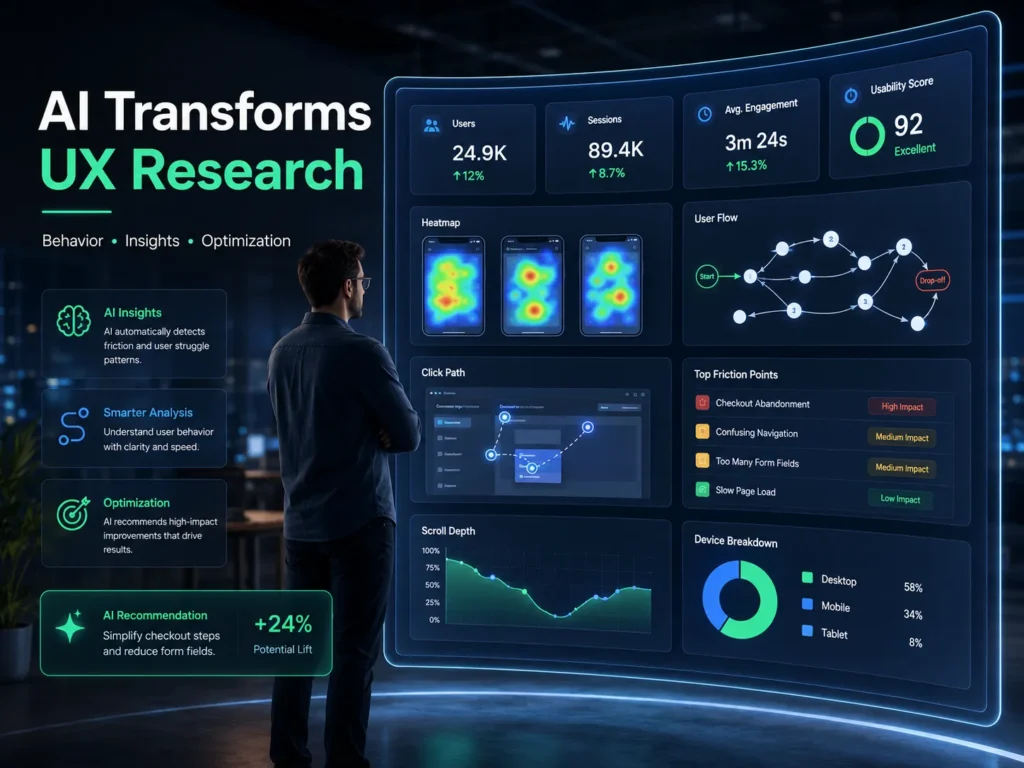
AI-powered usability testing identifies friction points, but creating an exceptional user experience also depends on applying modern interface principles. Explore our guide on UI Design Trends That Are Shaping Modern Digital Experiences to discover how today’s leading design trends improve usability, accessibility, and user engagement.
4.5 Scalable Global Research
Modern digital products serve users across multiple countries, languages, and cultures.
Conducting multilingual UX research traditionally requires separate teams, translators, and manual analysis.
AI removes many of these barriers.
It can process user feedback from different languages, identify common themes, analyze sentiment, and surface consistent usability issues across global audiences.
This makes AI in UX research particularly valuable for organizations building products for international markets.
AI-Powered UX Research at a Glance
| Research Activity | Traditional UX Research | AI-Powered UX Research |
|---|---|---|
| User Behavior Analysis | Manual observation | Automated pattern recognition |
| Survey Analysis | Individual review | Instant theme detection |
| Usability Testing | Session-by-session analysis | Automatic friction identification |
| User Insights | Historical reporting | Predictive recommendations |
| Global Research | Resource intensive | Multilingual AI analysis |
Why This Transformation Matters
AI is changing the role of UX research from data collection to intelligent decision support.
Instead of spending most of their time organizing information, researchers can dedicate more time to:
- Understanding user motivations
- Designing better experiences
- Validating business decisions
- Improving accessibility
- Creating innovative products
The result is a research process that is faster, more scalable, and more user-focused.
Key Takeaway
The future of UX research is not about replacing researchers with algorithms. It is about combining human empathy with intelligent technology.
By adopting AI in UX research, businesses can uncover deeper user insights, accelerate product development, and create digital experiences that are driven by real behavior rather than assumptions. This combination of AI-powered analysis and human-centered design is shaping the next generation of exceptional user experiences.
5. AI vs Traditional UX Research: What’s the Difference?
As user expectations continue to rise, businesses need research methods that are faster, more scalable, and capable of handling large volumes of data. While traditional UX research remains a critical part of product development, artificial intelligence is enhancing every stage of the research process.
The goal isn’t to replace researchers it’s to help them discover insights more efficiently.
AI in UX research combines automation, machine learning, and behavioral analysis to reduce repetitive tasks while allowing UX professionals to focus on strategy, creativity, and user empathy.
Quick Answer
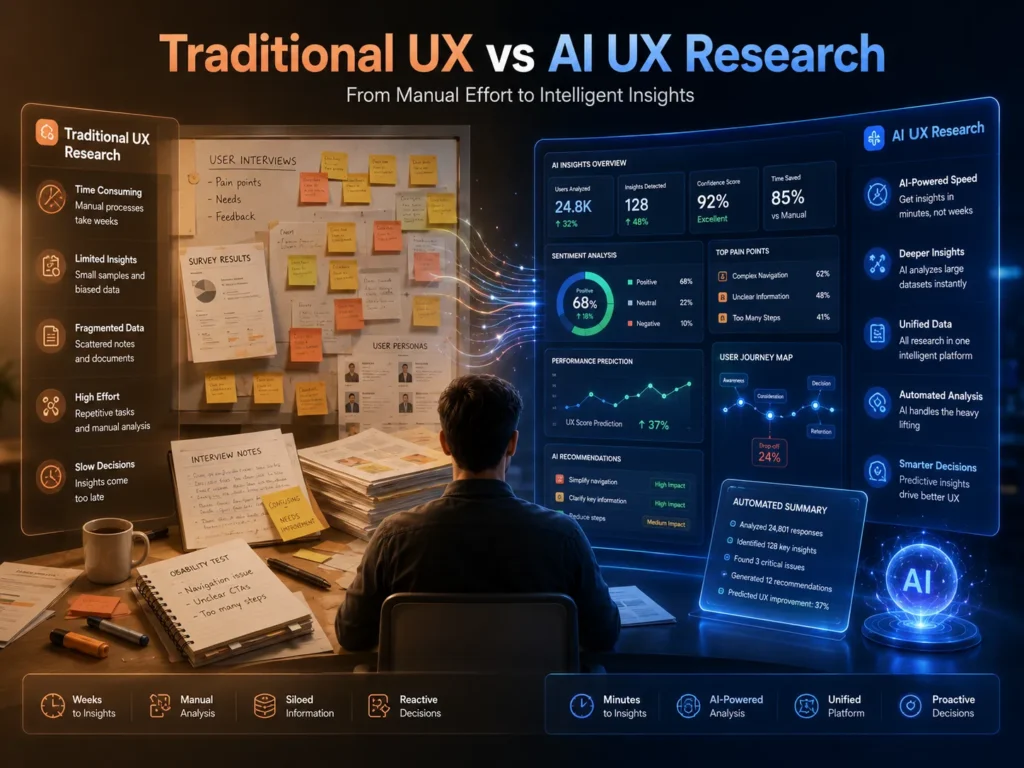
Traditional UX research relies on manual data collection and analysis, while AI in UX research automates pattern recognition, summarizes feedback, predicts user behavior, and accelerates decision-making without replacing human expertise.
AI vs Traditional UX Research Comparison
| Feature | Traditional UX Research | AI in UX Research |
|---|---|---|
| Data Analysis | Manual review and categorization | Automated pattern recognition |
| Research Speed | Days or weeks | Minutes or hours |
| Sample Size | Limited participants | Thousands or millions of interactions |
| Survey Analysis | Manual reading | Instant AI-generated summaries |
| User Behavior Analysis | Researcher observation | Machine learning insights |
| Predictive Capabilities | Limited | AI predicts future user behavior |
| Usability Testing | Session-by-session review | Automatic friction detection |
| Personalization | Manual segmentation | Dynamic user segmentation |
| Scalability | Resource intensive | Easily scales across products and markets |
| Decision Support | Historical reporting | Real-time actionable recommendations |
Where Traditional UX Research Still Excels
Despite rapid technological advancements, human researchers provide capabilities that AI cannot fully replicate.
Traditional UX research is especially valuable for:
- In-depth user interviews
- Contextual inquiry
- Emotional understanding
- Human empathy
- Cultural interpretation
- Strategic design thinking
Researchers can ask follow-up questions, observe non-verbal behavior, and uncover motivations that algorithms may not fully understand.
This human perspective remains essential for creating meaningful user experiences.
Where AI Creates the Biggest Impact
The strength of AI in UX research lies in its ability to process massive amounts of information quickly and consistently.
AI excels at:
- Identifying hidden behavioral patterns
- Summarizing thousands of survey responses
- Detecting usability issues automatically
- Finding recurring customer pain points
- Generating research reports
- Predicting user actions based on historical data
Instead of replacing researchers, AI removes repetitive analysis and allows teams to focus on solving user problems.
The Most Effective Approach: Human + AI
The highest-performing product teams don’t choose between traditional research and AI.
They combine both.
Human Researchers Contribute
- Empathy
- Creativity
- Critical thinking
- Contextual understanding
- Strategic decision-making
AI Contributes
- Speed
- Automation
- Pattern recognition
- Large-scale analysis
- Predictive insights
Together, they create a research process that is both data-driven and human-centered.
Business Impact Comparison
| Business Goal | Traditional UX Research | AI-Powered UX Research |
|---|---|---|
| Reduce research time | Moderate | High |
| Improve product decisions | High | Very High |
| Analyze large datasets | Limited | Excellent |
| Scale global research | Challenging | Highly scalable |
| Personalize user experiences | Manual effort | AI-driven automation |
| Support continuous optimization | Periodic research | Real-time insights |
Why Businesses Are Adopting AI-Powered Research
Organizations are no longer competing only on features they compete on user experience.
Products that continuously learn from user behavior can adapt faster, improve customer satisfaction, and reduce costly design mistakes.
By integrating AI in UX research, businesses can:
- Launch products with greater confidence
- Detect usability problems earlier
- Prioritize improvements using real data
- Accelerate design iterations
- Deliver more personalized digital experiences
This creates a competitive advantage while keeping user needs at the center of every product decision.
Key Takeaway
The future of UX research is not AI versus humans.
It is AI working alongside human researchers to create smarter workflows, faster insights, and better digital products.
While traditional research provides empathy and context, AI in UX research delivers speed, scalability, and intelligent analysis. Organizations that successfully combine both approaches will be better positioned to build intuitive, user-centric experiences that evolve with changing customer expectations.
6. Benefits of AI in UX Research for Businesses and Product Teams
The value of user experience research has always been measured by one question:
Does it help create better products?
With artificial intelligence, the answer is becoming clearer than ever. AI in UX research enables organizations to analyze more data, uncover deeper insights, and make faster product decisions without compromising user-centered design principles.
Rather than replacing UX professionals, AI enhances their capabilities by automating repetitive tasks and allowing them to focus on strategy, innovation, and solving real user problems.
Quick Answer
AI in UX research helps businesses improve product decisions, accelerate usability testing, personalize user experiences, reduce manual effort, and transform large datasets into actionable insights that drive growth.
6.1 Faster Decision-Making
Traditional research projects often require days or weeks to collect, organize, and analyze user feedback.
With AI in UX research, product teams can process thousands of interactions almost instantly.
AI automatically:
- Summarizes survey responses
- Groups similar user feedback
- Detects behavioral trends
- Prioritizes usability issues
This allows businesses to make informed decisions much faster and continuously improve their products based on real user behavior.
6.2 Better Personalization
Modern users expect digital experiences tailored to their preferences.
AI analyzes browsing patterns, feature usage, navigation behavior, and engagement history to identify unique user segments.
As a result, businesses can deliver:
- Personalized dashboards
- Relevant product recommendations
- Adaptive onboarding experiences
- Customized content
- Intelligent navigation flows
By leveraging AI in UX research, organizations can create experiences that feel more intuitive and relevant for every user.
Personalization is only effective when supported by intuitive and user-friendly interfaces. That’s why staying updated with modern design principles is equally important. Read our article on UI Design Trends That Are Shaping Modern Digital Experiences to see how contemporary UI practices create more engaging digital products.
6.3 Improved Usability Testing
Usability testing is essential for identifying friction points, but reviewing hundreds of user sessions manually can be time-consuming.
AI-powered usability analysis automatically detects:
- Repeated clicks
- Navigation errors
- Long task completion times
- User hesitation
- Confusing interface elements
- High abandonment points
Instead of reviewing every recording individually, researchers receive prioritized insights that help optimize the user journey more efficiently.
6.4 Scalable Research Across Global Audiences
Digital products are built for diverse audiences across multiple countries and languages.
Managing international UX research through traditional methods often requires significant resources.
AI in UX research enables businesses to analyze multilingual feedback, identify common usability challenges, and discover global user behavior patterns from a single research workflow.
This makes research more scalable while maintaining consistency across different markets.
6.5 Data-Driven Product Development
Successful products evolve based on evidence rather than assumptions.
AI combines information from:
- Product analytics
- Customer feedback
- Support conversations
- Session recordings
- Surveys
- Heatmaps
By connecting these data sources, AI in UX research provides a comprehensive view of user behavior and helps teams prioritize improvements with greater confidence.
Business Benefits at a Glance
| Business Objective | How AI in UX Research Creates Value |
|---|---|
| Faster Product Decisions | Automates research analysis and reporting |
| Better User Experiences | Identifies usability issues early |
| Increased Personalization | Understands user behavior patterns |
| Higher Research Efficiency | Reduces manual analysis time |
| Scalable Global Research | Processes multilingual feedback quickly |
| Smarter Product Strategy | Converts data into actionable insights |
Traditional Research vs AI-Assisted Research Outcomes
| Metric | Traditional UX Research | AI in UX Research |
|---|---|---|
| Research Speed | Moderate | High |
| Data Processing Capacity | Limited | Large-scale analysis |
| Pattern Recognition | Manual | Automated |
| Continuous Optimization | Periodic | Real-time |
| Personalization | Manual segmentation | AI-driven insights |
| Research Scalability | Resource intensive | Highly scalable |
Why Businesses Are Investing in AI-Powered UX Research
Organizations today compete on experience as much as they compete on products.
Users expect interfaces that are simple, responsive, accessible, and personalized.
Businesses that integrate AI in UX research gain the ability to continuously monitor user behavior, identify emerging trends, and improve digital experiences before usability issues impact customer satisfaction.
This proactive approach leads to:
- Higher user engagement
- Better conversion rates
- Faster product iterations
- Improved customer retention
- More efficient research operations
CrossShores Infotech’s Perspective
At CrossShores Infotech, we believe that the most successful digital products are built by combining human creativity with intelligent technology.
AI provides speed, automation, and data-driven insights, while UX professionals contribute empathy, critical thinking, and strategic design expertise.
By integrating AI in UX research into product development workflows, businesses can create experiences that are not only visually appealing but also intuitive, accessible, and aligned with real user needs.
Key Takeaway
The greatest benefit of AI in UX research is not automation-it’s better decision-making.
Organizations that combine AI-powered insights with human-centered design can reduce research time, improve usability, personalize experiences, and build digital products that continuously evolve with user expectations.
As AI continues to reshape product development, businesses that embrace AI-assisted UX research will be better positioned to deliver exceptional customer experiences and sustainable long-term growth.
7. Challenges and Best Practices for AI-Powered UX Research
Artificial intelligence is transforming the way businesses understand users, but adopting AI is not simply about automating research tasks. Like any technology, AI has limitations that require thoughtful implementation and human oversight.
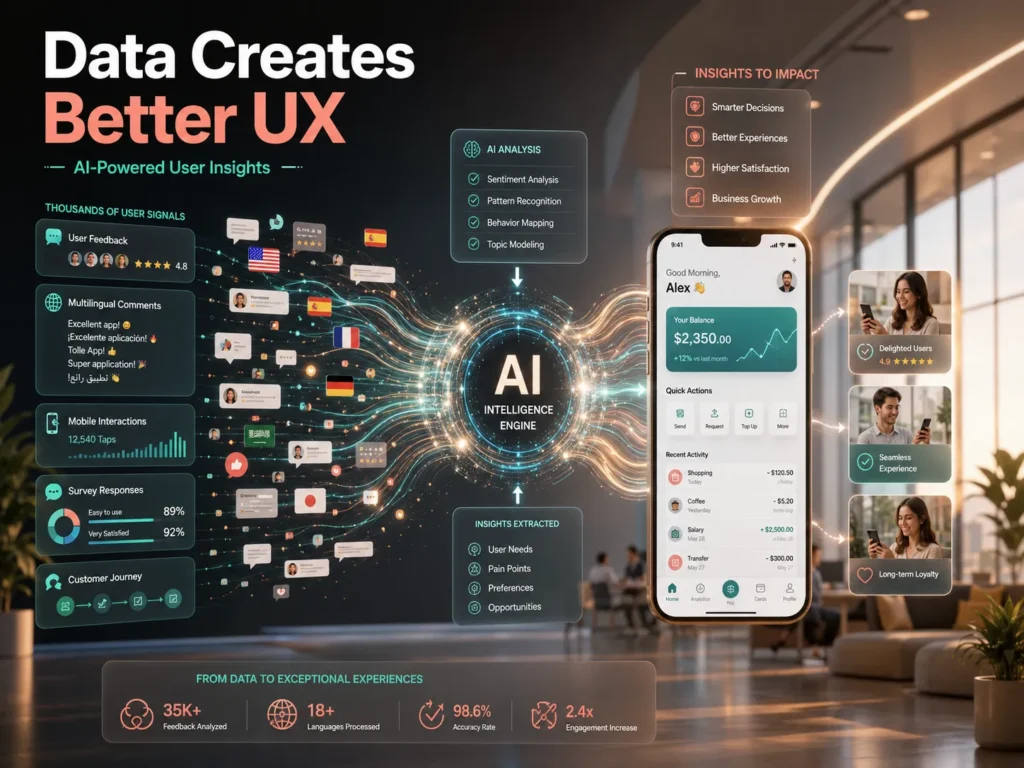
The most successful organizations use AI in UX research as a collaborative tool that enhances human expertise rather than replacing it. When AI and UX professionals work together, businesses can generate faster insights while maintaining empathy, ethical standards, and user trust.
Quick Answer
AI in UX research delivers the best results when it combines automation with human judgment, ethical data practices, continuous validation, and user-centered design principles.
7.1 AI Cannot Replace Human Empathy
AI can identify patterns, summarize feedback, and analyze user behavior at scale, but it cannot fully understand human emotions, cultural nuances, or personal experiences.
For example, AI may detect that users abandon a checkout page, but experienced UX researchers can uncover the emotional or contextual reasons behind that behavior through interviews and observation.
The most effective approach combines:
- AI for data analysis
- Human researchers for interpretation
- Designers for creative problem-solving
- Product teams for strategic decision-making
This balance ensures that products remain user-centric while benefiting from intelligent automation.
7.2 Data Quality Determines Research Quality
Artificial intelligence is only as reliable as the data it analyzes.
Incomplete datasets, outdated information, or biased user samples can produce misleading recommendations.
To improve the accuracy of AI in UX research, organizations should:
- Collect data from multiple sources
- Regularly validate research findings
- Remove duplicate or irrelevant data
- Continuously update AI models
- Compare AI insights with real user feedback
High-quality data leads to more reliable product decisions and better user experiences.
7.3 Privacy and Ethical Research Matter More Than Ever
Users expect transparency about how their information is collected and analyzed.
Businesses implementing AI in UX research should follow responsible data practices by:
- Collecting only necessary user data
- Protecting personal information
- Using anonymized research datasets
- Obtaining appropriate user consent
- Following applicable privacy regulations
Ethical AI research strengthens user trust while reducing compliance risks.
7.4 Avoid Over-Reliance on Automation
AI can significantly accelerate research, but product decisions should never depend entirely on automated recommendations.
Human validation remains essential because:
- Business goals change
- User expectations evolve
- Market conditions shift
- Cultural differences influence behavior
AI provides valuable insights, but experienced researchers determine which insights should drive design decisions.
Best Practices for AI-Powered UX Research
| Best Practice | Business Value |
|---|---|
| Combine AI with human expertise | Better strategic decisions |
| Validate AI-generated insights | Higher research accuracy |
| Use diverse research data | More representative findings |
| Prioritize user privacy | Increased customer trust |
| Continuously monitor AI performance | Reliable long-term insights |
| Test recommendations with real users | Improved product usability |
Common Mistakes Businesses Should Avoid
Many organizations adopt AI expecting instant results without establishing a research strategy.
Some of the most common mistakes include:
- Treating AI as a replacement for UX researchers
- Relying on a single data source
- Ignoring qualitative user feedback
- Making design decisions without validation
- Prioritizing automation over user needs
Avoiding these mistakes helps businesses maximize the value of AI in UX research while maintaining a strong focus on user experience.
AI + Human Collaboration: The Future of UX Research
| Human Researchers | AI-Powered Research |
|---|---|
| Empathy and emotional understanding | Large-scale data analysis |
| User interviews | Instant research summaries |
| Strategic thinking | Pattern recognition |
| Creative problem-solving | Predictive insights |
| Contextual interpretation | Automated usability analysis |
The strongest UX teams combine both capabilities instead of choosing one over the other.
CrossShores Infotech’s Perspective
At CrossShores Infotech, we believe AI should enhance human creativity, not replace it.
Our approach to AI in UX research combines intelligent automation with user-centered design thinking, ensuring every insight is supported by data while every product decision remains focused on real human needs.
This balanced methodology enables businesses to create digital experiences that are scalable, accessible, intuitive, and designed for long-term success.
Key Takeaway
The future of AI in UX research depends on responsible implementation rather than complete automation.
Organizations that combine AI-powered analysis with human empathy, ethical research practices, and continuous validation will be better equipped to understand users, improve digital experiences, and build products that deliver lasting business value.
By treating AI as a research partner instead of a replacement, businesses can unlock faster insights while preserving the human perspective that defines exceptional user experience.
8. CrossShores Infotech’s Perspective: Building Smarter Digital Experiences with AI-Powered UX Research
Great user experiences don’t happen by chance.
They are built through continuous research, thoughtful design, and a deep understanding of how people interact with technology. As digital products become more complex, businesses need faster and more intelligent ways to uncover user needs without losing the human perspective that makes great design possible.
This is where AI in UX research creates lasting business value.
Instead of replacing designers or researchers, AI acts as an intelligent partner that helps product teams analyze user behavior, validate design decisions, and optimize digital experiences with greater speed and accuracy.
Human-Centered Design Meets Artificial Intelligence
At CrossShores Infotech, we believe technology should simplify experiences rather than complicate them.
Our design philosophy combines:
- User-centered design thinking
- AI-powered research and analytics
- Data-driven product strategy
- Accessibility-first development
- Continuous usability optimization
This approach allows businesses to make informed design decisions based on real user behavior instead of assumptions.
Whether developing a SaaS platform, enterprise application, mobile app, or customer portal, integrating AI in UX research helps teams identify opportunities for improvement throughout the product lifecycle.
From Insights to Better Digital Products
Successful digital products are built through continuous learning.
AI-powered research enables organizations to:
- Identify usability issues before they impact users
- Analyze customer feedback at scale
- Prioritize features based on behavioral data
- Improve navigation and accessibility
- Personalize user experiences
- Reduce friction across critical user journeys
By combining these capabilities with human creativity and strategic thinking, businesses can build products that are intuitive, efficient, and aligned with user expectations.
Why AI-Assisted UX Research Matters for Businesses
Organizations across industries are adopting AI-powered research to accelerate innovation and improve customer satisfaction.
Some of the biggest advantages include:
| Business Need | How AI in UX Research Helps |
|---|---|
| Faster product validation | Automates research analysis and reporting |
| Better customer experiences | Detects usability issues early |
| Data-driven decision-making | Converts user behavior into actionable insights |
| Continuous product improvement | Monitors changing user expectations |
| Scalable research operations | Analyzes thousands of interactions simultaneously |
This combination of automation and human expertise enables businesses to move faster while maintaining a strong focus on usability and customer experience.
A Balanced Approach to AI and UX
Artificial intelligence is a powerful tool, but meaningful user experiences still require empathy, creativity, and strategic thinking.
At CrossShores Infotech, we see AI in UX research as an enabler rather than a replacement for designers and researchers.
AI accelerates:
- Behavioral analysis
- Pattern recognition
- Research summaries
- Predictive insights
- Large-scale usability evaluation
While UX professionals provide:
- Human empathy
- Contextual understanding
- Creative problem-solving
- Business strategy
- User-centered innovation
Together, these capabilities create digital experiences that are both intelligent and genuinely user-focused.
The Future of UX Research Is Collaborative
The next generation of digital products will not be built by AI alone or by humans working in isolation.
They will be built through collaboration between intelligent technology and experienced design teams.
Businesses that embrace AI in UX research today will be better equipped to:
- Understand evolving customer expectations
- Deliver personalized experiences
- Optimize products continuously
- Reduce research cycles
- Create digital solutions that scale with confidence
Key Takeaway
The future of user experience is not defined by automation it is defined by better understanding.
AI in UX research empowers organizations to transform vast amounts of user data into meaningful insights, while human expertise ensures those insights lead to thoughtful, accessible, and impactful digital experiences.
At CrossShores Infotech, we believe the best products are built when AI enhances human creativity, enabling businesses to design experiences that users not only interact with but genuinely enjoy.
Frequently Asked Questions (FAQs)
1. What is AI in UX research?
AI in UX research is the use of artificial intelligence to analyze user behavior, automate research tasks, summarize feedback, identify patterns, and generate actionable insights. It helps UX teams make faster, data-driven decisions while improving the overall user experience.
2. Can AI replace UX researchers?
No. AI cannot replace UX researchers because it lacks human empathy, contextual understanding, and creative problem-solving abilities. Instead, AI in UX research serves as an intelligent assistant, automating repetitive tasks and enabling researchers to focus on strategy, user interviews, and design innovation.
3. How does AI improve usability testing?
AI improves usability testing by automatically detecting user friction points such as repeated clicks, navigation errors, abandoned workflows, and long task completion times. This enables teams to identify usability issues faster and optimize digital experiences more efficiently.
4. What are the biggest benefits of AI in UX research?
The primary benefits of AI in UX research include:
- Faster research analysis
- Better user behavior insights
- Automated survey summaries
- Predictive user analytics
- Improved product decisions
- Personalized user experiences
- Scalable research across global audiences
These advantages help businesses create more intuitive and user-centric digital products.
5. Which industries use AI in UX research?
Many industries are adopting AI in UX research, including:
| Industry | Common Applications |
|---|---|
| E-commerce | Checkout optimization and personalization |
| SaaS | Product usability and feature adoption |
| Healthcare | Patient portal experience |
| Finance | Digital banking and customer journeys |
| Education | Learning platform optimization |
| Travel | Booking experience improvements |
AI-powered UX research benefits any organization focused on improving digital customer experiences.
6. Is AI in UX research suitable for startups and small businesses?
Yes. Startups and small businesses can use AI in UX research to gain valuable user insights without investing heavily in manual research processes. AI-powered tools help smaller teams analyze feedback, identify usability issues, and make informed product decisions more efficiently.
7. What are the limitations of AI in UX research?
While AI offers significant advantages, it also has limitations:
- It cannot fully understand human emotions.
- It depends on the quality of available data.
- It may introduce bias if datasets are incomplete.
- It requires human validation for strategic decisions.
The most effective approach combines AI-powered analysis with human expertise and user-centered design principles.
8. How can businesses successfully implement AI in UX research?
Businesses should adopt AI in UX research by following these best practices:
- Combine AI insights with human research.
- Use data from multiple research sources.
- Validate AI-generated recommendations through usability testing.
- Prioritize user privacy and ethical data practices.
- Continuously refine research workflows based on real user feedback.
This balanced approach helps organizations create digital experiences that are both intelligent and deeply user-focused.
Conclusion: The Future of UX Research Is AI-Assisted, Not AI-Replaced
The evolution of UX research is no longer about collecting more data—it’s about discovering better insights.
AI in UX research enables businesses to analyze user behavior at scale, automate repetitive analysis, predict user needs, and accelerate product improvements. At the same time, human researchers bring empathy, creativity, and strategic thinking that technology cannot replicate.
The organizations building the best digital experiences are those that combine artificial intelligence with human expertise rather than choosing one over the other.
As user expectations continue to evolve, AI-powered research will become an essential part of designing products that are intuitive, accessible, and personalized.
At CrossShores Infotech, we believe the future of user experience lies in this collaboration. Where AI transforms complex data into actionable insights and designers turn those insights into meaningful digital experiences.
Businesses that embrace AI in UX research today will be better positioned to innovate faster, understand users more deeply, and build products that create lasting value for both customers and organizations.