


Contents
- 1 Table of Contents
- 2 Introduction
- 3 1. What Is AI in Autonomous Vehicles and How Does It Work?
- 4 2. How Does AI Help Autonomous Vehicles Make Real-Time Decisions?
- 5 3. What Technologies Enable AI in Autonomous Vehicles?
- 5.1 How Do Cameras, LiDAR, Radar, and Sensors Work Together?
- 5.2 What Is the Role of Computer Vision?
- 5.3 How Does Machine Learning Improve Autonomous Driving?
- 5.4 How Do IoT and Cloud Technologies Support Autonomous Vehicles?
- 5.5 How Does V2X Communication Connect Vehicles and Infrastructure?
- 5.6 Key Takeaway
- 6 4. How Can AI Make Autonomous Vehicles Safer?
- 7 5. How Are Connected Vehicles Changing Autonomous Transportation?
- 8 6. How Is AI Transforming Autonomous Logistics and Transportation?
- 9 7. How Can AI-Powered Autonomous Vehicles Improve Smart Cities?
- 10 8. What Are the Biggest Challenges of AI in Autonomous Vehicles?
- 11 9. What Are the Benefits of AI-Powered Autonomous Transportation?
- 12 10. What Will the Future of AI in Autonomous Vehicles Look Like?
- 13 11. Frequently Asked Questions About AI in Autonomous Vehicles
- 13.1 What Is AI in Autonomous Vehicles?
- 13.2 How Does AI Help Self-Driving Vehicles?
- 13.3 What Technologies Are Used in AI-Powered Autonomous Vehicles?
- 13.4 Is AI Making Autonomous Vehicles Safer?
- 13.5 How Will AI Change the Future of Transportation?
- 13.6 What Challenges Does AI Face in Autonomous Driving?
- 14 12. Conclusion
Table of Contents
- Introduction
- 1. What Is AI in Autonomous Vehicles and How Does It Work?
- 2. How Does AI Help Autonomous Vehicles Make Real-Time Decisions?
- 3. What Technologies Enable AI in Autonomous Vehicles?
- 4. How Can AI Make Autonomous Vehicles Safer?
- 5. How Are Connected Vehicles Changing Autonomous Transportation?
- 6. How Is AI Transforming Autonomous Logistics and Transportation?
- 7. How Can AI-Powered Autonomous Vehicles Improve Smart Cities?
- 8. What Are the Biggest Challenges of AI in Autonomous Vehicles?
- 9. What Are the Benefits of AI-Powered Autonomous Transportation?
- 10. What Will the Future of AI in Autonomous Vehicles Look Like?
- 11. Frequently Asked Questions About AI in Autonomous Vehicles
- 12. Conclusion
Introduction
What if your car could see the road, understand traffic, predict what another driver might do, and make decisions in real time?
That is the promise of AI in autonomous vehicles.
Artificial intelligence is transforming vehicles from machines that simply follow human instructions into intelligent systems capable of perceiving their surroundings, analyzing information, and responding to changing road conditions.
But autonomous driving is only one part of the bigger picture.
From AI-powered autonomous vehicles and connected vehicles to autonomous logistics, smart infrastructure, and intelligent transportation systems, AI is reshaping how people and goods could move in the future.
So, how does AI actually make autonomous vehicles work? What technologies power them? Can AI make transportation safer and more efficient? And what challenges must be solved before autonomous transportation becomes part of everyday life?
In this article, we’ll explore how AI in autonomous vehicles is transforming driving, logistics, smart mobility, and the future of transportation and what this evolution could mean for the future of mobility.
1. What Is AI in Autonomous Vehicles and How Does It Work?
At its core, AI in autonomous vehicles allows a vehicle to perceive its surroundings, understand what is happening, and make decisions based on real-time information. Instead of relying only on predefined rules, AI systems can process large amounts of data and respond to changing road conditions.
This is what makes modern autonomous driving technology fundamentally different from traditional vehicle systems.
What Role Does AI Play in Autonomous Driving?
AI acts as the decision-making layer of an autonomous vehicle. It processes information collected by cameras, radar, LiDAR, GPS, and other sensors to understand the vehicle’s environment.
For example, an AI-powered autonomous vehicle may need to identify:
- Lane markings and traffic signs
- Pedestrians and cyclists
- Other vehicles
- Traffic signals
- Road obstacles
- Changing weather or road conditions
- Potential hazards
AI then evaluates this information and determines an appropriate response, such as slowing down, changing lanes, stopping, or continuing along the current route.
How Does AI Help Vehicles Understand Their Surroundings?
One of the most important capabilities of AI in autonomous vehicles is environmental perception.
Cameras can capture visual information, while LiDAR and radar provide additional information about distance, movement, and surrounding objects. AI algorithms combine these inputs to create a more complete understanding of the road.
This process is often supported by computer vision, which helps the vehicle recognize objects and interpret visual information.
For instance, the system may identify a pedestrian approaching a crossing and determine that the vehicle should reduce its speed.
How Do Machine Learning and Computer Vision Work Together?
Machine learning allows autonomous systems to learn patterns from large amounts of data, while computer vision helps interpret images and video captured by vehicle cameras.
Together, these technologies support important capabilities such as object detection, lane recognition, traffic-sign identification, and road-scene understanding.
This combination is helping self-driving vehicles become more capable of handling complex driving environments.
However, AI does not operate in isolation. Reliable autonomous transportation requires multiple technologies working together, including sensors, high-performance computing, connectivity, mapping systems, and carefully designed safety mechanisms.
Why Is AI Important for the Future of Transportation?
The broader goal extends beyond making individual vehicles autonomous. AI can become part of a connected transportation ecosystem where vehicles, roads, traffic systems, and digital infrastructure exchange information.
This creates opportunities for smart mobility, improved traffic management, intelligent fleet operations, and more responsive transportation networks.
As AI in transportation continues to develop, autonomous vehicles could become one component of a much larger intelligent mobility ecosystem.
Key Takeaway
AI in autonomous vehicles provides the intelligence needed to perceive surroundings, process information, and support driving decisions. By combining machine learning, computer vision, sensors, and connectivity, autonomous driving technology is moving transportation toward a more intelligent and connected future.
2. How Does AI Help Autonomous Vehicles Make Real-Time Decisions?
Driving is a constantly changing process. A vehicle may encounter a pedestrian, sudden braking, changing traffic signals, road construction, or an unexpected obstacle within seconds. This is where AI in autonomous vehicles becomes particularly important.
AI systems can process information from multiple sources simultaneously and use that information to support decisions while the vehicle is moving.
How Do Autonomous Vehicles Detect Roads, Objects, and Obstacles?
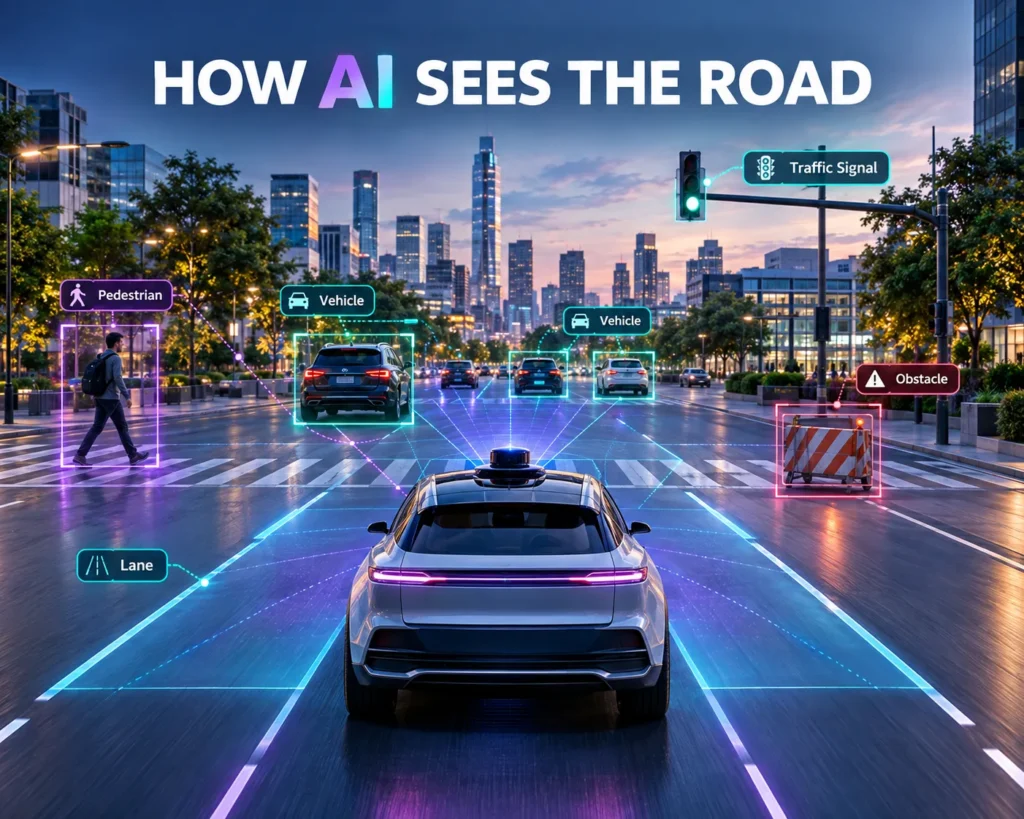
Autonomous vehicles use a combination of cameras, LiDAR, radar, ultrasonic sensors, GPS, and digital maps to understand their surroundings.
AI processes this sensor data to identify objects and road conditions. For example, self-driving vehicles can detect a vehicle changing lanes, recognize a pedestrian near the road, or identify an obstacle ahead.
This process is called perception and is one of the foundations of autonomous driving technology.
Instead of relying on one sensor, modern systems can combine information from multiple sources. This approach, known as sensor fusion, can provide a more comprehensive view of the vehicle’s surroundings.
How Does AI Predict the Behavior of Other Road Users?
Recognizing an object is only part of autonomous driving. The vehicle also needs to estimate what that object might do next.
For example, a vehicle may detect a pedestrian standing near a crossing. AI can analyze movement, position, road conditions, and surrounding traffic to estimate whether the pedestrian may enter the vehicle’s path.
Similarly, an autonomous vehicle can evaluate the movement of nearby cars to anticipate potential lane changes or sudden braking.
This predictive capability helps AI-powered autonomous vehicles make more informed decisions rather than simply reacting after something happens.
Why Is Real-Time Decision-Making Important for Autonomous Driving?
Road conditions can change in fractions of a second. An autonomous vehicle therefore needs to continuously process new information and adjust its actions.
AI can support decisions such as:
- Maintaining an appropriate speed
- Adjusting the vehicle’s path
- Changing lanes when conditions allow
- Responding to traffic signals
- Maintaining a safe distance
- Avoiding detected obstacles
This continuous decision cycle is central to AI in transportation because intelligent vehicles need to respond to their environment rather than follow a fixed sequence of instructions.
How Does AI Handle Complex Driving Situations?
Not every driving situation is predictable. Construction zones, unusual road layouts, poor visibility, and unpredictable road-user behavior can create complex scenarios.
Advanced AI in autonomous vehicles is being developed to handle increasingly diverse situations by learning from large datasets, simulations, and real-world driving conditions.
However, AI decision-making still requires extensive testing, safety validation, and appropriate human oversight. Autonomous transportation must be designed to manage uncertainty rather than assume that every situation can be predicted perfectly.
Key Takeaway
Real-time perception and decision-making are central to AI in autonomous vehicles. By combining sensor information, computer vision, machine learning, and predictive models, autonomous systems can continuously evaluate their surroundings and determine appropriate responses.
3. What Technologies Enable AI in Autonomous Vehicles?
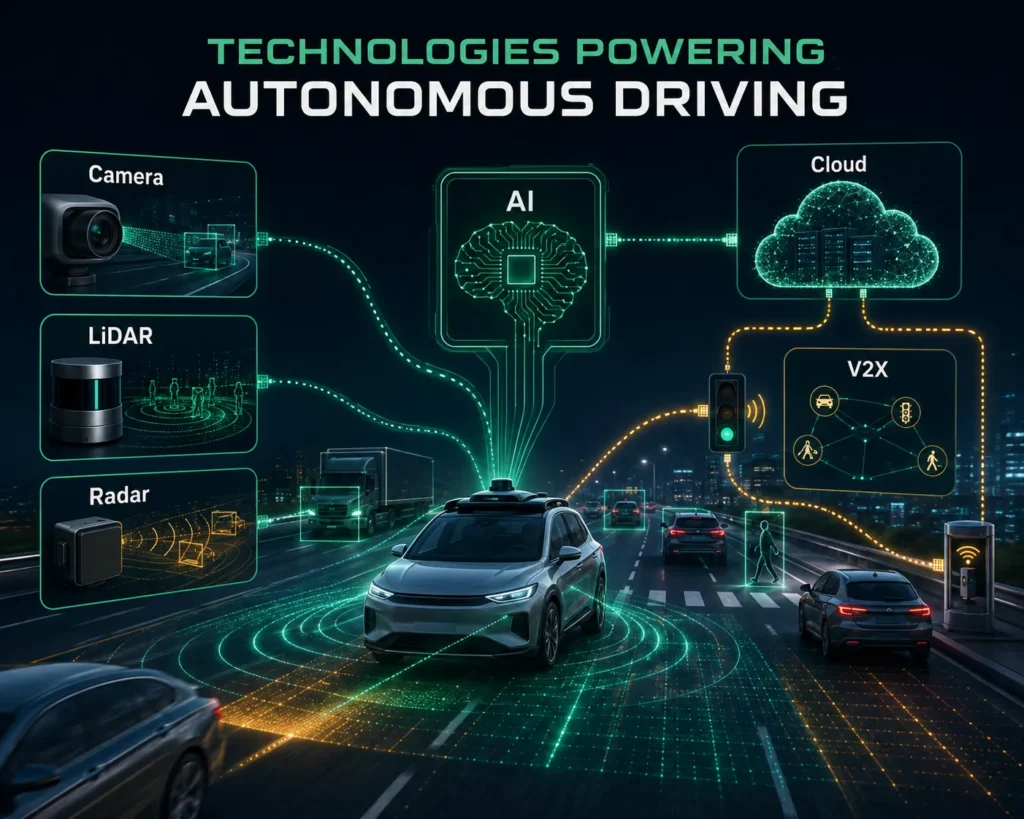
AI in autonomous vehicles depends on more than artificial intelligence alone. Autonomous driving requires a combination of sensors, computing systems, connectivity, software, and data technologies working together.
These technologies allow vehicles to perceive their surroundings, process information, communicate with external systems, and make driving decisions.
How Do Cameras, LiDAR, Radar, and Sensors Work Together?
Different sensors provide different types of information.
Cameras capture visual details such as lane markings, traffic signals, vehicles, and pedestrians. LiDAR uses laser-based sensing to help determine the distance and position of objects, while radar can detect objects and measure their movement and distance.
AI combines these inputs through sensor fusion to create a more detailed understanding of the surrounding environment.
This combination is particularly important for autonomous driving technology, because relying on a single source of information may not be sufficient in every driving condition.
What Is the Role of Computer Vision?
Computer vision enables an autonomous vehicle to interpret visual information captured by cameras.
Through computer vision, an AI-powered autonomous vehicle can identify road signs, lane markings, vehicles, pedestrians, and other visual elements.
Machine learning models can be trained using large datasets so that the system can recognize different road scenarios and objects.
This helps transform raw camera footage into information that the vehicle’s decision-making systems can use.
How Does Machine Learning Improve Autonomous Driving?
Machine learning helps autonomous systems identify patterns and improve their ability to interpret complex environments.
For example, models can be trained to recognize different types of vehicles, road layouts, traffic situations, and potential hazards.
Simulation environments can also expose autonomous systems to a wide range of scenarios before technologies are deployed in real-world conditions.
As development continues, machine learning remains a key component of AI in transportation and autonomous mobility.
How Do IoT and Cloud Technologies Support Autonomous Vehicles?
Connectivity adds another layer to autonomous transportation.
Through IoT in transportation, vehicles can potentially exchange information with infrastructure, traffic systems, and other connected devices. Cloud platforms can also support data processing, fleet management, software updates, and centralized analytics.
This connectivity becomes particularly valuable for connected vehicles operating within smart transportation networks.
For example, traffic information collected across a city could help connected vehicles identify congestion and adjust routes more efficiently.
How Does V2X Communication Connect Vehicles and Infrastructure?
Vehicle-to-everything (V2X) communication allows vehicles to exchange information with other vehicles, road infrastructure, pedestrians, and network systems.
This can provide additional context beyond what an individual vehicle’s sensors can detect.
For example, a connected traffic signal could communicate information about its status, while nearby vehicles could share relevant movement information.
Combined with AI, these technologies can support more coordinated smart mobility and contribute to the development of intelligent transportation systems.
Key Takeaway
The future of AI in autonomous vehicles depends on a technology ecosystem rather than a single AI model. Cameras, LiDAR, radar, machine learning, computer vision, IoT, cloud computing, and V2X connectivity work together to create increasingly intelligent transportation systems.
4. How Can AI Make Autonomous Vehicles Safer?
Safety is one of the most important reasons organizations are investing in AI in autonomous vehicles. Human drivers can become distracted, tired, or make mistakes, while AI systems can continuously monitor the driving environment and process information without fatigue.
However, AI should not be viewed as a guarantee of accident prevention. Autonomous driving systems still require extensive testing, validation, safety controls, and human oversight.
Can AI Reduce Human Driving Errors?
Human error is a significant consideration in road safety. AI can help address certain situations by continuously monitoring the road and responding to detected risks.
An AI-powered autonomous vehicle can monitor surrounding traffic, identify obstacles, maintain its lane, and adjust its speed based on changing conditions.
Unlike a human driver, an AI system does not become tired or distracted. Its ability to continuously process sensor information can support more consistent driving behavior.
How Does AI Help Prevent Collisions?
Collision avoidance is another important application of AI in autonomous vehicles.
AI can combine information from cameras, radar, LiDAR, and other sensors to identify potential hazards. If another vehicle suddenly slows down or an obstacle appears in the road, the system can evaluate the situation and determine an appropriate response.
Depending on the vehicle’s capabilities, this may include:
- Applying the brakes
- Reducing speed
- Maintaining a safe following distance
- Adjusting the vehicle’s path
- Providing warnings or requesting human intervention
These capabilities are an important part of modern autonomous driving technology.
How Do AI Systems Respond to Unexpected Road Conditions?
Real-world roads are unpredictable. Weather changes, construction zones, damaged roads, unusual traffic patterns, and unexpected obstacles can all create challenges.
AI systems can use sensor information and learned models to identify changing conditions and adjust their behavior.
For example, poor visibility may affect how cameras interpret the road, while rain can change road conditions. Combining multiple sensing technologies can help provide additional information when one source becomes less reliable.
What Role Does Human Oversight Play in Vehicle Safety?
Even as autonomous systems become more advanced, safety requires clear boundaries around what AI can do and when human intervention is necessary.
Developers and transportation organizations need to establish appropriate levels of automation, monitoring, testing, and fallback procedures.
This is especially important as AI in transportation moves from controlled environments toward increasingly complex real-world applications.
Key Takeaway
AI in autonomous vehicles can support road safety by continuously monitoring surroundings, identifying hazards, and responding to changing conditions. But safer autonomous transportation depends on more than AI alone—it also requires reliable hardware, robust software, rigorous testing, cybersecurity, regulation, and appropriate human oversight.
5. How Are Connected Vehicles Changing Autonomous Transportation?
Autonomous vehicles become even more capable when they can communicate beyond their own sensors. Instead of operating as isolated machines, connected vehicles can exchange information with other vehicles, infrastructure, cloud platforms, and transportation systems.
This combination of connectivity and AI in autonomous vehicles is helping move transportation toward a more coordinated and intelligent ecosystem.
What Is Vehicle-to-Everything (V2X) Communication?
Vehicle-to-everything (V2X) communication allows vehicles to exchange information with different parts of the transportation environment.
This can include:
- Vehicle-to-Vehicle (V2V) communication
- Vehicle-to-Infrastructure (V2I) communication
- Vehicle-to-Pedestrian (V2P) communication
- Vehicle-to-Network (V2N) communication
For example, a connected vehicle could receive information about a traffic signal, road hazard, or nearby vehicle that may not yet be directly visible through its own sensors.
How Can Vehicles Communicate With Infrastructure?
Connected roads can provide vehicles with additional information about traffic conditions, road closures, construction zones, traffic signals, and other transportation events.
When combined with AI in transportation, this information can help autonomous systems make more informed decisions.
For instance, if a connected traffic system identifies congestion ahead, an autonomous vehicle could use that information to evaluate alternative routes.
This creates a two-way relationship between vehicles and infrastructure rather than treating roads as passive environments.
How Does Real-Time Connectivity Improve Traffic Management?
Traffic congestion is not caused by individual vehicles alone. It is influenced by traffic volume, road capacity, accidents, construction, weather, and driving behavior.
Connected transportation systems can collect information from multiple sources and use AI to analyze it.
This can support intelligent transportation systems that monitor traffic patterns and help optimize routes, signals, and transportation flows.
For businesses operating fleets, connected data can also provide valuable information about vehicle locations, routes, fuel or energy usage, and operational performance.
Why Is Connected Infrastructure Important for Smart Mobility?
Smart mobility depends on different transportation components working together.
A city could combine connected vehicles with smart traffic signals, digital mapping, public transportation systems, charging infrastructure, and cloud-based platforms.
In this environment, IoT in transportation provides connectivity while AI helps interpret the information and identify useful actions.
The result is a broader transportation ecosystem in which vehicles are not simply moving from one location to another—they are participating in a connected network.
Key Takeaway
The combination of AI in autonomous vehicles, connected vehicles, V2X communication, and smart infrastructure can create more coordinated transportation systems. Instead of relying only on information collected by an individual vehicle, autonomous transportation can increasingly benefit from information shared across the wider mobility ecosystem.
6. How Is AI Transforming Autonomous Logistics and Transportation?
The impact of AI in autonomous vehicles extends beyond personal transportation. Logistics and freight are also becoming important areas where AI can improve how goods are moved, tracked, and delivered.
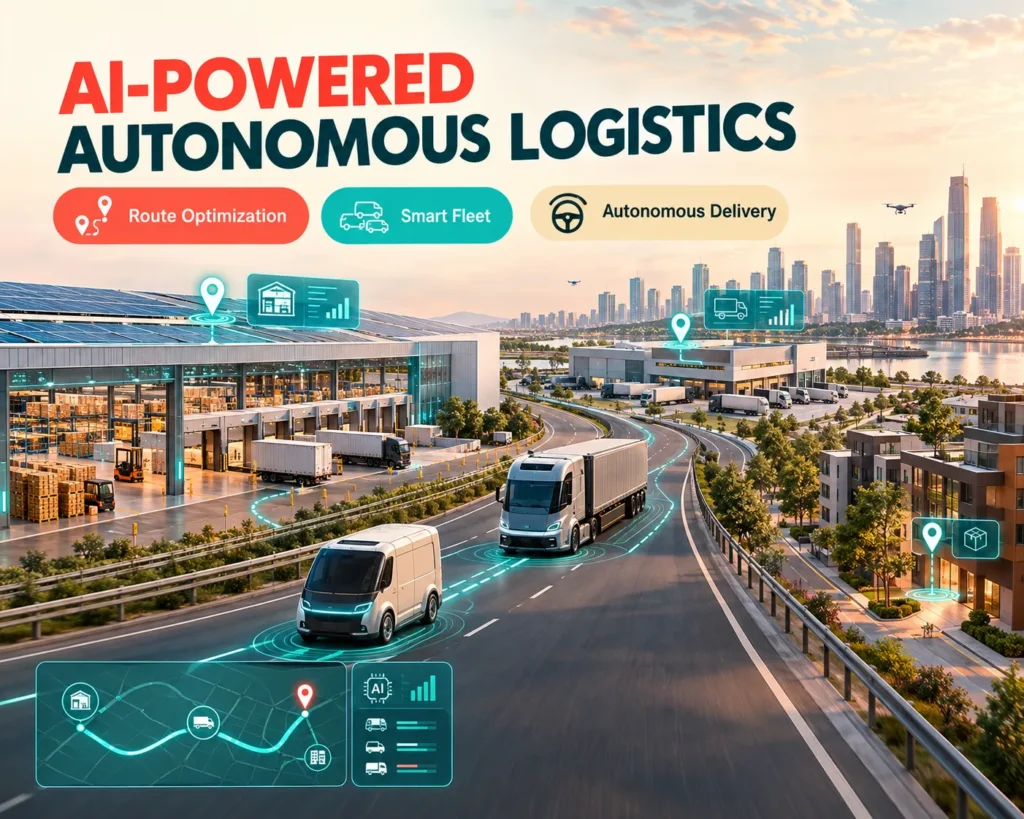
From warehouse operations to last-mile delivery, autonomous logistics can combine AI, robotics, connected vehicles, and intelligent route planning to create more efficient supply chains.
How Are AI-Powered Vehicles Changing Delivery Services?
AI-powered autonomous vehicles can support delivery operations by transporting packages and goods with reduced dependence on human drivers for certain tasks.
AI can help these vehicles navigate routes, recognize obstacles, adjust to traffic conditions, and determine efficient delivery sequences.
For businesses, this could support faster deliveries, better vehicle utilization, and more flexible logistics operations, particularly for repetitive routes or controlled environments.
What Is the Role of AI in Autonomous Freight?
Freight transportation involves complex decisions about routes, schedules, fuel or energy consumption, vehicle capacity, and delivery timelines.
AI can analyze these variables and help optimize freight movement. Autonomous trucks and other vehicles could potentially operate along suitable routes while AI systems continuously monitor road conditions and vehicle performance.
This makes autonomous transportation relevant not only to passenger vehicles but also to large-scale commercial logistics.
How Can AI Improve Fleet Management and Route Planning?
Fleet operators can use AI to analyze information from multiple vehicles and identify opportunities to improve operations.
For example, AI can help:
- Optimize delivery routes
- Predict traffic-related delays
- Monitor vehicle performance
- Improve fleet utilization
- Support predictive maintenance
- Adjust schedules based on changing conditions
When combined with connected vehicles, these capabilities can provide fleet managers with real-time visibility into transportation operations.
How Could Autonomous Logistics Improve Supply Chains?
Supply chains depend on reliable movement between manufacturers, warehouses, distribution centers, and customers.
Autonomous logistics could help automate parts of this process by connecting vehicles, warehouses, route-planning systems, and inventory platforms.
AI can analyze transportation data and help coordinate these activities, potentially reducing delays and improving operational efficiency.
As AI in transportation continues to develop, logistics could become increasingly data-driven, connected, and automated.
Key Takeaway
AI in autonomous vehicles can transform logistics by supporting automated deliveries, intelligent freight movement, optimized routes, and connected fleet management. Combined with autonomous logistics, AI could become an important part of how future supply chains move people and goods.
7. How Can AI-Powered Autonomous Vehicles Improve Smart Cities?
The future of transportation is closely connected to the development of smart cities. As urban populations grow, cities need better ways to manage traffic, reduce congestion, improve mobility, and use transportation infrastructure efficiently.
By combining AI in autonomous vehicles with connected infrastructure, real-time data, and intelligent transportation networks, cities can create more responsive mobility systems.
How Can AI Help Reduce Traffic Congestion?
Traffic congestion often results from unpredictable traffic patterns, inefficient routes, accidents, and uneven road usage.
AI can analyze traffic data from vehicles, cameras, sensors, and transportation systems to identify congestion patterns. Autonomous vehicles can then use this information to adjust routes and avoid heavily congested areas where appropriate.
This can support more efficient traffic movement across urban areas.
How Can Autonomous Vehicles Improve Urban Mobility?
AI-powered autonomous vehicles could provide new transportation options for people who cannot drive or have limited access to conventional transportation.
Autonomous shuttles, taxis, and shared mobility services could potentially connect residential areas with workplaces, public transportation hubs, and other important destinations.
This could make smart mobility more flexible by connecting different forms of transportation within a single ecosystem.
What Role Will Smart Infrastructure Play?
Autonomous vehicles cannot operate effectively through vehicle technology alone. Roads, traffic signals, parking systems, charging stations, and communication networks can all contribute to intelligent transportation.
For example, connected traffic signals could share information with vehicles, while smart parking systems could provide real-time information about available spaces.
Through IoT in transportation, these different systems can exchange data and create a more connected urban environment.
How Can Intelligent Transportation Systems Connect Cities?
Intelligent transportation systems can bring together traffic management, public transportation, connected infrastructure, and autonomous vehicles.
When these systems work alongside AI in transportation, cities can analyze transportation data and respond to changing conditions more effectively.
The long-term goal is not simply to create more autonomous cars. It is to build a connected transportation ecosystem where vehicles, infrastructure, and city systems can work together.
Key Takeaway
The combination of AI in autonomous vehicles, smart cities, connected infrastructure, and intelligent transportation systems could reshape urban mobility. Instead of treating transportation as a collection of separate vehicles and roads, future cities may operate as interconnected mobility networks.
8. What Are the Biggest Challenges of AI in Autonomous Vehicles?
While AI in autonomous vehicles offers significant opportunities, widespread adoption still depends on solving several technical, regulatory, security, and social challenges.
Autonomous driving systems must perform reliably in complex environments where road conditions, human behavior, and weather can change unexpectedly.
What Are the Technical Challenges?
Autonomous vehicles need to interpret enormous amounts of real-time data while making decisions within seconds.
Poor weather, unclear road markings, unusual traffic situations, construction zones, and unexpected obstacles can make perception and decision-making more difficult.
Developing reliable autonomous driving technology therefore requires extensive testing, high-quality data, powerful computing, and carefully designed safety systems.
How Can Autonomous Vehicles Handle Unpredictable Situations?
Not every road situation can be predicted in advance.
An autonomous vehicle may encounter an unusual object, an unexpected pedestrian movement, or a road layout that differs from its training data.
AI systems need to recognize uncertainty and respond safely rather than assuming that every situation will follow a familiar pattern. This remains an important challenge for self-driving vehicles.
What Are the Cybersecurity and Data Privacy Risks?
Connected vehicles communicate with other vehicles, infrastructure, networks, and cloud platforms. This connectivity creates additional opportunities for cyberattacks.
Security measures must protect vehicle systems, communication channels, and sensitive transportation data.
As connected vehicles become more integrated with digital infrastructure, cybersecurity and privacy will remain important parts of autonomous transportation.
How Do Regulations Affect Autonomous Driving?
Autonomous vehicles operate within transportation systems that are governed by safety standards, traffic laws, testing requirements, and other regulations.
Regulatory frameworks need to address questions such as vehicle responsibility, safety validation, data usage, human oversight, and operation across different regions.
Clear and adaptable regulations will be important as AI in transportation develops.
Why Does Public Trust Matter?
Technology alone cannot determine how quickly autonomous transportation becomes part of everyday life. People also need confidence that autonomous systems can operate safely and transparently.
Clear communication about system capabilities, limitations, and safety measures can help users understand what autonomous vehicles can and cannot do.
Key Takeaway
The future of AI in autonomous vehicles depends on more than technological progress. Technical reliability, cybersecurity, data privacy, regulation, testing, and public trust must develop alongside autonomous driving technology to support responsible adoption.
9. What Are the Benefits of AI-Powered Autonomous Transportation?
Beyond automation, AI-powered autonomous vehicles could change how people, businesses, and cities approach transportation. By combining AI with connected systems and intelligent infrastructure, transportation networks can become more data-driven and responsive.
How Can AI Improve Transportation Efficiency?
AI can analyze traffic, vehicle performance, routes, and travel patterns to identify more efficient ways of moving people and goods.
Autonomous systems can continuously evaluate road conditions and adjust routes or driving behavior when appropriate. This can support more efficient use of vehicles and transportation infrastructure.
Can Autonomous Vehicles Reduce Operating Costs?
For businesses, transportation costs can include fuel or energy, vehicle maintenance, driver-related expenses, inefficient routes, and delays.
AI can help optimize routes, monitor vehicle performance, and identify potential maintenance issues. In logistics, these capabilities could improve fleet utilization and reduce unnecessary operational inefficiencies.
The actual cost impact will depend on factors such as vehicle technology, regulations, infrastructure, and deployment models.
How Can AI Support Sustainable Mobility?
More efficient routing and traffic management can help reduce unnecessary travel and energy consumption.
When combined with electric vehicles, shared transportation, and smart infrastructure, AI in transportation could contribute to more efficient and potentially more sustainable mobility systems.
However, the environmental impact of autonomous vehicles will also depend on factors such as energy sources, vehicle manufacturing, travel demand, and how the technology is used.
How Can Businesses Benefit From Autonomous Transportation?
Businesses could use autonomous transportation across logistics, delivery, fleet management, warehouses, and other commercial operations.
For example, autonomous logistics could support repetitive delivery routes, while AI-based fleet systems could provide real-time insights into vehicle locations, routes, maintenance, and performance.
This could allow organizations to make transportation decisions using continuously updated operational data.
Key Takeaway
The potential benefits of AI-powered autonomous vehicles extend beyond hands-free driving. AI can support transportation efficiency, route optimization, fleet management, logistics, and smarter resource utilization, making autonomous technology relevant across both consumer and commercial transportation.
10. What Will the Future of AI in Autonomous Vehicles Look Like?
The future of autonomous vehicles will likely depend on how AI develops alongside connectivity, sensors, cloud computing, digital infrastructure, and transportation regulations.
Rather than being limited to individual self-driving cars, the technology could become part of a broader future of mobility where vehicles, infrastructure, logistics networks, and public transportation work together.
Will AI Make Fully Autonomous Driving Possible?
The development of AI in autonomous vehicles is moving toward increasingly capable systems that can handle more driving tasks with less human involvement.
However, achieving reliable full autonomy across every road, weather condition, and unexpected situation remains a complex technical and regulatory challenge.
Progress is likely to continue through better AI models, improved sensors, simulation, mapping, and safety systems.
How Will AI, IoT, and Cloud Technologies Work Together?
The next stage of autonomous transportation will involve multiple technologies working as a connected ecosystem.
IoT in transportation can connect vehicles and infrastructure, while cloud platforms can support data analysis, fleet management, and software services. AI can then process this information to support transportation decisions.
This combination could make connected vehicles more aware of conditions beyond what their onboard sensors can detect.
Will Autonomous Vehicles Become Part of Everyday Transportation?
Autonomous technology could gradually expand across different transportation environments rather than appearing everywhere at once.
Potential applications include autonomous taxis, public shuttles, delivery vehicles, freight transportation, warehouse vehicles, and controlled industrial environments.
The pace of adoption will depend on technology maturity, infrastructure, regulation, cost, and public acceptance.
What Will the Future of Smart Mobility Look Like?
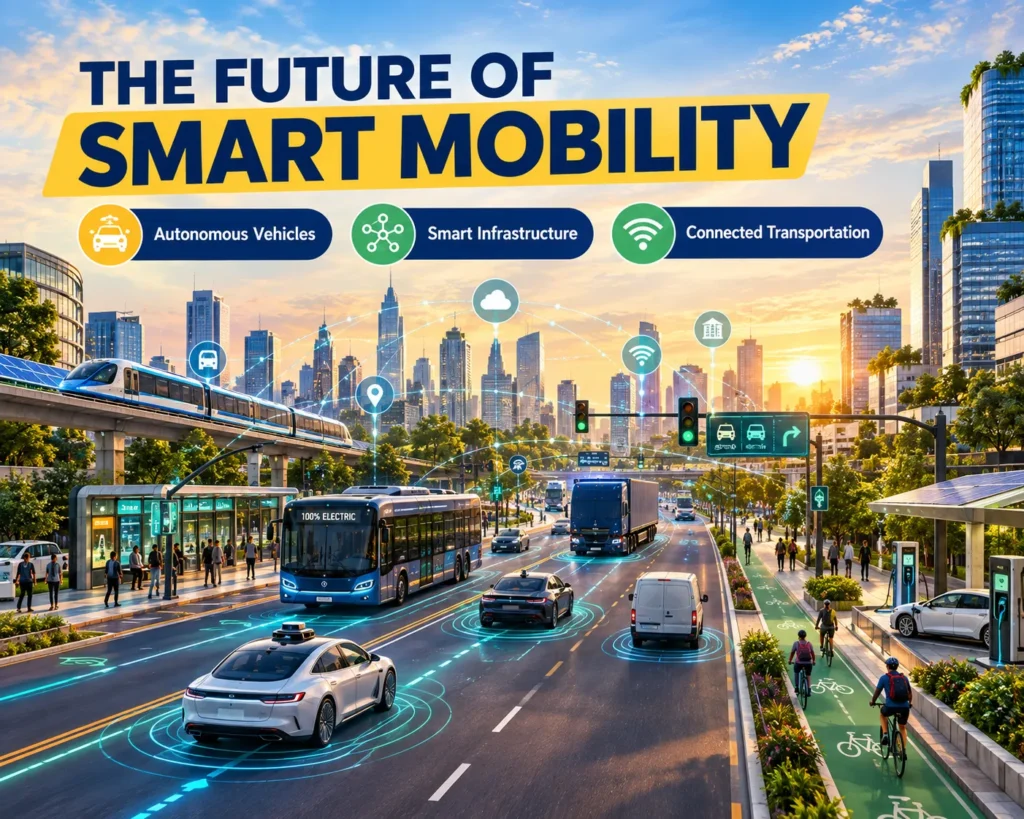
The long-term vision of smart mobility goes beyond autonomous cars. It involves transportation systems where vehicles, roads, traffic signals, public transit, logistics networks, and digital platforms can exchange information.
Intelligent transportation systems could use this connected information to manage traffic, coordinate mobility services, and improve transportation planning.
In this environment, AI in autonomous vehicles becomes one part of a much larger digital transportation ecosystem.
Key Takeaway
The future of autonomous vehicles is likely to be shaped by the convergence of AI, connectivity, sensors, IoT, cloud computing, and smart infrastructure. As these technologies mature, autonomous transportation could become an increasingly important part of the future of mobility and the broader future of transportation.
11. Frequently Asked Questions About AI in Autonomous Vehicles
What Is AI in Autonomous Vehicles?
AI in autonomous vehicles refers to the use of artificial intelligence to help vehicles perceive their surroundings, interpret information, predict situations, and support driving decisions. It works with technologies such as cameras, LiDAR, radar, GPS, machine learning, and computer vision.
How Does AI Help Self-Driving Vehicles?
AI helps self-driving vehicles identify road users, traffic signs, lane markings, obstacles, and changing road conditions. It can then process this information and support decisions such as slowing down, changing lanes, following a route, or stopping.
What Technologies Are Used in AI-Powered Autonomous Vehicles?
AI-powered autonomous vehicles typically combine several technologies, including cameras, LiDAR, radar, computer vision, machine learning, GPS, digital maps, connectivity, and sensor-fusion systems.
Connectivity technologies such as vehicle-to-everything (V2X) can also allow vehicles to exchange information with infrastructure and other connected systems.
Is AI Making Autonomous Vehicles Safer?
AI can support safety by continuously monitoring the driving environment, detecting potential hazards, and responding to changing conditions.
However, AI does not automatically guarantee safer transportation. Effective safety also depends on reliable hardware, software validation, testing, cybersecurity, regulations, and appropriate human oversight.
How Will AI Change the Future of Transportation?
AI could influence passenger transportation, logistics, fleet management, traffic systems, and public mobility. Combined with smart cities, connected vehicles, and intelligent transportation systems, AI could help create more coordinated and data-driven transportation networks.
What Challenges Does AI Face in Autonomous Driving?
Key challenges include unpredictable road situations, difficult weather conditions, sensor limitations, cybersecurity, data privacy, regulatory requirements, system reliability, and public trust.
Addressing these challenges will be essential for the continued development of autonomous driving technology and autonomous transportation.
12. Conclusion
The development of AI in autonomous vehicles is changing how we think about transportation. AI can help vehicles understand their surroundings, process real-time information, predict potential situations, and support driving decisions.
But the future extends beyond individual self-driving vehicles.
The combination of AI-powered autonomous vehicles, connected vehicles, IoT, V2X communication, smart infrastructure, and cloud technologies could create a more integrated transportation ecosystem. From personal mobility and public transportation to autonomous logistics and freight operations, AI has the potential to influence how people and goods move.
At the same time, challenges around safety, cybersecurity, regulation, data privacy, infrastructure, and public trust must be addressed carefully. Autonomous transportation will require cooperation between technology providers, vehicle manufacturers, governments, infrastructure developers, and transportation organizations.
For technology companies such as CrossShores Infotech, this evolving landscape creates opportunities to develop intelligent software solutions that connect AI, IoT, cloud technologies, data, and automation. By helping businesses explore and implement emerging technologies, CrossShores can contribute to the development of smarter and more connected transportation solutions.
As these technologies continue to evolve, AI in transportation could become an important foundation for smart mobility and the broader future of transportation.
The journey toward autonomous transportation is not simply about removing the driver from the vehicle. It is about creating transportation systems that can perceive, communicate, learn, and respond intelligently.
And as the future of autonomous vehicles continues to take shape, technology innovation will remain at the center of building safer, smarter, and more connected mobility experiences.