


Contents
- 1 Table of Contents
- 2 1. Quantum Security as a Present-Day Business Risk
- 3 2. The Quantum Risk Landscape Enterprises Face Today
- 4 3. Encryption Vulnerability in a Post-Quantum World
- 5 4. The “Harvest-Now, Decrypt-Later” Threat Model
- 6 5. Cyber Resilience Under Quantum Pressure
- 7 6. The Cost of Waiting vs. the Cost of Preparedness
- 8 7. Regulatory, Legal, and Fiduciary Exposure
- 9 8. Future-Proof Security as a Strategic Business Enabler
- 10 9. From Awareness to Action: Building a Quantum-Ready Roadmap
- 11 10. Embedding Quantum Risk into Enterprise Risk Management
- 12 11. Cross-Shores and Proactive Quantum Cyber Resilience
- 13 12. Operational Lessons from CrossShores’ Quantum Readiness Approach
- 14 13. Executive Ownership and Board-Level Decision Making
- 15 14. Conclusion
Table of Contents
- 1. Quantum Security as a Present-Day Business Risk
- 2. The Quantum Risk Landscape Enterprises Face Today
- 3. Encryption Vulnerability in a Post-Quantum World
- 4. The “Harvest-Now, Decrypt-Later” Threat Model
- 5. Cyber Resilience Under Quantum Pressure
- 6. The Cost of Waiting vs. the Cost of Preparedness
- 7. Regulatory, Legal, and Fiduciary Exposure
- 8. Future-Proof Security as a Strategic Business Enabler
- 9. From Awareness to Action: Building a Quantum-Ready Roadmap
- 10. Embedding Quantum Risk into Enterprise Risk Management
- 11. Cross-Shores and Proactive Quantum Cyber Resilience
- 12. Operational Lessons from CrossShores’ Quantum Readiness Approach
- 13. Executive Ownership and Board-Level Decision Making
- 14. Conclusion
1. Quantum Security as a Present-Day Business Risk
1.1 Why Quantum Threats Are No Longer Theoretical
Quantum risk has crossed the threshold from academic discussion to measurable enterprise exposure. The issue is not the arrival date of large-scale quantum computers but the longevity of sensitive data and the behaviour of sophisticated adversaries today. Regulated data, intellectual property, authentication records, and encrypted archives often retain business value for 10-30 years – well within realistic decryption horizons.
Threat actors are already acting rationally against this reality. The harvest-now-decrypt-later model allows attackers to extract encrypted data now and defer exploitation until cryptographic protections fail. From a business standpoint, this converts future technical breakthroughs into present liability.
Enterprises face quantum security risk because encryption decisions made today directly determine future breach impact.
- Long-lived data creates deferred breach exposure
- Nation-state actors optimise for long-term intelligence value.
- Encryption failure retroactively invalidates historical security controls
- Cyber insurance and breach cost models rarely account for delayed decryption.
The result is a widening gap between perceived security posture and actual enterprise risk.
1.2 Shifting Quantum Security from IT Issue to an Enterprise Risk
Quantum-era cryptography cannot be owned solely by security or infrastructure teams. Encryption underpins revenue systems, customer trust, legal defensibility, and regulatory compliance. When cryptographic assurances fail, consequences surface as contract disputes, audit failures, and operational disruption, not just technical incidents.
This reframing elevates quantum security risk into the same category as systemic financial or supply-chain risk, requiring executive sponsorship and board oversight. It also reshapes cyber resilience planning by exposing single points of cryptographic failure across identity, data access, and third-party integrations.
Accountability expands beyond implementation to governance, risk acceptance, and disclosure readiness.
- Encryption choices affect financial reporting integrity.
- Delayed remediation increases executive and fiduciary exposure.
- Business continuity depends on cryptographic trust anchors.
- Regulatory scrutiny increasingly targets “known but unaddressed” risks.
Treating quantum security as an enterprise risk aligns decision-making with actual business impact rather than technical convenience.
1.3 The Narrowing Window for Proactive Action
Time is the most underestimated variable in quantum preparedness. Cryptographic transitions are slow, operationally complex, and deeply embedded across applications, vendors, and data stores. Each year of delay concentrates future remediation into a smaller, more disruptive window.
Organisations that postpone action face rising transition costs, forced migrations under regulatory pressure, and increased operational downtime. The exposure curve is non-linear: remediation effort grows faster than perceived risk.
Quantum security risk intensifies not because of panic, but because of accumulated technical debt.
- Cryptographic inventory becomes harder to unwind over time
- Vendor dependencies restrict rapid algorithm transitions.
- Parallel system support increases cost and productivity drag.
- Reactive change limits strategic control over timing and scope.
Proactive action preserves optionality. Delay converts a manageable transformation into a mandatory crisis response.
2. The Quantum Risk Landscape Enterprises Face Today
2.1 Realistic Timelines for Cryptographically Relevant Quantum Computing
Most enterprises struggle with quantum planning because discussions fixate on specific breakthrough dates. That framing is unhelpful. What matters for leadership is not when a fully fault-tolerant quantum computer appears, but when the probability-adjusted impact becomes material enough to influence today’s security and data decisions. Research progress across error correction, qubit scaling, and hybrid classical–quantum models suggests incremental capability gains rather than a single disruptive moment.
From a planning perspective, this creates a rolling exposure window. Data encrypted today may face decryption risk long before systems are fully retired, audited, or legally irrelevant. Quantum security risk, therefore, emerges from uncertainty and data persistence, not precise timelines.
- Cryptographic transitions historically require multi-year lead times
- Long-lived data outlasts most infrastructure refresh cycles.
- Risk materialises through overlap, not sudden failure.
- Waiting for certainty compresses decision-making capacity.
This is a planning problem, not a prediction problem.
2.2 Adversary Capabilities and Nation-State Acceleration
State-level actors do not need quantum superiority today to benefit from tomorrow’s capabilities. Their advantage lies in preparation, data accumulation, and institutional patience. Intelligence agencies and well-resourced adversaries already operate under long planning horizons, aligning collection strategies with anticipated cryptographic shifts.
This behaviour transforms quantum risk into a present adversarial strategy rather than a future technical event. The primary driver is not speculative computing power but a known encryption vulnerability in widely deployed public-key systems.
- Systematic harvesting of encrypted traffic and archives
- Investment in cryptanalytic research and quantum talent pipelines
- Early testing of post-quantum migration paths
- Intelligence value assigned to long-duration data assets
For enterprises, the asymmetry is clear: adversaries prepare early, while defenders often wait for formal mandates.
2.3 Why Delayed Readiness Multiplies Long-Term Exposure
Quantum readiness delays do not add risk linearly – they compound it. Each year of postponement increases the volume of data exposed, the number of systems affected, and the operational complexity of future remediation. Cryptography is deeply embedded across applications, vendors, and workflows, making late-stage transitions disruptive and expensive.
Quantum security risk intensifies as overlapping lifecycles collide: data retention, regulatory obligations, vendor contracts, and system decommissioning schedules. When action is deferred, organisations inherit concentrated exposure instead of manageable, phased change.
- Larger cryptographic inventories become harder to unwind.
- Parallel system support increases cost and productivity loss.
- Emergency migrations reduce testing and assurance quality.
- Regulatory pressure removes timing control
Readiness is not about urgency – it is about preserving strategic options before they disappear.
3. Encryption Vulnerability in a Post-Quantum World
3.1 Which Cryptographic Standards Are Most at Risk
Enterprise systems rely heavily on asymmetric cryptography to establish trust, authenticate users, and protect data in transit. These mechanisms were designed around mathematical assumptions that are increasingly fragile in the face of quantum computation. The issue is not isolated to niche systems; it affects core business platforms that enable daily operations and revenue flows.
The greatest exposure sits where cryptography underwrites business trust rather than data storage alone. When these foundations weaken, security failures translate directly into operational and financial disruption. This creates a systemic encryption vulnerability tied to business dependency, not technical design choices.
- Key exchange mechanisms embedded in network communications
- Digital signatures supporting transactions and approvals
- Certificate-based trust across internal and external services
- Cryptographic assurances are relied upon for audit and compliance
The risk concentrates where cryptography is assumed to be invisible and permanent.
3.2 Long-Lived Data and the Hidden Persistence Problem
Data outlives systems. Contracts, customer records, authentication logs, product designs, and regulatory archives often retain sensitivity for decades. Even when infrastructure is modernised, historical data remains encrypted under older assumptions. This creates a silent exposure that accumulates over time.
Quantum security risk emerges because upgrading systems does not retroactively protect previously encrypted information. Once data is copied or exfiltrated, future decryption becomes an externalised risk that cannot be mitigated after the fact. Enterprises often underestimate how much valuable data exists outside active production environments.
- Backups and archives are retained for legal or operational reasons
- Data shared with partners, regulators, and service providers
- Logs and telemetry containing identity and access signals
- Legacy storage is overlooked in modernisation programmes
Persistence turns past decisions into future liabilities.
3.3 Impact on Identity, Cloud, and Data Protection Systems
Cryptography is deeply woven into enterprise architecture. When cryptographic trust weakens, the impact cascades across identity management, cloud platforms, and data protection controls. Identity and access management depend on cryptographic verification for authentication and authorisation, making it a primary pressure point.
Cloud environments amplify this effect through shared infrastructure and API-driven trust models. Data protection systems, including backup and disaster recovery, inherit the same cryptographic assumptions, extending exposure across resilience planning.
Post-quantum security, therefore, becomes an architectural concern, not a point solution.
- Compromised identity trust affects access across systems
- Cloud-native services inherit cryptographic weaknesses by default
- Encrypted backups may become future breach sources
- Recovery processes can reintroduce vulnerable data.
Addressing these impacts requires coordinated change across the entire security architecture, not isolated upgrades.
4. The “Harvest-Now, Decrypt-Later” Threat Model
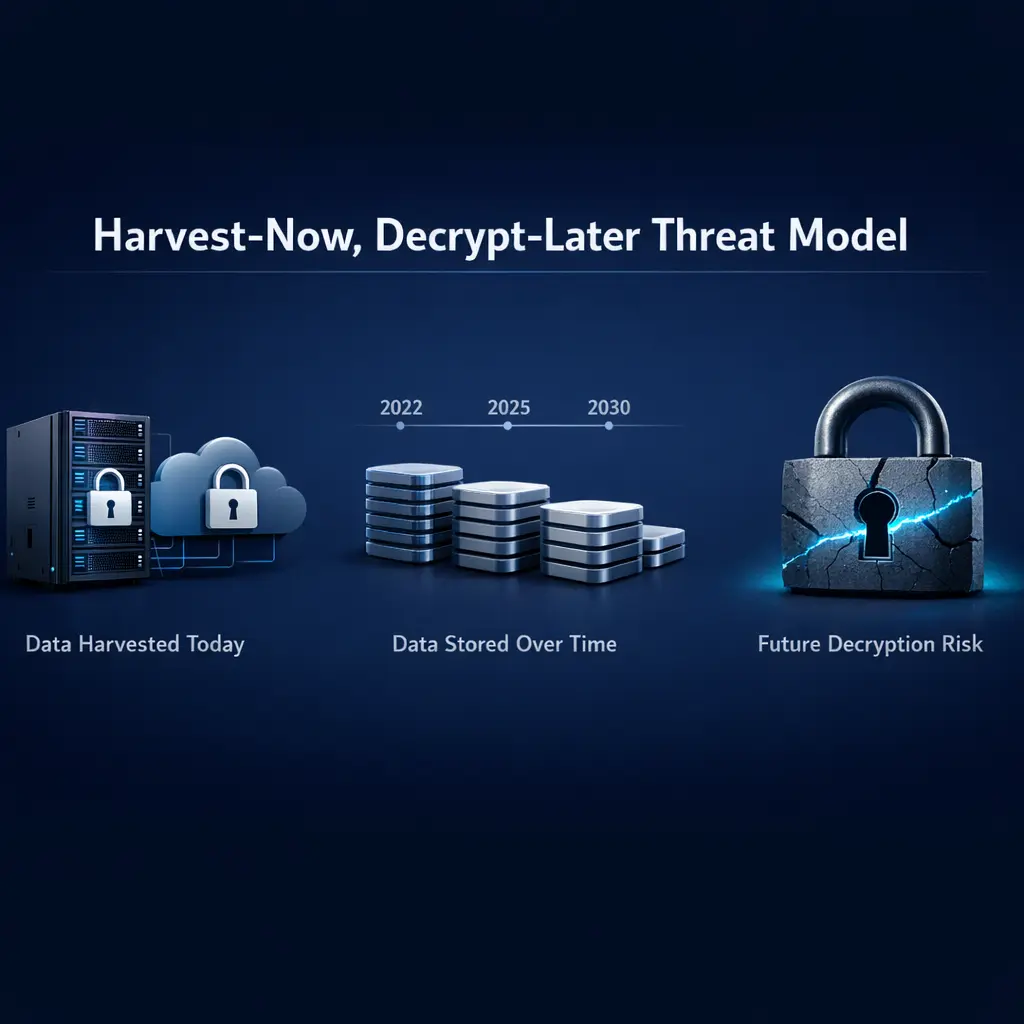
4.1 How Data Stolen Today Becomes Tomorrow’s Breach
Traditional breach models assume that the impact of data theft is immediate and visible. The harvest-now-decrypt-later approach breaks that assumption. Attackers extract encrypted data today, store it indefinitely, and wait until cryptographic protections can be bypassed. No further access to enterprise systems is required once the data is taken.
For executives, the implication is clear: the absence of an immediate incident does not mean the absence of a breach. Exposure is deferred, not eliminated. Data that appears secure at rest or in transit can later surface as a compliance failure, legal liability, or reputational event years after the original compromise.
- Encrypted data can be copied without triggering alerts.
- Decryption can occur outside the enterprise environment.
- Historical breaches may be reclassified retroactively.
- Legal responsibility persists even after systems are retired.
This transforms data theft into a long-term liability rather than a one-time event.
4.2 Industries Most Exposed to Delayed Decryption Risk
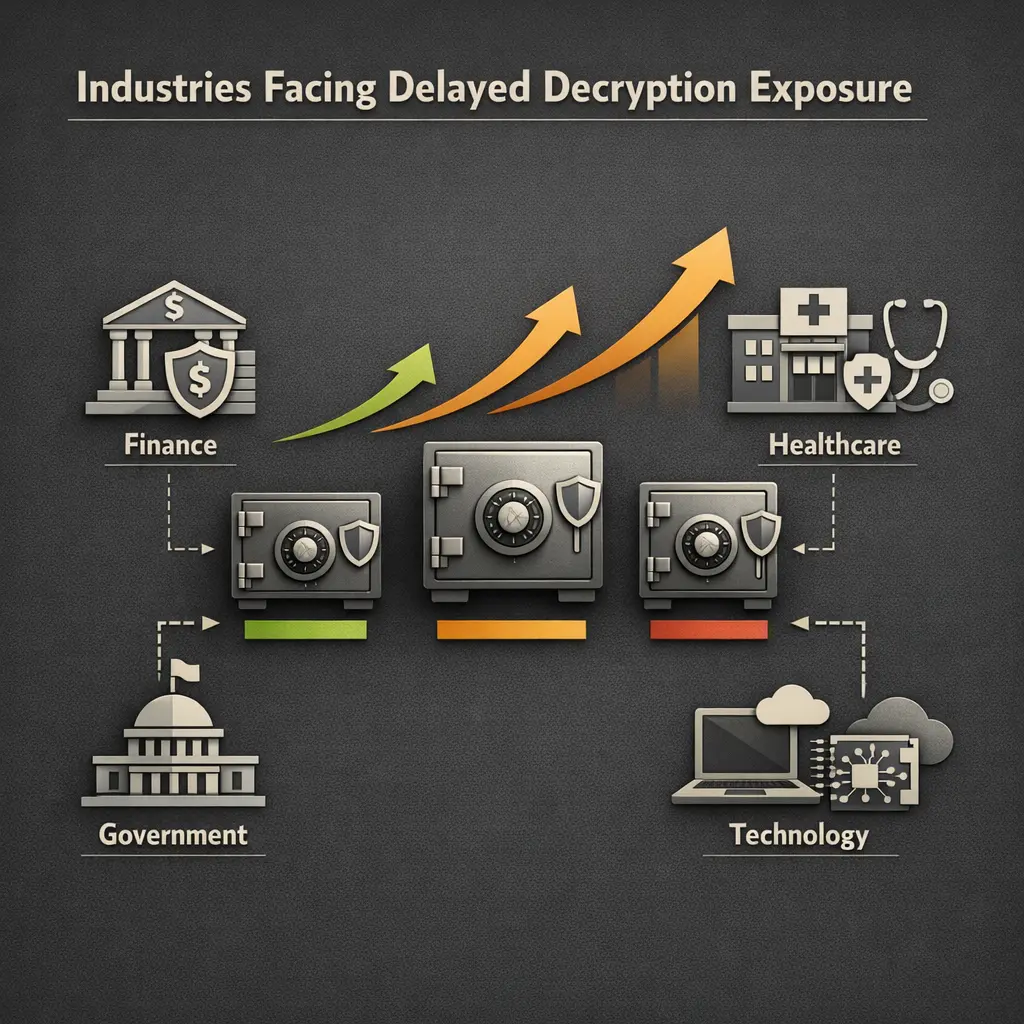
Exposure to delayed decryption varies by industry, driven by data sensitivity, retention requirements, and regulatory obligations. Sectors that rely on long-lived data or confidentiality guarantees face amplified quantum security risk because future decryption directly undermines their core value proposition.
Industries with extended data lifecycles and high trust expectations are particularly vulnerable.
- Financial services: transaction records, identity data, and audit trails
- Healthcare and life sciences: patient data and research IP
- Government and defence: classified and intelligence information
- Technology and manufacturing: proprietary designs and trade secrets
In these sectors, delayed decryption can invalidate decades of security investment and contractual assurances.
4.3 Why Traditional Breach Metrics Underestimate Quantum Impact
Most security metrics are designed to measure immediate damage: time to detect, time to contain, records exposed, and short-term financial loss. These indicators fail to account for breaches whose impact materialises years later. As a result, organisations underestimate the true risk profile of encrypted data theft. Traditional breach models assume that the impact of data theft is immediate and visible. The harvest-now-decrypt-later approach breaks that assumption. Attackers extract encrypted data today, store it indefinitely, and wait until cryptographic protections can be bypassed. No further access to enterprise systems is required once the data is taken.
For executives, the implication is clear: the absence of an immediate incident does not mean the absence of a breach. Exposure is deferred, not eliminated. Data that appears secure at rest or in transit can later surface as a compliance failure, legal liability, or reputational event years after the original compromise.
- Encrypted data can be copied without triggering alerts.
- Decryption can occur outside the enterprise environment.
- Historical breaches may be reclassified retroactively.
- Legal responsibility persists even after systems are retired.
This transforms data theft into a long-term liability rather than a one-time
Delayed decryption shifts risk outside the measurement window of standard KPIs, creating blind spots in risk reporting and investment decisions. This is why future-proof security requires new evaluation models that incorporate data longevity and cryptographic durability.
- Mean time to detect ignores deferred exploitation
- “Records exposed” undercounts the encrypted data value
- Incident closure does not eliminate future liability.
- ROI models overlook long-tail breach costs
Without adjusting metrics, leadership decisions are based on incomplete risk signals.
5. Cyber Resilience Under Quantum Pressure
Cyber resilience is being re-evaluated as organisations recognise that long-horizon cryptographic threats undermine assumptions about recovery, trust, and continuity. Quantum security risk reframes resilience from short-term incident response to sustained operational survivability under uncertainty. Encryption longevity, data persistence, and systemic dependencies now determine whether enterprises can absorb future shocks without cascading failure. This shift forces leaders to assess whether resilience strategies account for risks that emerge slowly but materialise with disproportionate business impact.
5.1 Quantum Risk as a Resilience Stress Test
Quantum security risk functions as a stress test for resilience maturity because it exposes whether organisations can manage threats that do not follow conventional incident timelines. Enterprises with strong resilience planning can tolerate ambiguity and phase change over time and protect continuity even when cryptographic assurances weaken. Those optimised only for rapid containment struggle with risks that accumulate silently and surface years later.
Resilience gaps translate directly into business consequences:
- Limited cryptographic visibility → delayed recovery and audit failures
- Inflexible architectures → higher downtime during forced transitions
- Weak governance → fragmented decision-making under pressure
This test differentiates reactive defence from durable resilience.
5.2 Third-Party, Supply Chain, and Ecosystem Weak Points
Quantum security risk rarely stays contained within organisational boundaries. Enterprises inherit cryptographic exposure from cloud providers, software vendors, managed services, and industry platforms embedded in daily operations. These dependencies extend liability while limiting control over transition timing. Shared encryption assumptions mean that one unprepared partner can weaken an entire ecosystem, creating productivity drag as teams compensate for external uncertainty. Contractual obligations, data-sharing agreements, and service-level dependencies further amplify exposure, turning vendor readiness into a material operational and financial concern.
5.3 Operational Disruption and Productivity Risk Scenarios
When quantum security risk is unmanaged, disruption often arrives through forced remediation rather than planned change. Regulatory mandates, partner requirements, or post-incident reviews can trigger accelerated cryptographic transitions across critical systems. These efforts divert leadership focus, strain technical teams, and interrupt normal operations.
Typical productivity and operational impacts include:
- 10-20% capacity loss during parallel system support
- Extended change freezes affecting product delivery
- Executive attention diverted from growth initiatives
Such scenarios erode resilience by turning foreseeable risk into an emergency response.
6. The Cost of Waiting vs. the Cost of Preparedness
Delaying action on cryptographic transition is often justified as cost avoidance, yet the financial reality is the opposite. As dependencies grow and data accumulates, postponement converts manageable change into large-scale retrofit under pressure. Quantum security risk exposes this trade-off by shifting costs forward in time while multiplying their eventual impact. Leaders must evaluate not whether investment is required, but whether it is made deliberately or under constraint, when flexibility, pricing leverage, and operational stability are already compromised.
- Deferred action concentrates future capital expenditure
- Operational disruption replaces planned transformation
- Risk exposure increases faster than budgets adjust
6.1 Financial Impact of Retrofitting Security at Scale
Retrofitting cryptographic controls across mature environments is materially more expensive than building readiness incrementally. Systems not designed for algorithm agility require reengineering, parallel operations, and extensive testing. Quantum security risk accelerates this cost escalation by forcing change across identity, applications, infrastructure, and third-party integrations simultaneously. Capital budgets absorb tooling and platform upgrades, while operating costs rise through prolonged project timelines and specialist resource demand.
Key cost drivers include:
- Application refactoring and integration rework
- Extended vendor contracts and premium services
- Increased dependency on scarce cryptographic expertise
6.2 Compounded Remediation, Downtime, and Incident Response Costs
When readiness is delayed, remediation rarely occurs in isolation. Cryptographic change collides with audits, incidents, or regulatory demands, amplifying operational strain. Quantum security risk compounds remediation because encrypted data spans production systems, backups, and external partners, all of which must be addressed together. Downtime increases as teams support legacy and transitional states, while incident response functions expand to cover deferred exposure.
Operational impacts typically include:
- Longer maintenance windows and service interruptions
- Reduced system availability during parallel operations
- Elevated incident response and forensics expenditure
6.3 Long-Term Data Liability and Brand Trust Erosion
Data compromised today may generate liability years later when decryption becomes feasible. This creates enduring legal and reputational exposure that cannot be mitigated retroactively. Quantum security risk extends accountability across the full data lifecycle, affecting disclosure obligations, regulatory penalties, and customer trust. Organisations that delay preparedness risk appearing negligent once risks are well understood, magnifying brand damage beyond the technical event itself.
Primary liability factors include:
- Regulatory sanctions for inadequate long-term safeguards
- Litigation tied to delayed breach realisation
- Loss of customer and partner confidence
Delayed Action vs Proactive Preparedness
| Dimension | Delayed Action | Proactive Preparedness |
|---|---|---|
| Cost | High, concentrated retrofit spend | Phased, predictable investment |
| Downtime | Unplanned, disruptive | Controlled, scheduled |
| Remediation Complexity | System-wide, reactive | Targeted, incremental |
| Risk Exposure | Long-tail, compounding | Reduced and time-bounded |
7. Regulatory, Legal, and Fiduciary Exposure
Regulators increasingly expect organisations to anticipate material security risks rather than react after harm occurs. As cryptographic durability becomes a known concern, quantum security risk is moving into the scope of reasonable foresight. Enterprises that continue to rely on legacy encryption without transition planning may face scrutiny not only for breaches but also for governance failures tied to preventable exposure.
- Expanding definitions of “adequate security”
- Rising expectations for long-term data protection
- Greater linkage between cyber risk and fiduciary duty
7.1 Emerging Global Guidance on Post-Quantum Cryptography
Standards bodies and regulators are issuing directional guidance on cryptographic transition, signalling that quantum preparedness is no longer optional. While mandates vary by region, the trajectory is consistent: organisations are expected to assess, plan, and demonstrate progress. Quantum security risk is increasingly referenced in supervisory reviews and risk frameworks, even where explicit deadlines are absent.
- Formal migration guidance from standards authorities
- Supervisory focus on cryptographic inventory and planning
- Alignment with long-term data protection requirements
7.2 Disclosure, Audit, and Compliance Readiness Gaps
Unmanaged cryptographic transition creates blind spots in disclosure and audit processes. Risk registers often fail to capture deferred decryption exposure, while compliance programs focus on current-state controls. Quantum security risk widens this gap by introducing future impact from present decisions, complicating attestations and control assurance.
- Incomplete risk disclosures tied to data longevity
- Audit evidence misaligned with cryptographic durability
- Control frameworks lacking long-horizon risk assessment
7.3 Board-Level Accountability for Known but Unaddressed Risks
Once a risk is widely understood, inaction becomes a governance decision. Boards and executives have a fiduciary obligation to oversee material risks that could affect enterprise value over time. Quantum security risk now meets this threshold, particularly for organisations holding sensitive or regulated data. Failure to act may be interpreted as neglect of duty rather than technical oversight.
- Increased personal accountability for directors and officers
- Heightened scrutiny following delayed breach realisation
- Expectation of documented oversight and investment decisions
8. Future-Proof Security as a Strategic Business Enabler
Security strategy increasingly influences growth, valuation, and market access. As organisations digitise core operations, cryptographic durability becomes a prerequisite for sustainable expansion. Quantum security risk elevates security investment from a cost centre to a strategic enabler by shaping how confidently enterprises can scale, enter new markets, and protect long-term value. Leaders who address this early gain flexibility and credibility that reactive organisations forfeit.
- Security posture affects revenue continuity and brand strength
- Long-term data protection underpins sustainable growth
- Early action preserves strategic optionality.
8.1 Quantum Readiness and Digital Trust
Trust is built on the expectation that data protections will endure over time, not just at the moment of transaction. Customers, regulators, and partners increasingly evaluate whether organisations are prepared for foreseeable cryptographic change. Quantum security risk directly influences confidence in digital channels, particularly where sensitive data or long-term relationships are involved.
- Stronger assurance for customers and stakeholders
- Reduced friction in regulated digital interactions
- Improved confidence in data stewardship commitments
8.2 Competitive Advantage in M&A and Enterprise Partnerships
Mergers, acquisitions, and partnerships expose latent security liabilities. Due diligence processes are expanding to include long-horizon cyber exposure, especially where data assets drive valuation. Organisations that manage quantum security risk proactively reduce uncertainty for buyers and partners, accelerating deal timelines and improving negotiating positions.
- Fewer security-related valuation adjustments
- Faster integration planning and execution
- Greater attractiveness as a trusted partner
8.3 Aligning Security Investment with Long-Term Growth Strategy
Disciplined investment in the cryptographic transition supports predictable growth by avoiding future shocks. Rather than reactive spending under pressure, organisations can sequence initiatives alongside platform modernisation and expansion plans. Addressing quantum security risk early aligns security budgets with business roadmaps, improving capital efficiency and executive confidence.
- Lower long-term total cost of ownership
- Better alignment between security and product strategy
- Reduced disruption to growth initiatives
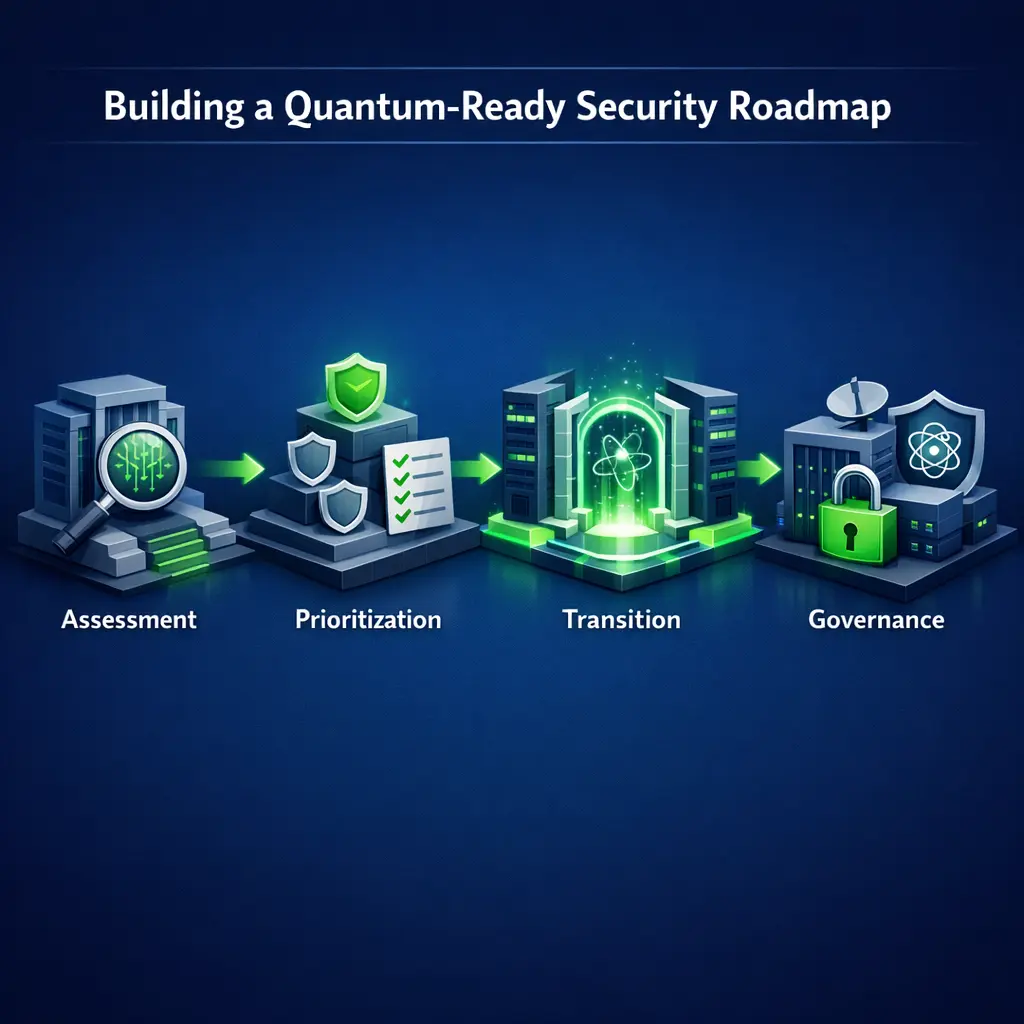
9. From Awareness to Action: Building a Quantum-Ready Roadmap
Awareness of cryptographic fragility does not automatically translate into execution. Most organisations struggle with scope, sequencing, and ownership when addressing long-horizon threats. Quantum security risk introduces execution challenges because it cuts across infrastructure, applications, data governance, and third-party dependencies simultaneously. Turning intent into action requires structured planning that balances urgency with operational stability and business priorities.
- Difficulty mapping cryptography across complex environments
- Competing transformation initiatives and budget constraints
- Unclear accountability between security, IT, and business leaders
9.1 Assessing Cryptographic Inventory and Risk Prioritisation
Effective action begins with visibility. Organisations must understand where cryptography is used, why it matters, and which assets create disproportionate exposure. Prioritisation should be driven by data sensitivity, longevity, and business criticality rather than technical convenience. Quantum security risk becomes manageable when decision-makers can distinguish between low-impact usage and cryptographic dependencies that underpin revenue, compliance, or trust.
- Systems protecting long-lived or regulated data
- Cryptography embedded in identity and access workflows
- External-facing services with contractual or legal exposure
9.2 Phased Transition Without Disrupting Core Operations
Large-scale cryptographic change cannot occur in a single step without destabilising operations. A phased approach allows organisations to address the highest risks first while maintaining service continuity. Managing quantum security risk through staged transition reduces downtime, spreads cost over time, and preserves flexibility as standards and guidance evolve.
- Parallel support for legacy and quantum-resistant controls
- Alignment with application modernisation cycles
- Controlled testing and validation before broad rollout
This approach converts disruptive change into a predictable transformation.
9.3 Integrating Quantum Security into Existing Security Architecture
Quantum readiness should extend existing security architecture, not replace it. Identity, key management, network security, and data protection platforms must evolve cohesively to avoid creating new gaps. Integrating quantum security risk into established frameworks ensures consistency, governance, and operational efficiency rather than isolated point fixes.
- Centralised cryptographic policy and key management
- Compatibility with zero-trust and cloud-native models
- Reuse of existing monitoring and assurance processes
Architectural alignment keeps quantum readiness sustainable as environments scale.
10. Embedding Quantum Risk into Enterprise Risk Management
Enterprise risk management frameworks are designed to surface material risks early enough for informed decision-making. As cryptographic durability becomes a strategic concern, quantum security risk must be integrated into ERM rather than treated as a technical exception. This integration ensures that long-horizon cyber exposure is evaluated alongside financial, operational, and legal risks, enabling proportional investment and governance oversight.
- Inclusion in enterprise risk registers
- Alignment with existing risk appetite statements
- Ongoing executive review and accountability
10.1 Translating Cryptographic Risk into Business Impact Metrics
Technical descriptions of cryptography do not resonate at the enterprise level. To be actionable, quantum security risk must be expressed in business terms such as revenue impact, regulatory exposure, and operational disruption. Metricisation enables leaders to compare cryptographic risk against other strategic risks and prioritise accordingly.
- Estimated cost of delayed remediation
- Volume and value of long-lived sensitive data
- Potential regulatory and contractual exposure
10.2 Aligning CISO, CTO, Legal, and Risk Leadership
Effective management of quantum security risk requires coordinated leadership across security, technology, legal, and risk functions. Each group owns a different dimension of impact, and misalignment creates gaps in accountability. Structured collaboration ensures consistent assumptions, shared prioritisation, and unified communication to the board.
- Clear ownership for assessment and execution
- Legal input on disclosure and liability
- Risk leadership integration into planning cycles
10.3 Making Quantum Risk Visible in Board Reporting
Board oversight depends on clarity and comparability. Quantum security risk must be presented in formats that align with existing board reporting, emphasising trend, exposure, and decision points rather than technical detail. Visibility at this level transforms quantum readiness from an abstract concern into a governed strategic issue.
- Periodic updates tied to enterprise risk reviews
- Clear indicators of progress and residual exposure
- Documented decisions and risk acceptance rationale
11. Cross-Shores and Proactive Quantum Cyber Resilience
CrossShores approaches long-horizon cyber threats through a strategic risk lens rather than a reactive technology cycle. Its stance on quantum security risk reflects an understanding that cryptographic durability underpins trust, compliance, and long-term enterprise value. By treating quantum exposure as a governance and planning issue early, CrossShores positions resilience as a continuous capability instead of a future remediation exercise.
- Early recognition of long-lived data exposure
- Alignment of cryptographic risk with enterprise priorities
- Emphasis on measured, non-disruptive preparedness
11.1 CrossShores as an Example of Early Quantum Risk Recognition
Rather than waiting for regulatory mandates or market pressure, CrossShores identified quantum security risk as a foreseeable enterprise issue tied to data longevity and ecosystem dependency. This early recognition enabled structured assessment before risk concentration set in, allowing leadership to frame quantum readiness as part of broader risk management rather than an isolated security initiative.
- Identification of high-value, long-lived data assets
- Early inclusion of quantum exposure in risk discussions
- Avoidance of last-minute, compliance-driven responses
11.2 Governance-First Approaches to Quantum Security Readiness
CrossShores emphasised governance before technology, ensuring that decision rights, accountability, and oversight were clearly defined. By addressing quantum security risk through policy, ownership, and executive alignment, the organisation reduced fragmentation and prevented reactive spending. This approach ensured cryptographic transition planning was consistent with business tolerance and regulatory expectations.
- Defined executive ownership for quantum-related risk
- Integration into existing risk and compliance frameworks
- Clear criteria for prioritisation and investment decisions
11.3 Measurable Outcomes from Strategic Early Planning
Early planning translated into tangible outcomes rather than abstract preparedness. CrossShores’ handling of quantum security risk produced operational and financial benefits by spreading effort over time and avoiding disruption. Progress could be measured through reduced exposure, improved audit readiness, and sustained productivity.
- Lower projected remediation and transition costs
- Minimal operational impact during early-stage changes
- Increased confidence from partners and stakeholders
This measured approach demonstrates how early action converts uncertainty into controlled, strategic advantage.
12. Operational Lessons from CrossShores’ Quantum Readiness Approach
CrossShores’ experience demonstrates that managing long-horizon threats requires operational discipline, not urgency-driven reaction. By treating quantum security risk as a planning variable rather than a future surprise, the organisation extracted practical lessons that apply across industries. These lessons focus on prioritisation, continuity, and debt avoidance-areas where many enterprises struggle once cryptographic change becomes unavoidable.
- Emphasis on sequencing rather than speed
- Clear linkage between data value and effort
- Operational stability was preserved during the transition
12.1 Prioritisation Frameworks for High-Value Data Assets
A key lesson from CrossShores is that not all data warrants equal treatment. Prioritisation frameworks anchored in business value, sensitivity, and lifespan enabled focused action where quantum security risk was most material. This avoided broad, inefficient programmes and ensured resources were directed toward assets with long-term exposure and regulatory significance.
- Classification by data longevity and sensitivity
- Alignment with legal and contractual obligations
- Focus on systems underpinning revenue and trust
12.2 Balancing Innovation, Security, and Business Continuity
CrossShores avoided framing readiness as a trade-off between innovation and security. Instead, quantum security risk was addressed alongside modernisation initiatives, ensuring that innovation pipelines remained intact. By synchronising cryptographic planning with platform upgrades, the organisation reduced friction and prevented security requirements from slowing delivery.
- Integration with existing transformation roadmaps
- Minimal disruption to product development cycles
- Shared accountability between security and engineering
This balance preserved momentum while reducing future disruption.
12.3 Avoiding Technical Debt in Post-Quantum Transitions
One of the most critical lessons was the cost of deferring structural change. CrossShores treated quantum security risk as a signal to reduce cryptographic rigidity early, limiting future technical debt. By favouring adaptable designs and centralised controls, the organisation avoided locking in assumptions that would require expensive rework later.
- Adoption of algorithm-agile architectures
- Centralised key and policy management
- Reduced reliance on hard-coded cryptographic dependencies
These practices transformed readiness into a long-term operational advantage rather than a temporary fix.
13. Executive Ownership and Board-Level Decision Making
Quantum-related exposure has reached a level where leadership oversight is no longer optional. As the implications extend across financial, legal, and operational domains, quantum security risk must be governed as a strategic enterprise issue. Executives and boards are responsible for ensuring that known long-horizon risks are assessed, prioritised, and addressed within acceptable tolerance levels rather than deferred by default.
- Board visibility into long-term cyber exposure
- Executive accountability for preparedness decisions
- Alignment with enterprise risk appetite and strategy
13.1 Defining Clear Accountability for Quantum Security
Effective management begins with ownership. Organisations that treat quantum security risk as a shared or undefined responsibility often fail to act. Clear accountability structures assign decision rights, execution authority, and reporting obligations across leadership roles, ensuring that assessment and action progress in parallel.
- Designated executive sponsor with authority and budget influence
- Defined roles across security, technology, and risk functions
- Formal escalation paths for unresolved exposure
13.2 Funding Models for Long-Horizon Cyber Risks
Traditional annual budgeting struggles to accommodate risks that unfold over many years. Addressing quantum security risk requires funding models that support phased investment, flexibility, and continuity. Multi-year planning reduces volatility and avoids costly, reactive spending triggered by external pressure.
- Programme-based funding aligned to risk reduction milestones
- Integration with modernisation and infrastructure budgets
- Predictable spend that avoids emergency reallocations
13.3 Making Inaction a Conscious and Measurable Decision
Inaction is itself a strategic choice when risks are understood. Boards and executives must explicitly document decisions to defer or accept quantum security risk, including rationale and review timelines. This transforms silence into governance and protects leadership from retrospective accountability gaps.
- Documented risk acceptance or deferral decisions
- Defined triggers for reassessment
- Periodic review aligned with risk evolution
When decisions are explicit, organisations retain control over their risk posture rather than inheriting it by default.
14. Conclusion
Quantum-related exposure has moved beyond theoretical debate into the realm of foreseeable enterprise impact. Data longevity, adversary behaviour, and regulatory expectations have converged, leaving little room for passive deferral. Quantum security risk now represents a strategic inflexion point: organisations either shape their transition deliberately or inherit consequences later under less favourable conditions. The urgency is not driven by speculation but by accumulated exposure, mounting governance expectations, and the irreversible nature of data compromise over time.
Executive attention is required because quantum security risk affects enterprise value in ways operational teams cannot resolve alone. Decisions around timing, investment, and risk acceptance carry financial, legal, and reputational consequences that sit squarely within leadership accountability. Delayed engagement compresses options, increases future disruption, and shifts control away from the organisation toward regulators, partners, or post-incident response. Early oversight preserves flexibility and protects decision-making authority.
Organisations that act early convert readiness into advantage rather than cost. Managing quantum security risk proactively supports trust, regulatory confidence, and operational stability while avoiding disruptive, forced remediation. CrossShores illustrates how early planning reframes quantum exposure as a governance and resilience capability, not a technical fire drill. By embedding readiness into long-term strategy, enterprises strengthen digital foundations that support growth, partnerships, and sustained competitiveness well beyond the quantum transition.