



Contents
- 1 Introduction
- 2 Quick Answer: What Is the Future of Cybersecurity?
- 3 TL;DR
- 4 2. Why Is AI Transforming Cybersecurity?
- 5 3. How Does AI Improve Threat Detection and Prevention?
- 6 4. What Are the Biggest Cybersecurity Threats in an AI-Driven World?
- 7 5. How Is AI-Powered Cybersecurity Changing Incident Response?
- 8 7. How Do Zero Trust Security Models Strengthen Cyber Defense?
- 8.1 7.1 What Is a Zero Trust Security Model?
- 8.2 7.2 Why Is “Never Trust, Always Verify” Important?
- 8.3 7.3 How Does Zero Trust Reduce Security Risks?
- 8.4 Least Privilege Access
- 8.5 Continuous Authentication
- 8.6 Micro-Segmentation
- 8.7 Real-Time Monitoring
- 8.8 Adaptive Access Controls
- 8.9 7.4 Why Is Zero Trust Becoming Essential for Modern Businesses?
- 8.10 Key Takeaway
- 9 8. What Challenges Do Organizations Face When Using AI in Cybersecurity?
- 10 9. What Are the Best Practices for Building Future-Ready Cybersecurity Strategies?
- 11 10. How Are Leading Companies Using AI to Improve Cybersecurity?
- 12 10. How Are Leading Companies Using AI to Improve Cybersecurity?
- 13 11. What Are the Most Frequently Asked Questions About the Future of Cybersecurity?
- 13.1 11.1 What Is the Future of Cybersecurity?
- 13.2 11.2 How Is AI Changing Cybersecurity?
- 13.3 11.3 Will AI Replace Cybersecurity Professionals?
- 13.4 11.4 What Is AI-Powered Cybersecurity?
- 13.5 11.5 What Is Predictive Cybersecurity?
- 13.6 11.6 Why Is Zero Trust Security Important?
- 13.7 Never Trust, Always Verify
- 13.8 11.7 How Can Businesses Improve Cybersecurity Readiness?
- 13.9 Key Takeaway
- 14 12. What Should Businesses Do to Prepare for the Future of Cybersecurity?
Introduction
Every day, businesses face thousands of cyber threats from phishing emails and ransomware attacks to sophisticated AI-powered cybercrime. At the same time, organizations are rapidly adopting cloud technologies, remote work models, and connected digital ecosystems.
This creates an important question:
Can traditional cybersecurity keep up with modern threats?
The answer is increasingly becoming no.
As cybercriminals use more advanced tools and attack techniques, businesses need smarter ways to protect their data, systems, and customers. This is where Artificial Intelligence, Machine Learning, predictive cybersecurity, and zero trust security are changing the game.
The future of cybersecurity is no longer about reacting to attacks after they happen. It’s about predicting threats, automating defenses, and building security systems that can adapt in real time.
In this article, you’ll discover how AI is transforming cybersecurity, the biggest threats organizations face, emerging security trends, and what businesses can do today to prepare for the future.
Quick Answer: What Is the Future of Cybersecurity?
The future of cybersecurity is centered around proactive, AI-driven security systems that can detect, predict, and respond to threats in real time. Technologies such as AI-powered cybersecurity, Machine Learning, predictive cybersecurity, and zero trust security are helping organizations move from reactive protection to intelligent threat prevention.
Businesses that combine advanced security technologies with strong cybersecurity practices will be better positioned to defend against evolving cyber threats and protect their digital assets.
TL;DR
✔ AI is making cybersecurity faster and more intelligent.
✔ Cyber threats are becoming more sophisticated and automated.
✔ AI-powered cybersecurity improves threat detection and incident response.
✔ Zero trust security is becoming a critical defense strategy.
✔ Businesses must adopt proactive security approaches rather than reactive ones.
✔ The future of cybersecurity belongs to organizations that can adapt faster than emerging threats.
2. Why Is AI Transforming Cybersecurity?
The rapid increase in cyber threats, growing volumes of digital data, and expanding attack surfaces have made traditional security approaches increasingly difficult to manage. Security teams are expected to monitor thousands of devices, applications, user activities, and network events while responding to threats in real time. This challenge has accelerated the adoption of AI in cybersecurity, making it one of the most significant drivers shaping the future of cybersecurity.
Unlike traditional security tools that rely heavily on predefined rules and manual analysis, Artificial Intelligence can process massive amounts of information, recognize patterns, and identify suspicious activities much faster than humans. As cyberattacks become more sophisticated, organizations are turning to AI-powered cybersecurity solutions to improve detection, response, and prevention capabilities.
The future of cybersecurity is increasingly dependent on intelligent systems that can learn, adapt, and respond to evolving threats without requiring constant manual intervention.
2.1 How Does Artificial Intelligence Improve Cyber Defense?
Traditional security systems are often limited to identifying known threats based on predefined signatures or rules. While effective against previously identified attacks, these systems may struggle to detect new or rapidly evolving threats.
This is where Artificial Intelligence provides a major advantage.
Using advanced algorithms, AI can:
- Analyze network traffic in real time.
- Identify unusual user behavior.
- Detect hidden attack patterns.
- Monitor endpoint activities.
- Recognize potential vulnerabilities.
- Continuously learn from new data.
Instead of simply looking for known threats, AI evaluates behavior and context, allowing organizations to identify suspicious activities that may otherwise go unnoticed.
For example, if an employee suddenly attempts to access sensitive systems from an unusual location or downloads large amounts of confidential data, AI can immediately flag the activity for investigation.
This proactive approach is one of the reasons why AI in cybersecurity is becoming a core component of modern security strategies.
2.2 Why Are Organizations Investing in AI-Powered Cybersecurity?
Cybersecurity teams face a growing challenge: there are simply too many security events to monitor manually.
Large organizations generate millions of security alerts every day. Many of these alerts are false positives, making it difficult for analysts to identify genuine threats quickly.
AI-powered cybersecurity helps address this challenge by automating data analysis and prioritizing risks based on severity.
Organizations are investing in AI because it can:
- Reduce alert fatigue.
- Improve threat detection accuracy.
- Accelerate incident response.
- Identify vulnerabilities faster.
- Enhance security monitoring.
- Improve operational efficiency.
- Strengthen overall cyber resilience.
As cyber threats become more frequent and complex, businesses need solutions that can scale effectively. AI provides that scalability by continuously analyzing data and adapting to emerging attack techniques.
This growing reliance on intelligent security systems is a key trend shaping the future of cybersecurity.
2.3 How Does AI Help Security Teams Work More Efficiently?
One of the biggest misconceptions about AI is that it replaces human cybersecurity professionals. In reality, AI is designed to support security teams by handling repetitive and time-consuming tasks.
Security analysts often spend significant time reviewing alerts, investigating incidents, and monitoring system activity. AI can automate many of these processes, allowing experts to focus on higher-value security activities.
For example, AI can:
- Automatically classify security alerts.
- Correlate events across multiple systems.
- Identify attack patterns.
- Recommend response actions.
- Monitor network behavior continuously.
- Prioritize vulnerabilities based on risk.
This combination of automation and intelligence improves productivity while reducing the workload on security teams.
The most effective cybersecurity strategies combine Artificial Intelligence, Machine Learning, and human expertise. AI handles large-scale analysis and automation, while security professionals provide critical thinking, strategic decision-making, and contextual understanding.
As organizations continue to face increasingly sophisticated cyber threats, this partnership between humans and intelligent technology will play a vital role in the future of cybersecurity.
Key Takeaway
The growing adoption of AI in cybersecurity is transforming how organizations defend against modern threats. By improving detection capabilities, reducing response times, and automating complex security tasks, AI-powered cybersecurity enables businesses to build stronger and more adaptive defenses.
As cybercriminals continue to evolve their tactics, organizations that leverage Artificial Intelligence, Machine Learning, and cybersecurity automation will be better equipped to protect their digital assets and navigate the rapidly changing future of cybersecurity.
3. How Does AI Improve Threat Detection and Prevention?
One of the most significant advantages of AI in cybersecurity is its ability to identify and stop threats before they cause serious damage. Traditional security systems often rely on predefined rules, known attack signatures, or manual monitoring processes. While these methods can detect familiar threats, they frequently struggle against new and evolving attack techniques.
Modern cybercriminals continuously adapt their methods, making it difficult for conventional security solutions to keep pace. This is where AI-powered cybersecurity provides a major advantage. By leveraging Artificial Intelligence, Machine Learning, and cyber threat detection technologies, organizations can monitor their digital environments in real time, identify unusual activities, and respond to threats much faster than traditional approaches.
As organizations face increasingly complex attack landscapes, intelligent threat detection is becoming a cornerstone of the future of cybersecurity.
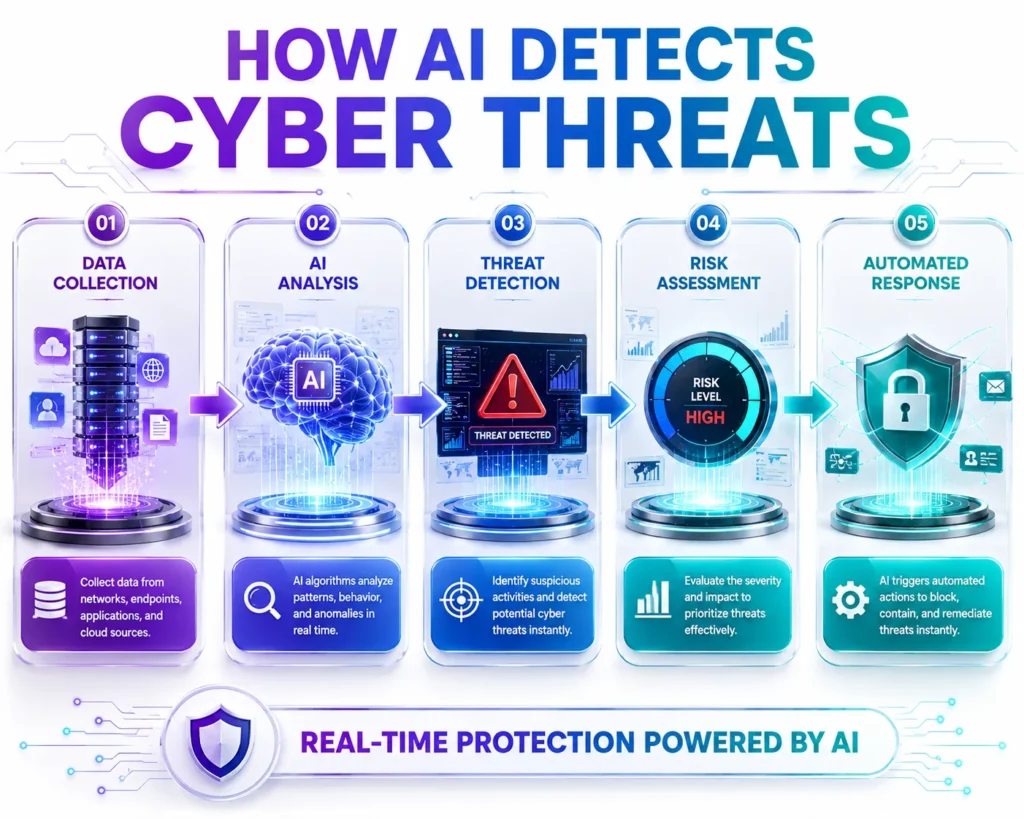
3.1 How Does AI Detect Cyber Threats in Real Time?
Cybersecurity teams often deal with enormous volumes of data generated by users, applications, networks, and devices. Manually analyzing this information is nearly impossible.
Artificial Intelligence helps solve this challenge by continuously monitoring and analyzing data across an organization’s infrastructure.
AI can evaluate:
- Network traffic patterns
- User login behavior
- Application activities
- File transfers
- Device communications
- Access requests
- Cloud environment activities
When the system identifies behavior that deviates from normal patterns, it can immediately generate alerts or trigger automated responses.
For example:
- An employee logging in from multiple countries within minutes.
- A sudden spike in file downloads.
- Unusual access to sensitive databases.
- Unexpected network communications.
These activities may indicate a potential cyberattack, allowing organizations to investigate and respond before significant damage occurs.
Real-time monitoring is one of the reasons why AI-powered cybersecurity is becoming essential for modern security operations.
3.2 How Does Machine Learning Identify Suspicious Activities?
Machine Learning, a key component of AI in cybersecurity, enables security systems to learn from historical data and continuously improve their ability to detect threats.
Instead of relying solely on predefined rules, Machine Learning algorithms establish a baseline of normal behavior across users, devices, and networks.
The system learns:
- Typical login locations.
- Normal working hours.
- Common application usage.
- Standard network traffic patterns.
- Expected user behavior.
When activities fall outside these established patterns, the system identifies them as anomalies.
For example:
A finance employee who typically accesses accounting software during business hours suddenly attempts to download large volumes of confidential data at midnight from an unfamiliar device.
A Machine Learning model can recognize this behavior as suspicious and alert security teams immediately.
This ability to identify unusual behavior makes Machine Learning a critical component of the future of cybersecurity, particularly as organizations face increasingly sophisticated threats.
3.3 Why Is Early Threat Detection Critical for Modern Businesses?
The longer a cyber threat remains undetected, the greater the potential damage.
Many successful cyberattacks occur because attackers gain access to systems and remain hidden for extended periods. During this time, they may:
- Steal sensitive information.
- Move across networks.
- Escalate privileges.
- Deploy ransomware.
- Disrupt business operations.
Early detection significantly reduces these risks.
With AI-powered cybersecurity, organizations can:
- Identify threats faster.
- Reduce attacker dwell time.
- Prevent data breaches.
- Minimize operational disruption.
- Lower incident response costs.
- Protect customer trust.
For example, if AI identifies malicious behavior within seconds rather than days or weeks, security teams can contain the threat before it spreads throughout the organization.
This proactive capability is one of the biggest reasons why businesses are investing heavily in predictive cybersecurity and advanced threat detection technologies.
3.4 How Does AI Help Prevent Cyberattacks Before They Happen?
Detection is important, but prevention is even more valuable.
The future of cybersecurity increasingly focuses on preventing attacks rather than simply responding to them.
AI helps prevent threats by:
- Identifying vulnerabilities before attackers exploit them.
- Monitoring systems continuously.
- Recognizing emerging attack patterns.
- Blocking suspicious activities automatically.
- Predicting potential risks based on historical data.
- Prioritizing security weaknesses that require immediate attention.
This proactive approach allows organizations to strengthen their defenses before cybercriminals can take advantage of weaknesses.
As cybersecurity threats become more advanced, businesses need security systems that can anticipate risks rather than simply react to incidents.
Key Takeaway
The combination of Artificial Intelligence, Machine Learning, cyber threat detection, and AI-powered cybersecurity is transforming how organizations identify and prevent cyberattacks. By monitoring environments in real time, detecting unusual behavior, and predicting potential threats, AI enables businesses to move from reactive defense to proactive protection.
As the future of cybersecurity continues to evolve, organizations that adopt intelligent threat detection and prevention strategies will be better positioned to protect their data, maintain business continuity, and stay ahead of increasingly sophisticated cyber threats.
4. What Are the Biggest Cybersecurity Threats in an AI-Driven World?
While Artificial Intelligence is helping organizations strengthen their defenses, it is also creating new opportunities for cybercriminals. The same technologies that enable faster threat detection, automated security monitoring, and predictive defense can also be used to develop more sophisticated cyberattacks.
This dual nature of AI is one of the defining challenges shaping the future of cybersecurity. As organizations adopt AI-powered cybersecurity, attackers are increasingly leveraging automation, intelligent algorithms, and advanced techniques to bypass traditional security controls.
Understanding these emerging threats is essential for building effective defense strategies and maintaining long-term cyber resilience.
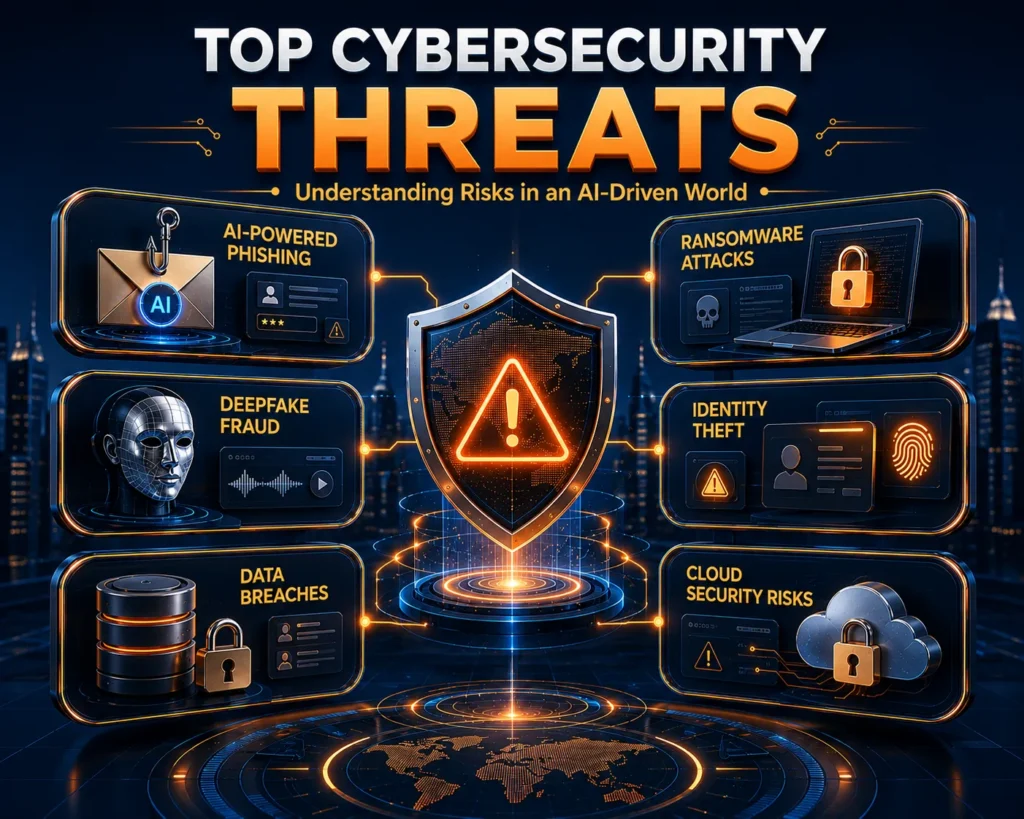
4.1 How Are AI-Powered Cyberattacks Becoming More Sophisticated?
Cybercriminals are increasingly using Artificial Intelligence to improve the speed, scale, and effectiveness of their attacks.
Traditional cyberattacks often required significant manual effort. Today, AI can automate many aspects of the attack process, allowing criminals to target more organizations with greater precision.
AI can be used to:
- Automate vulnerability discovery.
- Analyze large datasets for weaknesses.
- Create convincing phishing campaigns.
- Evade security detection systems.
- Adapt attack methods in real time.
- Generate malicious code more efficiently.
These capabilities make attacks faster, more targeted, and harder to detect.
As AI technology becomes more accessible, organizations must prepare for increasingly advanced threats that can evolve and adapt much like the security systems designed to stop them.
This growing threat landscape is a major factor influencing the future of cybersecurity.
4.2 Why Are Phishing and Social Engineering Attacks Evolving?
Phishing remains one of the most successful cyberattack methods, and AI is making these attacks even more convincing.
In the past, phishing emails often contained obvious errors, suspicious language, or poorly designed content. Today, Generative AI can create highly personalized and professional-looking messages that closely resemble legitimate communications.
AI-enhanced phishing attacks can:
- Mimic writing styles.
- Personalize messages using publicly available information.
- Generate realistic business communications.
- Create convincing fake websites.
- Automate large-scale phishing campaigns.
Attackers can also use AI-generated voice cloning and deepfake technologies to impersonate executives, employees, or trusted contacts.
As a result, organizations must combine technical defenses with employee awareness training to reduce the risk of successful social engineering attacks.
The rise of intelligent phishing campaigns highlights why the future of cybersecurity requires both advanced technology and human vigilance.
4.3 How Do Ransomware Attacks Continue to Threaten Organizations?
Ransomware remains one of the most damaging forms of cybercrime.
In a ransomware attack, cybercriminals encrypt critical systems or data and demand payment in exchange for restoring access.
Modern ransomware operations have become highly sophisticated, often involving:
- Automated attack tools.
- AI-assisted vulnerability scanning.
- Multi-stage attack strategies.
- Data theft before encryption.
- Double-extortion tactics.
Attackers no longer rely solely on locking systems. Many now steal sensitive information and threaten to release it publicly if ransom demands are not met.
The financial and operational consequences can be severe, including:
- Business interruption.
- Revenue loss.
- Regulatory penalties.
- Reputational damage.
- Customer trust issues.
To address these risks, organizations are increasingly investing in AI-powered cybersecurity, cyber threat detection, and predictive cybersecurity solutions that help identify ransomware activity before it spreads throughout the network.
4.4 Why Is Data Privacy Becoming a Major Security Concern?
As businesses collect and process larger amounts of data, protecting sensitive information has become a top priority.
Modern organizations store valuable assets such as:
- Customer information.
- Financial records.
- Intellectual property.
- Healthcare data.
- Business communications.
- Employee information.
Cybercriminals view this data as a highly valuable target.
At the same time, governments and regulators around the world are introducing stricter privacy requirements, increasing the responsibility organizations have to secure personal information.
A data breach can result in:
- Financial losses.
- Compliance violations.
- Legal consequences.
- Loss of customer confidence.
- Long-term reputational harm.
This is why the future of cybersecurity increasingly focuses on combining security and privacy strategies. Organizations must not only defend against attacks but also ensure responsible data management and protection practices.
Key Takeaway
The future of cybersecurity is being shaped by a new generation of threats powered by Artificial Intelligence, automation, and increasingly sophisticated attack techniques. From AI-enhanced phishing campaigns and ransomware attacks to evolving privacy risks, organizations face challenges that require more advanced and adaptive defense strategies.
By leveraging AI in cybersecurity, cyber threat detection, predictive cybersecurity, and cybersecurity automation, businesses can better identify emerging threats, reduce risk exposure, and strengthen their ability to respond to an increasingly complex threat landscape.
5. How Is AI-Powered Cybersecurity Changing Incident Response?
Detecting cyber threats is only one part of a strong security strategy. Organizations must also respond quickly and effectively when incidents occur. In today’s fast-moving threat landscape, even a small delay can allow attackers to spread across networks, steal sensitive information, or disrupt critical business operations.
Traditional incident response often relies heavily on manual investigation and decision-making. While security professionals remain essential, the growing volume and complexity of cyber threats make it increasingly difficult for teams to respond quickly enough without technological assistance.
This is where AI-powered cybersecurity is transforming incident response. By combining Artificial Intelligence, Machine Learning, cybersecurity automation, and cyber threat detection, organizations can identify, investigate, and respond to security incidents faster than ever before.
As businesses continue to strengthen their defenses, intelligent incident response capabilities will play a central role in the future of cybersecurity.
5.1 How Does AI Accelerate Security Incident Detection?
One of the biggest challenges facing security teams is identifying genuine threats among thousands of daily alerts.
Large organizations generate enormous volumes of security data from:
- Endpoints
- Servers
- Cloud platforms
- Applications
- User accounts
- Network devices
Manually reviewing every alert is both time-consuming and inefficient.
Artificial Intelligence helps solve this challenge by continuously analyzing data and identifying patterns that indicate malicious activity.
AI can:
- Correlate events across multiple systems.
- Detect unusual behavior.
- Prioritize high-risk alerts.
- Identify attack chains.
- Recognize indicators of compromise.
- Reduce false positives.
Instead of forcing analysts to investigate every alert, AI highlights the incidents most likely to represent real threats.
This allows security teams to focus their efforts where they matter most, improving both efficiency and effectiveness.
5.2 How Can Automation Improve Cybersecurity Response Times?
Speed is critical during a cyberattack.
The longer attackers remain undetected or uncontained, the greater the potential impact on the organization.
Cybersecurity automation helps reduce response times by enabling systems to perform predefined actions without waiting for human intervention.
For example, automated security systems can:
- Isolate compromised devices.
- Block suspicious IP addresses.
- Disable compromised user accounts.
- Quarantine malicious files.
- Trigger security workflows.
- Notify response teams instantly.
These actions can occur within seconds of detecting suspicious activity.
Without automation, security teams might require minutes or even hours to perform the same tasks manually.
This dramatic improvement in response speed is one of the primary reasons organizations are investing heavily in AI-powered cybersecurity solutions.
5.3 Why Is Faster Incident Response Essential for Businesses?
The cost of a cyberattack often increases with every passing minute.
Delayed responses can result in:
- Data breaches.
- Business disruption.
- Financial losses.
- Regulatory penalties.
- Reputational damage.
- Customer trust issues.
Rapid incident response helps organizations:
- Minimize attack impact.
- Reduce recovery costs.
- Protect critical assets.
- Maintain operational continuity.
- Strengthen overall cyber resilience.
For example, if ransomware activity is detected and contained within minutes, organizations can prevent widespread encryption of systems and avoid significant operational downtime.
This ability to act quickly is becoming increasingly important as cyber threats continue to evolve.
The future of cybersecurity depends not only on detecting attacks but also on responding to them with speed and precision.
5.4 How Do AI and Human Experts Work Together During Incident Response?
Although Artificial Intelligence plays a crucial role in modern security operations, human expertise remains essential.
AI excels at:
- Processing large datasets.
- Identifying patterns.
- Automating repetitive tasks.
- Prioritizing alerts.
- Monitoring systems continuously.
However, human security professionals provide:
- Strategic decision-making.
- Contextual understanding.
- Threat assessment.
- Business risk evaluation.
- Incident leadership.
- Complex investigation skills.
The most effective security operations combine both capabilities.
AI handles routine monitoring and rapid analysis, while human experts focus on critical decisions and complex incident management.
This partnership enables organizations to build stronger, more adaptive security programs capable of addressing both current and emerging threats.
Key Takeaway
The future of cybersecurity is transforming incident response through the combined power of AI-powered cybersecurity, cybersecurity automation, Machine Learning, and intelligent analytics. By accelerating threat detection, automating routine actions, and enabling faster response times, AI helps organizations reduce risk and improve resilience.
As cyber threats become more sophisticated, businesses that embrace intelligent incident response capabilities will be better equipped to contain attacks, protect sensitive data, and maintain operational continuity in an increasingly complex digital environment.
7. How Do Zero Trust Security Models Strengthen Cyber Defense?
As organizations expand their digital ecosystems through cloud computing, remote work, mobile devices, and connected technologies, traditional security models are becoming less effective. For many years, cybersecurity strategies focused on protecting the network perimeter, assuming that anything inside the organization’s environment could be trusted.
However, modern cyber threats have exposed the limitations of this approach.
Attackers often gain access through compromised accounts, stolen credentials, phishing attacks, or vulnerable devices. Once inside, they can move throughout the network with minimal resistance.
This reality has accelerated the adoption of zero trust security, a model that is becoming a foundational component of the future of cybersecurity.
Rather than assuming trust, Zero Trust continuously verifies every user, device, application, and access request, regardless of whether it originates inside or outside the network.
7.1 What Is a Zero Trust Security Model?
A zero trust security model is built around a simple principle:
Never Trust, Always Verify.
Instead of granting broad access based on location or network position, Zero Trust requires continuous validation before allowing access to resources.
Under this approach, organizations verify:
- User identities
- Device health
- Access permissions
- Application behavior
- Network activity
- Authentication status
Every access request is evaluated based on context and risk.
For example:
Even if an employee successfully logs in, the system may still verify:
- Device security status
- Geographic location
- Login behavior
- Requested resources
- Access history
This layered verification process significantly reduces the chances of unauthorized access.
As digital environments become more complex, zero trust security is emerging as a critical pillar of the future of cybersecurity.
7.2 Why Is “Never Trust, Always Verify” Important?
Traditional security models often assume that users inside the network are trustworthy.
Unfortunately, many successful cyberattacks begin with:
- Stolen credentials
- Insider threats
- Compromised devices
- Phishing attacks
- Malware infections
Once attackers gain initial access, they may move laterally across systems and access sensitive resources.
The Zero Trust approach minimizes this risk by continuously validating access requests.
Instead of granting unrestricted access after login, the system:
- Authenticates users repeatedly.
- Evaluates device security.
- Monitors behavior patterns.
- Applies least-privilege access controls.
- Detects unusual activities.
This approach limits the ability of attackers to move freely within the environment.
By reducing implicit trust, organizations can significantly strengthen their cyber defenses against modern threats.
7.3 How Does Zero Trust Reduce Security Risks?
One of the greatest advantages of zero trust security is its ability to contain threats before they spread.
Zero Trust reduces risk by implementing:
Least Privilege Access
Users receive access only to the resources necessary for their specific roles.
Continuous Authentication
Verification occurs throughout the session rather than only during login.
Micro-Segmentation
Networks are divided into smaller protected zones, limiting attacker movement.
Real-Time Monitoring
Security systems continuously analyze behavior and detect anomalies.
Adaptive Access Controls
Access decisions are adjusted dynamically based on risk levels.
These capabilities make it significantly harder for cybercriminals to escalate privileges or access critical systems.
As organizations continue investing in AI-powered cybersecurity, cyber threat detection, and predictive cybersecurity, Zero Trust provides the security foundation needed to support these advanced technologies.
7.4 Why Is Zero Trust Becoming Essential for Modern Businesses?
The modern workplace looks very different from traditional corporate environments.
Today’s organizations rely on:
- Remote employees
- Cloud applications
- Hybrid work models
- Third-party vendors
- Mobile devices
- Internet of Things (IoT) systems
These changes have expanded the attack surface and increased security complexity.
Traditional perimeter-based security models were not designed for this level of connectivity.
Zero Trust helps address these challenges by ensuring that every interaction is verified regardless of where it originates.
Organizations adopting zero trust security often benefit from:
- Improved visibility.
- Stronger access controls.
- Better compliance support.
- Reduced insider threat risks.
- Enhanced protection against credential-based attacks.
- Greater resilience against evolving cyber threats.
As digital ecosystems continue to grow, Zero Trust will remain a critical strategy shaping the future of cybersecurity.
Key Takeaway
The future of cybersecurity requires organizations to move beyond traditional trust-based security models. By adopting zero trust security, businesses can continuously verify users, devices, and access requests while reducing the risk of unauthorized access and lateral movement.
Combined with AI in cybersecurity, cybersecurity automation, cyber threat detection, and predictive cybersecurity, Zero Trust provides a powerful framework for protecting modern digital environments against increasingly sophisticated threats.

8. What Challenges Do Organizations Face When Using AI in Cybersecurity?
While AI in cybersecurity offers powerful advantages, it is not a complete solution to every security challenge. Organizations adopting AI-powered cybersecurity must understand that intelligent technologies introduce their own risks, limitations, and operational complexities.
As businesses increasingly rely on Artificial Intelligence, Machine Learning, and cybersecurity automation, they must ensure these technologies are implemented responsibly and effectively. Failing to do so can create new vulnerabilities rather than strengthen security.
The future of cybersecurity will depend not only on how organizations use AI but also on how they manage the challenges that come with it.
8.1 Can Cybercriminals Use AI Against Businesses?
Yes. One of the biggest concerns surrounding the future of cybersecurity is that cybercriminals now have access to many of the same AI technologies used by defenders.
Just as organizations use AI to detect threats, attackers can use AI to improve their offensive capabilities.
Cybercriminals may leverage Artificial Intelligence to:
- Automate phishing campaigns.
- Identify vulnerabilities faster.
- Generate convincing fake content.
- Create realistic deepfake videos and audio.
- Evade traditional detection systems.
- Launch large-scale attacks more efficiently.
For example, AI-generated phishing emails can mimic the writing style of executives or trusted business partners, making them much harder to identify.
As AI capabilities continue to advance, organizations must assume that attackers will also become more sophisticated.
This ongoing arms race between defenders and attackers is one of the defining characteristics of the future of cybersecurity.
8.2 What Are the Risks of Over-Reliance on AI Security Systems?
Although AI-powered cybersecurity provides significant benefits, relying entirely on automated systems can create risks.
AI systems are highly effective at processing data and identifying patterns, but they are not infallible.
Potential limitations include:
- False positives.
- False negatives.
- Incomplete data analysis.
- Misinterpreted behaviors.
- Algorithmic bias.
- Unexpected system failures.
For example, an AI system may incorrectly classify legitimate activity as malicious, disrupting normal business operations. Conversely, it may fail to recognize a novel attack technique that does not resemble previously observed patterns.
This is why human oversight remains essential.
Organizations should view AI as a powerful tool that supports cybersecurity professionals rather than replacing them entirely.
The strongest security programs combine intelligent automation with experienced human decision-making.
8.3 How Can Organizations Address AI Security Challenges?
Successfully implementing AI in cybersecurity requires a balanced and strategic approach.
Organizations can strengthen their AI-driven security programs by focusing on several key areas.
Maintain Human Oversight
Security experts should continuously review AI-generated recommendations and investigate high-priority incidents.
Improve Data Quality
AI systems depend on accurate and comprehensive data. Poor-quality data can lead to inaccurate results and ineffective security decisions.
Continuously Update AI Models
Threat landscapes evolve rapidly. Organizations must regularly retrain and update AI systems to ensure they remain effective against emerging attack techniques.
Test Security Systems Regularly
Routine testing helps identify weaknesses, improve detection accuracy, and validate AI performance.
Develop Strong Security Policies
Clear governance frameworks help ensure AI technologies are used responsibly and align with organizational security objectives.
By addressing these challenges proactively, businesses can maximize the benefits of AI-powered cybersecurity while minimizing associated risks.
8.4 Why Is Human Expertise Still Essential in Cybersecurity?
Despite advances in Artificial Intelligence, cybersecurity remains a human-centered discipline.
AI can:
- Analyze massive datasets.
- Detect anomalies.
- Automate repetitive tasks.
- Prioritize alerts.
- Accelerate investigations.
However, human professionals provide capabilities that AI cannot fully replicate.
Security experts contribute:
- Strategic thinking.
- Risk assessment.
- Business context.
- Ethical judgment.
- Complex decision-making.
- Incident leadership.
For example, determining the business impact of a cyberattack often requires understanding organizational priorities, legal obligations, customer relationships, and operational risks—areas where human expertise remains indispensable.
The future of cybersecurity will not be defined by humans versus AI.
Instead, it will be shaped by effective collaboration between intelligent technologies and skilled cybersecurity professionals.
Key Takeaway
The growing adoption of AI in cybersecurity presents tremendous opportunities, but it also introduces new challenges. Cybercriminals are using AI to enhance attacks, organizations risk over-relying on automation, and AI systems require continuous monitoring and improvement.
To succeed in the future of cybersecurity, businesses must combine AI-powered cybersecurity, cybersecurity automation, and Machine Learning with strong governance, high-quality data, and experienced human expertise. Organizations that achieve this balance will be better positioned to defend against evolving threats while maximizing the benefits of intelligent security technologies.
9. What Are the Best Practices for Building Future-Ready Cybersecurity Strategies?
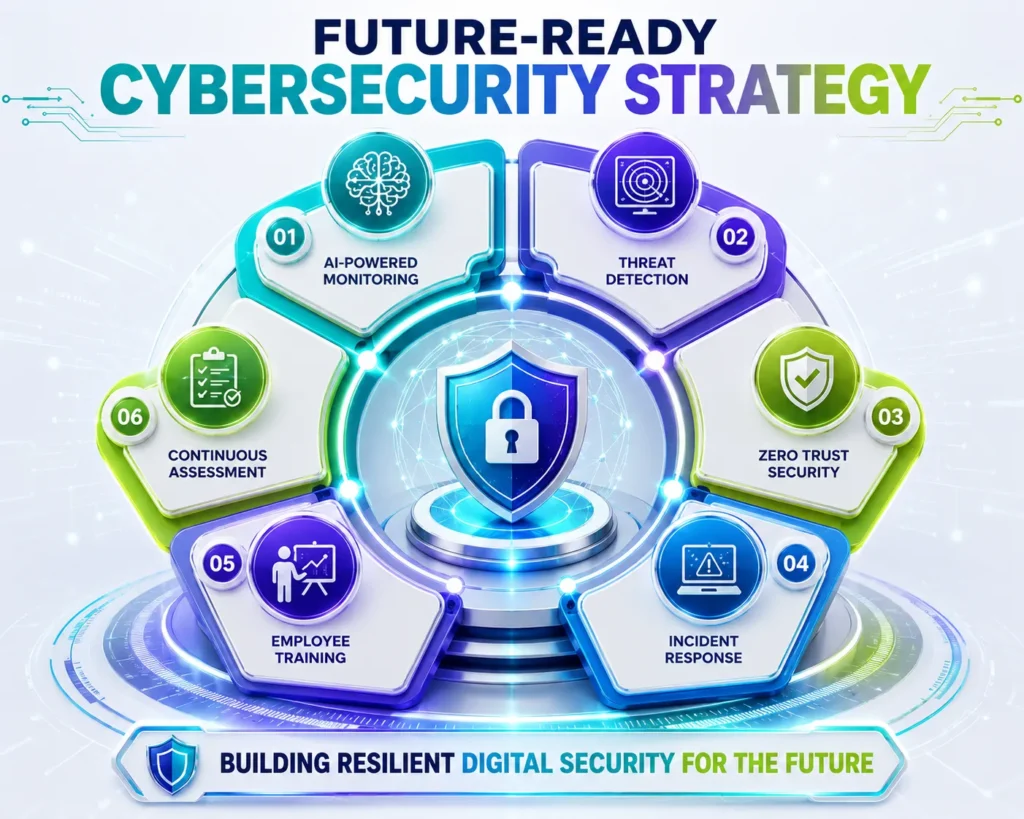
As cyber threats become more advanced and digital environments grow increasingly complex, organizations need security strategies that can evolve alongside emerging risks. Relying solely on traditional defenses is no longer enough. Businesses must adopt a proactive approach that combines AI-powered cybersecurity, cyber threat detection, zero trust security, and strong security governance.
The future of cybersecurity belongs to organizations that can anticipate threats, adapt quickly, and continuously strengthen their security posture. Building a future-ready cybersecurity strategy requires more than investing in new technologies—it requires creating a culture of security throughout the organization.
By following proven cybersecurity best practices, businesses can improve resilience, reduce vulnerabilities, and better protect their digital assets.
9.1 How Can Businesses Create a Strong Cybersecurity Culture?
Technology alone cannot eliminate cyber risks.
Many successful cyberattacks occur because of human errors such as:
- Weak passwords.
- Phishing email interactions.
- Poor security practices.
- Unauthorized software installations.
- Mishandling sensitive information.
This is why creating a strong cybersecurity culture is essential.
Organizations should focus on:
Security Awareness Training
Employees should understand how to recognize cyber threats and respond appropriately.
Regular Education Programs
Cybersecurity training should be ongoing rather than a one-time event.
Clear Security Policies
Employees should know their responsibilities regarding data protection and system security.
Leadership Support
Security initiatives are most effective when supported by senior leadership.
A strong security culture helps transform employees from potential vulnerabilities into active participants in the organization’s defense strategy.
9.2 Why Is Continuous Security Monitoring Important?
Cyber threats do not operate on a schedule.
Attackers can attempt to compromise systems at any time, making continuous visibility essential.
Continuous monitoring enables organizations to:
- Detect suspicious activities quickly.
- Identify unauthorized access attempts.
- Monitor network behavior.
- Track security events in real time.
- Improve incident response readiness.
Using AI in cybersecurity, organizations can analyze vast amounts of security data continuously and identify anomalies that may indicate potential attacks.
Modern monitoring solutions often combine:
- Artificial Intelligence
- Machine Learning
- cybersecurity automation
- cyber threat detection
Together, these technologies provide organizations with greater visibility into their security environments and support faster response times.
Continuous monitoring is becoming a fundamental requirement for the future of cybersecurity.
9.3 How Should Organizations Combine Human Expertise and AI?
One of the most effective cybersecurity strategies involves combining intelligent technologies with experienced security professionals.
While AI-powered cybersecurity excels at:
- Data analysis.
- Pattern recognition.
- Threat detection.
- Automated response.
- Risk prioritization.
Human experts provide:
- Strategic judgment.
- Business context.
- Threat investigation.
- Decision-making.
- Security leadership.
Organizations should view AI as a force multiplier rather than a replacement for cybersecurity teams.
Successful security programs establish clear collaboration between automated systems and human analysts.
For example:
- AI identifies suspicious activity.
- Security analysts investigate findings.
- Leadership teams determine appropriate business responses.
This balanced approach improves both efficiency and effectiveness.
The future of cybersecurity will increasingly depend on strong partnerships between intelligent technologies and skilled professionals.
9.4 What Cybersecurity Best Practices Should Every Business Follow?
Regardless of industry or organization size, several cybersecurity best practices remain essential.
Implement Zero Trust Security
Adopt a zero trust security framework that continuously verifies users, devices, and access requests.
Strengthen Identity and Access Management
Use multi-factor authentication and least-privilege access controls.
Maintain Regular Software Updates
Patch vulnerabilities quickly to reduce attack opportunities.
Secure Cloud Environments
Protect cloud resources through strong configurations and continuous monitoring.
Backup Critical Data
Maintain secure backups to support business continuity and ransomware recovery.
Conduct Regular Security Assessments
Identify vulnerabilities before attackers can exploit them.
Use AI-Powered Security Tools
Leverage AI-powered cybersecurity solutions to improve detection, prevention, and response capabilities.
Develop an Incident Response Plan
Prepare for potential security incidents before they occur.
Organizations that consistently apply these best practices are better positioned to defend against modern cyber threats.
Key Takeaway
Building a future-ready cybersecurity strategy requires a combination of technology, people, and processes. Organizations must create strong security cultures, implement continuous monitoring, adopt zero trust security, and leverage AI in cybersecurity to strengthen their defenses.
As the future of cybersecurity continues to evolve, businesses that embrace proactive security strategies will be better equipped to identify threats, respond effectively, and maintain resilience in an increasingly connected digital world.
10. How Are Leading Companies Using AI to Improve Cybersecurity?
The adoption of AI in cybersecurity is no longer limited to technology giants or highly specialized security organizations. Today, businesses across industries are using Artificial Intelligence, Machine Learning, predictive cybersecurity, and cybersecurity automation to strengthen their defenses against increasingly sophisticated threats.
From financial institutions and healthcare providers to cloud service providers and global enterprises, organizations are leveraging intelligent security technologies to improve threat detection, automate security operations, and reduce response times.
These real-world applications provide valuable insights into how the future of cybersecurity is being shaped by AI-driven innovation.
10.1 How Does AI Enhance Enterprise Security Operations?
Large enterprises manage complex digital environments that generate enormous amounts of security data every day.
These environments often include:
- Cloud platforms
- Remote work infrastructures
- Mobile devices
- Data centers
- Business applications
- Third-party integrations
Monitoring these systems manually is nearly impossible.
To address this challenge, leading organizations are integrating AI-powered cybersecurity into their Security Operations Centers (SOCs).
AI helps enterprise security teams by:
- Monitoring millions of events in real time.
- Identifying suspicious activities.
- Correlating alerts across multiple systems.
- Reducing false positives.
- Prioritizing high-risk incidents.
- Accelerating threat investigations.
Instead of spending valuable time reviewing thousands of low-priority alerts, analysts can focus on the most critical threats.
This significantly improves operational efficiency while strengthening overall cyber defense capabilities.
10.2 How Are Businesses Using AI for Threat Intelligence?
Threat intelligence plays a crucial role in modern cybersecurity strategies.
Organizations must continuously monitor:
- Emerging attack techniques.
- Vulnerability disclosures.
- Malware campaigns.
- Ransomware groups.
- Industry-specific threats.
- Global cybercrime trends.
The volume of available threat information is far too large for manual analysis.
This is where Artificial Intelligence provides a major advantage.
AI-powered threat intelligence platforms can:
- Analyze large datasets.
- Identify attack patterns.
- Predict emerging risks.
- Detect indicators of compromise.
- Prioritize threats based on relevance.
- Deliver actionable security insights.
By transforming raw security data into meaningful intelligence, AI enables organizations to make faster and more informed security decisions.
This proactive capability is a key component of the future of cybersecurity.
10.3 How Are Financial Institutions Using AI to Strengthen Security?
Financial organizations are among the most heavily targeted industries in the world.
Banks, payment providers, and financial service companies use AI-powered cybersecurity to protect sensitive customer information and detect fraudulent activities.
AI helps financial institutions:
- Monitor transactions in real time.
- Identify unusual spending patterns.
- Detect account takeover attempts.
- Prevent fraudulent payments.
- Monitor customer behavior.
- Strengthen identity verification processes.
For example, if a customer’s account suddenly shows activity from multiple locations or devices, AI systems can quickly identify the anomaly and trigger additional verification measures.
These capabilities help reduce fraud while improving customer security.
As digital banking continues to expand, AI will play an increasingly important role in the future of cybersecurity within the financial sector.
10.4 What Lessons Can Organizations Learn from Industry Leaders?
Although every organization faces unique security challenges, successful companies share several common cybersecurity principles.
They Adopt Proactive Security Strategies
Rather than waiting for attacks to occur, they invest in predictive cybersecurity and continuous monitoring.
They Combine AI and Human Expertise
Leading organizations use Artificial Intelligence to enhance security operations while relying on skilled professionals for decision-making and incident management.
They Prioritize Zero Trust Security
Many organizations are implementing zero trust security frameworks to strengthen access controls and reduce risk.
They Continuously Improve Security Programs
Cybersecurity is treated as an ongoing process rather than a one-time project.
They Invest in Security Awareness
Employees receive regular training to help reduce human-related security risks.
Key Takeaway
Leading organizations are using AI in cybersecurity to transform how they detect threats, analyze risks, and respond to security incidents. Through intelligent monitoring, advanced threat intelligence, fraud detection, and cybersecurity automation, businesses are building more resilient and adaptive security programs.
As the future of cybersecurity continues to evolve, organizations that embrace AI-powered cybersecurity, Machine Learning, predictive cybersecurity, and zero trust security will be better positioned to protect their assets, maintain customer trust, and stay ahead of increasingly sophisticated cyber threats.
10. How Are Leading Companies Using AI to Improve Cybersecurity?
The adoption of AI in cybersecurity is no longer limited to technology giants or highly specialized security organizations. Today, businesses across industries are using Artificial Intelligence, Machine Learning, predictive cybersecurity, and cybersecurity automation to strengthen their defenses against increasingly sophisticated threats.
From financial institutions and healthcare providers to cloud service providers and global enterprises, organizations are leveraging intelligent security technologies to improve threat detection, automate security operations, and reduce response times.
These real-world applications provide valuable insights into how the future of cybersecurity is being shaped by AI-driven innovation.
10.1 How Does AI Enhance Enterprise Security Operations?
Large enterprises manage complex digital environments that generate enormous amounts of security data every day.
These environments often include:
- Cloud platforms
- Remote work infrastructures
- Mobile devices
- Data centers
- Business applications
- Third-party integrations
Monitoring these systems manually is nearly impossible.
To address this challenge, leading organizations are integrating AI-powered cybersecurity into their Security Operations Centers (SOCs).
AI helps enterprise security teams by:
- Monitoring millions of events in real time.
- Identifying suspicious activities.
- Correlating alerts across multiple systems.
- Reducing false positives.
- Prioritizing high-risk incidents.
- Accelerating threat investigations.
Instead of spending valuable time reviewing thousands of low-priority alerts, analysts can focus on the most critical threats.
This significantly improves operational efficiency while strengthening overall cyber defense capabilities.
10.2 How Are Businesses Using AI for Threat Intelligence?
Threat intelligence plays a crucial role in modern cybersecurity strategies.
Organizations must continuously monitor:
- Emerging attack techniques.
- Vulnerability disclosures.
- Malware campaigns.
- Ransomware groups.
- Industry-specific threats.
- Global cybercrime trends.
The volume of available threat information is far too large for manual analysis.
This is where Artificial Intelligence provides a major advantage.
AI-powered threat intelligence platforms can:
- Analyze large datasets.
- Identify attack patterns.
- Predict emerging risks.
- Detect indicators of compromise.
- Prioritize threats based on relevance.
- Deliver actionable security insights.
By transforming raw security data into meaningful intelligence, AI enables organizations to make faster and more informed security decisions.
This proactive capability is a key component of the future of cybersecurity.
10.3 How Are Financial Institutions Using AI to Strengthen Security?
Financial organizations are among the most heavily targeted industries in the world.
Banks, payment providers, and financial service companies use AI-powered cybersecurity to protect sensitive customer information and detect fraudulent activities.
AI helps financial institutions:
- Monitor transactions in real time.
- Identify unusual spending patterns.
- Detect account takeover attempts.
- Prevent fraudulent payments.
- Monitor customer behavior.
- Strengthen identity verification processes.
For example, if a customer’s account suddenly shows activity from multiple locations or devices, AI systems can quickly identify the anomaly and trigger additional verification measures.
These capabilities help reduce fraud while improving customer security.
As digital banking continues to expand, AI will play an increasingly important role in the future of cybersecurity within the financial sector.
10.4 What Lessons Can Organizations Learn from Industry Leaders?
Although every organization faces unique security challenges, successful companies share several common cybersecurity principles.
They Adopt Proactive Security Strategies
Rather than waiting for attacks to occur, they invest in predictive cybersecurity and continuous monitoring.
They Combine AI and Human Expertise
Leading organizations use Artificial Intelligence to enhance security operations while relying on skilled professionals for decision-making and incident management.
They Prioritize Zero Trust Security
Many organizations are implementing zero trust security frameworks to strengthen access controls and reduce risk.
They Continuously Improve Security Programs
Cybersecurity is treated as an ongoing process rather than a one-time project.
They Invest in Security Awareness
Employees receive regular training to help reduce human-related security risks.
These practices demonstrate that the future of cybersecurity is not defined by technology alone. Success comes from combining advanced security tools, intelligent automation, strong governance, and continuous improvement.
Key Takeaway
Leading organizations are using AI in cybersecurity to transform how they detect threats, analyze risks, and respond to security incidents. Through intelligent monitoring, advanced threat intelligence, fraud detection, and cybersecurity automation, businesses are building more resilient and adaptive security programs.
As the future of cybersecurity continues to evolve, organizations that embrace AI-powered cybersecurity, Machine Learning, predictive cybersecurity, and zero trust security will be better positioned to protect their assets, maintain customer trust, and stay ahead of increasingly sophisticated cyber threats.
11. What Are the Most Frequently Asked Questions About the Future of Cybersecurity?
As organizations continue investing in AI-powered cybersecurity, many business leaders, IT professionals, and decision-makers have questions about how security will evolve in the coming years. Below are answers to some of the most common questions about the future of cybersecurity and the role of emerging technologies in protecting digital environments.
11.1 What Is the Future of Cybersecurity?
The future of cybersecurity focuses on proactive threat prevention, intelligent automation, and adaptive security systems that can identify and respond to threats in real time.
Instead of relying solely on traditional security tools, organizations are increasingly adopting:
- AI in cybersecurity
- Machine Learning
- predictive cybersecurity
- cyber threat detection
- zero trust security
- cybersecurity automation
These technologies help businesses detect risks faster, reduce response times, and strengthen overall cyber resilience.
11.2 How Is AI Changing Cybersecurity?
Artificial Intelligence is transforming cybersecurity by enabling organizations to analyze large amounts of security data, identify suspicious activities, and automate threat detection processes.
AI improves cybersecurity by:
- Detecting threats in real time.
- Reducing false positives.
- Automating security operations.
- Enhancing threat intelligence.
- Accelerating incident response.
- Supporting predictive risk analysis.
As cyber threats become more sophisticated, AI-powered cybersecurity is becoming an essential component of modern security strategies.
11.3 Will AI Replace Cybersecurity Professionals?
No.
While Artificial Intelligence can automate many repetitive security tasks, it cannot replace the expertise, judgment, and strategic thinking provided by cybersecurity professionals.
AI excels at:
- Data analysis.
- Pattern recognition.
- Threat monitoring.
- Automated responses.
Human experts remain essential for:
- Risk assessment.
- Incident leadership.
- Strategic decision-making.
- Security planning.
- Regulatory compliance.
- Business context evaluation.
The future of cybersecurity will involve collaboration between intelligent technologies and skilled professionals rather than replacement.
11.4 What Is AI-Powered Cybersecurity?
AI-powered cybersecurity refers to the use of Artificial Intelligence, Machine Learning, and advanced analytics to improve security operations.
These solutions can:
- Monitor environments continuously.
- Detect cyber threats.
- Analyze attack patterns.
- Automate security workflows.
- Respond to incidents more efficiently.
By improving speed and accuracy, AI-powered security helps organizations better defend against evolving cyber threats.
11.5 What Is Predictive Cybersecurity?
Predictive cybersecurity uses historical data, behavioral analysis, and intelligent algorithms to anticipate potential threats before they occur.
Rather than reacting to attacks after they happen, predictive security helps organizations:
- Identify vulnerabilities.
- Detect emerging risks.
- Prioritize security efforts.
- Prevent potential incidents.
This proactive approach is becoming a major trend shaping the future of cybersecurity.
11.6 Why Is Zero Trust Security Important?
Zero trust security follows the principle:
Never Trust, Always Verify
Instead of automatically trusting users or devices, Zero Trust continuously verifies every access request.
This approach helps organizations:
- Reduce unauthorized access.
- Prevent lateral movement.
- Strengthen identity verification.
- Protect sensitive resources.
- Improve security visibility.
As organizations adopt cloud technologies, remote work models, and connected systems, zero trust security is becoming a critical element of modern cybersecurity strategies.
11.7 How Can Businesses Improve Cybersecurity Readiness?
Organizations can strengthen their cybersecurity readiness by:
- Implementing zero trust security.
- Investing in AI-powered cybersecurity solutions.
- Conducting regular security assessments.
- Training employees on cyber risks.
- Monitoring systems continuously.
- Developing incident response plans.
- Maintaining secure backups.
- Adopting cybersecurity best practices.
Businesses that take a proactive approach are better positioned to manage risks and adapt to the evolving future of cybersecurity.
Key Takeaway
The future of cybersecurity is increasingly driven by intelligent technologies, proactive defense strategies, and continuous adaptation. As AI in cybersecurity, predictive cybersecurity, and zero trust security continue to evolve, organizations must stay informed and prepared to address emerging threats while maintaining strong security foundations.
12. What Should Businesses Do to Prepare for the Future of Cybersecurity?
The future of cybersecurity is no longer a distant concept it is already shaping how organizations protect their data, systems, employees, and customers. As digital transformation accelerates and cyber threats become increasingly sophisticated, businesses can no longer rely on traditional security approaches alone.
The rise of Artificial Intelligence, Machine Learning, predictive cybersecurity, cyber threat detection, and cybersecurity automation is fundamentally changing how organizations defend against attacks. At the same time, cybercriminals are becoming more advanced, using many of the same technologies to launch faster and more targeted attacks.
This evolving landscape requires organizations to adopt a proactive mindset. Instead of focusing solely on responding to incidents after they occur, businesses must build security strategies that anticipate threats, strengthen resilience, and continuously adapt to change.
12.1 What Are the Key Takeaways for Organizations?
Throughout this article, several important themes have emerged.
The future of cybersecurity will be defined by:
- Intelligent threat detection.
- Faster incident response.
- Predictive security capabilities.
- Continuous monitoring.
- Strong identity protection.
- Zero trust security frameworks.
- Collaboration between AI and human expertise.
Organizations that embrace these principles will be better equipped to manage emerging risks while maintaining business continuity.
Cybersecurity is no longer just a technical function it has become a strategic business priority that directly impacts growth, reputation, customer trust, and operational success.
12.2 Why Is Proactive Cybersecurity the Future?
Traditional cybersecurity strategies often focus on reacting to threats after they have already caused damage.
However, modern organizations cannot afford this reactive approach.
The most successful businesses are investing in:
- AI-powered cybersecurity
- predictive cybersecurity
- cyber threat detection
- cybersecurity automation
- Continuous risk assessment
These technologies enable organizations to identify vulnerabilities, recognize suspicious activities, and prevent attacks before they escalate into major incidents.
Proactive cybersecurity reduces:
- Financial losses.
- Downtime.
- Data breaches.
- Compliance risks.
- Reputational damage.
As cyber threats continue to evolve, prevention and preparedness will become increasingly important components of the future of cybersecurity.
12.3 How Can Businesses Stay Ahead of Emerging Threats?
Staying ahead of cyber threats requires a commitment to continuous improvement.
Organizations should focus on:
Strengthening Security Culture
Employees should receive regular cybersecurity training and understand their role in protecting organizational assets.
Adopting Intelligent Security Technologies
Investing in AI in cybersecurity helps organizations improve detection, prevention, and response capabilities.
Implementing Zero Trust Security
A zero trust security approach helps reduce risk by continuously verifying users, devices, and access requests.
Monitoring Threat Landscapes
Organizations should remain informed about emerging cyber threats and evolving attack techniques.
Developing Resilient Security Programs
Security strategies should be flexible enough to adapt to changing business requirements and technological advancements.
Businesses that continuously evaluate and improve their cybersecurity posture will be far better prepared for future challenges.
The future of cybersecurity is being shaped by intelligence, automation, and adaptability. Technologies such as Artificial Intelligence, Machine Learning, AI-powered cybersecurity, predictive cybersecurity, and cybersecurity automation are enabling organizations to move beyond traditional defense models and build more resilient digital environments.
However, technology alone is not enough.
The organizations that succeed in the future will combine advanced security solutions with strong governance, skilled professionals, employee awareness, and proactive security strategies. By balancing innovation with vigilance, businesses can create security programs that not only defend against today’s threats but also prepare for tomorrow’s challenges.
At CrossShores Infotech, we believe that modern cybersecurity requires a forward-thinking approach that combines intelligent technologies, secure software development, cloud innovation, and industry best practices. As the digital landscape continues to evolve, organizations that invest in adaptable and proactive security strategies will be best positioned to protect their assets, maintain customer trust, and thrive in an increasingly connected world.
Ultimately, the future of cybersecurity belongs to organizations that can anticipate change, embrace innovation, and stay one step ahead of the threats they face.