


Contents
- 1 Introduction
- 2 1. What Are Cybersecurity Challenges in the AI Era?
- 3 2. Why Are AI-Powered Cyberattacks Becoming More Dangerous?
- 3.1 2.1 What Makes AI-Powered Attacks Different from Traditional Attacks?
- 3.2 2.2 How Can Cybercriminals Use AI to Scale Attacks?
- 3.3 2.3 Why Are Businesses Struggling to Detect AI-Driven Threats?
- 3.4 2.4 What Are Real-World Examples of AI-Powered Cyber Threats?
- 3.5 AI-Generated Phishing Emails
- 3.6 Deepfake Voice Fraud
- 3.7 Intelligent Malware
- 3.8 Automated Vulnerability Discovery
- 3.9 AI-Enhanced Social Engineering
- 4 3. How Are Deepfakes Creating New Security Risks?
- 4.1 3.1 What Are Deepfakes and How Do They Work?
- 4.2 3.2 How Can Deepfake Technology Be Used for Fraud?
- 4.3 Executive Impersonation
- 4.4 Financial Fraud
- 4.5 Social Engineering Attacks
- 4.6 Reputation Manipulation
- 4.7 Identity Theft
- 4.8 3.3 Why Should Businesses Be Concerned About Deepfake Attacks?
- 4.9 Trust
- 4.10 3.4 How Can Organizations Protect Themselves Against Deepfake Threats?
- 4.11 Implement Multi-Step Verification
- 4.12 Educate Employees
- 4.13 Verify Financial Requests
- 4.14 Use AI-Powered Detection Tools
- 4.15 Strengthen Identity Verification Processes
- 4.16 Key Takeaway
- 4.17 4. Why Is Data Privacy Becoming More Challenging in the AI Era?
- 4.18 4.1 How Does AI Depend on Large Volumes of Data?
- 4.19 4.2 What Privacy Risks Do Organizations Face?
- 4.20 Unauthorized Data Access
- 4.21 Data Breaches
- 4.22 Excessive Data Collection
- 4.23 Third-Party Data Exposure
- 4.24 Regulatory Compliance Risks
- 4.25 4.3 Why Are Data Breaches More Concerning in AI-Driven Environments?
- 4.26 4.4 How Can Businesses Protect Sensitive Information in the AI Era?
- 4.27 Implement Strong Access Controls
- 4.28 Encrypt Critical Data
- 4.29 Minimize Data Collection
- 4.30 Monitor Data Usage
- 4.31 Strengthen Vendor Security Reviews
- 4.32 Train Employees on Data Protection
- 4.33 Adopt Privacy-First AI Practices
- 5 5. How Are Automated Cyber Threats Increasing Security Risks?
- 5.1 5.1 What Are Automated Cyberattacks?
- 5.2 5.2 How Does AI Enable Attack Automation?
- 5.3 Analyze Targets More Efficiently
- 5.4 Personalize Attacks
- 5.5 Adapt to Security Defenses
- 5.6 Increase Attack Speed
- 5.7 Improve Attack Success Rates
- 5.8 5.3 What Impact Do Automated Threats Have on Organizations?
- 5.9 Increased Attack Volume
- 5.10 Faster Threat Execution
- 5.11 Greater Resource Pressure
- 5.12 Higher Financial Risks
- 5.13 Expanded Exposure
- 5.14 5.4 Why Are Traditional Defenses Struggling Against Automated Threats?
- 5.15 5.5 How Can Businesses Defend Against Automated Cyber Threats?
- 5.16 AI-Powered Threat Detection
- 5.17 Continuous Monitoring
- 5.18 Automated Incident Response
- 5.19 Strong Access Controls
- 5.20 Regular Security Assessments
- 5.21 Employee Awareness Training
- 6 6. Why Are Traditional Cybersecurity Strategies No Longer Enough?
- 6.1 6.1 What Are the Limitations of Conventional Security Approaches?
- 6.2 Reactive Threat Detection
- 6.3 Signature-Based Protection
- 6.4 Limited Visibility
- 6.5 Manual Security Processes
- 6.6 Difficulty Managing Scale
- 6.7 6.2 Why Must Security Strategies Continuously Evolve?
- 6.8 6.3 How Are Cloud and Remote Work Changing Security Requirements?
- 6.9 Identity Management
- 6.10 Access Control
- 6.11 Data Protection
- 6.12 Threat Visibility
- 6.13 6.4 How Can Organizations Reduce Emerging Security Gaps?
- 6.14 Adopting AI-Powered Defense
- 6.15 Implementing Zero Trust Principles
- 6.16 Enhancing Security Monitoring
- 6.17 Automating Security Operations
- 6.18 Strengthening Cybersecurity Awareness
- 6.19 Conducting Continuous Risk Assessments
- 7 7. How Can AI Be Used to Strengthen Cybersecurity Defenses?
- 7.1 7.1 What Is AI-Powered Threat Detection?
- 7.2 7.2 How Does Predictive Security Improve Protection?
- 7.3 Faster Risk Identification
- 7.4 Improved Resource Allocation
- 7.5 Reduced Incident Impact
- 7.6 Better Strategic Planning
- 7.7 7.3 Why Is Real-Time Monitoring Important?
- 7.8 7.4 How Does Cybersecurity Automation Improve Incident Response?
- 7.9 Prioritize Alerts
- 7.10 Investigate Incidents
- 7.11 Contain Threats
- 7.12 Accelerate Response
- 7.13 Improve Efficiency
- 7.14 7.5 Can AI Replace Human Cybersecurity Professionals?
- 8 8. What Role Does Human Expertise Play in AI-Driven Cybersecurity?
- 8.1 8.1 Can AI Replace Cybersecurity Professionals?
- 8.2 8.2 Why Is Human Judgment Still Critical?
- 8.3 8.3 How Do Cybercriminals Exploit Human Behavior?
- 8.4 Phishing Attacks
- 8.5 Social Engineering
- 8.6 Deepfake Fraud
- 8.7 Business Email Compromise
- 8.8 8.4 Why Is Cybersecurity Training More Important Than Ever?
- 8.9 8.5 How Can Organizations Balance AI and Human Oversight?
- 8.10 Using AI for Threat Detection
- 8.11 Empowering Human Analysts
- 8.12 Automating Repetitive Tasks
- 8.13 Maintaining Human Oversight
- 8.14 Continuously Improving Security Processes
- 8.15 Key Takeaway
- 9 9. What Best Practices Can Help Businesses Prepare for AI Cybersecurity Risks?
- 9.1 9.1 How Can Organizations Build Cyber Resilience?
- 9.2 Develop a Comprehensive Security Strategy
- 9.3 Implement Layered Security Controls
- 9.4 Strengthen Backup and Recovery Processes
- 9.5 Conduct Regular Security Assessments
- 9.6 Test Incident Response Plans
- 9.7 9.2 Why Is Employee Awareness Essential?
- 9.8 Phishing Recognition
- 9.9 Password Security
- 9.10 Data Protection
- 9.11 Deepfake Awareness
- 9.12 Incident Reporting
- 9.13 9.3 How Can Businesses Develop Future-Ready Security Strategies?
- 9.14 Adopt AI-Powered Defense Solutions
- 9.15 Implement Zero Trust Principles
- 9.16 Enhance Security Monitoring
- 9.17 Automate Security Operations
- 9.18 Protect Data Throughout Its Lifecycle
- 9.19 Stay Informed About Emerging Threats
- 9.20 9.4 Why Is Continuous Improvement Critical in Cybersecurity?
- 10 10. What Are the Most Frequently Asked Questions About Cybersecurity Challenges in the AI Era?
- 11 10.1 What Are the Biggest Cybersecurity Challenges in the AI Era?
- 12 10.2 How Do AI-Powered Cyberattacks Work?
- 13 10.3 Are Deepfakes a Serious Cybersecurity Threat?
- 14 10.4 Can AI Improve Cybersecurity?
- 15 10.5 Why Is Data Privacy Important in the AI Era?
- 16 10.6 Can Small Businesses Be Targeted by AI Cyber Threats?
- 17 10.7 What Is the Role of Human Expertise in AI-Driven Cybersecurity?
- 18 10.8 How Can Businesses Prepare for Future AI Cybersecurity Risks?
- 19 11. Conclusion
Introduction
Artificial Intelligence is transforming the way businesses operate. From automating workflows and improving customer experiences to strengthening security systems, AI has become a powerful force behind modern digital transformation.
However, there is a growing concern that many organizations are beginning to recognize.
The same technology helping businesses become smarter is also helping cybercriminals become more sophisticated.
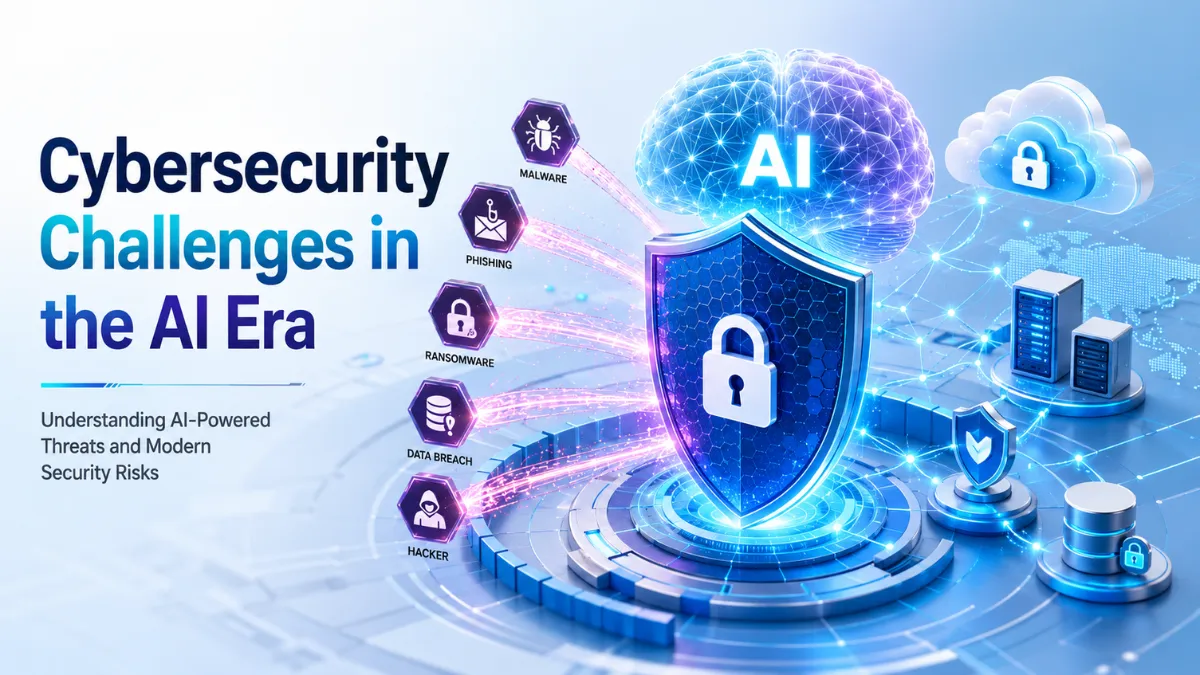
Today, attackers can use AI to automate phishing campaigns, create convincing deepfakes, identify vulnerabilities faster, and launch large-scale attacks with unprecedented speed. As a result, organizations are facing entirely new cybersecurity challenges in the AI era that traditional security approaches were never designed to handle.
At the same time, businesses are collecting more data, expanding cloud infrastructures, and connecting more devices than ever before. This increased connectivity creates additional opportunities for cybercriminals to exploit security gaps.
As AI continues to evolve, cybersecurity is no longer just about preventing attacks. It is about anticipating threats, adapting defenses, and staying ahead of an increasingly intelligent threat landscape.
In this article, you’ll discover the biggest cybersecurity challenges in the AI era, how AI-powered cyberattacks are changing the security landscape, the growing risks associated with deepfake security threats and data privacy challenges, and what organizations can do to build stronger and more resilient cyber defenses.
Quick Answer: What Are the Biggest Cybersecurity Challenges in the AI Era?
The biggest cybersecurity challenges in the AI era include AI-powered cyberattacks, deepfake security threats, data privacy challenges, automated attacks at scale, and rapidly evolving security vulnerabilities. While Artificial Intelligence helps organizations improve threat detection and response, it also enables cybercriminals to create more sophisticated attacks. Businesses must combine AI-powered defense, proactive security strategies, employee awareness, and continuous monitoring to stay protected against emerging AI cybersecurity threats.
1. What Are Cybersecurity Challenges in the AI Era?
The rise of Artificial Intelligence is fundamentally reshaping the cybersecurity landscape. While AI delivers significant benefits for businesses, it also introduces new risks that organizations must understand and address.
The term cybersecurity challenges in the AI era refers to the unique security risks, vulnerabilities, and threats that emerge as AI technologies become more integrated into business operations and digital ecosystems.
Unlike traditional cyber threats, modern AI-driven cyber threats are often faster, more adaptive, and more difficult to detect. Cybercriminals can leverage AI to automate attacks, bypass conventional security controls, and exploit vulnerabilities on a much larger scale.
This creates a situation where both defenders and attackers are using the same advanced technology.
As a result, cybersecurity has become an ongoing race between innovation and exploitation.
1.1 Why Is AI Changing the Cybersecurity Landscape?
AI has dramatically increased the speed at which both defensive and offensive cyber operations can occur.
Organizations use AI to:
- Detect suspicious activity.
- Analyze large volumes of security data.
- Identify vulnerabilities.
- Automate incident response.
- Improve threat intelligence.
At the same time, cybercriminals can use similar technologies to:
- Create highly convincing phishing attacks.
- Develop realistic deepfake content.
- Automate malware deployment.
- Discover system weaknesses faster.
- Launch attacks at scale.
This dual-use nature of AI is one of the primary reasons why cybersecurity challenges in the AI era are becoming more complex.
The technology itself is not the problem. The challenge lies in how it can be used by both defenders and attackers.
1.2 How Are Cyber Threats Evolving Alongside AI?
Traditional cyberattacks often required significant manual effort, technical expertise, and time to execute successfully.
Today’s AI-powered cyberattacks are changing that reality.
Attackers can now use AI to:
- Automate reconnaissance activities.
- Generate realistic phishing messages.
- Mimic human communication patterns.
- Adapt attacks based on victim behavior.
- Analyze security defenses in real time.
These capabilities allow cybercriminals to become more efficient while increasing the scale and sophistication of their operations.
For businesses, this means security teams are no longer facing only human-driven threats. They are increasingly confronting intelligent systems capable of learning, adapting, and improving over time.
This shift is driving many of the most significant cybersecurity risks of AI facing organizations today.
Why Should Businesses Pay Attention Now?
Many organizations still view cybersecurity through the lens of traditional threats such as malware, ransomware, and phishing attacks.
While these threats remain important, the emergence of AI cybersecurity threats introduces new dimensions of risk.
Businesses that fail to adapt may struggle with:
- Increased attack sophistication.
- Larger attack volumes.
- Faster threat execution.
- More convincing social engineering attacks.
- Growing data privacy challenges.
- Expanding digital attack surfaces.
The organizations that succeed in the coming years will be those that understand how AI is reshaping both sides of cybersecurity.
Recognizing these evolving risks is the first step toward building effective defenses against the growing cybersecurity challenges in the AI era.
2. Why Are AI-Powered Cyberattacks Becoming More Dangerous?
One of the most concerning aspects of the modern threat landscape is the rapid rise of AI-powered cyberattacks. While Artificial Intelligence has helped organizations improve threat detection and automate security operations, cybercriminals are using the same technology to make attacks faster, smarter, and more effective.
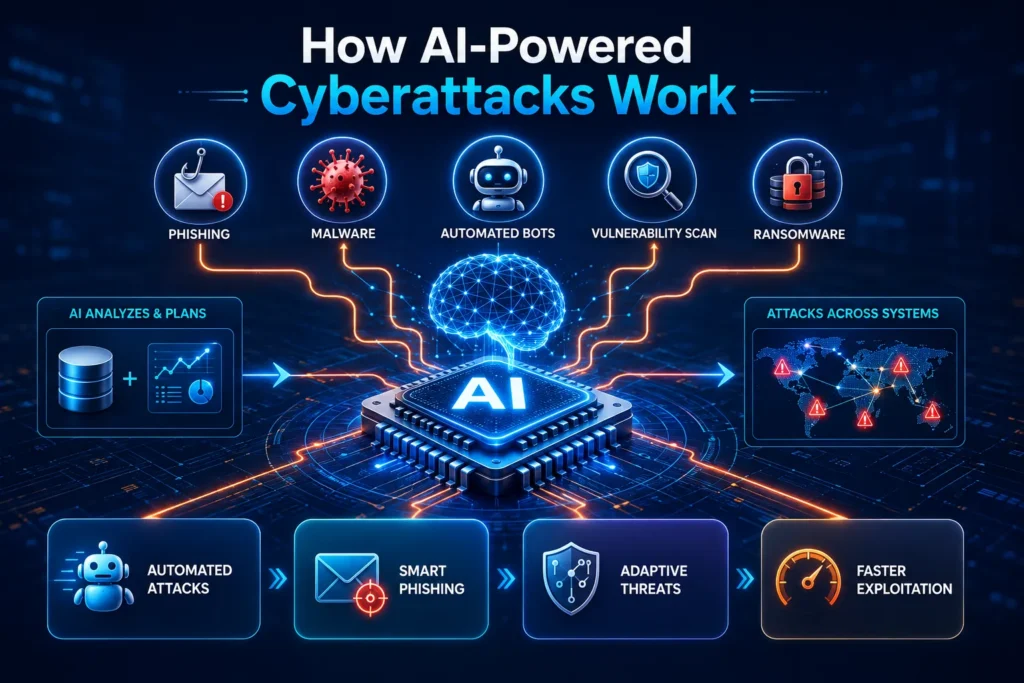
Unlike traditional attacks that often relied heavily on manual effort, AI-driven attacks can analyze targets, adapt strategies, and execute at scale with minimal human intervention.
This evolution is creating some of the most serious cybersecurity challenges in the AI era.
For organizations, the question is no longer whether AI will influence cyber threats—it is how quickly businesses can adapt to defend against them.
2.1 What Makes AI-Powered Attacks Different from Traditional Attacks?
Traditional cyberattacks typically required attackers to manually gather information, identify vulnerabilities, and launch attacks against specific targets.
Modern AI-powered cyberattacks dramatically reduce the time and effort required to perform these activities.
AI can help attackers:
- Analyze large amounts of data quickly.
- Identify weak points in systems.
- Personalize phishing campaigns.
- Generate convincing messages.
- Automate attack execution.
- Continuously adapt attack methods.
This makes attacks more targeted, scalable, and difficult to detect.
For example, traditional phishing emails often contained spelling errors, generic messaging, or suspicious formatting that made them easier to identify.
Today, AI can generate highly personalized messages that closely resemble legitimate communications, significantly increasing the likelihood of success.
This is one reason why AI cybersecurity threats are becoming increasingly difficult for organizations to manage.
2.2 How Can Cybercriminals Use AI to Scale Attacks?
One of AI’s greatest strengths is automation.
Unfortunately, automation also benefits cybercriminals.
AI allows attackers to launch large-scale campaigns with far greater efficiency than ever before.
Instead of manually targeting a handful of victims, attackers can automate:
- Phishing campaigns.
- Credential theft attempts.
- Vulnerability scanning.
- Malware deployment.
- Social engineering attacks.
- Data collection activities.
This capability enables cybercriminals to reach thousands or even millions of potential targets simultaneously.
As attack volumes increase, organizations face greater pressure to detect and respond quickly.
The scalability of AI-driven cyber threats means businesses can no longer rely solely on manual security monitoring and response processes.
Modern defense strategies must be capable of operating at the same speed as automated attacks.
2.3 Why Are Businesses Struggling to Detect AI-Driven Threats?
Many traditional cybersecurity tools were designed to identify known attack patterns and previously observed threats.
However, AI-powered cyberattacks are often dynamic and adaptive.
AI systems can modify attack behavior based on:
- Security controls encountered.
- User responses.
- System configurations.
- Detection mechanisms.
This adaptability allows attackers to evade conventional defenses more effectively.
Additionally, AI-generated content can closely mimic legitimate communications, making it difficult for both users and security systems to distinguish between genuine and malicious activity.
Businesses may struggle with:
- Sophisticated phishing attempts.
- Realistic impersonation attacks.
- Rapidly changing malware variants.
- Automated attack campaigns.
- Advanced social engineering techniques.
These challenges contribute significantly to the growing cybersecurity risks of AI.
Organizations that continue relying solely on traditional security models may find it increasingly difficult to keep pace with evolving threats.
2.4 What Are Real-World Examples of AI-Powered Cyber Threats?
The impact of AI-powered cyberattacks is already visible across industries.
Examples include:
AI-Generated Phishing Emails
Attackers use AI to create highly convincing emails that mimic trusted organizations, executives, or business partners.
Deepfake Voice Fraud
Cybercriminals use AI-generated voice cloning to impersonate executives and authorize fraudulent transactions.
Intelligent Malware
Advanced malware can modify its behavior to avoid detection and adapt to different environments.
Automated Vulnerability Discovery
AI tools can rapidly scan systems and identify weaknesses that attackers can exploit.
AI-Enhanced Social Engineering
Attackers use AI to gather information from public sources and create highly personalized attack campaigns.
These examples demonstrate how AI cybersecurity threats are becoming increasingly sophisticated and difficult to detect.
Key Takeaway
The rise of AI-powered cyberattacks represents one of the most significant cybersecurity challenges in the AI era. By automating attacks, improving personalization, and adapting to security defenses, AI enables cybercriminals to operate faster and more effectively than ever before.
As organizations face growing AI-driven cyber threats, traditional security approaches alone are no longer sufficient. Businesses must invest in intelligent security technologies, proactive threat monitoring, and AI-powered defense strategies to stay ahead of increasingly sophisticated attackers.
3. How Are Deepfakes Creating New Security Risks?
Among the most alarming developments in modern cybersecurity is the rise of deepfake technology. What started as an AI-powered tool for generating realistic media has quickly evolved into a serious security concern for businesses, governments, and individuals.
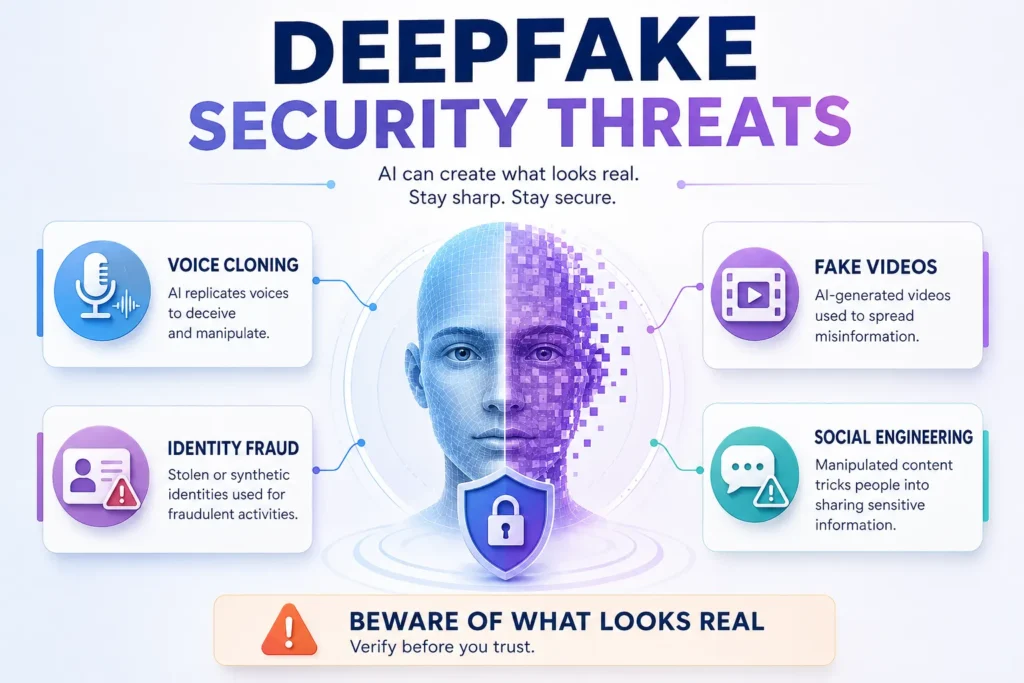
Today, cybercriminals can use AI to create highly convincing fake videos, audio recordings, and images that are often indistinguishable from genuine content.
As a result, deepfake security threats have become one of the fastest-growing cybersecurity challenges in the AI era.
These threats go beyond technical vulnerabilities. They target human trust, making them particularly dangerous in a world where digital communication plays a critical role in business operations.
3.1 What Are Deepfakes and How Do They Work?
A deepfake is synthetic media created using Artificial Intelligence and Machine Learning algorithms.
These systems analyze large amounts of existing content to learn how a person looks, speaks, moves, and behaves.
Once trained, AI can generate realistic fake content such as:
- Videos.
- Audio recordings.
- Images.
- Live video simulations.
- Voice replicas.
The resulting content often appears authentic to the average viewer.
For example, a deepfake system can create a video of a CEO appearing to make statements they never actually made or generate a phone call using a cloned voice that sounds nearly identical to a real executive.
The rapid improvement of AI technology is making these AI cybersecurity threats increasingly accessible and convincing.
3.2 How Can Deepfake Technology Be Used for Fraud?
Cybercriminals are finding new ways to weaponize deepfake technology.
One of the most common uses involves impersonation.
Attackers can create realistic representations of trusted individuals and use them to manipulate employees, customers, or business partners.
Examples include:
Executive Impersonation
A fake video or voice recording appears to come from a company executive requesting sensitive information or authorizing payments.
Financial Fraud
Cybercriminals use cloned voices to convince employees to transfer funds to fraudulent accounts.
Social Engineering Attacks
Deepfakes can increase the credibility of phishing and fraud campaigns.
Reputation Manipulation
Fake content can be used to spread misinformation and damage brand reputation.
Identity Theft
AI-generated media can support sophisticated identity fraud schemes.
These attacks demonstrate how deepfake security threats are expanding beyond traditional cybersecurity concerns and entering the realm of trust manipulation.
This makes them one of the most dangerous cybersecurity risks of AI.
3.3 Why Should Businesses Be Concerned About Deepfake Attacks?
Many organizations focus primarily on protecting networks, systems, and data.
However, deepfakes target something equally valuable:
Trust
Businesses rely heavily on trust in their daily operations.
Employees trust leadership.
Customers trust brands.
Partners trust communications.
Deepfake attacks exploit these relationships by creating highly believable fraudulent interactions.
Organizations may face risks such as:
- Financial losses.
- Fraudulent transactions.
- Reputational damage.
- Data breaches.
- Customer trust erosion.
- Regulatory complications.
As deepfake technology continues to improve, distinguishing between real and fake communications will become increasingly difficult.
This is why many experts view deepfake security threats as one of the defining cybersecurity challenges in the AI era.
3.4 How Can Organizations Protect Themselves Against Deepfake Threats?
Although deepfake technology presents significant risks, organizations can take proactive steps to reduce their exposure.
Implement Multi-Step Verification
Sensitive requests should require multiple forms of verification before action is taken.
Educate Employees
Staff should be trained to recognize potential deepfake attacks and suspicious communications.
Verify Financial Requests
Payment approvals should follow established verification procedures regardless of who appears to be making the request.
Use AI-Powered Detection Tools
Many security providers are developing AI-powered defense solutions capable of identifying synthetic media.
Strengthen Identity Verification Processes
Additional authentication layers can help prevent impersonation-based attacks.
By combining technology, policies, and employee awareness, organizations can significantly reduce the risks associated with AI-driven cyber threats and deepfake fraud.
Key Takeaway
The growing sophistication of deepfake security threats highlights how rapidly cybersecurity challenges in the AI era are evolving. By leveraging Artificial Intelligence, cybercriminals can create convincing fake content that targets trust, identity, and human decision-making.
As businesses increasingly rely on digital communication, protecting against deepfake attacks will become an essential part of modern cybersecurity strategies. Organizations that invest in employee awareness, verification procedures, and AI-powered defense technologies will be better prepared to address this emerging category of AI cybersecurity threats.
4. Why Is Data Privacy Becoming More Challenging in the AI Era?
As organizations increasingly adopt Artificial Intelligence to improve operations, customer experiences, and decision-making, data has become one of their most valuable assets.
However, the success of AI systems depends heavily on access to large amounts of information.
The more data AI can analyze, the more accurate and effective it becomes.
While this creates tremendous opportunities for innovation, it also introduces significant data privacy challenges.
Businesses must now balance the benefits of AI-driven insights with the responsibility of protecting sensitive information.
This balancing act has become one of the most important cybersecurity challenges in the AI era.
As AI systems continue to process vast amounts of personal, financial, and operational data, organizations face growing pressure to maintain security, compliance, and customer trust.
4.1 How Does AI Depend on Large Volumes of Data?
AI systems learn by analyzing data.
Whether the goal is improving customer service, detecting fraud, automating workflows, or strengthening security, AI requires access to information to identify patterns and generate insights.
Common data sources include:
- Customer records.
- Financial transactions.
- Employee information.
- User behavior data.
- Business operations data.
- Cloud-based applications.
The effectiveness of AI often improves as the volume of available data increases.
However, this dependency creates additional risks.
The more information organizations collect and store, the more attractive they become to cybercriminals.
As businesses continue investing in AI-powered defense and intelligent automation, protecting data becomes increasingly critical.
4.2 What Privacy Risks Do Organizations Face?
The growing use of AI introduces several important privacy concerns.
Many organizations struggle with understanding exactly how data is collected, processed, stored, and shared across AI systems.
Some of the most significant data privacy challenges include:
Sensitive information may be exposed if proper security controls are not in place.
Data Breaches
Large datasets used for AI training can become valuable targets for attackers.
Excessive Data Collection
Organizations may collect more information than necessary, increasing privacy risks.
Third-Party Data Exposure
AI platforms often rely on external vendors, creating additional security considerations.
Regulatory Compliance Risks
Organizations must comply with evolving privacy regulations and data protection requirements.
Failure to address these risks can result in financial penalties, legal consequences, and reputational damage.
This is why cybersecurity and artificial intelligence are becoming increasingly interconnected.
Strong privacy protections are now essential for successful AI adoption.
4.3 Why Are Data Breaches More Concerning in AI-Driven Environments?
Data breaches have always been a major cybersecurity concern.
However, AI-driven environments often contain larger and more valuable datasets than traditional systems.
When attackers gain access to these environments, they may obtain:
- Personal customer information.
- Financial records.
- Business intelligence.
- Employee data.
- Proprietary algorithms.
- Training datasets.
The potential impact can be substantial.
In some cases, compromised AI training data can also affect how AI systems perform, creating additional operational and security risks.
As organizations expand their use of AI, protecting these assets becomes an increasingly important component of addressing cybersecurity challenges in the AI era.
4.4 How Can Businesses Protect Sensitive Information in the AI Era?
Addressing data privacy challenges requires a proactive and comprehensive approach.
Organizations should focus on several key strategies.
Implement Strong Access Controls
Limit access to sensitive information based on business requirements.
Encrypt Critical Data
Encryption helps protect information both in storage and during transmission.
Minimize Data Collection
Collect only the information necessary to achieve specific business objectives.
Monitor Data Usage
Continuously track how data is accessed, processed, and shared.
Strengthen Vendor Security Reviews
Evaluate third-party providers that have access to sensitive information.
Train Employees on Data Protection
Human error remains one of the leading causes of data exposure incidents.
Adopt Privacy-First AI Practices
Privacy considerations should be incorporated into AI initiatives from the beginning.
By implementing these measures, organizations can reduce risk while continuing to benefit from AI innovation.
Key Takeaway
The increasing reliance on data makes data privacy challenges one of the most significant cybersecurity challenges in the AI era. While Artificial Intelligence offers tremendous opportunities for innovation and efficiency, it also creates new responsibilities for protecting sensitive information.
Organizations that prioritize privacy, strengthen security controls, and adopt responsible AI practices will be better positioned to manage AI cybersecurity threats, maintain customer trust, and navigate the evolving relationship between cybersecurity and artificial intelligence.
5. How Are Automated Cyber Threats Increasing Security Risks?
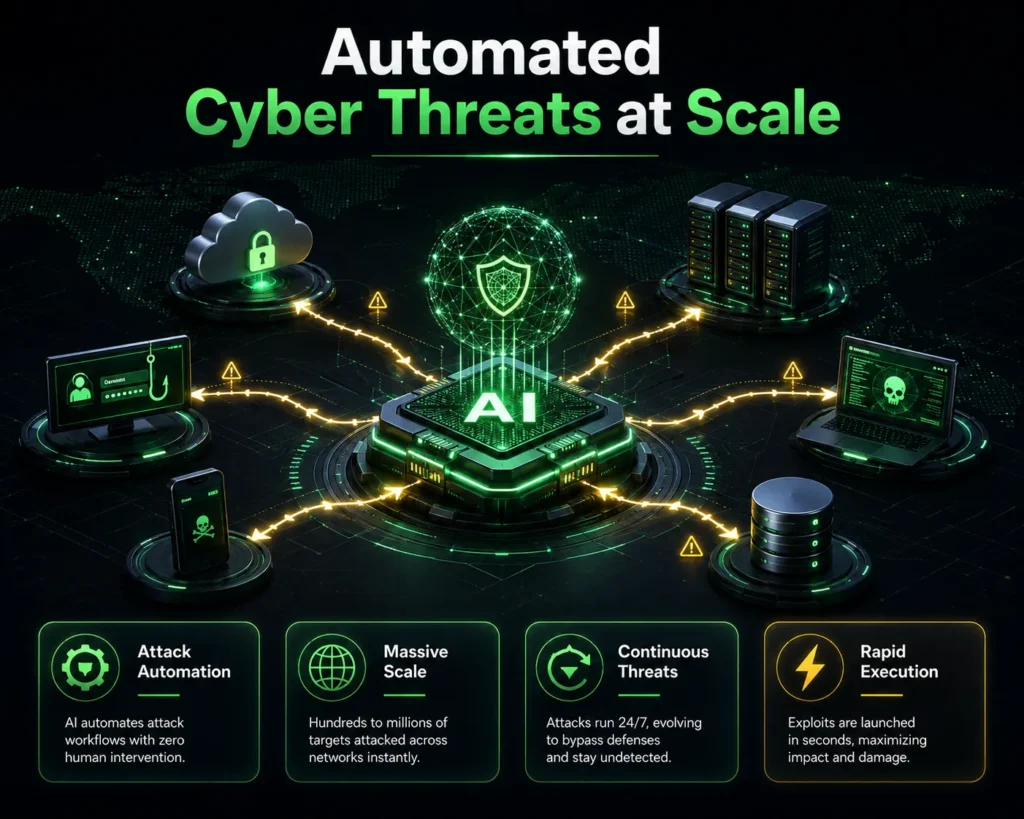
One of the most significant developments in modern cybersecurity is the growing use of automation by cybercriminals. Traditionally, many attacks required substantial manual effort, technical expertise, and time. Today, Artificial Intelligence is helping attackers automate many stages of the attack lifecycle, making cyber threats faster, more scalable, and more difficult to stop.
As a result, automated attacks have become a major contributor to the growing cybersecurity challenges in the AI era.
Organizations are no longer facing isolated attacks launched by individual hackers. Instead, they are increasingly confronting intelligent, automated systems capable of continuously scanning, targeting, and exploiting vulnerabilities at a scale that was previously impossible.
This shift is forcing businesses to rethink how they approach cybersecurity.
5.1 What Are Automated Cyberattacks?
Automated cyberattacks use software, scripts, and AI technologies to perform attack activities with little or no human intervention.
Instead of manually carrying out each step, attackers can automate tasks such as:
- Vulnerability scanning.
- Credential stuffing.
- Phishing campaigns.
- Malware distribution.
- Data collection.
- Network reconnaissance.
Automation enables cybercriminals to launch attacks faster while significantly increasing their reach.
For example, a traditional phishing campaign may target a limited number of individuals. An AI-powered automated phishing system can generate thousands of personalized messages and distribute them across multiple channels within minutes.
This increased efficiency is one reason why AI-powered cyberattacks are becoming more dangerous.
5.2 How Does AI Enable Attack Automation?
AI dramatically improves the effectiveness of automated cyber threats.
Unlike basic automation tools, AI systems can learn, adapt, and make decisions based on new information.
Cybercriminals can use AI to:
Analyze Targets More Efficiently
AI can process large datasets and identify potential victims based on publicly available information.
Personalize Attacks
AI-generated content can make phishing emails and social engineering attempts appear more legitimate.
Adapt to Security Defenses
Some advanced attack tools can modify their behavior when they encounter detection systems.
Increase Attack Speed
AI can automate repetitive tasks that would otherwise require human involvement.
Improve Attack Success Rates
By continuously learning from previous attempts, AI systems can refine future attacks.
These capabilities contribute directly to the rise of AI-driven cyber threats and create additional cybersecurity risks of AI for organizations.
5.3 What Impact Do Automated Threats Have on Organizations?
Automated attacks can affect businesses of all sizes.
Large enterprises may have more resources, but they also present larger attack surfaces.
Small and medium-sized businesses often face challenges due to limited cybersecurity resources.
Common impacts include:
Increased Attack Volume
Organizations may experience significantly higher numbers of attack attempts.
Faster Threat Execution
Automated attacks can occur within seconds of identifying a vulnerability.
Greater Resource Pressure
Security teams may struggle to investigate and respond to large volumes of alerts.
Higher Financial Risks
Successful attacks can result in downtime, recovery costs, and lost revenue.
Expanded Exposure
Businesses with cloud environments, remote workforces, and connected devices often face broader attack surfaces.
These factors make automated attacks one of the fastest-growing cybersecurity challenges in the AI era.
5.4 Why Are Traditional Defenses Struggling Against Automated Threats?
Many traditional security tools rely on predefined rules and known attack signatures.
While effective against certain threats, these approaches often struggle against rapidly evolving automated attacks.
Automated threats can:
- Change behavior dynamically.
- Generate new attack variations.
- Operate continuously.
- Target multiple systems simultaneously.
- Exploit vulnerabilities quickly after discovery.
This speed creates a major challenge for organizations relying on manual security processes.
Security teams often cannot investigate and respond quickly enough without assistance from intelligent technologies.
As a result, many organizations are adopting AI-powered defense systems that can match the speed and scale of modern attacks.
5.5 How Can Businesses Defend Against Automated Cyber Threats?
Successfully addressing automated threats requires a combination of technology, strategy, and continuous monitoring.
Organizations should focus on:
AI-Powered Threat Detection
Using AI to identify suspicious behavior and detect anomalies in real time.
Continuous Monitoring
Maintaining visibility across networks, devices, and cloud environments.
Automated Incident Response
Reducing response times through intelligent security workflows.
Strong Access Controls
Limiting unauthorized access opportunities.
Regular Security Assessments
Identifying vulnerabilities before attackers can exploit them.
Employee Awareness Training
Helping employees recognize phishing attempts and social engineering attacks.
By combining these measures, businesses can improve their ability to detect and respond to evolving AI cybersecurity threats.
Key Takeaway
The rise of automated attacks is significantly increasing the complexity of cybersecurity challenges in the AI era. By leveraging Artificial Intelligence, cybercriminals can automate reconnaissance, phishing, malware deployment, and other malicious activities at unprecedented speed and scale.
As AI-powered cyberattacks continue to evolve, organizations must move beyond traditional security approaches and adopt intelligent, proactive defense strategies. Businesses that invest in AI-powered defense, continuous monitoring, and automation will be better equipped to manage the growing risks posed by AI-driven cyber threats.
6. Why Are Traditional Cybersecurity Strategies No Longer Enough?
For many years, organizations relied on firewalls, antivirus software, perimeter defenses, and rule-based monitoring systems to protect their digital environments. While these solutions remain important, the cybersecurity landscape has changed dramatically.
Today’s threat environment is more dynamic, interconnected, and intelligent than ever before.
Cybercriminals are leveraging Artificial Intelligence, automation, cloud technologies, and advanced attack techniques to bypass conventional security controls. At the same time, businesses are operating across cloud platforms, remote work environments, mobile devices, and complex digital ecosystems.
As a result, many traditional security approaches are struggling to keep pace with modern threats.
This growing gap is one of the most significant cybersecurity challenges in the AI era.
Organizations must move beyond static defense models and adopt more adaptive security strategies capable of responding to rapidly evolving risks.
6.1 What Are the Limitations of Conventional Security Approaches?
Traditional cybersecurity solutions were designed for a different technological environment.
In the past, organizations typically operated within clearly defined network boundaries. Most employees worked from centralized locations, and business systems were hosted within company-controlled infrastructure.
Today’s reality is very different.
Businesses now rely on:
- Cloud platforms.
- Remote work environments.
- Mobile devices.
- Third-party integrations.
- Internet-connected systems.
- AI-powered applications.
This increased complexity creates security challenges that traditional tools often struggle to address.
Some common limitations include:
Reactive Threat Detection
Many traditional systems identify threats only after suspicious activity has already occurred.
Signature-Based Protection
Conventional tools often depend on known attack patterns and may struggle against new or evolving threats.
Limited Visibility
Organizations may lack complete visibility across modern digital environments.
Manual Security Processes
Many security operations still require significant human involvement, slowing response times.
Difficulty Managing Scale
As attack volumes increase, traditional systems may become overwhelmed.
These limitations make it difficult for businesses to effectively address modern AI cybersecurity threats.
6.2 Why Must Security Strategies Continuously Evolve?
The threat landscape is constantly changing.
New attack techniques emerge regularly, and cybercriminals continuously adapt their methods to bypass security controls.
The rise of AI-powered cyberattacks has accelerated this process.
Attackers can now:
- Modify attack strategies automatically.
- Generate new phishing campaigns instantly.
- Discover vulnerabilities faster.
- Scale attacks more efficiently.
- Adapt to security defenses in real time.
Organizations that rely solely on static security measures may struggle to keep up with these changes.
Modern cybersecurity requires continuous improvement.
Businesses must regularly:
- Update security policies.
- Assess vulnerabilities.
- Monitor emerging threats.
- Improve detection capabilities.
- Strengthen incident response processes.
This ongoing evolution is essential for managing the growing cybersecurity risks of AI.
6.3 How Are Cloud and Remote Work Changing Security Requirements?
Cloud computing and remote work have transformed how businesses operate.
While these technologies offer flexibility and scalability, they also expand the attack surface available to cybercriminals.
Employees now access systems from:
- Home networks.
- Mobile devices.
- Public internet connections.
- Multiple geographic locations.
At the same time, organizations store critical data across various cloud platforms and third-party services.
This creates new security challenges, including:
Identity Management
Verifying users across distributed environments.
Access Control
Ensuring only authorized individuals can access sensitive resources.
Data Protection
Securing information stored across multiple systems.
Threat Visibility
Monitoring activity across diverse digital environments.
These challenges highlight why modern organizations need more adaptive security models.
6.4 How Can Organizations Reduce Emerging Security Gaps?
Addressing modern security challenges requires a shift from reactive defense to proactive protection.
Organizations should focus on:
Adopting AI-Powered Defense
Using intelligent systems to identify threats and respond faster.
Implementing Zero Trust Principles
Continuously verifying users, devices, and access requests.
Enhancing Security Monitoring
Maintaining real-time visibility across systems and networks.
Automating Security Operations
Reducing response times and improving operational efficiency.
Strengthening Cybersecurity Awareness
Educating employees about evolving threats and security best practices.
Conducting Continuous Risk Assessments
Regularly evaluating vulnerabilities and security controls.
These strategies help organizations close security gaps and improve resilience against emerging AI-driven cyber threats.
Key Takeaway
The increasing sophistication of cyber threats has exposed the limitations of traditional security models. As businesses adopt cloud technologies, remote work, and AI-powered systems, security strategies must evolve accordingly.
One of the most important cybersecurity challenges in the AI era is ensuring that security defenses can adapt as quickly as the threats they are designed to stop. Organizations that embrace AI-powered defense, continuous monitoring, automation, and proactive security practices will be better prepared to navigate the complex threat landscape of the future.
7. How Can AI Be Used to Strengthen Cybersecurity Defenses?
While much of the discussion around AI focuses on emerging threats, it is important to remember that Artificial Intelligence is also one of the most powerful tools available to cybersecurity professionals.
In fact, many organizations are turning to AI-powered defense systems to help manage the growing complexity of modern cyber threats. As attack volumes increase and threat actors become more sophisticated, security teams need technologies capable of processing massive amounts of information, identifying risks quickly, and responding in real time.
To understand the broader impact of AI on modern cybersecurity and digital protection, explore our guide on the Future of Cybersecurity: How AI Is Transforming Digital Security.
This is where AI is making a significant impact.
By enhancing threat detection, automating security operations, and improving predictive capabilities, AI is helping organizations address many of the most pressing cybersecurity challenges in the AI era.
The goal is not to replace human expertise but to empower security teams with faster insights and stronger defensive capabilities.
7.1 What Is AI-Powered Threat Detection?
Traditional security tools often rely on predefined rules and known attack signatures to identify threats.
While these methods remain valuable, they can struggle to detect new or evolving attack techniques.
AI-powered defense systems take a different approach.
Instead of looking only for known threats, AI analyzes patterns, behaviors, and anomalies across large datasets to identify suspicious activity.
These systems can:
- Monitor network traffic continuously.
- Detect unusual user behavior.
- Identify potential security breaches.
- Analyze system activity in real time.
- Recognize previously unseen attack patterns.
This allows organizations to detect threats earlier and reduce the likelihood of successful attacks.
For example, if an employee account suddenly begins accessing systems it has never used before, AI can flag the behavior as potentially suspicious and alert security teams.
This proactive capability is becoming increasingly important as AI-powered cyberattacks continue to evolve.
7.2 How Does Predictive Security Improve Protection?
One of the most valuable applications of AI in cybersecurity is predictive analysis.
Rather than waiting for an attack to occur, AI can help organizations identify potential risks before they become serious security incidents.
Predictive security systems analyze:
- Historical attack data.
- User behavior patterns.
- Network activity.
- Vulnerability information.
- Threat intelligence feeds.
Using this information, AI can estimate where future risks may emerge and help organizations prioritize defensive measures.
This proactive approach offers several advantages:
Faster Risk Identification
Potential vulnerabilities can be identified before attackers exploit them.
Improved Resource Allocation
Security teams can focus on the highest-priority risks.
Reduced Incident Impact
Threats can often be addressed before they escalate.
Better Strategic Planning
Organizations gain greater visibility into emerging security trends.
Predictive security is rapidly becoming an essential component of addressing cybersecurity challenges in the AI era.
7.3 Why Is Real-Time Monitoring Important?
Cyber threats operate continuously.
Attackers do not follow business hours, and many automated threats can execute within seconds.
This makes real-time visibility critical.
AI-powered monitoring solutions can process enormous amounts of security data far more efficiently than human analysts alone.
These systems help organizations:
- Detect threats as they occur.
- Monitor cloud environments.
- Track user activities.
- Identify suspicious behaviors.
- Analyze security events across multiple systems.
Real-time monitoring significantly improves an organization’s ability to respond quickly and reduce potential damage.
As AI-driven cyber threats become faster and more adaptive, continuous monitoring is becoming a fundamental requirement for modern cybersecurity programs.
7.4 How Does Cybersecurity Automation Improve Incident Response?
One of the biggest challenges facing security teams is the sheer volume of alerts generated by modern environments.
Many organizations struggle with:
- Alert fatigue.
- Limited staffing.
- Slow response times.
- Complex investigations.
AI helps address these challenges through cybersecurity automation.
Automated security systems can:
Prioritize Alerts
Focus attention on the most serious threats.
Investigate Incidents
Collect and analyze relevant information automatically.
Contain Threats
Isolate affected systems before attacks spread.
Accelerate Response
Reduce the time required to address security incidents.
Improve Efficiency
Allow security professionals to focus on higher-value tasks.
By reducing manual workloads, automation helps organizations strengthen defenses while improving operational efficiency.
This capability is increasingly important for managing modern AI cybersecurity threats.
7.5 Can AI Replace Human Cybersecurity Professionals?
Despite its capabilities, AI is not a replacement for experienced cybersecurity professionals.
AI excels at:
- Processing data.
- Detecting patterns.
- Monitoring activity.
- Automating repetitive tasks.
However, human expertise remains essential for:
- Strategic decision-making.
- Threat investigation.
- Risk assessment.
- Security leadership.
- Business context evaluation.
The most effective cybersecurity programs combine AI technology with skilled professionals.
This partnership allows organizations to leverage the strengths of both human intelligence and machine intelligence.
As the cybersecurity challenges in the AI era continue to evolve, collaboration between AI systems and security experts will become increasingly important.
Key Takeaway
Although AI introduces new security risks, it also provides powerful defensive capabilities. Through AI-powered defense, predictive security, real-time monitoring, and cybersecurity automation, organizations can improve their ability to detect, prevent, and respond to cyber threats.
As AI-powered cyberattacks become more sophisticated, businesses must embrace intelligent security technologies while continuing to rely on human expertise. The organizations that successfully combine AI innovation with proactive security strategies will be best positioned to address the growing cybersecurity challenges in the AI era.
8. What Role Does Human Expertise Play in AI-Driven Cybersecurity?
As organizations increasingly adopt Artificial Intelligence to strengthen security operations, a common question arises:
Can AI eventually replace cybersecurity professionals?
The short answer is no.
While AI is transforming how organizations detect and respond to threats, cybersecurity remains a field that depends heavily on human judgment, strategic thinking, and decision-making.
In reality, the future of cybersecurity is not about humans versus AI. It is about humans and AI working together.
This partnership is becoming increasingly important as organizations navigate the growing cybersecurity challenges in the AI era.
AI can process massive amounts of data and identify patterns at incredible speed, but it cannot fully understand business context, organizational priorities, or the complex motivations behind cyberattacks.
That is where human expertise remains irreplaceable.
8.1 Can AI Replace Cybersecurity Professionals?
AI is exceptionally good at handling repetitive and data-intensive tasks.
For example, AI can:
- Monitor network traffic continuously.
- Detect suspicious behavior.
- Analyze large security datasets.
- Automate incident response workflows.
- Identify unusual activity patterns.
However, cybersecurity involves far more than threat detection.
Security professionals are responsible for:
- Investigating incidents.
- Evaluating risks.
- Making strategic decisions.
- Developing security policies.
- Managing compliance requirements.
- Coordinating responses during major security events.
These responsibilities require critical thinking, experience, and contextual understanding that AI cannot fully replicate.
While AI-powered defense systems can assist security teams, they cannot replace the human expertise needed to make informed decisions.
Organizations that view AI as a replacement for cybersecurity professionals may actually increase their risk exposure.
Instead, businesses should focus on using AI as a force multiplier that enhances human capabilities.
8.2 Why Is Human Judgment Still Critical?
Cybersecurity is not simply a technical problem.
It is also a business problem.
When security incidents occur, organizations must make decisions that balance:
- Risk.
- Business continuity.
- Customer trust.
- Regulatory requirements.
- Operational priorities.
AI can provide recommendations, but humans must evaluate those recommendations within the broader business context.
For example:
An AI system may flag unusual activity and recommend blocking access to a critical system.
However, security leaders must determine:
- Is the activity truly malicious?
- What business impact will blocking access create?
- Are there alternative response options?
- What are the potential consequences of taking action?
These decisions require experience and judgment that AI cannot independently provide.
This is why human expertise remains essential for addressing modern AI cybersecurity threats.
8.3 How Do Cybercriminals Exploit Human Behavior?
One reason human involvement remains so important is that many attacks target people rather than technology.
Even the most advanced security systems can be compromised if employees are manipulated into making poor decisions.
Common examples include:
Phishing Attacks
Attackers trick users into revealing credentials or sensitive information.
Social Engineering
Cybercriminals manipulate individuals into granting access or performing actions.
Deepfake Fraud
Attackers use synthetic media to impersonate trusted individuals.
Business Email Compromise
Fraudulent communications convince employees to transfer funds or disclose data.
These attacks exploit psychology, trust, and human behavior rather than technical vulnerabilities.
As deepfake security threats and AI-powered cyberattacks become more convincing, employee awareness and critical thinking become even more important.
Organizations cannot rely solely on technology to defend against these risks.
8.4 Why Is Cybersecurity Training More Important Than Ever?
Technology alone cannot solve every security challenge.
Employees remain one of the most important lines of defense.
Regular cybersecurity awareness programs can help employees:
- Identify phishing attempts.
- Recognize suspicious communications.
- Verify sensitive requests.
- Protect confidential information.
- Follow security best practices.
Training becomes especially important as AI-driven cyber threats become more sophisticated.
Modern phishing emails, deepfake scams, and social engineering attacks are often far more convincing than traditional threats.
Organizations that invest in employee education significantly improve their overall security posture.
This is a critical strategy for reducing cybersecurity risks of AI.
8.5 How Can Organizations Balance AI and Human Oversight?
The most effective cybersecurity programs combine the strengths of both AI and human expertise.
AI excels at:
- Speed.
- Scalability.
- Data analysis.
- Automation.
- Continuous monitoring.
Humans excel at:
- Strategic thinking.
- Decision-making.
- Creativity.
- Contextual understanding.
- Risk management.
Together, these capabilities create stronger and more resilient security programs.
Organizations should focus on:
Using AI for Threat Detection
Allow AI to identify potential threats quickly.
Empowering Human Analysts
Enable experts to investigate and validate findings.
Automating Repetitive Tasks
Reduce manual workloads where appropriate.
Maintaining Human Oversight
Ensure critical decisions remain under human control.
Continuously Improving Security Processes
Adapt strategies as threats evolve.
This balanced approach helps organizations manage the growing cybersecurity challenges in the AI era while maximizing the benefits of Artificial Intelligence.
Key Takeaway
Despite rapid advancements in AI, human expertise remains a critical component of effective cybersecurity. While AI-powered defense systems improve detection, automation, and response capabilities, they cannot replace human judgment, strategic thinking, and business context awareness.
As organizations face increasingly sophisticated AI cybersecurity threats, the most successful security strategies will combine intelligent technologies with skilled professionals. The future of cybersecurity belongs not to AI alone, but to organizations that effectively integrate human expertise with advanced security technologies.
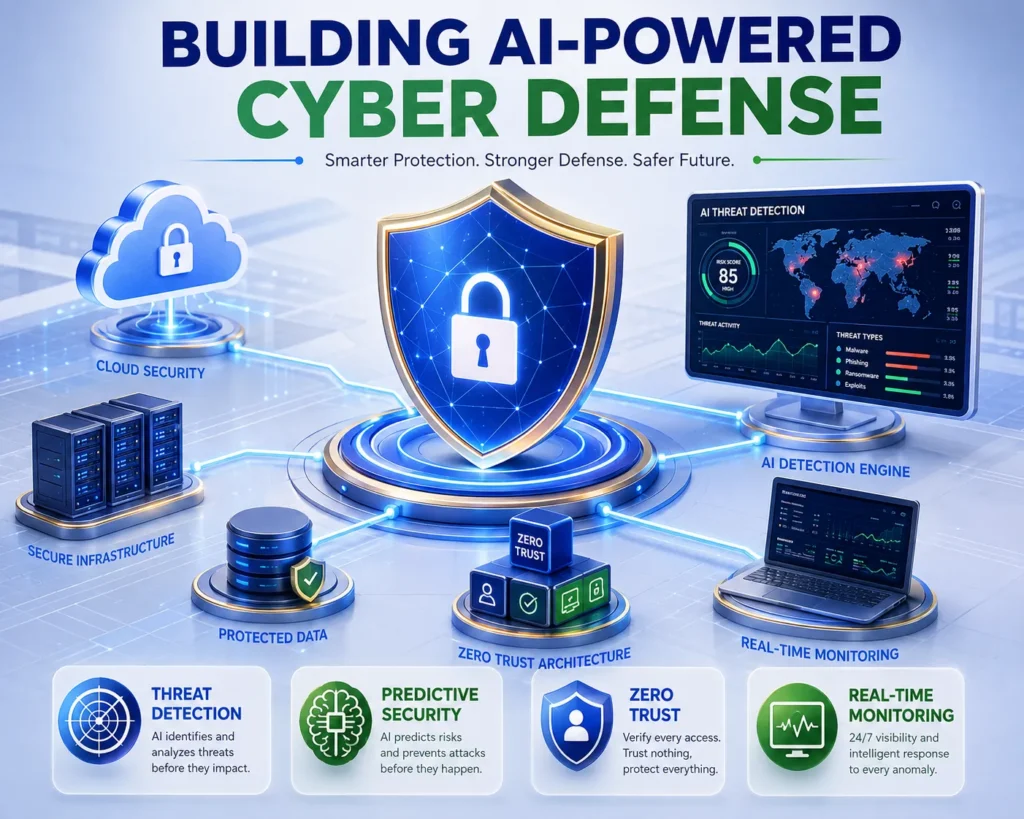
9. What Best Practices Can Help Businesses Prepare for AI Cybersecurity Risks?
As Artificial Intelligence continues to transform business operations, organizations must recognize that cybersecurity can no longer be treated as a one-time initiative. The threat landscape is evolving constantly, and businesses must evolve alongside it.
The rise of AI-powered cyberattacks, deepfake security threats, automated attack campaigns, and growing data privacy challenges means that organizations need a proactive and long-term approach to cybersecurity.
The companies that succeed in the coming years will not necessarily be those with the most security tools. Instead, they will be the organizations that build cyber resilience, embrace continuous improvement, and adapt quickly to emerging threats.
Developing a future-ready cybersecurity strategy is one of the most effective ways to address the growing cybersecurity challenges in the AI era.
9.1 How Can Organizations Build Cyber Resilience?
Cyber resilience refers to an organization’s ability to prepare for, withstand, respond to, and recover from cyber incidents.
In today’s environment, preventing every attack is unrealistic.
Instead, businesses must focus on minimizing impact and recovering quickly when incidents occur.
Key steps include:
Develop a Comprehensive Security Strategy
Cybersecurity should align with business objectives and digital transformation initiatives.
Implement Layered Security Controls
Combining multiple security measures reduces the likelihood of successful attacks.
Strengthen Backup and Recovery Processes
Reliable backup systems help organizations recover from ransomware and other disruptions.
Conduct Regular Security Assessments
Identifying vulnerabilities early reduces exposure to risk.
Test Incident Response Plans
Organizations should regularly evaluate their ability to respond to security incidents effectively.
Building resilience helps organizations remain operational even when facing sophisticated AI cybersecurity threats.
9.2 Why Is Employee Awareness Essential?
Technology alone cannot eliminate cybersecurity risks.
Human error continues to be one of the leading causes of security incidents.
Cybercriminals understand this and frequently target employees through:
- Phishing campaigns.
- Social engineering attacks.
- Deepfake impersonation.
- Fraudulent communications.
As AI-powered cyberattacks become more convincing, employees must be equipped to recognize and respond appropriately.
Effective cybersecurity awareness programs should cover:
Phishing Recognition
Teaching employees how to identify suspicious emails and messages.
Password Security
Promoting strong authentication practices.
Data Protection
Ensuring employees understand how to handle sensitive information securely.
Deepfake Awareness
Helping teams recognize potential deepfake security threats.
Incident Reporting
Encouraging employees to report suspicious activity promptly.
An informed workforce can significantly strengthen an organization’s overall security posture.
9.3 How Can Businesses Develop Future-Ready Security Strategies?
The future of cybersecurity will require organizations to move beyond traditional defense models.
Future-ready security strategies should emphasize adaptability, intelligence, and continuous improvement.
Key priorities include:
Adopt AI-Powered Defense Solutions
Modern security systems should leverage AI to improve threat detection and response capabilities.
Implement Zero Trust Principles
Every user, device, and access request should be verified continuously.
Enhance Security Monitoring
Real-time visibility helps organizations detect threats more quickly.
Automate Security Operations
Automation improves efficiency and accelerates incident response.
Protect Data Throughout Its Lifecycle
Strong privacy controls help address growing data privacy challenges.
Stay Informed About Emerging Threats
Organizations should continuously monitor developments in AI-driven cyber threats and cybersecurity best practices.
By taking these steps, businesses can better prepare for future risks while maintaining the flexibility needed to adapt to changing conditions.
9.4 Why Is Continuous Improvement Critical in Cybersecurity?
Cybersecurity is not a destination—it is an ongoing process.
Threats continue to evolve.
Technologies continue to advance.
Attackers continue to innovate.
As a result, organizations must adopt a mindset of continuous improvement.
This includes:
- Updating security controls.
- Reviewing policies regularly.
- Conducting security audits.
- Monitoring threat intelligence.
- Investing in employee education.
- Evaluating emerging technologies.
Organizations that continuously improve their cybersecurity capabilities are better positioned to manage evolving cybersecurity challenges in the AI era.
Key Takeaway
Preparing for future cyber threats requires more than deploying security tools. Organizations must build resilience, educate employees, strengthen data protection practices, and embrace AI-powered defense capabilities.
The businesses that successfully address cybersecurity challenges in the AI era will be those that view cybersecurity as a strategic business priority rather than a purely technical function. By combining intelligent technologies, proactive planning, and continuous improvement, organizations can better protect themselves against evolving AI cybersecurity threats and future security risks.
10. What Are the Most Frequently Asked Questions About Cybersecurity Challenges in the AI Era?
As organizations continue adopting Artificial Intelligence, many business leaders, IT professionals, and decision-makers have questions about how AI is changing the cybersecurity landscape. Below are answers to some of the most common questions related to cybersecurity challenges in the AI era.
10.1 What Are the Biggest Cybersecurity Challenges in the AI Era?
The biggest cybersecurity challenges in the AI era include AI-powered cyberattacks, deepfake security threats, data privacy challenges, automated cyber threats, evolving vulnerabilities, and the increasing complexity of digital ecosystems.
As attackers use AI to automate and enhance their operations, organizations must adopt more intelligent and proactive security strategies to protect their systems and data.
10.2 How Do AI-Powered Cyberattacks Work?
AI-powered cyberattacks use Artificial Intelligence and automation to improve the efficiency, speed, and effectiveness of cyber threats.
Attackers can use AI to:
- Automate phishing campaigns.
- Analyze potential targets.
- Discover vulnerabilities faster.
- Generate realistic fraudulent content.
- Adapt attacks based on security defenses.
These capabilities make modern attacks more scalable and difficult to detect compared to traditional cyber threats.
10.3 Are Deepfakes a Serious Cybersecurity Threat?
Yes. Deepfake security threats are becoming increasingly dangerous because they target human trust rather than technical vulnerabilities.
Cybercriminals can use AI-generated voices, videos, and images to:
- Impersonate executives.
- Commit financial fraud.
- Manipulate employees.
- Spread misinformation.
- Conduct social engineering attacks.
As deepfake technology improves, organizations must strengthen verification processes and employee awareness programs.
10.4 Can AI Improve Cybersecurity?
Absolutely.
While AI introduces new risks, it also provides powerful defensive capabilities.
AI-powered defense solutions can help organizations:
- Detect threats faster.
- Monitor systems continuously.
- Analyze security data at scale.
- Automate incident response.
- Predict potential vulnerabilities.
Many organizations now use AI as a core component of their cybersecurity strategies.
10.5 Why Is Data Privacy Important in the AI Era?
AI systems depend heavily on data to function effectively.
As organizations collect and process larger volumes of information, data privacy challenges become more significant.
Protecting sensitive information helps organizations:
- Maintain customer trust.
- Meet regulatory requirements.
- Reduce the risk of data breaches.
- Protect business operations.
- Strengthen overall cybersecurity.
Strong privacy practices are essential for responsible AI adoption.
10.6 Can Small Businesses Be Targeted by AI Cyber Threats?
Yes.
Many cybercriminals target small and medium-sized businesses because they often have fewer security resources than larger enterprises.
AI cybersecurity threats do not discriminate based on company size.
Every organization should implement:
- Strong access controls.
- Employee security training.
- Multi-factor authentication.
- Data protection measures.
- Regular security assessments.
These practices help reduce risk regardless of business size.
10.7 What Is the Role of Human Expertise in AI-Driven Cybersecurity?
Human expertise remains essential.
While AI can automate monitoring, detection, and response activities, cybersecurity professionals provide:
- Strategic decision-making.
- Threat investigation.
- Risk assessment.
- Business context.
- Incident management.
The most effective cybersecurity programs combine Artificial Intelligence with skilled human oversight.
10.8 How Can Businesses Prepare for Future AI Cybersecurity Risks?
Organizations can prepare by:
- Adopting AI-powered defense technologies.
- Implementing Zero Trust security principles.
- Conducting regular risk assessments.
- Investing in employee awareness training.
- Strengthening data protection practices.
- Monitoring emerging AI-driven cyber threats.
A proactive approach is critical for managing future risks.
11. Conclusion
The rapid advancement of Artificial Intelligence is reshaping both cybersecurity defenses and cyber threats. While AI creates new opportunities for innovation, efficiency, and automation, it also introduces significant security risks that organizations cannot afford to ignore.
The rise of AI-powered cyberattacks, deepfake security threats, automated attack campaigns, and growing data privacy challenges demonstrates that cybersecurity is entering a new era.
Traditional security approaches alone are no longer sufficient.
Organizations must embrace more intelligent, adaptive, and proactive security strategies capable of responding to modern threats at scale.
Successfully addressing cybersecurity challenges in the AI era requires a balanced approach that combines:
- Advanced security technologies.
- AI-powered defense capabilities.
- Human expertise.
- Employee awareness.
- Continuous improvement.
- Strong data protection practices.
Businesses that invest in resilience today will be better prepared to handle the increasingly sophisticated AI cybersecurity threats of tomorrow.
As technology continues to evolve, cybersecurity must evolve alongside it.
Organizations that can successfully integrate cybersecurity and artificial intelligence will not only strengthen their defenses but also position themselves for long-term success in an increasingly connected digital world.
At CrossShores Infotech, we help businesses build secure, scalable, and future-ready digital solutions by combining modern cybersecurity practices, AI innovation, cloud technologies, and intelligent software development. As the threat landscape evolves, organizations need security strategies that are designed not only for today’s challenges but also for the opportunities and risks of the future.