


Contents
- 1 Introduction
- 2 2. How Is AI Transforming the Way SaaS Products Work?
- 2.1 How Is AI Turning Features Into Intelligent Capabilities?
- 2.2 How Can SaaS Products Understand User Intent?
- 2.3 How Can AI Help SaaS Applications Make Better Decisions?
- 2.4 How Is AI Making SaaS More Context-Aware?
- 2.5 How Is AI Changing SaaS From Reactive to Proactive?
- 2.6 How Can AI Improve Existing SaaS Workflows?
- 2.7 Why Is This Shift Important for SaaS Product Development?
- 2.8 What Does the Intelligent SaaS Model Look Like?
- 2.9 Key Takeaway
- 3 3. How Is AI Automating SaaS Workflows?
- 3.1 What Tasks Can AI Automate in SaaS?
- 3.2 How Does SaaS Automation Improve Business Productivity?
- 3.3 Can AI Reduce Repetitive Manual Work?
- 3.4 How Can AI Make SaaS Workflows More Adaptive?
- 3.5 How Can AI Improve Workflow Prioritization?
- 3.6 How Is Generative AI Changing SaaS Automation?
- 3.7 Can AI Automation Improve Customer Experience?
- 3.8 What Are the Risks of Automating SaaS Workflows With AI?
- 3.9 How Should Businesses Identify the Right SaaS Workflows for AI Automation?
- 3.10 Key Takeaway
- 4 4. How Does AI Make SaaS Products More Personalized?
- 4.1 What Is SaaS Personalization?
- 4.2 How Can AI Adapt SaaS Experiences to Individual Users?
- 4.3 Why Is Personalization Important for SaaS Products?
- 4.4 How Can AI Personalize Recommendations?
- 4.5 How Does AI Personalization Improve Customer Experience?
- 4.6 Can AI Personalization Improve SaaS Customer Retention?
- 4.7 How Does AI Personalization Work With User Context?
- 4.8 What Are the Privacy Concerns With SaaS Personalization?
- 4.9 How Can Businesses Avoid Over-Personalization?
- 4.10 Key Takeaway
- 5 5. How Is AI Turning SaaS Data Into Actionable Insights?
- 5.1 Why Are Traditional SaaS Dashboards No Longer Enough?
- 5.2 How Can AI Analyze Business Data?
- 5.3 How Can AI Generate Recommendations From SaaS Data?
- 5.4 How Can AI Identify Patterns That Humans May Miss?
- 5.5 How Is AI Changing Predictive Analytics in SaaS?
- 5.6 Can AI Help Businesses Make Faster Decisions?
- 5.7 How Can AI Turn Unstructured SaaS Data Into Insights?
- 5.8 How Can AI Improve SaaS Reporting?
- 5.9 Can AI Make Data Insights More Accessible to Non-Technical Users?
- 5.10 What Should Businesses Consider Before Using AI for Data Analysis?
- 5.11 Key Takeaway
- 6 6. How Are Conversational Interfaces Changing SaaS?
- 6.1 Why Are Users Moving From Clicking to Conversing?
- 6.2 How Can Natural Language Improve SaaS Applications?
- 6.3 What Role Will AI Assistants Play in SaaS?
- 6.4 How Can Conversational SaaS Simplify Complex Workflows?
- 6.5 Can Users Ask SaaS Products to Perform Actions?
- 6.6 How Does Conversational AI Improve SaaS Accessibility?
- 6.7 What Makes a Conversational SaaS Experience Effective?
- 6.8 What Are the Risks of Conversational SaaS?
- 6.9 How Will Conversational SaaS Evolve?
- 6.10 Key Takeaway
- 7 7. How Is Predictive AI Changing the Future of SaaS?
- 7.1 What Is Predictive SaaS?
- 7.2 How Can AI Anticipate User Needs?
- 7.3 Why Are Proactive SaaS Experiences Becoming More Important?
- 7.4 How Does Predictive AI Improve Business Decision-Making?
- 7.5 Can Predictive AI Improve Customer Retention?
- 7.6 What Should Businesses Consider Before Using Predictive AI?
- 7.7 Key Takeaway
- 8 8. What Are AI Agents and How Could They Change SaaS?
- 9 9. What Are the Biggest Benefits of AI-Powered SaaS for Businesses?
- 10 10. What Challenges Should Businesses Consider Before Adopting AI SaaS?
- 11 11. What Will Define the Future of SaaS?
- 12 12. Faqs
- 13 13. What Should Businesses Do to Prepare for the Future of SaaS?
Introduction
Software has changed the way businesses work.
From managing customers and tracking projects to handling finances and team collaboration, SaaS has become the foundation of modern business operations. But while traditional software helped organizations become more efficient, it still relied on one thing people had to tell it what to do.
That is beginning to change.
Today, AI-powered SaaS is transforming software from a tool that simply follows commands into one that can understand context, automate repetitive work, generate meaningful insights, and even recommend the next best action. Instead of just helping businesses work faster, intelligent SaaS is helping them work smarter.
This shift is redefining the future of SaaS, and it’s changing how companies build products, serve customers, and make decisions in an increasingly digital world.
Quick Answer: What Is AI-Powered SaaS?
AI-powered SaaS is cloud-based software that combines Artificial Intelligence with traditional SaaS to automate workflows, personalize user experiences, analyze business data, and generate intelligent recommendations. Unlike conventional software that only responds to user commands, AI-powered SaaS products can understand context, predict needs, and help businesses make faster, smarter decisions.
This introduction is conversational, builds curiosity gradually, naturally includes the focus keyword, and leads smoothly into the Quick Answer and the rest of the article.
Want to understand the fundamentals of AI in SaaS? Explore our in-depth guide on What Is AI in SaaS? Benefits, Applications, Challenges, and Future Trends before diving deeper into how intelligent SaaS products are transforming modern businesses.
2. How Is AI Transforming the Way SaaS Products Work?
The biggest change AI in SaaS brings is not simply adding artificial intelligence to existing software. It changes how software understands users, processes information, and supports everyday decisions.
Traditional SaaS applications generally execute predefined instructions. AI-powered SaaS can analyze context, recognize patterns, learn from data, and generate recommendations that make those workflows more useful.
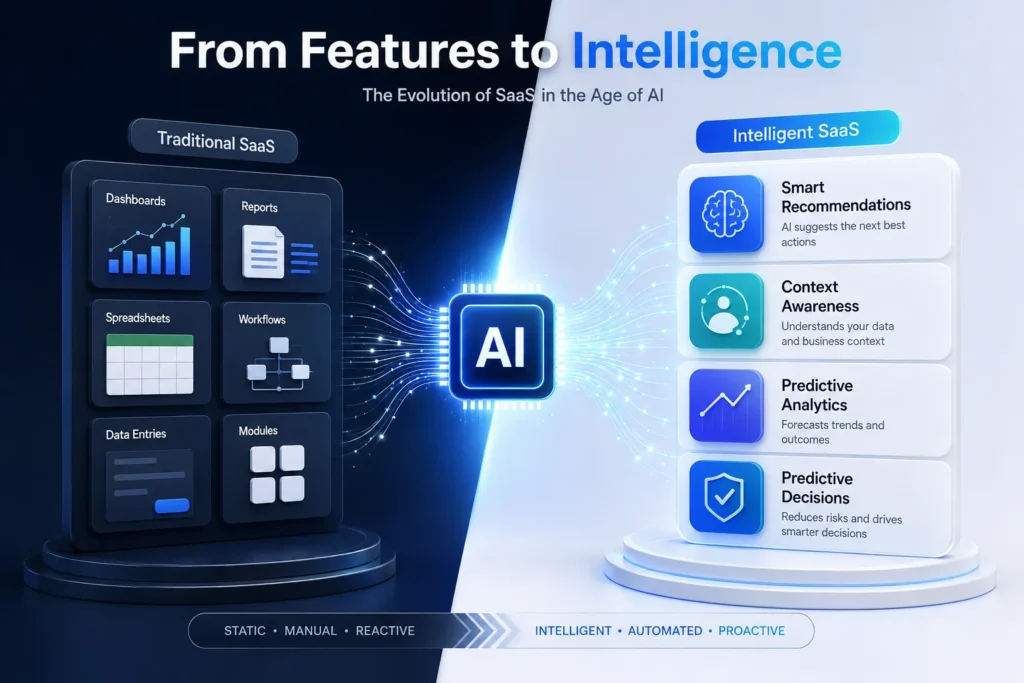
This is creating a shift from feature-driven software to intelligence-driven software.
Instead of asking, “What features does this SaaS product have?” businesses are increasingly asking, “How intelligently can this product help users achieve their goals?”
How Is AI Turning Features Into Intelligent Capabilities?
Traditional SaaS features usually perform specific functions.
For example, a customer relationship management platform may provide features for:
- Managing customer records.
- Tracking sales opportunities.
- Scheduling follow-ups.
- Creating reports.
- Managing communications.
With AI-powered SaaS products, these same features can become more intelligent.
An AI-enabled CRM could analyze customer interactions and identify which leads are most likely to convert. It could summarize previous conversations, recommend follow-up actions, or identify customers who may be at risk of leaving.
The feature remains the same at its foundation, but AI adds an intelligence layer.
This is an important distinction for SaaS product development.
The goal is not necessarily to replace existing features. Instead, AI can make those features more contextual, useful, and proactive.
How Can SaaS Products Understand User Intent?
One of the most important developments in AI software is the ability to understand natural-language requests and user intent.
Traditional interfaces often require users to know exactly which buttons, menus, filters, or workflows to use.
AI can simplify this interaction.
For example, instead of manually filtering sales data, a user could ask:
“Which customers haven’t purchased anything in the last 90 days?”
An intelligent SaaS application could understand the request, locate the relevant information, analyze the data, and present the result.
This capability is helping drive the growth of conversational SaaS.
Users no longer need to understand every part of an application’s interface to access its capabilities. They can increasingly communicate their goals directly.
However, effective conversational experiences require more than simply connecting a chatbot to a SaaS application.
The AI needs access to relevant context, accurate business data, appropriate permissions, and carefully designed workflows.
Without these elements, an AI interface may produce answers that sound useful but lack business accuracy.
How Can AI Help SaaS Applications Make Better Decisions?
Modern businesses generate enormous amounts of data, but having more data does not automatically lead to better decisions.
The challenge is identifying which information actually matters.
This is where AI-driven SaaS can provide significant value.
AI can analyze patterns across large datasets and surface information that might otherwise be difficult for users to identify.
For example, an AI-powered analytics platform could detect:
- A sudden decline in customer engagement.
- Unusual purchasing behavior.
- Increasing support requests.
- Operational bottlenecks.
- Changes in conversion patterns.
- Potential revenue opportunities.
Instead of requiring users to manually analyze every data point, AI can highlight important patterns and explain why they may matter.
This represents a shift from data to insights.
How Is AI Making SaaS More Context-Aware?
Context is becoming increasingly important in modern AI SaaS solutions.
A useful AI system should not simply respond to a user’s words. It should understand the circumstances surrounding the request.
For example, if a sales manager asks an AI assistant to “prepare today’s priorities,” the system could potentially consider:
- Open opportunities.
- Upcoming meetings.
- Overdue follow-ups.
- Customer activity.
- Sales targets.
- Recent communications.
The result is more useful than a generic task list because it is based on the user’s actual working context.
This contextual intelligence can make intelligent SaaS products feel less like traditional software tools and more like digital assistants.
How Is AI Changing SaaS From Reactive to Proactive?
Traditional software generally waits for users to initiate an action.
AI can make SaaS applications more proactive.
For example, instead of waiting for a manager to notice that a project is behind schedule, an AI system could identify the delay and recommend corrective action.
Instead of waiting for a customer to complain, an AI-powered support system could identify signals indicating dissatisfaction.
Instead of simply displaying sales data, an AI system could identify an emerging opportunity.
This is the foundation of predictive SaaS.
The software doesn’t simply tell users what has happened. It can help them understand what might happen next and what actions could be worth considering.
This transition from reactive to predictive experiences is one of the most important developments shaping the future of SaaS.
How Can AI Improve Existing SaaS Workflows?
Businesses don’t necessarily need to rebuild their entire SaaS platforms to benefit from AI.
In many cases, AI can be introduced into existing workflows strategically.
For example:
Traditional workflow:
User → Enters data → Runs report → Reviews results → Makes decision
AI-enhanced workflow:
User → Enters data → AI analyzes information → Identifies patterns → Provides recommendations → User makes decision
The second workflow can reduce manual effort while giving users additional context.
This is where thoughtful AI integration becomes important.
Businesses should identify workflows where AI can produce measurable improvements rather than adding AI to every available feature.
Potential opportunities include:
- Automated document processing.
- Intelligent search.
- Predictive analytics.
- Customer support automation.
- Recommendation systems.
- Workflow optimization.
- Content generation.
- Risk detection.
The right use case depends on the product, users, available data, and business objectives.
Why Is This Shift Important for SaaS Product Development?
The evolution toward intelligent products is changing how companies approach SaaS product development.
Previously, product teams often focused on:
- Feature requirements.
- Interface design.
- Performance.
- Scalability.
- Integration capabilities.
These remain important, but AI introduces additional considerations.
Product teams must also think about:
- Data quality.
- AI accuracy.
- Model performance.
- User trust.
- Explainability.
- Privacy.
- Human oversight.
An AI feature that produces inaccurate recommendations can damage user trust even if the underlying SaaS platform works perfectly.
Therefore, successful SaaS innovation requires a combination of software engineering, AI capabilities, user experience design, data management, and security.
What Does the Intelligent SaaS Model Look Like?
The emerging model can be summarized as:
Traditional SaaS:
Features → User Actions → Results
AI-Powered SaaS:
Data + Context → AI Analysis → Insights → Recommendations → Automation → Results
This doesn’t mean humans disappear from the process.
In many business applications, the best model will involve AI supporting users rather than making every decision independently.
AI can handle data-heavy analysis and repetitive tasks while people maintain control over important decisions.
That balance can make AI-powered SaaS both more powerful and more trustworthy.
Key Takeaway
AI is transforming SaaS by making software more intelligent, contextual, personalized, and proactive. Through AI in SaaS, traditional features can become intelligent capabilities that understand user intent, analyze business data, generate recommendations, and automate workflows.
The most valuable AI SaaS products will not simply add artificial intelligence as another feature. They will integrate intelligence into the product experience so naturally that users can accomplish more with less manual effort.
As this evolution continues, the next major opportunity is automation using AI to move repetitive SaaS workflows from manual execution toward intelligent, automated processes.
3. How Is AI Automating SaaS Workflows?
One of the most practical applications of AI-powered SaaS is automation.
Traditional SaaS already helps businesses automate predefined processes, but these workflows often depend on fixed rules and manual inputs. Users still need to decide what should happen, trigger specific actions, and monitor the results.
AI changes this by making automation more intelligent.
Instead of simply following a predefined instruction, AI can analyze information, understand context, identify patterns, and determine which action may be appropriate.
This is moving SaaS automation from simple rule-based workflows toward more adaptive and intelligent processes.
What Tasks Can AI Automate in SaaS?
AI can automate a wide range of repetitive tasks across modern SaaS applications.
Common examples include:
- Data entry and classification.
- Document processing.
- Customer support responses.
- Lead qualification.
- Email categorization.
- Meeting and conversation summaries.
- Report generation.
- Data analysis.
- Task prioritization.
- Follow-up recommendations.
- Workflow notifications.
For example, a traditional CRM may require a sales representative to manually review leads and determine which prospects should receive follow-up.
An AI SaaS platform can analyze customer activity, previous interactions, engagement levels, and other relevant signals to prioritize leads automatically.
The employee still makes the final decision, but AI reduces the amount of manual analysis required.
This is one of the clearest ways AI in SaaS can improve productivity.
How Does SaaS Automation Improve Business Productivity?
Repetitive work consumes significant amounts of employee time.
Tasks such as copying information between systems, organizing documents, reviewing customer requests, generating reports, and responding to routine questions may not require complex human judgment, but they still require time.
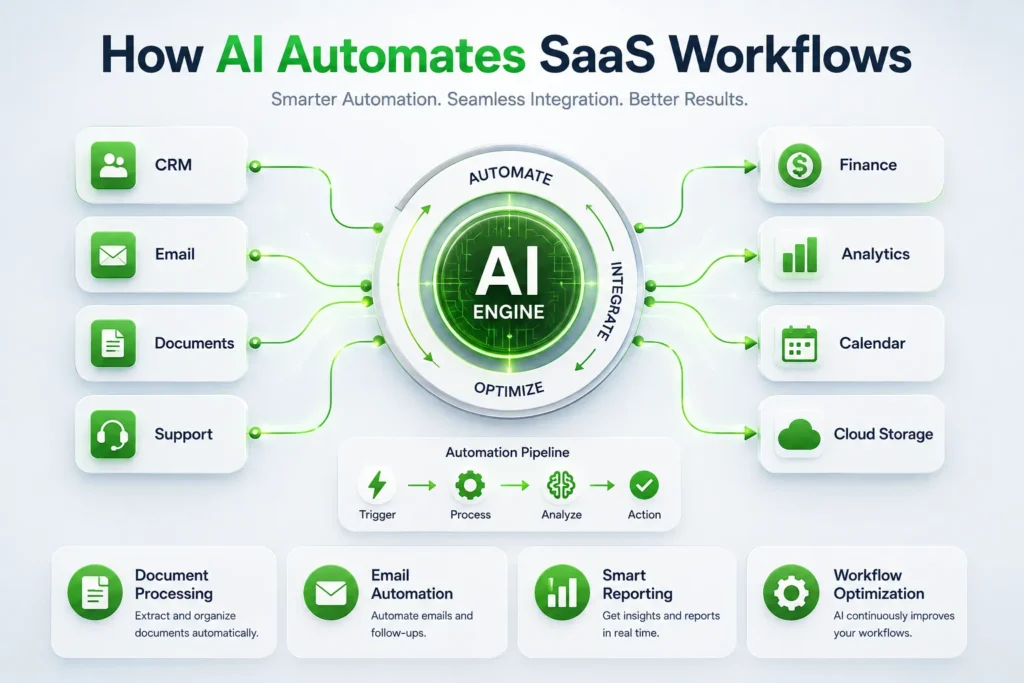
AI can automate many of these processes.
For example, consider a customer support workflow.
Traditional Process
Customer submits request → Employee reads request → Employee identifies issue → Employee searches for information → Employee responds → Employee updates system
AI-Enhanced Process
Customer submits request → AI understands request → AI identifies category → AI retrieves relevant information → AI recommends or generates response → System updates workflow
The second approach can significantly reduce repetitive work.
This is particularly valuable for growing businesses because automation allows teams to handle increasing workloads without proportionally increasing manual effort.
As a result, SaaS automation can support both productivity and scalability.
Can AI Reduce Repetitive Manual Work?
Yes. Reducing repetitive work is one of the strongest business cases for AI-powered SaaS products.
AI can identify recurring patterns and automate processes that previously required human intervention.
For example, an AI-powered finance SaaS application could automatically categorize transactions and flag unusual expenses.
A human resources platform could summarize employee feedback and identify recurring themes.
A marketing platform could analyze campaign performance and recommend where budgets should be adjusted.
A customer service platform could classify incoming tickets and route them to the appropriate team.
In each case, AI doesn’t necessarily replace employees. Instead, it reduces the amount of repetitive work employees need to perform.
This allows teams to spend more time on activities that require creativity, communication, strategy, and judgment.
How Can AI Make SaaS Workflows More Adaptive?
Traditional automation generally follows predefined rules.
For example:
If X happens → Do Y.
This approach works well when processes are predictable.
However, modern businesses often deal with situations that cannot be captured by simple rules.
AI allows workflows to become more adaptive.
Instead of following only fixed conditions, an AI-driven SaaS system can evaluate multiple signals before recommending an action.
For example, a customer may not have explicitly canceled a subscription, but the system might identify several warning signs:
- Reduced product usage.
- Fewer logins.
- Declining engagement.
- Increased support complaints.
- Lower transaction activity.
Individually, these signals may not mean much.
Together, they could indicate a potential customer retention problem.
An intelligent SaaS platform could recognize the pattern and recommend that the customer success team intervene.
This is a major difference between conventional automation and intelligent automation.
How Can AI Improve Workflow Prioritization?
Not every task has the same level of importance.
Traditional SaaS platforms often organize tasks based on deadlines, categories, or manually assigned priorities.
AI can introduce additional context.
An AI system could evaluate:
- Business impact.
- Urgency.
- Customer importance.
- Historical patterns.
- Deadlines.
- Dependencies.
- Current workload.
It can then recommend which tasks should receive attention first.
This can be particularly valuable for sales, customer service, project management, and operations teams.
For example, instead of showing a support team 100 tickets in chronological order, an intelligent system could identify which tickets are most urgent based on customer impact and issue severity.
This creates a more efficient workflow without requiring employees to manually review every item.
How Is Generative AI Changing SaaS Automation?
Generative AI is adding another dimension to SaaS automation.
Earlier automation systems were primarily designed to execute predefined actions.
Generative AI can also create content and transform information.
Within SaaS applications, this can include:
- Generating email drafts.
- Summarizing documents.
- Creating reports.
- Producing meeting summaries.
- Drafting customer responses.
- Generating product descriptions.
- Converting unstructured information into structured data.
For example, after a sales meeting, an AI-powered CRM could summarize the conversation, identify important requirements, generate follow-up tasks, and prepare a draft email.
Instead of requiring the employee to complete each step manually, AI can coordinate multiple parts of the workflow.
This is helping transform AI software from a passive tool into an active productivity layer.
Can AI Automation Improve Customer Experience?
Yes, intelligent automation can have a direct impact on customer experience.
Customers increasingly expect businesses to provide fast, relevant, and personalized interactions.
AI can help SaaS platforms deliver this by automating customer-facing processes while maintaining contextual awareness.
For example, an intelligent support platform can:
- Understand customer questions.
- Identify the underlying issue.
- Retrieve relevant information.
- Provide an immediate response.
- Escalate complex cases to human agents.
- Summarize the interaction for the support team.
This can reduce response times while allowing human employees to focus on complicated customer issues.
The result is a more efficient combination of automation and human support.
This is also where conversational SaaS becomes valuable, because customers can communicate with software using natural language rather than navigating complex menus.
What Are the Risks of Automating SaaS Workflows With AI?
Although AI automation offers significant benefits, businesses should not automate every process blindly.
Some decisions require human judgment.
Organizations should consider:
Accuracy
AI-generated recommendations may not always be correct.
Data Quality
Poor or incomplete data can lead to poor outputs.
Privacy
Sensitive business and customer information must be handled securely.
Human Oversight
Critical decisions should have appropriate human review.
Transparency
Users should understand when AI is making recommendations or taking actions.
The goal should be responsible automation, not maximum automation.
Businesses should prioritize workflows where AI can provide measurable value while maintaining appropriate controls.
How Should Businesses Identify the Right SaaS Workflows for AI Automation?
A practical starting point is to identify processes that are:
- Repetitive.
- Time-consuming.
- Data-intensive.
- Rule-driven.
- Frequently performed.
- Easy to measure.
- Low risk when automated.
Once these workflows are identified, businesses can evaluate where AI integration can improve efficiency.
A useful question is:
“Can AI reduce the amount of manual work without reducing the quality of the outcome?”
If the answer is yes, that workflow may be a strong candidate for AI automation.
This approach helps organizations avoid adding AI simply for the sake of following a technology trend.
Instead, AI becomes a tool for solving genuine business problems.
Key Takeaway
AI is transforming SaaS automation from fixed, rule-based workflows into more adaptive and intelligent processes. By analyzing context, prioritizing tasks, generating content, and recommending actions, AI-powered SaaS can reduce repetitive work and help teams operate more efficiently.
The next major step is personalization. Once SaaS products can understand users and their workflows more effectively, they can begin adapting the experience to individual preferences, behaviors, and business needs.
4. How Does AI Make SaaS Products More Personalized?
Personalization is becoming one of the most important ways AI-powered SaaS can improve the user experience.
Traditional SaaS products generally provide the same core interface and functionality to every user. Although users may have different roles, permissions, or settings, the underlying experience is often relatively standardized.
AI changes this approach.
With SaaS personalization, software can analyze user behavior, preferences, goals, and usage patterns to create experiences that are more relevant to individual users.
Instead of asking users to adapt to the software, intelligent SaaS can increasingly adapt the software to the user.
What Is SaaS Personalization?
SaaS personalization means adapting a software experience based on information about an individual user, customer, team, or business.
This can involve:
- User behavior.
- Previous interactions.
- Preferences.
- Business requirements.
- Role and responsibilities.
- Product usage patterns.
- Customer history.
For example, a sales manager and a customer support manager may use the same SaaS platform, but they have very different priorities.
A personalized SaaS experience could show the sales manager:
- High-priority leads.
- Sales opportunities.
- Pipeline changes.
- Follow-up recommendations.
Meanwhile, the customer support manager could see:
- Urgent customer issues.
- Support performance.
- Ticket trends.
- Customer satisfaction indicators.
The underlying platform remains the same, but the experience becomes more relevant to each user.
How Can AI Adapt SaaS Experiences to Individual Users?
AI can analyze how users interact with a SaaS product and identify recurring patterns.
For example, if a user frequently checks specific reports, works with particular customers, or uses certain features, an AI-driven SaaS platform can recognize those behaviors.
Over time, the system can use these signals to improve the user’s experience.
AI may help determine:
- Which information should appear first.
- Which recommendations are most relevant.
- Which tasks should be prioritized.
- Which features users may need next.
- Which notifications are important.
- Which workflows can be simplified.
This makes the product feel more responsive to the user’s actual needs.
Instead of providing the same experience to everyone, AI software can create a more contextual experience based on individual behavior.
Why Is Personalization Important for SaaS Products?
SaaS applications are becoming increasingly feature-rich.
While more functionality can provide greater value, it can also make software more complicated.
Users don’t necessarily want to see every feature.
They want to find the features and information that help them accomplish their goals.
This is where personalization can reduce complexity.
For example, imagine an analytics platform with dozens of dashboards.
A new user might need basic performance information, while an experienced executive may need high-level business metrics.
An intelligent platform can potentially surface different information based on the user’s role, behavior, and preferences.
This can make the experience:
- Faster.
- More relevant.
- Easier to navigate.
- More efficient.
- More engaging.
As a result, SaaS personalization can become an important part of product experience and customer retention strategies.
How Can AI Personalize Recommendations?
Recommendations are one of the most visible applications of personalization.
AI can analyze user activity and identify patterns that indicate what a user may need next.
For example, an AI-powered marketing platform could recommend:
- Campaign improvements.
- Content ideas.
- Audience segments.
- Budget adjustments.
- Follow-up opportunities.
A project management platform could recommend:
- Which task should be prioritized.
- Which team member may be overloaded.
- Which project is at risk.
- Which deadline may need attention.
A customer relationship platform could recommend:
- Which customer should receive a follow-up.
- Which lead is most promising.
- Which account may be at risk.
- Which communication may be most relevant.
These recommendations turn SaaS from a passive tool into a more active decision-support system.
How Does AI Personalization Improve Customer Experience?
Personalization isn’t only useful for internal employees.
It can also transform customer-facing SaaS experiences.
For example, an AI-powered customer portal could understand a customer’s previous interactions and provide more relevant recommendations, support resources, or product information.
Instead of showing every customer the same content, the system could prioritize information based on their history and needs.
This can create a more natural experience.
Customers don’t have to repeatedly explain their situation or search through irrelevant information.
The system can use available context to make the interaction more efficient.
This is particularly valuable for subscription-based businesses because customer experience can directly influence retention and long-term value.
Can AI Personalization Improve SaaS Customer Retention?
It can.
One of the challenges SaaS businesses face is identifying why users stop engaging with a product.
AI can analyze usage patterns to identify potential warning signs.
For example, a user who previously used a platform every day may suddenly:
- Log in less frequently.
- Stop using important features.
- Reduce activity.
- Ignore recommendations.
- Experience repeated support issues.
These signals could indicate declining engagement.
An intelligent SaaS platform can identify the pattern and potentially trigger an appropriate response.
This could include:
- A personalized product recommendation.
- A helpful onboarding message.
- Additional educational content.
- A customer success notification.
- A targeted support intervention.
Rather than waiting until the customer cancels, businesses can respond earlier.
This demonstrates how personalization and predictive SaaS can work together.
How Does AI Personalization Work With User Context?
Personalization becomes more powerful when AI considers context rather than isolated actions.
For example, knowing that a user opened a report is useful.
Knowing that the user opened the report immediately before an important client meeting provides additional context.
Similarly, knowing that a customer contacted support is useful.
Understanding that the customer has contacted support several times about the same issue provides much more valuable information.
This contextual understanding is one of the areas where AI in SaaS can create significant advantages.
AI can combine multiple signals to produce more relevant recommendations.
However, businesses must ensure that personalization is transparent and responsible.
What Are the Privacy Concerns With SaaS Personalization?
Personalization requires data.
That creates an important responsibility for SaaS businesses.
Organizations must carefully consider:
- What data is collected.
- Why the data is collected.
- How the data is stored.
- Who can access it.
- How long it is retained.
- How it is used by AI systems.
Customers and employees should have confidence that their information is being handled responsibly.
This means privacy and security should be considered during SaaS product development, rather than added as an afterthought.
Strong access controls, data governance, encryption, and appropriate AI policies can help organizations build trustworthy personalized experiences.
How Can Businesses Avoid Over-Personalization?
More personalization isn’t always better.
If software constantly changes its interface or makes too many recommendations, users may find the experience confusing or intrusive.
Effective AI SaaS solutions should therefore balance personalization with consistency.
Users should still understand:
- Where they are in the application.
- How the system reached a recommendation.
- How to change preferences.
- How to override automated suggestions.
The objective is not to make the software unpredictable.
The objective is to make it more relevant.
Good personalization should feel helpful rather than invasive.
Key Takeaway
SaaS personalization allows software to adapt experiences based on user behavior, preferences, roles, and business context. With AI-powered SaaS, personalization can go beyond basic settings by enabling intelligent recommendations, predictive insights, personalized workflows, and more relevant customer experiences.
The most effective AI-driven SaaS products will use personalization to reduce complexity and help users accomplish their goals more efficiently while maintaining transparency, privacy, and user control.
But personalization is only one part of the transformation. The next major shift is how AI can turn the enormous amount of data stored inside SaaS platforms into meaningful, actionable insights.
5. How Is AI Turning SaaS Data Into Actionable Insights?
Modern businesses collect enormous amounts of information through SaaS applications. Customer interactions, sales activity, support requests, financial transactions, marketing campaigns, employee activity, and operational workflows can all generate valuable data.
But simply having access to data does not automatically create better business decisions.
The real challenge is understanding what the data means.
This is where AI-powered SaaS can create a major difference. Instead of simply storing information or displaying it through traditional dashboards, AI can analyze patterns, identify important changes, summarize complex datasets, and surface recommendations that help users decide what to do next.
This represents a shift from data to insights.
Why Are Traditional SaaS Dashboards No Longer Enough?
Traditional dashboards remain useful for monitoring business performance.
They can show metrics such as:
- Revenue.
- Sales.
- Customer growth.
- Website traffic.
- Conversion rates.
- Support tickets.
- Employee productivity.
However, dashboards generally require users to interpret the information themselves.
A manager may see that sales declined by 12%, for example, but still need to investigate why the decline happened.
An intelligent SaaS platform can potentially go further by analyzing multiple data sources and identifying patterns that may explain the change.
For example, AI might identify that the decline is associated with:
- Reduced website traffic.
- Lower conversion rates.
- Changes in customer behavior.
- Increased competition.
- Reduced engagement from a particular customer segment.
The dashboard tells the user what happened.
AI can help explain why it happened and what might happen next.
That difference is becoming increasingly important in modern AI SaaS solutions.
How Can AI Analyze Business Data?
AI can process large volumes of structured and unstructured information much faster than humans can manually review it.
Depending on the application, AI can analyze:
- Customer behavior.
- Transaction history.
- Product usage.
- Sales activity.
- Support conversations.
- Documents.
- Emails.
- Marketing performance.
- Operational data.
The goal isn’t simply to process more information.
The goal is to identify meaningful relationships within that information.
For example, an AI-driven SaaS platform could analyze thousands of customer interactions and discover that users who experience a particular onboarding problem are significantly more likely to stop using the product later.
That insight could help the business improve onboarding before the problem affects more customers.
This is one of the major advantages of integrating AI in SaaS—the system can continuously analyze information and identify patterns that might otherwise remain hidden.
How Can AI Generate Recommendations From SaaS Data?
Insight becomes much more valuable when it leads to action.
Instead of simply reporting that customer engagement has declined, an intelligent SaaS platform could recommend specific actions.
For example:
“Customer engagement has declined among enterprise accounts over the last 30 days. Consider scheduling proactive account reviews with customers showing the largest reduction in activity.”
The recommendation connects data with a potential business action.
This is where AI software can become a decision-support tool rather than simply an analytics feature.
Depending on the application, AI could recommend:
- Which leads to prioritize.
- Which customers need attention.
- Which tasks should be completed first.
- Which campaigns need optimization.
- Which operational processes are inefficient.
- Which products may require additional investment.
The recommendations should still be reviewed appropriately by users, particularly when they involve high-impact business decisions.
How Can AI Identify Patterns That Humans May Miss?
Humans are good at understanding context and making judgments, but analyzing extremely large datasets manually can be difficult.
AI can continuously evaluate large numbers of signals and identify relationships across them.
For example, a business might have:
- 50,000 customers.
- Millions of transactions.
- Thousands of support conversations.
- Multiple marketing campaigns.
- Hundreds of product usage signals.
Manually connecting all these datasets would be extremely time-consuming.
An AI-powered SaaS product can analyze these signals together and identify recurring patterns.
It might discover that customers with a particular usage pattern are more likely to upgrade, or that certain support issues are associated with higher churn.
These insights can help businesses move from intuition-driven decisions toward more data-informed strategies.
How Is AI Changing Predictive Analytics in SaaS?
One of the most valuable developments in AI SaaS is predictive analytics.
Traditional analytics generally focuses on historical information.
It answers questions such as:
- What happened?
- How much did we sell?
- How many customers did we acquire?
- Which campaigns performed well?
Predictive analytics introduces another question:
What could happen next?
AI can analyze historical patterns and current signals to identify potential future outcomes.
For example, a SaaS platform could help predict:
- Customer churn.
- Sales opportunities.
- Demand changes.
- Inventory requirements.
- Revenue patterns.
- Operational risks.
This connects directly with predictive SaaS, where software becomes increasingly capable of anticipating potential outcomes instead of simply reporting past activity.
Can AI Help Businesses Make Faster Decisions?
Yes.
One of the biggest benefits of intelligent analytics is reducing the time between discovering information and taking action.
A traditional process might look like this:
Collect data → Build report → Analyze report → Discuss findings → Decide → Take action
An AI-enhanced process could look like:
Collect data → AI analyzes patterns → Insight generated → Recommendation provided → Human reviews → Action
The human decision-maker remains important, but AI can reduce the amount of manual analysis required.
This can be particularly useful when businesses need to respond quickly to changing market conditions, customer behavior, or operational problems.
How Can AI Turn Unstructured SaaS Data Into Insights?
Not all valuable business information exists in spreadsheets or databases.
A significant amount of information is unstructured.
This can include:
- Customer emails.
- Support conversations.
- Meeting transcripts.
- Documents.
- Reviews.
- Feedback.
- Internal communications.
Traditional analytics tools can struggle to work with this type of information.
Modern AI-powered SaaS platforms can use natural-language processing and generative AI capabilities to analyze unstructured content.
For example, an AI customer service platform could review thousands of support conversations and identify the most common complaints.
Instead of reading every conversation individually, managers could receive a summary such as:
- 32% of complaints relate to onboarding.
- 24% relate to billing.
- 18% relate to product performance.
This transforms unstructured information into structured business insights.
How Can AI Improve SaaS Reporting?
Reporting is another area where AI in SaaS can reduce manual work.
Traditional reporting often requires users to:
- Collect data.
- Filter information.
- Build charts.
- Compare periods.
- Identify changes.
- Write explanations.
AI can automate parts of this process.
An intelligent reporting system could automatically identify significant changes and generate a summary explaining the key findings.
For example:
“Revenue increased 18% compared with the previous quarter, primarily due to stronger enterprise sales. However, customer acquisition costs increased by 9% during the same period.”
This type of natural-language reporting makes complex data easier to understand.
It also supports conversational SaaS, because users can ask questions about business performance instead of navigating multiple reporting screens.
Can AI Make Data Insights More Accessible to Non-Technical Users?
Yes.
One of the biggest barriers to data-driven decision-making is technical complexity.
Users may have access to valuable information but lack the technical skills required to query databases, build complex reports, or interpret advanced analytics.
AI can provide a simpler interface.
A non-technical user could ask:
“Which products generated the highest revenue this quarter?”
Or:
“Why did customer churn increase last month?”
An intelligent SaaS system can translate the natural-language request into an appropriate data analysis and present the result in an understandable format.
This makes advanced analytics accessible to a broader group of employees.
What Should Businesses Consider Before Using AI for Data Analysis?
AI-generated insights are only as reliable as the data and systems behind them.
Businesses should therefore consider:
Data Quality
Incomplete or inaccurate data can produce unreliable insights.
Data Security
Sensitive information must be properly protected.
AI Accuracy
AI recommendations should be validated, particularly when they influence important decisions.
Explainability
Users should understand where important recommendations come from when appropriate.
Human Oversight
AI should support decision-making rather than automatically control every high-impact business decision.
These considerations are especially important as AI SaaS solutions become more deeply integrated into business operations.
Key Takeaway
AI is changing SaaS analytics by moving businesses beyond dashboards and historical reporting toward intelligent insights, recommendations, and predictive analysis.
With AI-powered SaaS, businesses can analyze structured and unstructured information, identify hidden patterns, generate natural-language reports, and surface potential actions from complex datasets.
The next step in this evolution is changing how users interact with those insights. Instead of navigating dashboards and menus, users can increasingly ask software questions directly and receive contextual answers through natural-language interfaces.
6. How Are Conversational Interfaces Changing SaaS?
The way people interact with software is changing rapidly. For years, using a SaaS application meant navigating menus, searching through dashboards, selecting filters, and learning where different features were located.
AI-powered SaaS is introducing a simpler interaction model: conversation.
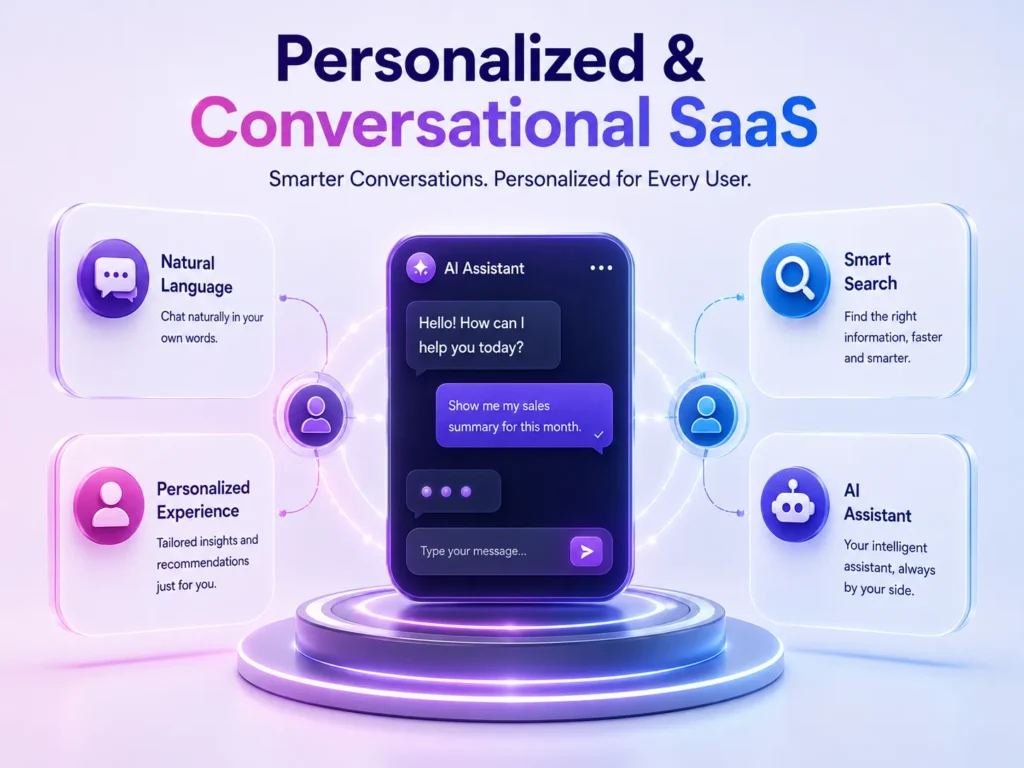
Instead of asking users to learn every part of an application, conversational SaaS allows them to communicate with software using natural language. Users can ask questions, request actions, analyze information, and receive recommendations without necessarily navigating through multiple screens.
This shift is making SaaS products more accessible, intuitive, and context-aware.
Why Are Users Moving From Clicking to Conversing?
Traditional interfaces require users to understand how software works.
For example, if someone wants to find their highest-value customers, they may need to:
- Open the customer dashboard.
- Select the appropriate report.
- Apply filters.
- Choose a date range.
- Sort the results.
- Interpret the information.
A conversational interface can simplify this process.
A user could ask:
“Which customers generated the most revenue this quarter?”
The system can understand the request, identify the relevant data, and present the result.
This doesn’t mean traditional interfaces will disappear. Dashboards, menus, buttons, and visual reports will remain valuable for many tasks.
Instead, AI in SaaS is adding another interaction layer that allows users to communicate with software in a more natural way.
How Can Natural Language Improve SaaS Applications?
Natural-language interaction can make complex software easier to use.
Many SaaS platforms have powerful capabilities, but users may not know where those capabilities are located.
A conversational AI interface can make those capabilities accessible through simple instructions.
For example, a user could ask:
“Summarize my team’s performance this month and highlight the areas that need attention.”
An intelligent SaaS system could analyze relevant performance information and generate a concise summary.
Similarly, a marketing manager could ask:
“Which campaign has the highest customer acquisition cost?”
A finance manager could ask:
“Show me the biggest unexpected expenses from this month.”
A customer success manager could ask:
“Which accounts are showing signs of declining engagement?”
These interactions make AI software feel less like a collection of tools and more like an intelligent assistant.
What Role Will AI Assistants Play in SaaS?
AI assistants are becoming an important component of AI SaaS solutions.
Instead of functioning as standalone chatbots, these assistants can potentially become integrated into the core SaaS experience.
An AI assistant inside a CRM could help users:
- Summarize customer history.
- Draft follow-up emails.
- Identify high-priority leads.
- Prepare meeting briefs.
- Recommend next actions.
An AI assistant inside a project management platform could:
- Summarize project progress.
- Identify delayed tasks.
- Highlight resource issues.
- Generate status reports.
- Recommend priorities.
The value comes from connecting the assistant to relevant application data and workflows.
A generic chatbot may provide information.
An integrated SaaS assistant can potentially understand context and help users act on information.
How Can Conversational SaaS Simplify Complex Workflows?
Some SaaS workflows involve multiple steps.
For example, creating a business report may require users to select data sources, configure filters, choose visualizations, and export the result.
A conversational interface could simplify this.
The user might say:
“Create a monthly sales report comparing this month with the previous three months and highlight any major changes.”
The system can interpret the request and potentially handle several steps automatically.
This is where conversational SaaS overlaps with SaaS automation.
The conversation becomes the starting point, while AI handles some of the underlying workflow.
As AI capabilities become more sophisticated, conversational interfaces may move beyond answering questions and begin initiating actions.
Can Users Ask SaaS Products to Perform Actions?
Yes, and this is one of the most important developments in AI-enabled software.
Early AI interfaces primarily focused on answering questions.
Modern systems are increasingly moving toward action-oriented experiences.
For example, instead of asking:
“Which leads need follow-up?”
a user might eventually ask:
“Identify the five highest-priority leads and prepare follow-up emails for them.”
The AI system could identify the relevant leads and generate drafts while leaving final approval to the user.
Similarly, a project manager could ask:
“Find the tasks that are likely to miss their deadlines and create a summary for the project team.”
This moves SaaS interaction from:
Ask → Answer
toward:
Ask → Analyze → Recommend → Act
That progression is central to the evolution of AI-powered SaaS.
How Does Conversational AI Improve SaaS Accessibility?
Complex software can create a learning curve for new users.
Employees may need training before they can confidently use advanced features.
Natural-language interfaces can reduce some of that friction.
Instead of learning exactly how to use a feature, users can describe what they want to accomplish.
For example:
“Help me understand why our conversion rate dropped this week.”
The system can potentially identify relevant information and explain the results.
This can make advanced capabilities more accessible to non-technical users.
However, conversational interfaces should not become a replacement for good product design.
The best SaaS product development strategy is likely to combine intuitive interfaces with conversational capabilities rather than relying exclusively on AI.
What Makes a Conversational SaaS Experience Effective?
Simply adding a chatbot to a SaaS platform doesn’t automatically create a useful AI experience.
An effective conversational system needs several important capabilities.
Context Awareness
The system should understand relevant user, account, and business context.
Data Access
It needs access to the information required to answer questions accurately.
Permission Controls
Users should only be able to access information and perform actions they are authorized to use.
Clear Responses
Answers should be understandable and relevant rather than unnecessarily complicated.
Action Controls
When AI can perform actions, users should have appropriate confirmation and oversight mechanisms.
Reliability
The system should minimize inaccurate or misleading responses.
These factors are essential for building trustworthy AI-driven SaaS products.
What Are the Risks of Conversational SaaS?
Conversational AI also introduces new challenges.
One major concern is inaccurate information.
If an AI assistant misunderstands a request or produces an incorrect response, users may make poor decisions based on that information.
There are also security and privacy considerations.
A conversational interface may provide access to sensitive business information, making strong authentication, authorization, and data protection essential.
Businesses should also consider how AI handles confidential information, customer data, and internal documents.
Therefore, AI integration should be implemented with security and governance in mind.
How Will Conversational SaaS Evolve?
The next stage is likely to involve more contextual and action-oriented interactions.
Users may increasingly communicate with software using natural language while AI handles the underlying complexity.
Instead of learning where every feature is located, users may simply describe the outcome they want.
For example:
“Prepare everything I need for tomorrow’s client meeting.”
An advanced SaaS platform could potentially gather relevant customer information, summarize recent interactions, identify outstanding issues, prepare performance metrics, and create a meeting brief.
This illustrates how intelligent SaaS could become increasingly proactive.
The software doesn’t simply wait for individual instructions.
It understands the broader objective and helps coordinate the steps required to accomplish it.
Key Takeaway
Conversational SaaS is changing how users interact with software by allowing them to communicate with applications using natural language. Instead of navigating complex interfaces for every task, users can increasingly ask questions, analyze information, generate content, and initiate workflows through AI assistants.
The future of AI-powered SaaS will likely combine conversational interaction with automation, personalization, and contextual intelligence.
But conversation is only the beginning. The next major evolution is making SaaS systems proactive enough to anticipate user needs before users even ask.
7. How Is Predictive AI Changing the Future of SaaS?
The next evolution of AI-powered SaaS is moving beyond automation toward prediction.
Traditional software helps users understand what has already happened. Modern AI SaaS solutions are increasingly helping businesses understand what is likely to happen next. This shift is transforming SaaS from a reactive business tool into a proactive decision-support platform.
Instead of waiting for users to identify problems manually, predictive SaaS can recognize patterns, anticipate future outcomes, and recommend actions before issues become critical. For businesses, this means faster decisions, reduced risks, and more intelligent operational planning.
What Is Predictive SaaS?
Predictive SaaS refers to cloud-based software that uses Artificial Intelligence, machine learning, and historical business data to forecast future events and recommend proactive actions.
Unlike conventional analytics, predictive SaaS focuses on future possibilities rather than past performance.
For example, an intelligent SaaS platform may predict:
- Customer churn risk
- Sales opportunities
- Revenue trends
- Inventory demand
- Project delays
- Employee workload
- Support ticket volume
Rather than simply displaying these metrics, the software can notify users before problems escalate.
This is one of the defining characteristics of AI-driven SaaS.
How Can AI Anticipate User Needs?
Modern AI systems continuously learn from user behavior, workflows, and business data.
By analyzing recurring patterns, AI in SaaS can identify what users are likely to need next.
For example, a sales manager who reviews pipeline reports every Monday may automatically receive an AI-generated sales summary before opening the dashboard.
Similarly, a project manager approaching multiple deadlines could receive:
- High-risk task alerts
- Resource conflict warnings
- Recommended priority changes
- Estimated completion risks
The software isn’t replacing human decision-making—it is preparing users with relevant information before they ask for it.
This proactive assistance makes AI-powered SaaS products significantly more valuable than traditional reporting tools.
Why Are Proactive SaaS Experiences Becoming More Important?
Businesses today operate in fast-changing environments where waiting to react often means losing opportunities.
A reactive SaaS platform typically follows this sequence:
Problem occurs → User discovers it → User investigates → User responds
A proactive AI-powered SaaS platform changes the workflow:
AI detects pattern → Predicts outcome → Recommends action → User responds earlier
This difference can have a major business impact.
Examples include:
- Identifying customers likely to cancel before renewal.
- Detecting unusual spending before budgets are exceeded.
- Predicting inventory shortages before supply issues occur.
- Flagging declining user engagement before churn increases.
- Warning about project delays before deadlines are missed.
These capabilities allow businesses to solve problems earlier and make more informed strategic decisions.
How Does Predictive AI Improve Business Decision-Making?
Decision-making becomes stronger when businesses have both historical insight and future context.
AI software can combine multiple data sources to identify trends that humans may overlook.
For example, instead of showing only monthly revenue, an intelligent SaaS platform could recognize that:
- Enterprise sales are increasing.
- Small-business subscriptions are declining.
- Customer acquisition costs are rising.
- Renewal rates remain stable.
Based on these connected signals, AI can recommend where leadership should focus attention.
This transforms dashboards into decision-support systems rather than simple reporting tools.
For executives, managers, and operational teams, predictive insights can improve planning while reducing uncertainty.
Can Predictive AI Improve Customer Retention?
Customer retention is one of the strongest use cases for predictive SaaS.
Every SaaS business generates behavioral signals such as:
- Login frequency
- Feature adoption
- Session duration
- Support interactions
- Subscription history
- Product engagement
Individually, these metrics provide useful information.
Together, they allow AI to estimate which customers may be losing interest.
An AI SaaS platform can identify early warning signs and recommend actions such as:
- Personalized onboarding
- Educational content
- Customer success outreach
- Feature recommendations
- Renewal engagement campaigns
Instead of reacting after a customer cancels, businesses gain an opportunity to improve retention proactively.
What Should Businesses Consider Before Using Predictive AI?
Although predictive AI offers significant advantages, successful implementation depends on responsible AI integration.
Organizations should prioritize:
High-Quality Data
Accurate predictions require reliable business data.
Human Validation
AI recommendations should support—not replace—important business decisions.
Transparency
Users should understand why significant recommendations are being generated.
Continuous Learning
Predictive models should be regularly evaluated and improved as business conditions change.
The most successful AI-powered SaaS products combine predictive intelligence with human oversight, creating software that helps businesses anticipate change while maintaining trust and control.
Key Takeaway
Predictive SaaS is redefining the future of business software by helping organizations anticipate customer behavior, operational risks, and business opportunities before they happen. Through AI-powered SaaS, companies can move from reactive workflows to proactive decision-making, creating smarter, more adaptive digital products.
The next stage of this evolution goes even further—introducing AI agents that can not only recommend actions but also coordinate and execute complex workflows across SaaS platforms.
8. What Are AI Agents and How Could They Change SaaS?
The conversation around AI-powered SaaS is rapidly moving beyond chatbots and automation. The next major evolution is the emergence of AI agents—intelligent software entities capable of understanding goals, coordinating multiple tasks, and executing complex workflows with minimal human intervention.
Unlike traditional automation, which follows predefined rules, AI agents are designed to reason through multi-step processes using context, business data, and user intent. This makes them one of the most exciting developments shaping the future of SaaS.
For SaaS businesses, AI agents represent a shift from software that assists users to software that actively collaborates with them.
How Do AI Agents Work Inside SaaS Products?
An AI agent is an intelligent system that can interpret a user’s objective, gather the necessary information, perform multiple actions, and deliver a meaningful outcome.
Instead of executing a single command, the agent coordinates several related tasks.
For example, imagine a sales manager gives this instruction:
“Prepare everything I need for tomorrow’s client meeting.”
A traditional SaaS platform might require the user to manually open several modules.
An AI-powered SaaS platform with an AI agent could automatically:
- Retrieve customer history.
- Summarize previous meetings.
- Analyze recent purchase activity.
- Identify open support issues.
- Generate a meeting brief.
- Recommend next best actions.
The user focuses on the objective, while the AI handles much of the operational complexity.
This is fundamentally different from simple workflow automation.
What Tasks Can AI Agents Handle?
AI agents are particularly valuable for workflows that involve multiple systems and repetitive coordination.
Within AI SaaS solutions, they can assist with:
Sales Operations
- Preparing customer meeting summaries.
- Prioritizing leads.
- Drafting follow-up emails.
- Identifying upsell opportunities.
Customer Support
- Classifying incoming tickets.
- Retrieving knowledge base articles.
- Escalating complex issues.
- Summarizing customer conversations.
Project Management
- Monitoring project progress.
- Identifying delivery risks.
- Reassigning workloads.
- Creating status reports.
Business Analytics
- Comparing performance across departments.
- Explaining unusual trends.
- Generating executive summaries.
- Recommending operational improvements.
Rather than replacing employees, these agents reduce administrative work and allow teams to focus on higher-value decision-making.
Could AI Agents Replace Traditional SaaS Workflows?
Not entirely but they will significantly transform them.
Traditional SaaS workflows usually follow this pattern:
User → Feature → Action → Result
An AI agent introduces a more intelligent workflow:
User Goal → AI Agent → Data Analysis → Multiple Actions → Result
For example:
| Traditional SaaS | AI Agent SaaS |
|---|---|
| User creates report manually | AI generates the report automatically |
| User searches customer history | AI summarizes customer context |
| User prioritizes tasks | AI recommends task priorities |
| User drafts emails | AI prepares personalized drafts |
| User analyzes dashboards | AI explains business insights |
The important distinction is that AI-powered SaaS products still keep humans in control. AI agents support execution and recommendations, while users retain authority over critical business decisions.
Why Will AI Agents Matter for the Future of SaaS?
As businesses adopt more digital tools, one growing challenge is software fragmentation. Teams often switch between CRM platforms, project management tools, communication apps, analytics dashboards, and customer support systems throughout the day.
AI agents have the potential to connect these experiences.
Instead of navigating five different applications, users may simply describe their objective, and the agent coordinates information across integrated SaaS applications.
This creates several business advantages:
- Reduced manual work.
- Faster decision-making.
- Better cross-platform productivity.
- More personalized workflows.
- Improved operational efficiency.
For SaaS companies, this also changes SaaS product development. Future products will increasingly be designed around user outcomes rather than isolated features.
The competitive advantage will no longer be measured only by how many features a platform offers, but by how intelligently it helps users achieve meaningful business results.
Key Takeaway
AI agents represent the next evolution of AI-powered SaaS by enabling software to understand objectives, coordinate workflows, and execute multi-step business tasks intelligently. Rather than replacing traditional SaaS, they enhance it by making software more proactive, contextual, and outcome-focused.
As the future of SaaS continues to evolve, AI agents are likely to become a defining capability of next-generation AI SaaS solutions, helping businesses work smarter instead of simply working faster.
9. What Are the Biggest Benefits of AI-Powered SaaS for Businesses?
The growing adoption of AI-powered SaaS is not simply about adding intelligent features to cloud software. For businesses, it represents a fundamental shift in how work is completed, decisions are made, and customer experiences are delivered.
Organizations today are under constant pressure to improve productivity, reduce operational costs, deliver personalized experiences, and scale without significantly increasing resources. This is where AI SaaS solutions create measurable business value.
Rather than replacing existing SaaS platforms, AI enhances them by making software more adaptive, contextual, and capable of supporting better business decisions.
How Can AI Improve Business Productivity?
One of the most immediate benefits of AI in SaaS is increased productivity.
Many business teams spend a significant portion of their day performing repetitive administrative work instead of focusing on strategic activities. AI helps reduce this burden by automating routine processes and simplifying complex workflows.
For example, AI-powered SaaS products can:
- Summarize meetings automatically.
- Generate reports from business data.
- Draft customer communications.
- Prioritize daily tasks.
- Organize documents intelligently.
- Route customer requests to the right teams.
Instead of manually completing these activities, employees can spend more time solving problems, building customer relationships, and making higher-value decisions.
The result is greater efficiency without sacrificing quality.
How Can AI Reduce Operational Costs?
Operational efficiency is another major advantage of AI-driven SaaS.
Businesses often incur costs through repetitive manual work, delayed decision-making, inefficient workflows, and fragmented software processes. Intelligent automation helps reduce these inefficiencies.
Examples include:
Customer Support
AI can resolve routine inquiries before they reach human agents, reducing support workload.
Sales Operations
AI automatically qualifies leads and recommends the highest-priority opportunities.
Finance
Intelligent systems categorize transactions and generate financial summaries.
HR Operations
AI organizes employee feedback, resumes, and internal documentation.
By reducing manual effort across departments, organizations can improve productivity while controlling operational costs.
This makes SaaS automation an important business strategy rather than simply a technical feature.
How Can AI Improve Customer Experience?
Modern customers expect software to be fast, personalized, and intuitive.
SaaS personalization allows businesses to deliver experiences that adapt to individual users instead of offering the same interface to everyone.
AI can improve customer experience by providing:
- Personalized recommendations.
- Context-aware support.
- Faster response times.
- Intelligent search.
- Predictive onboarding.
- Relevant product guidance.
For example, an AI-powered SaaS platform can recognize that a customer is struggling with a specific feature and proactively recommend tutorials or support resources.
Rather than waiting for customers to ask for help, the software becomes more supportive throughout the user journey.
This proactive experience can improve engagement, customer satisfaction, and long-term retention.
How Can AI Help Businesses Scale More Efficiently?
Growth often creates complexity.
As customer numbers increase, businesses generate more data, support requests, projects, and operational processes. Hiring alone is not always the most sustainable solution.
AI SaaS helps organizations scale by increasing the capacity of existing teams.
Instead of adding more manual work, AI assists employees through:
- Intelligent workflow automation.
- Predictive analytics.
- Automated reporting.
- AI-assisted customer service.
- Personalized product experiences.
- Decision-support recommendations.
This allows businesses to handle greater workloads while maintaining consistency and service quality.
For SaaS companies, scalability becomes less about adding more features and more about creating smarter experiences that continuously improve as the business grows.
Why Is AI Becoming a Competitive Advantage for SaaS Businesses?
The SaaS market is becoming increasingly competitive, and customers now expect more than cloud accessibility and basic automation.
The strongest AI-powered SaaS products create value by helping users achieve outcomes faster—not simply by offering more functionality.
Businesses that successfully integrate AI integration into their products can differentiate themselves through:
- Smarter user experiences.
- Better business insights.
- Intelligent automation.
- Personalized workflows.
- Predictive decision support.
- Higher customer engagement.
Ultimately, the competitive advantage comes from making software more useful, not more complicated.
As the future of SaaS continues to evolve, organizations that embrace intelligent product experiences will be better positioned to innovate, scale, and deliver lasting value to their customers.
Key Takeaway
The biggest benefit of AI-powered SaaS is its ability to combine automation, intelligence, personalization, and predictive decision-making within a single cloud platform. By improving productivity, reducing operational costs, enhancing customer experience, and supporting scalable growth, AI SaaS solutions are helping businesses move beyond traditional software toward truly intelligent digital products.
10. What Challenges Should Businesses Consider Before Adopting AI SaaS?
The rapid growth of AI-powered SaaS has created exciting opportunities for businesses, but successful adoption requires more than simply integrating an AI model into an existing product. Organizations must carefully evaluate data quality, privacy, security, costs, and user trust before building or implementing intelligent software.
The most successful AI SaaS solutions are not necessarily the ones with the most AI features—they are the products that solve real business problems while remaining reliable, secure, and easy to use.
Understanding these challenges helps businesses make smarter long-term technology decisions and build sustainable AI-driven SaaS products.
What Are the Data Privacy Concerns?
Data is the foundation of every intelligent SaaS product. The more relevant and accurate the data, the more valuable the AI becomes. However, collecting and processing large amounts of information also creates significant privacy responsibilities.
Businesses developing AI-powered SaaS products must consider:
- Customer data protection
- Employee information security
- Compliance with privacy regulations
- Secure cloud data storage
- Access control and permissions
- Responsible AI data usage
Customers are becoming increasingly aware of how their information is used. Building trust requires transparency about data collection, storage, and AI processing practices.
Strong privacy governance is essential for long-term SaaS innovation.
How Much AI Integration Is Actually Necessary?
One of the biggest mistakes companies make is adding AI simply because it is trending.
Not every feature benefits from AI integration.
Before introducing AI, product teams should ask:
- Does this solve a real customer problem?
- Will it reduce manual effort?
- Can it improve decision-making?
- Does it simplify the user experience?
- Will users genuinely benefit from automation?
If AI adds complexity without delivering measurable value, it may reduce product usability rather than improve it.
The goal should always be meaningful intelligence, not unnecessary automation.
What Are the Costs of Building AI-Powered SaaS?
Developing AI-powered SaaS involves more than integrating an AI API. Businesses should plan for both technical and operational investments.
Common considerations include:
Infrastructure
Cloud computing resources for AI processing and scalable SaaS performance.
Data Management
Collecting, organizing, and maintaining high-quality datasets.
Model Maintenance
AI models require continuous monitoring, testing, and improvement.
Product Development
Designing intuitive experiences that integrate AI naturally into workflows.
Security & Compliance
Protecting sensitive business and customer information throughout the product lifecycle.
Although these investments can be significant, they often create long-term value through improved productivity, automation, and customer experience.
Why Are Human Oversight and Security Still Important?
AI is powerful, but it is not infallible.
Even advanced AI software can occasionally produce inaccurate recommendations, misunderstand user intent, or make decisions based on incomplete data.
For this reason, businesses should design intelligent SaaS systems with human oversight rather than complete autonomy.
Best practices include:
- Human approval for high-impact decisions
- Explainable AI recommendations where appropriate
- Continuous monitoring of AI performance
- Security testing for AI-enabled features
- Regular model evaluation and improvement
This balanced approach helps organizations maximize the benefits of AI in SaaS while reducing operational and security risks.
How Can Businesses Successfully Adopt AI SaaS?
A practical adoption strategy focuses on solving business problems first and introducing AI where it creates measurable value.
Successful organizations typically follow these principles:
- Start with high-impact workflows.
- Prioritize user experience over novelty.
- Build strong data governance practices.
- Invest in secure cloud infrastructure.
- Maintain transparency around AI usage.
- Continuously improve models using real customer feedback.
The future of AI-powered SaaS belongs to businesses that combine intelligent automation with responsible product design, creating software that is both powerful and trustworthy.
Key Takeaway
Adopting AI-powered SaaS requires more than adding intelligent features—it requires thoughtful product strategy, strong data governance, security, and human oversight. Organizations that focus on solving real customer problems through responsible AI integration will build more scalable, reliable, and competitive SaaS products.
11. What Will Define the Future of SaaS?
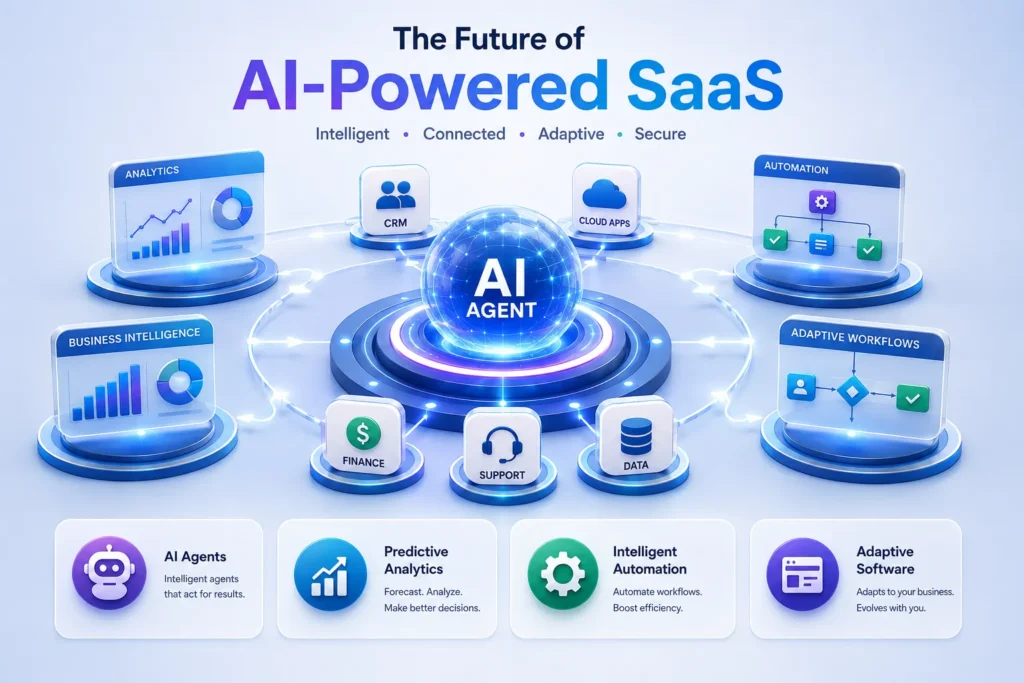
The evolution of AI-powered SaaS is no longer centered on adding smarter features it is about creating software that can understand users, adapt to changing business needs, and continuously improve the way work gets done.
Over the last decade, SaaS transformed how businesses accessed software through the cloud. The next decade will transform how software thinks.
Instead of becoming larger collections of features, the most successful AI SaaS solutions will become intelligent business partners that help organizations automate operations, generate insights, personalize experiences, and support better decision-making.
This shift is redefining the future of SaaS across every industry.
Will SaaS Become More Autonomous?
The next generation of SaaS will be significantly more autonomous, but not completely independent.
Rather than waiting for users to initiate every action, intelligent SaaS platforms will increasingly:
- Detect operational bottlenecks automatically.
- Recommend the next best business actions.
- Generate reports without manual requests.
- Prioritize high-impact tasks.
- Personalize user experiences in real time.
- Coordinate workflows across connected applications.
The objective is not to replace human decision-makers but to eliminate repetitive operational work so people can focus on strategy, creativity, and innovation.
This is where intelligent SaaS creates its greatest business value.
Will AI Agents Become Standard SaaS Features?
AI agents are likely to become one of the defining capabilities of future SaaS products.
Unlike traditional assistants that simply answer questions, AI agents can understand objectives and coordinate multiple business processes.
For example, a future AI-powered SaaS product could receive a request like:
Prepare this week’s executive business review.
The AI agent could automatically:
- Analyze sales performance.
- Summarize customer feedback.
- Identify operational risks.
- Compare KPIs with previous periods.
- Generate presentation-ready insights.
- Recommend strategic priorities.
This transforms software from a passive productivity tool into an active business collaborator.
As AI integration becomes more sophisticated, these intelligent agents will become increasingly common across CRM, HR, finance, marketing, analytics, and enterprise SaaS platforms.
How Will SaaS Products Adapt to Changing User Needs?
One of the most important characteristics of the future of SaaS will be adaptability.
Businesses evolve continuously.
Customer expectations change.
Teams grow.
Markets shift.
Software must evolve just as quickly.
Future AI-driven SaaS products will rely on continuous learning to deliver experiences that become more relevant over time through:
- Personalized workflows.
- Context-aware recommendations.
- Predictive analytics.
- Conversational interfaces.
- Intelligent automation.
- Real-time decision support.
Rather than forcing users to adapt to software, software will increasingly adapt to users.
That represents the real transformation of SaaS.
12. Faqs
What Is AI-Powered SaaS?
AI-powered SaaS is cloud-based software that uses Artificial Intelligence to automate workflows, analyze data, personalize user experiences, generate insights, and support business decisions. Unlike traditional SaaS, it can understand context and provide intelligent recommendations.
How Is AI Different From Traditional SaaS?
Traditional SaaS primarily follows predefined workflows and user commands, while AI in SaaS adds intelligence through automation, personalization, predictive analytics, and natural-language interaction, making software more adaptive and proactive.
What Are the Biggest Benefits of AI SaaS?
The key benefits of AI SaaS include increased productivity, intelligent workflow automation, personalized customer experiences, predictive insights, improved decision-making, and better scalability for growing businesses.
Can AI Automate SaaS Workflows?
Yes. SaaS automation powered by AI can automate repetitive tasks such as report generation, document processing, customer support, lead qualification, task prioritization, and business analytics while allowing employees to focus on higher-value work.
What Is Predictive SaaS?
Predictive SaaS uses AI and historical business data to anticipate future outcomes such as customer churn, sales opportunities, operational risks, and demand forecasting. It helps businesses make proactive rather than reactive decisions.
Are AI Agents the Future of SaaS?
AI agents are expected to become a major part of the future of SaaS. They can coordinate multi-step workflows, analyze business context, retrieve information across applications, and help users accomplish complex objectives through intelligent automation.
Is AI-Powered SaaS Suitable for Small Businesses?
Yes. Modern AI SaaS solutions can help businesses of all sizes improve productivity, reduce manual work, personalize customer experiences, and scale operations without significantly increasing operational complexity.
How Can Businesses Start Adopting AI-Powered SaaS?
Organizations should begin by identifying repetitive, data-intensive workflows where AI can create measurable value. Successful adoption depends on thoughtful AI integration, strong data governance, user-centered design, and continuous improvement.
13. What Should Businesses Do to Prepare for the Future of SaaS?
The future of SaaS is no longer defined by cloud delivery alone. It is being shaped by intelligence, automation, personalization, and predictive decision-making.
As businesses generate more data and customer expectations continue to rise, traditional software will struggle to deliver the speed and adaptability organizations need. AI-powered SaaS addresses this challenge by transforming software into an intelligent platform that can understand context, automate workflows, generate actionable insights, and help users make better decisions.
However, successful adoption requires more than simply adding AI features. Businesses must focus on responsible AI integration, secure cloud infrastructure, high-quality data, human oversight, and exceptional product experiences. The strongest AI-powered SaaS products will be those that solve genuine business problems while remaining intuitive, trustworthy, and scalable.
At CrossShores Infotech, we help businesses build next-generation SaaS products by combining AI, modern software engineering, cloud technologies, intelligent automation, and scalable product development. As the SaaS industry evolves, organizations that embrace intelligent software today will be better positioned to innovate, grow, and lead tomorrow.
The future of SaaS belongs to software that doesn’t just respond it understands, learns, and continuously adapts to create smarter digital experiences.