


Contents
- 1 Introduction
- 2 Quick Answer: What Are AI-Powered Personal Assistants?
- 3 1. What Are AI-Powered Personal Assistants and How Do They Work?
- 4 2. Why Are AI-Powered Personal Assistants Becoming Essential in the Workplace?
- 5 3. How Do AI Assistants Automate Repetitive Business Tasks?
- 6 4. How Can AI Assistants Analyze Data and Generate Insights?
- 7 5. How Are AI Assistants Changing Content Creation at Work?
- 8 6. How Do AI Assistants Manage Workflows and Team Collaboration?
- 9 7. Are AI Agents the Next Evolution of Personal Assistants?
- 10 8. What Are the Biggest Benefits of AI-Powered Personal Assistants?
- 11 9. What Challenges Should Businesses Consider Before Using AI Assistants?
- 12 10. What Will the Future of AI-Powered Personal Assistants Look Like?
- 13 11. Faqs
- 13.1 What are AI-powered personal assistants?
- 13.2 How can AI personal assistants help businesses?
- 13.3 What is the difference between AI assistants and AI agents?
- 13.4 Can AI assistants replace employees?
- 13.5 What tasks can AI assistants automate?
- 13.6 Are AI-powered personal assistants secure?
- 13.7 How do AI assistants improve productivity?
- 13.8 What is the future of AI-powered personal assistants?
- 14 12. Conclusion: Why Human + AI Will Define the Future of Work
Introduction
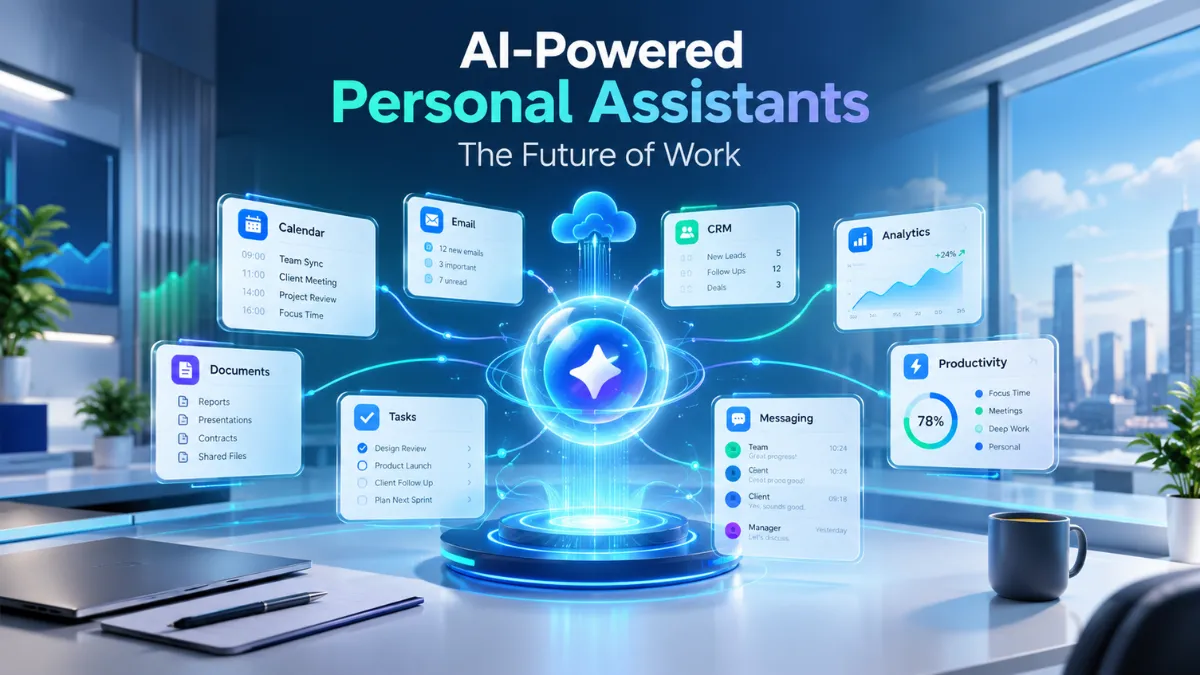
Imagine starting your workday with an assistant that has already organized your calendar, summarized yesterday’s meetings, drafted important emails, and highlighted your highest-priority tasks—all before your first cup of coffee.
That is the promise of AI-powered personal assistants.
Businesses are moving beyond simple automation tools toward intelligent workplace companions that can understand context, manage workflows, analyze information, and support everyday decision-making. Rather than replacing employees, these AI tools are helping professionals spend less time on repetitive work and more time on creativity, strategy, and collaboration.
As organizations embrace AI workplace assistants, the future of work is becoming less about humans competing with AI and more about humans working alongside intelligent technology.
In this guide, you’ll discover how AI-powered personal assistants are reshaping productivity, AI business automation, team collaboration, and the modern digital workplace.
Quick Answer: What Are AI-Powered Personal Assistants?
AI-powered personal assistants are intelligent software tools that use Artificial Intelligence to automate routine tasks, manage schedules, analyze business data, generate content, organize workflows, and assist professionals with daily work. Unlike traditional AI virtual assistants, modern AI personal assistants can understand context, learn user preferences, and actively support business productivity across multiple applications.
1. What Are AI-Powered Personal Assistants and How Do They Work?
The modern workplace generates hundreds of small tasks every day. Emails need replies, meetings require scheduling, reports need summaries, projects demand updates, and priorities constantly change. Individually these tasks seem minor, but together they consume a significant portion of an employee’s time.
This is where AI-powered personal assistants are creating real business value.
Instead of functioning as simple voice assistants, today’s intelligent assistants are designed to become digital teammates. They connect with workplace tools, understand user intent, retrieve information, and help complete meaningful business tasks with minimal manual effort.
What Is an AI Personal Assistant?
An AI personal assistant is software that combines Artificial Intelligence, natural language processing, and automation to help users complete work more efficiently.
Rather than simply answering questions, these assistants can:
- Organize calendars and meetings
- Draft emails and business documents
- Summarize conversations and reports
- Manage reminders and follow-ups
- Search company knowledge instantly
- Coordinate daily workflows
- Generate actionable business insights
The goal is not to replace professionals but to eliminate repetitive administrative work that slows productivity.
How Is It Different From Traditional Virtual Assistants?
Many people associate assistants with tools that set alarms or answer basic questions. However, AI-powered personal assistants operate at a much higher level.
| Traditional Assistant | AI-Powered Personal Assistant |
|---|---|
| Responds to commands | Understands context and intent |
| Sets reminders | Manages complete workflows |
| Answers simple questions | Analyzes business information |
| Limited automation | Intelligent AI workflow automation |
| Static responses | Personalized recommendations |
This evolution makes AI assistants for business valuable across departments including sales, HR, marketing, finance, customer support, and project management.
These capabilities are possible because modern workplace software is becoming increasingly intelligent. Learn more in our guide on AI-Powered SaaS: How AI Is Transforming the Future of SaaS, where we explain how AI is reshaping cloud-based business applications.
Why Are Businesses Adopting AI Assistants?
The biggest reason is productivity.
Employees often spend hours each week on repetitive work instead of high-value thinking. AI productivity tools help reduce that burden by handling routine coordination while people focus on decision-making and innovation.
For example, an AI workplace assistant can automatically prepare meeting briefs, summarize customer interactions, prioritize urgent tasks, and generate draft reports—all within seconds.
As a result, organizations benefit from:
- Faster decision-making
- Better AI business automation
- Reduced manual workload
- Improved collaboration
- Higher employee productivity
This is why AI-powered personal assistants are becoming one of the fastest-growing categories in enterprise technology. They are no longer just helpful software—they are becoming intelligent partners that make everyday work smarter, faster, and more organized.
Key Takeaway
AI-powered personal assistants are transforming workplace productivity by combining Artificial Intelligence, automation, and contextual understanding into a single intelligent tool. Unlike traditional assistants, they help professionals manage workflows, generate content, analyze information, and improve daily efficiency—making them a key part of the future of work.
2. Why Are AI-Powered Personal Assistants Becoming Essential in the Workplace?
The modern workplace has never been more connected—or more demanding. Professionals switch between emails, calendars, project management tools, documents, meetings, and messaging platforms dozens of times every day. While technology has improved efficiency, it has also created information overload.
This is exactly why AI-powered personal assistants are becoming essential.
Instead of adding another tool to the workplace, these intelligent assistants help unify everyday work by organizing priorities, reducing repetitive tasks, and supporting faster decision-making. The result is a more productive and less fragmented work experience.
What Problems Do AI-Powered Personal Assistants Solve?
Many business challenges are not caused by a lack of software—they are caused by too much manual coordination.
An AI workplace assistant helps solve common productivity problems such as:
- Spending hours replying to routine emails
- Forgetting meeting follow-ups
- Searching through documents for information
- Manually updating project tasks
- Prioritizing an overwhelming workload
- Switching between multiple business applications
By automating these repetitive activities, employees gain more time for strategic and creative work.
How Do They Improve Daily Productivity?
One of the biggest advantages of AI productivity tools is their ability to simplify everyday workflows.
For example, an AI personal assistant can automatically:
- Organize your daily schedule
- Summarize yesterday’s meetings
- Draft follow-up emails
- Highlight urgent tasks
- Prepare a daily priority list
- Remind you about important deadlines
Rather than beginning the day by sorting through dozens of notifications, professionals receive a structured overview of what matters most.
This creates a smoother and more focused workday.
Why Is Workplace Automation Growing So Quickly?
Businesses are increasingly adopting AI workflow automation because repetitive work limits growth.
Consider how much time teams spend on activities that do not directly create value:
- Scheduling meetings
- Updating documentation
- Creating status reports
- Organizing files
- Sending reminders
- Tracking task progress
These processes are necessary, but they do not always require human creativity.
With AI assistants for business, organizations can automate these operational tasks while employees focus on problem-solving, customer relationships, innovation, and business strategy.
The workplace is shifting from working harder to working smarter, and AI-powered personal assistants are becoming the intelligent layer that makes this transformation possible.
Key Takeaway
The growing demand for AI-powered personal assistants is driven by one simple goal: helping professionals spend less time managing work and more time accomplishing meaningful work. Through AI workplace assistants, businesses can reduce repetitive tasks, improve productivity, and create more efficient digital workplaces.
3. How Do AI Assistants Automate Repetitive Business Tasks?
One of the biggest reasons businesses are investing in AI-powered personal assistants is their ability to eliminate repetitive administrative work. Every day, professionals spend valuable hours managing emails, scheduling meetings, updating documents, creating summaries, and following up on routine tasks.
These activities are essential but they rarely require deep human creativity.
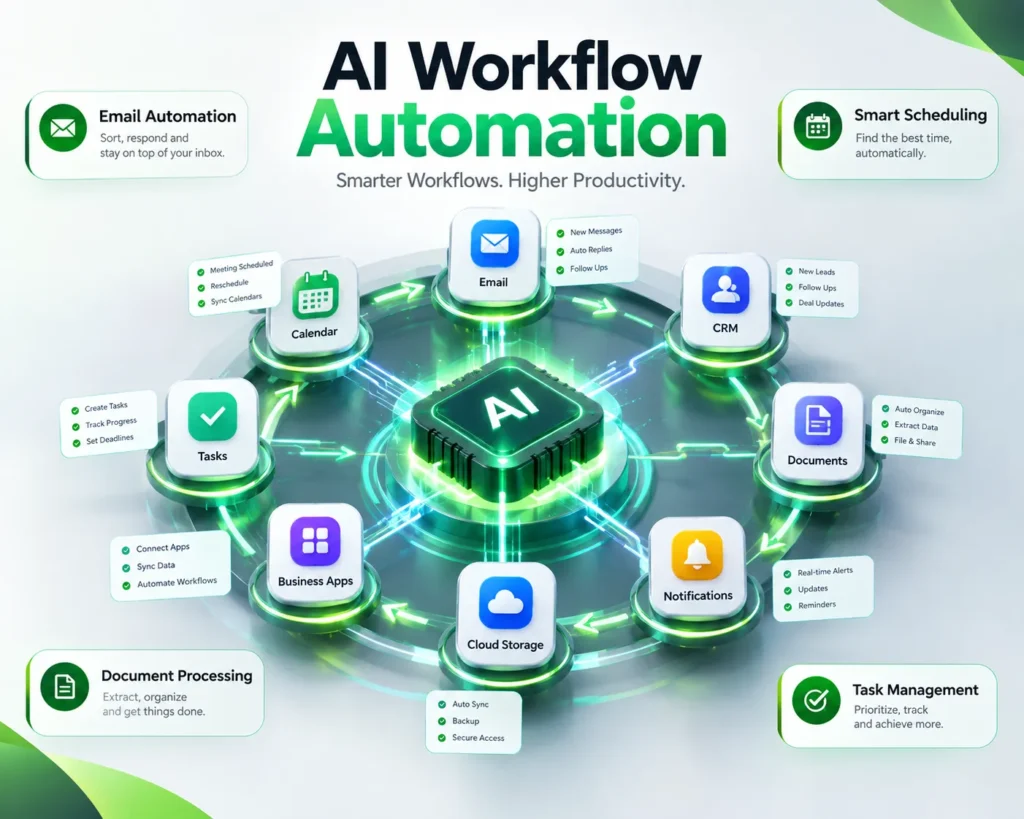
This is where AI workflow automation creates measurable business value. Instead of manually completing every operational task, employees can rely on intelligent assistants to handle repetitive processes while they focus on higher-value work.
Can AI Manage Emails and Scheduling?
Yes. Modern AI personal assistants can significantly reduce the time spent organizing communication and calendars.
For example, an AI workplace assistant can:
- Draft professional email replies
- Prioritize important messages
- Schedule meetings automatically
- Resolve calendar conflicts
- Send reminders and follow-ups
- Prepare meeting agendas
Rather than constantly switching between inboxes and calendars, professionals receive organized recommendations that help them stay focused.
This makes email and calendar management one of the most practical applications of AI assistants for business.
How Does AI Handle Documentation and Follow-Ups?
Documentation is another task that consumes countless working hours.
An AI-powered personal assistant can automatically generate:
- Meeting summaries
- Project notes
- Client follow-up emails
- Action item lists
- Status updates
- Internal documentation
For example, after a project meeting, AI can summarize the discussion, identify key decisions, assign action items, and prepare a follow-up message within seconds.
Instead of manually writing everything, employees simply review and refine the output.
This combination of automation and human oversight improves both speed and accuracy.
What Workflows Can Be Automated?
The strength of AI business automation lies in connecting multiple workplace processes into one intelligent workflow.
Common business workflows include:
- Customer follow-up sequences
- Task creation and assignment
- Document organization
- CRM activity updates
- Project status reporting
- Reminder and notification management
- Internal knowledge retrieval
Rather than treating these as separate activities, an AI virtual assistant can coordinate them as one connected process.
For growing organizations, this reduces operational friction while improving consistency across teams.
Why Is Intelligent Automation Better Than Rule-Based Automation?
Traditional automation follows predefined rules:
If X happens, do Y.
AI-powered personal assistants add intelligence by considering context before taking action.
For example, instead of sending every reminder at the same time, AI can prioritize reminders based on urgency, meeting schedules, workload, and business importance.
This contextual decision-making makes automation more useful because it adapts to how people actually work.
As a result, AI workflow automation becomes less about replacing tasks and more about improving the overall employee experience.
Key Takeaway
AI-powered personal assistants transform repetitive business processes into intelligent workflows by automating emails, scheduling, documentation, reminders, and operational coordination. Through AI business automation, organizations can reduce manual workload, improve consistency, and give employees more time for strategic work.
4. How Can AI Assistants Analyze Data and Generate Insights?
Businesses generate enormous amounts of information every day—from sales reports and customer interactions to financial records and project updates. The challenge isn’t collecting data anymore; it’s understanding what the data actually means.
This is where AI-powered personal assistants go beyond automation.
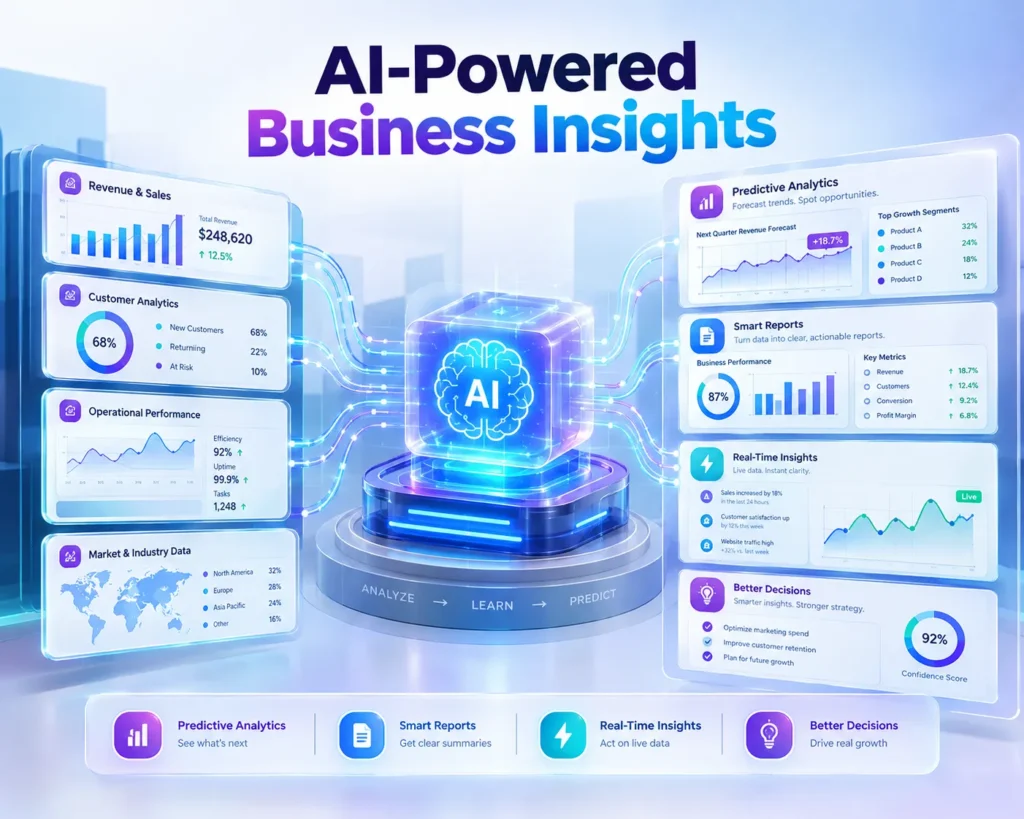
Instead of simply displaying dashboards, intelligent assistants can analyze business information, identify patterns, summarize complex reports, and present actionable insights in seconds. That makes them valuable AI productivity tools for professionals who need faster, data-driven decisions.
How Does AI Turn Data Into Decisions?
A traditional dashboard tells you what happened. An AI workplace assistant helps explain why it happened and what deserves your attention.
For example, instead of manually reviewing multiple reports, an AI assistant can identify:
- Declining customer engagement
- High-performing sales opportunities
- Delayed project milestones
- Unusual business expenses
- Emerging productivity trends
Rather than overwhelming users with numbers, AI assistants for business convert data into clear business recommendations.
Can AI Create Business Reports Automatically?
Yes. One of the most practical applications of AI business automation is automated reporting.
An AI-powered personal assistant can generate:
- Weekly performance summaries
- Sales reports
- Marketing campaign analysis
- Executive business briefings
- Customer support insights
- Project progress reports
For example, after analyzing business data, the assistant might produce a concise report explaining revenue growth, customer behavior, and key operational changes—all without requiring manual report creation.
This saves significant time while improving reporting consistency across teams.
Why Is Real-Time Analysis Valuable?
Business decisions often lose value when insights arrive too late.
An AI virtual assistant can continuously monitor connected business systems and notify users when important changes occur.
Examples include:
- A sudden drop in website conversions
- An increase in customer support requests
- A project moving behind schedule
- Sales performance exceeding targets
- Budget spending approaching limits
Instead of discovering these issues days later, professionals receive timely alerts that support faster decision-making.
This proactive approach is becoming a defining feature of AI-powered personal assistants and the broader future of work.
Key Takeaway
AI-powered personal assistants help businesses move beyond static dashboards by transforming raw data into meaningful insights, automated reports, and real-time recommendations. As intelligent AI productivity tools, they enable faster, more informed decisions while reducing the manual effort required to analyze complex business information.
5. How Are AI Assistants Changing Content Creation at Work?
Content creation has become an essential part of almost every business. Teams create emails, proposals, reports, presentations, product descriptions, social media posts, and internal documents every day.
The challenge is that producing this content consistently takes time.
This is where AI-powered personal assistants are changing the way professionals approach business communication. Instead of starting every document from scratch, employees can use AI to generate drafts, summarize information, improve writing, and organize ideas.
The result is not simply faster content creation—it is a more efficient collaboration between people and intelligent software.
Can AI Draft Reports and Proposals?
Yes. An AI personal assistant can turn basic instructions, notes, or existing business information into structured drafts.
For example, a sales professional could ask an AI assistant to prepare a proposal based on:
- Customer requirements
- Previous conversations
- Product information
- Pricing details
- Business objectives
The assistant can organize this information into a first draft that the employee can review and customize.
Similarly, AI assistants for business can help create meeting summaries, project reports, executive briefings, and internal documentation.
This reduces the time spent on repetitive writing while keeping humans involved in the final decision.
How Does AI Improve Business Communication?
Business communication often involves repeating similar information across different channels.
An AI workplace assistant can help adapt the same information into different formats.
For example, a project update could become:
- A short executive summary
- An internal team message
- A customer email
- A detailed project report
- A presentation outline
AI can also adjust tone, structure, length, and clarity based on the intended audience.
This makes AI productivity tools particularly useful for teams managing high volumes of communication.
Where Should Humans Still Lead?
Despite rapid advances in generative AI, human judgment remains essential.
AI can generate a useful first draft, but employees should still review important content for:
- Accuracy
- Brand consistency
- Context
- Confidential information
- Strategic messaging
- Final approval
This human-in-the-loop approach ensures that AI business automation improves productivity without removing accountability.
The most effective model is therefore not AI-generated content replacing people, but AI handling the repetitive parts while people provide expertise, creativity, and judgment.
Key Takeaway
AI-powered personal assistants are making workplace content creation faster by helping professionals draft reports, proposals, emails, summaries, and presentations. When combined with human review, these tools create a practical form of intelligent automation that improves productivity without removing human creativity or accountability.
6. How Do AI Assistants Manage Workflows and Team Collaboration?
Managing a modern team involves much more than completing individual tasks. Employees need to coordinate projects, track deadlines, share information, attend meetings, and continuously adjust priorities.
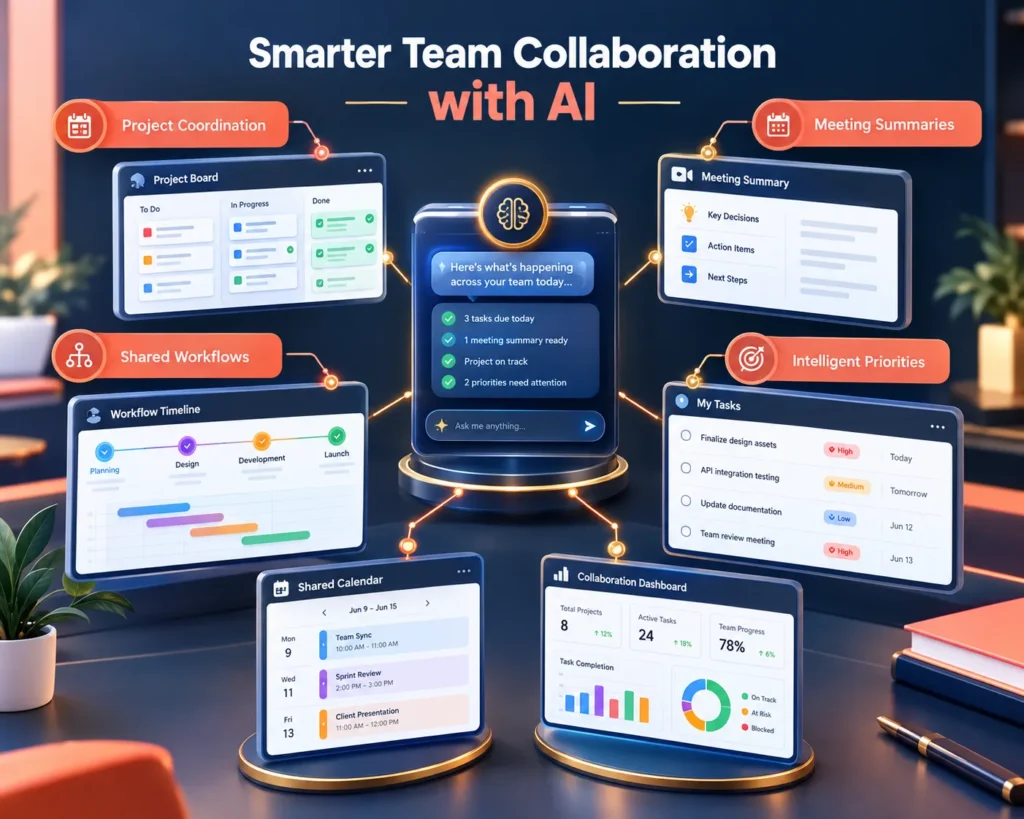
As teams become more distributed and workflows become more complex, AI-powered personal assistants can act as an intelligent coordination layer between people, information, and business applications.
Instead of simply reminding employees about tasks, AI can understand priorities, identify dependencies, summarize progress, and help teams decide what needs attention next.
Can AI Coordinate Projects?
Yes. An AI workplace assistant can help project teams monitor tasks, deadlines, dependencies, and progress across different workflows.
For example, an AI assistant could identify that a delayed design task may affect a development milestone and notify the relevant team members.
It can also help generate:
- Project status summaries
- Task lists
- Deadline reminders
- Meeting action items
- Progress reports
- Priority recommendations
This makes AI workflow automation useful for project managers who need visibility without manually checking every task.
How Does AI Prioritize Tasks?
Not every task has the same level of importance.
Traditional task-management software generally sorts activities according to rules such as deadlines or assigned priority. AI personal assistants can consider additional context, including urgency, dependencies, workload, and business impact.
For example, an AI assistant might recommend completing a task today because:
- It is blocking another team.
- A customer deadline is approaching.
- Several dependent tasks are waiting.
- The responsible employee has limited availability.
This contextual prioritization can help employees focus on work that has the greatest impact.
Can AI Improve Team Productivity?
One of the strongest advantages of AI assistants for business is their ability to reduce coordination overhead.
Consider a typical project meeting. Employees may spend time discussing progress, documenting decisions, identifying action items, and sending follow-up messages.
An AI-powered personal assistant can help automate much of this process by:
- Summarizing the meeting.
- Identifying decisions.
- Extracting action items.
- Assigning tasks where appropriate.
- Creating follow-up reminders.
- Preparing a progress summary.
This allows teams to spend less time managing the process and more time completing the work.
How Can AI Support Collaboration Across Teams?
Departments often work with different systems and information.
Sales may use a CRM, marketing may manage campaigns separately, and project teams may use project-management platforms. This fragmentation can make collaboration difficult.
With appropriate integrations, AI workplace assistants can bring relevant information together and provide teams with a shared understanding of ongoing work.
For example, before a customer meeting, an AI assistant could summarize recent sales activity, open support issues, previous communications, and upcoming deliverables.
This creates better context for employees and supports more informed collaboration.
Key Takeaway
AI-powered personal assistants can improve team collaboration by coordinating tasks, monitoring deadlines, summarizing meetings, and recommending priorities. Through AI workflow automation, they reduce administrative coordination and help teams focus on the work that matters most.
7. Are AI Agents the Next Evolution of Personal Assistants?
The capabilities of AI-powered personal assistants are expanding beyond answering questions and automating individual tasks. The next step is the rise of AI agents systems that can understand goals, make decisions, use connected tools, and complete multiple steps with less human intervention.
This shift could transform AI from a helpful workplace tool into an active digital teammate.
What Is the Difference Between AI Assistants and AI Agents?
An AI personal assistant typically helps users respond to requests. For example, it can summarize a document, draft an email, or schedule a meeting.
AI agents can go further by working toward a defined objective.
For example, instead of simply drafting a customer follow-up email, an AI agent could:
- Review the customer’s recent interactions.
- Identify the appropriate follow-up.
- Draft a personalized message.
- Update the CRM.
- Schedule a reminder.
- Notify the responsible employee.
The key difference is action and autonomy. Assistants primarily help with tasks, while agents can coordinate multiple actions to achieve a broader goal.
If you’d like a deeper look at intelligent workflows, read our complete guide on AI Agents for Business Automation: How Intelligent Workflows Are Transforming Modern Businesses.
Can AI Agents Complete Multi-Step Tasks?
Yes. Multi-step task execution is one of the most important developments in AI business automation.
An AI agent can break a larger objective into smaller actions and use different business tools to complete them.
For example, a sales workflow could involve checking customer information, analyzing previous conversations, preparing a proposal, updating records, and scheduling follow-ups.
Instead of employees manually moving information between applications, intelligent systems can coordinate these steps as part of a connected workflow.
However, businesses should still define appropriate approval points for sensitive or high-impact actions.
How Will Intelligent Agents Change Business Software?
Traditional software generally waits for employees to interact with it.
The combination of AI agents, AI workflow automation, and business applications creates a more proactive model.
Software could identify what needs to happen next and initiate appropriate actions rather than simply displaying information.
This could lead to:
- More proactive customer support
- Automated business reporting
- Smarter sales workflows
- Intelligent project coordination
- Automated administrative processes
- Personalized employee assistance
As these capabilities mature, AI-powered personal assistants may evolve from tools employees use into intelligent systems that actively participate in everyday business operations.
Key Takeaway
AI agents represent the next evolution of workplace assistance by combining reasoning, automation, tool usage, and multi-step task execution. The future is likely to involve humans setting goals and providing oversight while intelligent systems handle more of the execution.
8. What Are the Biggest Benefits of AI-Powered Personal Assistants?
The growing adoption of AI-powered personal assistants is driven by a simple business goal: helping employees accomplish more without increasing unnecessary manual work.
When AI can handle repetitive activities, organize information, and support decision-making, employees can dedicate more time to strategic and creative responsibilities.
How Do AI Assistants Increase Productivity?
AI productivity tools reduce the amount of time employees spend on routine activities such as scheduling, documentation, information searches, and follow-ups.
An AI personal assistant can help employees start their day with organized priorities, summarize important information, prepare drafts, and surface tasks that require immediate attention.
The result is less time spent managing work and more time spent doing meaningful work.
How Do AI Assistants Reduce Operational Costs?
Repetitive processes consume valuable employee time. As businesses grow, these small tasks can create significant operational costs.
AI business automation can handle many routine processes at scale, including:
- Data entry and information processing
- Meeting documentation
- Customer follow-ups
- Report generation
- Task management
- Scheduling and reminders
This does not necessarily mean replacing employees. Instead, businesses can use AI to increase the productivity of existing teams and allow employees to focus on higher-value responsibilities.
How Do AI Assistants Improve Employee Experience?
Constantly switching between applications, searching for information, responding to routine messages, and tracking deadlines can create unnecessary workplace friction.
AI workplace assistants can simplify these activities by bringing relevant information and actions together.
For example, an employee could ask an AI assistant to summarize a project, identify outstanding tasks, and prepare a list of upcoming deadlines rather than manually checking multiple systems.
This creates a more streamlined working experience.
Can AI Assistants Improve Decision-Making?
Yes. One of the most valuable benefits of AI assistants for business is their ability to turn large amounts of information into useful insights.
Instead of simply presenting data, an intelligent assistant can highlight unusual changes, identify potential risks, summarize performance, and help employees understand what deserves attention.
This makes intelligent automation useful not only for execution but also for everyday business decision support.
Why Is AI Collaboration Important for the Future of Work?
The biggest opportunity is not simply automating individual tasks. It is creating a stronger partnership between employees and AI.
Humans bring creativity, judgment, empathy, leadership, and strategic thinking. AI can provide speed, analysis, automation, and continuous assistance.
Together, this AI collaboration model can create more productive and adaptable workplaces.
Key Takeaway
The biggest benefits of AI-powered personal assistants include higher productivity, lower operational effort, better employee experiences, faster access to information, and stronger decision support. Their greatest value comes when AI handles repetitive work while people remain responsible for judgment and strategy.
9. What Challenges Should Businesses Consider Before Using AI Assistants?
While AI-powered personal assistants can improve productivity and automation, businesses should not adopt them without considering security, accuracy, privacy, and human oversight.
The goal should not be to automate everything. Instead, organizations need to identify where AI can create value while maintaining appropriate controls.
How Important Is Data Privacy?
AI workplace assistants may interact with emails, documents, customer information, calendars, internal communications, and other business data.
Organizations should understand:
- What information the AI can access
- Where data is processed and stored
- Who can access AI-generated information
- How permissions are managed
- Whether sensitive information is protected
Strong access controls and clear data policies are essential when implementing AI assistants for business.
Can AI Assistants Make Mistakes?
Yes. AI-generated content and recommendations can sometimes be inaccurate, incomplete, or based on misunderstood context.
For important business decisions, employees should review AI outputs before taking action.
A human-in-the-loop approach is particularly important for financial decisions, customer communications, legal documentation, security-related actions, and other high-impact workflows.
What About Security and Responsible AI?
Connecting an AI personal assistant to multiple business applications can increase its usefulness—but it can also increase the potential impact of a security issue.
Businesses should establish safeguards around:
- User authentication
- Application permissions
- Sensitive data
- Automated actions
- Audit logs
- Human approvals
Organizations should also define clear rules for when an AI assistant can recommend an action and when it can actually execute one.
How Can Businesses Adopt AI Responsibly?
A practical approach is to start with low-risk, repetitive workflows.
For example, businesses can initially use AI for meeting summaries, internal documentation, scheduling support, task organization, and report drafts.
Once the organization understands performance, accuracy, security, and employee adoption, it can gradually expand into more advanced AI workflow automation.
Key Takeaway
The value of AI-powered personal assistants depends on responsible implementation. Businesses need strong privacy controls, security measures, human oversight, and clearly defined AI permissions to ensure automation improves productivity without creating unnecessary risks.
10. What Will the Future of AI-Powered Personal Assistants Look Like?
The future of work is moving toward a model where AI is not simply another software feature but an active part of everyday workflows. As AI-powered personal assistants become more capable, they are likely to take on broader responsibilities across communication, analysis, coordination, and automation.
The biggest change will be the shift from employees using software to employees working with intelligent systems.
Will Every Employee Have an AI Teammate?
It is increasingly possible that employees across different roles will have access to some form of AI employee assistant.
A sales professional could have AI prepare customer briefs and follow-ups. A manager could use it to monitor priorities and generate reports. A marketer could use AI to analyze campaigns and create content.
Rather than providing the same capabilities to everyone, these assistants can become personalized around each employee’s role, responsibilities, and workflows.
How Will Human + AI Collaboration Evolve?
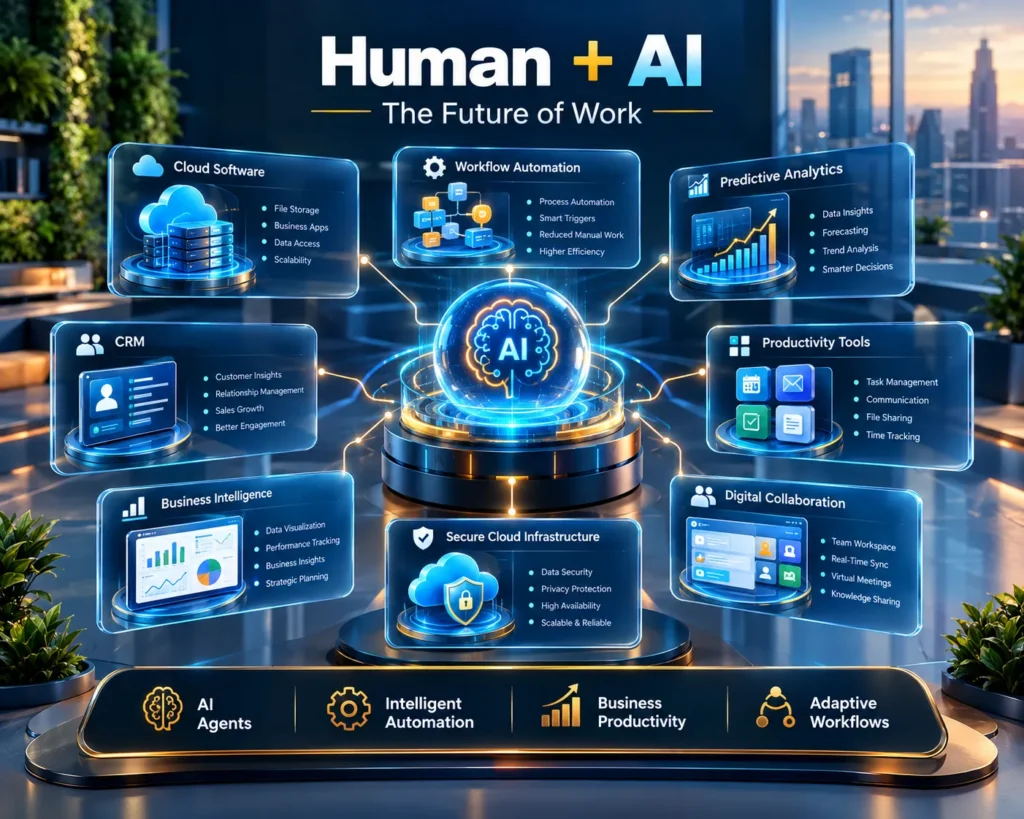
The future of work is unlikely to be simply humans versus AI. A more practical model is Human + AI, where each contributes different strengths.
AI can handle repetitive processing, information analysis, task coordination, and routine execution. Humans remain essential for creativity, judgment, leadership, empathy, relationship-building, and complex decision-making.
This combination can create a workplace where employees spend less time on administrative work and more time on high-value activities.
What Skills Will Become More Valuable?
As workplace automation handles more repetitive responsibilities, employees may need to focus increasingly on skills that AI cannot easily replace.
These include:
- Strategic thinking
- Creative problem-solving
- Communication
- Leadership
- Critical thinking
- Relationship management
- AI collaboration
- Business decision-making
Employees will also need to understand how to work effectively with AI agents and other intelligent systems.
Could AI Assistants Become More Proactive?
Yes. Future AI assistants for business may move beyond responding to requests and become increasingly proactive.
Instead of waiting for an employee to ask for a report, an AI assistant could identify an important business change and bring it to their attention. It could recognize upcoming deadlines, detect workflow bottlenecks, recommend priorities, or prepare information before an important meeting.
This evolution could make intelligent automation a natural part of everyday business operations.
Key Takeaway
The future of AI-powered personal assistants is about collaboration rather than replacement. As AI becomes more proactive and capable, every professional could have an intelligent digital teammate that handles routine work while humans focus on strategy, creativity, and meaningful decision-making.
11. Faqs
What are AI-powered personal assistants?
AI-powered personal assistants are intelligent software systems that use Artificial Intelligence to help professionals complete tasks, manage information, automate workflows, analyze data, and support everyday decision-making.
Unlike basic virtual assistants, they can understand context and work across multiple business activities.
How can AI personal assistants help businesses?
An AI personal assistant can help businesses automate repetitive work such as email drafting, scheduling, documentation, meeting summaries, follow-ups, reporting, and task management.
They can also support employees with data analysis, content creation, and workflow coordination.
What is the difference between AI assistants and AI agents?
An AI assistant generally responds to user requests and helps complete individual tasks. AI agents can operate more autonomously, breaking larger objectives into multiple steps and using connected tools to complete workflows.
The distinction is becoming less rigid as modern AI assistants gain more agent-like capabilities.
Can AI assistants replace employees?
AI workplace assistants are primarily designed to augment employees rather than replace them entirely.
AI is well suited to repetitive processing, information analysis, and routine automation, while humans remain important for creativity, judgment, leadership, empathy, and strategic decisions.
What tasks can AI assistants automate?
Common examples of AI task automation include:
- Email drafting and prioritization
- Meeting scheduling
- Meeting summaries
- Follow-up reminders
- Report generation
- Document creation
- Task management
- Data analysis
- Workflow coordination
- Information retrieval
The exact capabilities depend on the AI system and its integrations.
Are AI-powered personal assistants secure?
Security depends on how the system is designed and implemented. Businesses should evaluate data access, permissions, authentication, storage, integrations, auditability, and human approval requirements before deploying an AI assistant.
Sensitive workflows should receive additional security controls and oversight.
How do AI assistants improve productivity?
AI productivity tools reduce the time employees spend on repetitive administrative work. By automating routine processes and surfacing relevant information, they allow employees to focus more on strategic, creative, and customer-focused activities.
What is the future of AI-powered personal assistants?
The future will likely involve more proactive and capable assistants that can understand business context, coordinate multiple applications, complete multi-step workflows, and provide personalized support.
This points toward a workplace where Human + AI collaboration becomes a normal part of how businesses operate.
12. Conclusion: Why Human + AI Will Define the Future of Work
The workplace is entering a new phase where AI is moving beyond simple automation and becoming an active partner in everyday business operations.
AI-powered personal assistants can already help professionals manage schedules, automate repetitive tasks, analyze information, create content, coordinate workflows, and improve productivity. As AI agents become more capable, these systems will increasingly be able to complete complex, multi-step tasks with greater independence.
But the real opportunity is not about replacing people.
It is about Human + AI collaboration.
AI can handle repetitive processes, organize large amounts of information, identify patterns, and support execution. Humans bring creativity, strategic thinking, emotional intelligence, leadership, and judgment.
When these strengths work together, businesses can create faster, smarter, and more efficient workflows.
The organizations that benefit most will be those that treat AI as more than another software tool. By integrating AI business automation, AI workflow automation, and intelligent assistants into everyday operations, businesses can give employees the support they need to focus on higher-value work.
At CrossShores Infotech, we help businesses build intelligent digital products by combining AI-powered personal assistants, workflow automation, modern software engineering, and scalable enterprise solutions that improve productivity across the workplace
The future of work isn’t humans or AI. It’s humans working better with AI.